The OnePlus 15 is the kind of phone that doesn’t scream “flagship” from across the room—until you actually live with it. It looks restrained, feels refined, and somehow packs a genuinely top-tier spec sheet into a body that stays practical on a desk and comfortable in the hand. In daily use, it’s fast, stable, and surprisingly hard to kill on battery. The catch? In a market where “best camera” is often the main reason people buy an expensive phone, the OnePlus 15 doesn’t always hit the absolute top shelf—at least not yet.
OnePlus was founded in 2013 with a pretty simple mission: prove that a well-balanced, thoughtfully designed flagship doesn’t have to cost a fortune. The brand’s early devices built a near-cult following, and later the Nord lineup showed OnePlus could also win in the upper midrange. But the last few years have been uneven—especially since the brand’s closer alignment with OPPO, which also influenced the look and feel of OxygenOS.
With the OnePlus 15 family (skipping “14”), the company clearly wants a strong comeback. In Hungary, that means two versions: the value-oriented OnePlus 15R and the full-fat OnePlus 15, which aims to keep a “not insane” price while refusing to compromise on core hardware. This review focuses on the OnePlus 15.
Design and build quality
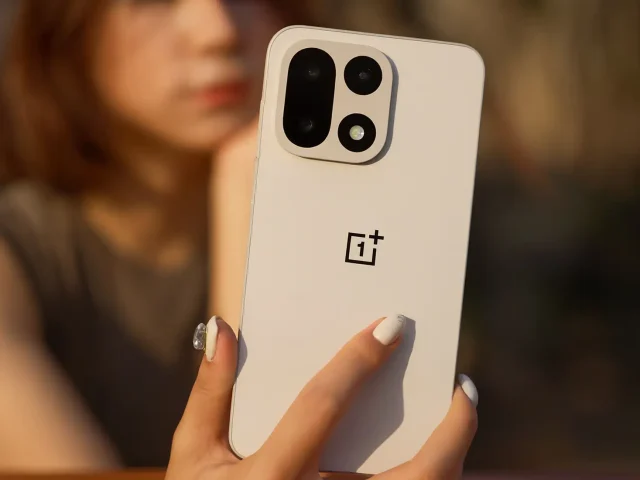
The OnePlus 15 is deliberately understated. Not “thin at any cost” and not “missing features,” but “engineered to look calm.” The smartest choice here is the camera bump: OnePlus seems to have made it a priority to keep it from turning into a wobble machine.
Instead of a huge, towering camera island, you get a squarish module placed toward the side, rising only about 1.5–2 mm. The payoff is immediate: the phone doesn’t rock back and forth on a table, and it doesn’t feel like you’re carrying a brick with a lump on it when it’s in your pocket.
In hand, the dimensions are typical for a modern flagship:
Thickness: 8.1 mm
Weight: 211 g
That weight starts to make a lot more sense once you understand what OnePlus crammed inside—especially the battery.
The frame is a flat aluminum alloy design, and the back uses Gorilla Glass 7i, which provides a secure, non-slippery grip. Overall weight distribution is excellent, so it feels “dense but balanced” rather than “heavy and awkward.”
Hardware controls are familiar, with an added bonus: an action button on the upper left side. It’s configurable in software and can be mapped to a useful function (more on that later). Durability is also a major strength—IP68/IP69K means dust-proof, water-resistant, and able to withstand strong water jets as well.
Display and biometrics
The front is protected by Gorilla Glass Victus 2, and the panel is exactly what you’d expect in a real flagship:
6.78-inch LTPO AMOLED
Adaptive refresh rate up to 165 Hz
1 billion colors
HDR10+ and Dolby Vision
Peak brightness: 1800 nits
Resolution: FHD+ (1272 × 2772)
In plain English: it’s sharp, fluid, and looks premium in both videos and everyday UI use. The selfie camera sits in a centered punch hole, and it’s a 32 MP unit with autofocus, which is still not as common as it should be.
Biometrics are handled by an ultrasonic fingerprint scanner placed at a comfortable height. It’s fast and reliable, and feels like the kind of feature you stop thinking about because it simply works. One small but welcome detail: a screen protector is pre-applied from the factory.
Battery and charging
This is the OnePlus 15’s headline feature, and it’s not even close.
Battery capacity: 7300 mAh.
That number is massive for a phone that’s still “normal flagship size,” and it’s enabled by modern silicon-carbon battery technology (higher energy density than older lithium-ion approaches). OnePlus didn’t just chase capacity—they also made charging speeds aggressive:
Up to 120 W wired charging
Up to 50 W wireless charging
In testing, the battery performance was the kind of result that makes you double-check the numbers. Continuous-load testing pushed close to 30 hours, which is outright lab-record territory. In real life over roughly a week and a half, the phone consistently delivered:
2 full days of active use without drama
and potentially 3 days on lighter days (less camera/video)
If you’re tired of managing battery anxiety, this phone changes the routine. You stop thinking in “hours remaining” and start thinking in “days until I bother charging again.”
One important practical note: the advertised top wired speeds typically require OnePlus’ own compatible charging system rather than a generic USB PD charger. You can still charge with PD, but you won’t necessarily hit the headline numbers unless you use the right brick. Depending on promotions, OnePlus sometimes bundles the charger through its own European store, which can soften that annoyance.
Performance and thermals
Even though the OnePlus 15 launched in China in November (so it’s treated as a 2025 device), it arrives with a top-end chipset:
Snapdragon 8 Elite Gen 5
16 GB RAM
512 GB storage
On the connectivity side, it’s properly future-proofed:
5G + eSIM
Wi-Fi 7
Bluetooth 6.0
NFC
IR blaster
Stereo speakers
Full GPS support
Benchmark performance lands where you’d expect:
AnTuTu: consistently above 4 million
Geekbench: strong multi-core results (above ~11,000)
3DMark: excellent performance
PCMark had testing issues (storage test failures and unreliable main test output), but the day-to-day experience doesn’t reflect any instability. Everything feels immediate: app launches, multitasking, heavy browsing, and gaming all run like you’re using a true flagship.
Thermals and throttling are also better than many people expect with this level of performance. Under sustained load, throttling landed around ~88%, which is mild, and the device didn’t become uncomfortably hot. Charging didn’t cause noticeable thermal drama either.
Software experience: OxygenOS 16 on Android 16
If you want “pure Google Android,” this isn’t it—and OnePlus isn’t trying to pretend otherwise. OxygenOS 16 is heavily customized, animation-rich, and clearly influenced by the UI direction OnePlus inherited through its closer ecosystem alignment.
That said, it’s also polished and surprisingly enjoyable once you stop fighting it. From the initial setup flow to the settings menus and the home screen behavior, it offers far more visual flair and customization than stock Android. Transparency effects are back in style, transitions are smooth, and UI elements (buttons, sliders, panels) have extra motion and feedback.
Where OnePlus really wins is depth: there are many more tweakable options than you’ll find on a Pixel, and if you invest time exploring settings, you can make the phone feel genuinely yours.
AI features and “mind space”
The system includes an AI section that sits alongside Google Gemini, offering manufacturer-side tools similar to what you see from other big Android brands:
translation/interpreter-style features
AI note-taking utilities
a “Mind Space” type feature where you can save images and later search the content inside them
These features feel useful when they’re frictionless—especially if you actually organize screenshots, receipts, or reference materials.
Plus key: a great idea with one limitation
The configurable action button (Plus Key) is genuinely handy. You can map it to a key function like Do Not Disturb, Mind Space, and other shortcuts.
The disappointment is flexibility: it appears limited to a single interaction type (for example, one press only). Support for double press, long press variations, or multi-action mapping would make it dramatically more powerful.
Camera system: strong hardware, inconsistent top-tier results
On paper, OnePlus clearly wants this to be a camera-focused flagship. The system is a triple 50 MP setup:
Main camera: f/1.8 + OIS
Telephoto: OIS + PDAF + 3.5× optical zoom
Ultra-wide: PDAF autofocus (a big plus vs many rivals)
Support hardware includes:
laser autofocus assist
spectral sensor
LED flash
Some people will see “no 200 MP sensor” and immediately assume it’s behind the curve. Sensor megapixels aren’t the whole story, but in 2025-era flagships, perception matters—and competitors are marketing huge numbers aggressively.
Daylight photos
In good light, the OnePlus 15 delivers enjoyable images:
accurate colors
solid dynamic range
pleasing overall look
Where it stumbles is fine detail, especially indoors. Several shots showed softness or imperfect micro-contrast where top-tier camera phones tend to look crisp and confident.
Portraits and people
Portrait results are generally flattering:
good skin tone handling
exposure and lighting look natural
But again, detail rendering doesn’t always feel “ultra-flagship.” Edge separation can be inconsistent, and in some situations the processing doesn’t quite lock in the premium look.
Telephoto and ultra-wide
The 3.5× telephoto is stable and dependable thanks to OIS, with good colors and light handling. Zoom is fun and useful, and the system supports a combined hybrid zoom reaching very high magnification levels—but the further you push beyond the optical range, the more you’ll see the classic signs of aggressive processing.
The ultra-wide is better than what you get from smaller-sensor phones in terms of detail, but color accuracy isn’t as consistent as with the main and telephoto cameras.
Low light and motion
OIS helps a lot in lower light, and night shots can still look nice, but night mode capture can feel slower than ideal.
Fast-moving subjects were also not a strong point in average lighting conditions. There is a dedicated fast-motion mode that helps, but you can still miss shots that other top-tier flagships might catch more reliably.
The biggest issue is processing behavior when the phone “knows” the shot wasn’t perfect. In those moments it can over-correct, producing:
smeared details
unnatural textures
overly processed, slightly “fake” results
This is exactly the kind of thing software updates can improve, and it’s likely where OnePlus should focus.
Front camera behavior was also inconsistent at times: there were cases where autofocus missed and a shot had to be repeated because the entire image came out soft.
Video: a real flagship feature
Video is one of the OnePlus 15’s strongest camera-related wins.
It supports 4K at 120 fps with Dolby Vision HDR, which is a serious spec that immediately puts it in “creator-friendly” territory. Zoom behavior in video is strong, colors and exposure look correct, and overall footage quality is impressive.
In faster motion scenes, you can still see some blur, but the total package is absolutely high-end—and for many people, the video side may be more convincing than the still-photo side.
Everyday experience: why it’s easy to like
The OnePlus 15 is hard to dislike because the fundamentals are so strong:
the display is excellent
performance is effortless
speakers and connectivity are flagship-grade
cooling is well-handled
OxygenOS is feature-rich and visually polished
and the battery life is, frankly, ridiculous in the best way
It’s the kind of phone where your friends are hunting for power banks while you’re still sitting above 70%—even with always-on display enabled—after a full day away from a charger.
The one area where you may feel you didn’t buy the absolute “no compromises” top shelf phone is camera consistency. It’s not bad at all, but in a segment where the best phones are brutally competitive, “not the best” is noticeable—especially in tricky indoor light, fast motion, or aggressive hybrid zoom.
Pros and cons
Pros
Exceptional 7300 mAh battery life (real multi-day usage)
Fast 120 W wired and 50 W wireless charging (with compatible gear)
Excellent LTPO AMOLED display with 165 Hz adaptive refresh
True flagship performance (Snapdragon + 16 GB RAM)
Solid thermals and mild throttling under load
Strong video features (including 4K 120 fps Dolby Vision HDR)
Practical camera bump design with minimal wobble
IP68/IP69K durability
Cons
Camera processing can be inconsistent, especially indoors and in hybrid zoom
Motion capture and night mode speed could be better
Top charging speeds depend on OnePlus’ charging ecosystem
Plus Key feels underused without multi-press options
Image(s) used in this article are either AI-generated or sourced from royalty-free platforms like Pixabay or Pexels.
This article may contain affiliate links. If you purchase through these links, we may earn a commission at no extra cost to you.
Get the weekly RF & IT briefing
Radio guides, RF calculators, AI, Windows, Linux and satellite communication explainers. One useful email per week. No spam.