Spaceflight is often described through rockets, spacecraft, landers, rovers and astronauts, but none of these systems can operate usefully without communication. A spacecraft that cannot send data back to Earth is little more than a silent object moving through space. A lunar base without reliable radio links would be isolated. A Mars rover without a stable relay path would be unable to deliver images, telemetry or scientific results. A deep space probe without radio communication would become invisible once it left the range of optical tracking.
Radio communication is therefore not a secondary support technology in space exploration. It is one of the core systems that makes exploration possible.
From the first artificial satellites to the Apollo Moon landings, from robotic Mars missions to Voyager, New Horizons and the James Webb Space Telescope, space missions depend on electromagnetic waves to exchange commands, telemetry, tracking signals, voice, scientific measurements and high-resolution images. The basic physical principle is familiar: radio waves travel at the speed of light. The engineering problem is that space stretches this principle to extreme distances, extremely weak signal levels and harsh environmental conditions.
On Earth, radio communication usually takes place over meters, kilometers or, in the case of long-distance HF links, thousands of kilometers. In space, the link can extend across hundreds of thousands, millions or billions of kilometers. A signal may need to travel from a small spacecraft transmitter to a giant Earth-based dish antenna, survive the effects of distance, motion, noise, radiation and pointing error, and still contain usable data when it finally arrives.
This is why communication with the Moon and deep space is one of the most demanding branches of radio engineering. It combines RF propagation, antenna theory, orbital mechanics, signal processing, error correction, time synchronization, low-noise receiver design and mission operations into a single technical discipline.
From Sputnik to modern deep space links
The story of space radio communication began with a very simple signal. When Sputnik 1 was launched in 1957, it transmitted a series of radio beeps that could be received by stations and radio amateurs around the world. Those signals were not complex by modern standards, but they proved something fundamental: a spacecraft could be tracked, identified and monitored by radio.
Early satellite communication was mostly about basic telemetry. Engineers needed to know whether the spacecraft was alive, whether its batteries were working, whether its temperature remained within limits and whether it was following the expected orbit. Even a simple beacon could provide valuable information.
As missions became more ambitious, radio systems had to become more capable. Spacecraft were no longer only transmitting beeps or low-rate engineering data. They were sending scientific measurements, images, radar observations, video, voice and navigation data. The radio link became a data pipeline between a remote machine and the people operating it from Earth.
The Apollo program pushed this requirement into public view. During the Moon landings, radio communication had to support voice, telemetry, tracking and live television from the lunar surface. NASA’s Unified S-Band system allowed several types of data to be carried through a coordinated communication architecture. This was not only an engineering achievement; it was also a demonstration that human spaceflight beyond low Earth orbit required an integrated, highly reliable radio system.
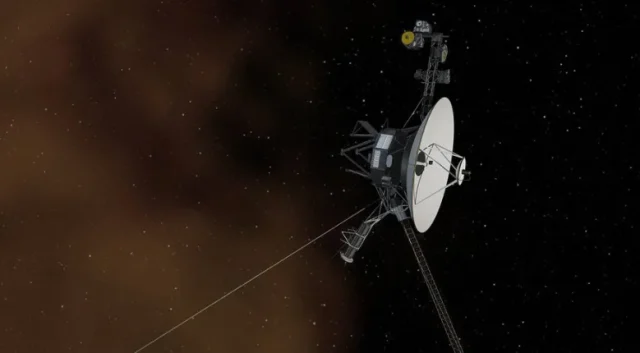
Deep space missions increased the difficulty further. Voyager 1 and Voyager 2, launched in the late 1970s, still communicate with Earth from extraordinary distances. Their transmitters operate with very modest power compared with terrestrial broadcast stations, yet their signals can still be detected by extremely large, sensitive Earth-based antennas. This is possible only because of high-gain antennas, ultra-low-noise receivers, precise pointing, narrowband techniques, error correction and patient signal processing.
Modern spacecraft use much more advanced communication systems, but the underlying challenge remains the same: a weak signal must cross a vast distance and still be interpreted correctly.
The Moon is close, but not simple
Compared with Mars or the outer planets, the Moon is close. The average distance between Earth and the Moon is about 384,400 kilometers. A radio signal needs roughly 1.3 seconds to travel one way, so a round trip takes about 2.6 seconds. That is short enough for conversation, but long enough to be noticeable in voice communication and control loops.
The Moon also presents a very different communication environment from Earth. There is no dense atmosphere, no ionosphere comparable to Earth’s, and no natural infrastructure. A radio system on the lunar surface cannot rely on cell towers, repeaters, terrestrial fiber backhaul or weather-protected service facilities. Everything must be brought, deployed, powered, protected and maintained under extreme conditions.
The lunar surface is exposed to intense temperature swings. Equipment may face very hot sunlight and extremely cold darkness. Radiation is stronger than at Earth’s surface. Lunar dust can affect mechanical systems, thermal surfaces, connectors and possibly antenna deployment mechanisms. The far side of the Moon cannot communicate directly with Earth at all because the Moon itself blocks the line of sight.
This means that lunar communication requires careful planning. Near-side missions can often use direct Earth links. Far-side missions need relay satellites or lunar-orbiting infrastructure. Future lunar bases will need local wireless networks between habitats, rovers, instruments, landing pads, power systems and relay nodes. A lunar communication system is therefore not just a single radio link. It is a developing network.
Deep space communication is a different class of problem
Deep space begins where normal near-Earth communication assumptions break down. Once a spacecraft travels far beyond the Moon, distance becomes the dominant factor in nearly every communication decision.
The most visible issue is delay. Radio waves travel fast, but they do not travel instantly. When a spacecraft is close to Earth, delay is small. When it is on Mars, delay becomes a mission-planning problem. When it is beyond the outer planets, delay becomes a major operational constraint.
The second issue is signal strength. Radio energy spreads out as it travels. Under ideal conditions, received power decreases with the square of distance. Double the distance and the received signal becomes four times weaker. Increase the distance by a factor of a thousand and the link budget becomes brutally difficult. A spacecraft transmitter with tens of watts may need to be heard across hundreds of millions or billions of kilometers.
The third issue is motion. Spacecraft and planets are constantly moving. This creates Doppler shift, changing geometry, changing distance and changing antenna pointing requirements. Ground stations must know where the spacecraft is, where it will be, and how its signal frequency will shift over time.
The fourth issue is reliability. A deep space mission cannot be repaired easily. Communication equipment must survive launch vibration, vacuum, radiation, thermal cycling and years of operation. The link must be designed with margins, redundancy and recovery procedures.
This is why deep space communication is not simply “Wi-Fi with a bigger antenna.” It is a specialized engineering system built around weak-signal reception, precise timing and long-distance mission operations.
Signal delay between Earth, the Moon, Mars and beyond
The delay of a radio signal is one of the easiest deep space communication problems to understand, but one of the hardest to work around operationally. Since radio waves travel at the speed of light, the delay depends directly on distance.
For the Moon, the delay is about 1.3 seconds one way. That is noticeable but manageable. Astronauts on the Moon can speak with mission control, although there is a short pause. Direct manual control from Earth is not ideal, but the delay is not extreme.
Mars is very different. Depending on the positions of Earth and Mars in their orbits, one-way radio delay can range from roughly 3 minutes to more than 20 minutes. A round-trip delay can therefore approach or exceed 40 minutes. This makes real-time remote control impossible. A Mars rover cannot be driven like a radio-controlled car. Commands must be planned, validated, uploaded and executed with onboard autonomy.
The Mars link is one of the clearest examples of why deep space communication cannot work like a normal radio connection on Earth. A detailed explanation of how long radio signals take to travel between Earth and Mars shows how orbital distance, light speed and mission planning determine the delay between a command sent from Earth and a response received from a spacecraft.
For spacecraft beyond the outer planets, the situation becomes even more extreme. Voyager communication involves one-way delays measured in many hours. In such cases, mission control sends commands and waits until the next available communication window to confirm the result. Deep space operation becomes less like live control and more like long-duration remote procedure execution.
This latency is not a defect of radio technology. It is a basic consequence of physics.
Why real-time control is impossible on Mars
Mars missions illustrate the practical consequences of interplanetary delay better than almost any other example. When a command is sent from Earth, it takes several minutes to reach Mars. If the spacecraft or rover responds immediately, that response takes several more minutes to return. Even under favorable orbital conditions, the control loop is far too slow for human real-time steering.
This affects rover driving, robotic arm operation, sampling, drilling, navigation and fault recovery. Engineers cannot simply watch a live video feed and react instantly. Instead, they build a sequence of commands, simulate it, check it for hazards, upload it and allow the rover to execute the plan autonomously or semi-autonomously.
Modern Mars rovers use onboard software to avoid obstacles, estimate position, analyze terrain and protect themselves from unsafe actions. The communication delay forces the spacecraft to become more intelligent. Autonomy is not only a convenience; it is a requirement.
Mars orbiters also play a crucial role. Surface rovers often send data to orbiters, which then relay the data back to Earth using higher-gain antennas and more favorable communication geometry. This relay architecture improves data return and reduces the burden on small surface transmitters.
The result is a layered communication system: rover to orbiter, orbiter to Earth, Earth to mission control, and then commands back through the same delayed chain. Every step must be scheduled around orbital mechanics and ground station availability.
Signal attenuation and the deep space link budget
The most difficult technical problem in deep space radio is not generating a signal. It is receiving a signal after it has spread across a vast distance.
A spacecraft transmitter may operate with only 20 to 30 watts of RF power. That may sound adequate on Earth, but in deep space the signal becomes incredibly weak by the time it reaches Earth. The receiving station must detect this signal against thermal noise, cosmic background noise, atmospheric effects, equipment noise and interference.
This is where the link budget becomes critical. A deep space link budget includes transmitter power, antenna gain, free-space path loss, pointing loss, polarization loss, receiver antenna gain, system noise temperature, modulation type, coding gain and required data rate. Engineers calculate whether the received signal-to-noise ratio will be sufficient for the desired communication mode.
There is always a trade-off between data rate and reliability. A weak signal may still be usable if the data rate is low enough and the coding is strong enough. This is why distant spacecraft often transmit at extremely low bit rates. The farther the spacecraft goes, the more carefully engineers must balance power, antenna pointing, bandwidth and error correction.
On Earth, large dish antennas and cooled low-noise amplifiers help recover extremely weak signals. In many cases, data must be accumulated, decoded and corrected using advanced algorithms. Deep space reception is a form of precision weak-signal engineering.
Antennas are the real power amplifiers of space communication
In space communication, antenna gain is often more important than transmitter power alone. A spacecraft cannot usually carry a huge transmitter because power is limited by solar panels, batteries or radioisotope generators. It also cannot carry an enormous antenna in most mission designs. Therefore, both spacecraft and ground stations rely on carefully designed high-gain antennas.
A high-gain antenna focuses RF energy into a narrow beam. This increases effective radiated power in the desired direction and improves reception from that direction. The disadvantage is that narrow beams require accurate pointing. If the spacecraft antenna is not aimed correctly at Earth, the link may weaken or disappear.
Spacecraft often use multiple antennas for different mission phases. Low-gain antennas provide wider coverage and are useful during launch, safe mode or early acquisition. Medium-gain antennas offer a compromise. High-gain antennas provide the main data link when the spacecraft is properly oriented.
Earth-based antennas can be much larger. The largest Deep Space Network dishes are enormous structures designed to collect tiny amounts of RF energy from distant spacecraft. Their size gives them high gain and allows them to support missions that would otherwise be impossible.
In this sense, antennas are not passive accessories. They are the main reason deep space radio communication can work at all.
The Deep Space Network and global tracking infrastructure
NASA’s Deep Space Network is one of the most important communication systems ever built. It consists of three major ground station complexes located approximately 120 degrees apart in longitude: Goldstone in California, Madrid in Spain and Canberra in Australia. This geometry allows Earth’s rotation to provide continuous or near-continuous coverage for deep space missions.
As Earth turns, a spacecraft may disappear below the horizon for one station, but another station can take over. This global distribution is essential because deep space missions do not stop transmitting when one country enters night or day. The network must support continuous tracking, scheduled communication passes and emergency contacts.
The Deep Space Network uses large 34-meter and 70-meter antennas, precision frequency standards, low-noise receivers and powerful transmitters for uplink. It supports multiple frequency bands, including S-band, X-band and Ka-band. It is used not only for communication but also for navigation. By measuring signal timing, Doppler shift and range, mission teams can determine spacecraft position and velocity with high precision.
The European Space Agency operates its own deep space tracking infrastructure, known as ESTRACK, with major stations supporting missions beyond Earth orbit. Other spacefaring nations, including China and India, have also developed deep space communication and tracking networks.
As more missions travel to the Moon, Mars and beyond, ground station capacity becomes increasingly valuable. Deep space antennas are limited resources. Missions must schedule communication time, prioritize data return and sometimes share infrastructure across agencies.
Frequency bands used in lunar and deep space communication
Different frequency bands are used in space communication because each band has different advantages and limitations. Lower frequencies are generally more forgiving in terms of pointing and propagation, while higher frequencies can support higher data rates with smaller antennas but require greater precision.
UHF has been used for many satellite and local relay applications. In space missions, UHF links are often used for short-range communication, such as rover-to-orbiter links around Mars. UHF equipment can be relatively compact and robust, making it useful for local networks and proximity operations.
S-band has a long history in spaceflight. It was used in Apollo and remains useful for telemetry, tracking and command applications. It provides a good balance between reliability and manageable antenna size.
X-band is widely used for deep space missions. It offers better antenna gain for a given dish size than lower frequencies and is less vulnerable to some atmospheric issues than Ka-band. Many deep space probes use X-band for reliable long-distance communication.
Ka-band allows higher data rates and more efficient spectrum use, but it is more sensitive to weather, especially rain and atmospheric water vapor. For high-rate science data return, Ka-band can be very attractive, but it requires careful ground station planning and link margin management.
Optical communication may eventually supplement or partially replace some high-data-rate RF links, but radio remains essential because of its robustness, heritage and ability to operate under a wider range of conditions.
Modulation and error correction in weak-signal space links
A deep space signal is not useful unless the information can be extracted accurately. This is why modulation and coding are central to space communication.
Phase-based modulation schemes such as BPSK and QPSK are widely used because they can perform well in noisy conditions. More advanced modulation methods may be used when the signal-to-noise ratio allows higher throughput, but deep space communication often prioritizes robustness over raw spectral efficiency.
Error correction is equally important. Turbo codes, LDPC codes, convolutional codes and Reed-Solomon coding have all played roles in space communication. These methods add structured redundancy to the transmitted data so that the receiver can detect and correct errors caused by noise, fading or interference.
The deeper the mission travels into space, the more valuable coding gain becomes. If a spacecraft cannot increase transmitter power and cannot easily improve antenna gain, better coding can help recover data that would otherwise be lost.
This is one of the reasons modern missions can return usable data from extreme distances. The receiver is not simply “listening.” It is applying sophisticated mathematical recovery methods to a signal that may be barely above the noise.
Doppler shift and spacecraft motion
Spacecraft are not stationary targets. They move at high speeds relative to Earth, and Earth itself rotates and orbits the Sun. This relative motion produces Doppler shift, meaning the received frequency changes depending on whether the spacecraft is moving toward or away from the receiver.
In everyday life, Doppler shift is familiar as the changing pitch of a passing siren. In radio communication, the same effect shifts the carrier frequency. For deep space links, this shift must be predicted and compensated precisely.
Ground stations track the expected frequency of a spacecraft signal and adjust receivers accordingly. Uplink frequencies may also be adjusted so that the spacecraft receives the signal at the expected frequency after Doppler effects are accounted for. Doppler measurements are not only a communication problem; they are also a navigation tool. By analyzing frequency shifts over time, mission teams can estimate spacecraft velocity and trajectory.
For narrowband communication, even a small frequency error can reduce link quality. Accurate frequency standards, orbital models and real-time tracking are therefore essential.
Why pointing accuracy matters so much
High-gain antennas make deep space communication possible, but they also create a pointing challenge. A high-gain dish produces a narrow beam. That beam must be aimed at Earth with high precision. If a spacecraft is rotating, tumbling, in safe mode or uncertain about its attitude, communication can become difficult.
This is why spacecraft attitude control and communication are deeply connected. A probe must know its orientation and be able to point its antenna. Star trackers, gyroscopes, reaction wheels, thrusters and sun sensors may all support this task.
Earth stations must also point accurately. A large dish antenna has a narrow beamwidth, especially at higher frequencies. Tracking a spacecraft requires precise ephemeris data and mechanical accuracy. The farther away the spacecraft is, the smaller its apparent position error can be before the link suffers.
Pointing becomes even more demanding for optical communication. A laser beam can carry enormous data rates, but it must be aimed with extreme precision. This is one reason radio communication remains attractive for many mission-critical links: it is more forgiving than laser communication, especially under uncertain conditions.
Space weather, radiation and solar conjunction
Space is not empty from a communication perspective. The Sun constantly emits radiation and charged particles. Solar flares and coronal mass ejections can disturb communication, damage electronics and increase noise. Spacecraft outside Earth’s protective magnetosphere are more exposed to these effects.
Solar conjunction is a special problem for Mars missions. When Mars is near the opposite side of the Sun from Earth, radio signals must pass close to the Sun from Earth’s point of view. Solar plasma can distort, delay and weaken signals, making communication unreliable. During these periods, mission teams often reduce commanding and allow spacecraft to operate more autonomously until the geometry improves.
Radiation also affects onboard electronics. Spacecraft communication systems must be designed to tolerate single-event upsets, component degradation and long-term exposure. Redundancy, shielding, error detection and fault recovery are essential.
A reliable deep space radio system must survive not only distance, but also the space environment itself.
Radio communication on the lunar surface
The lunar surface creates its own communication problems. On the near side, direct line-of-sight communication with Earth is possible when local terrain and mission geometry allow it. On the far side, direct Earth communication is impossible because the Moon blocks the path. This makes relay satellites essential for far-side missions.
The Moon has no atmosphere and no ionosphere like Earth’s. This removes some propagation complications but creates others. Without atmosphere, there is no weather absorption in the ordinary terrestrial sense, but there is also no natural protection from radiation. Equipment must be hardened.
Terrain can block local communication. Craters, hills and lava tubes may create shadow zones where direct line-of-sight radio links fail. Future lunar bases will likely require relay nodes, mesh networks or local base stations to maintain reliable coverage across work areas.
Lunar dust is another engineering concern. It is abrasive, electrostatically active and difficult to manage. Antennas, connectors, deployment mechanisms and thermal surfaces must be designed with this environment in mind.
A future lunar communication architecture may combine local surface networks, lunar orbiting relays, Earth-facing high-gain links and possibly optical communication terminals. In other words, the Moon will need its own communication infrastructure.
Mars communication architecture
Mars communication is more complex than a simple Earth-to-Mars link. Most successful Mars surface missions have used orbiters as communication relays. A rover or lander transmits data to a spacecraft orbiting Mars, and the orbiter later sends that data to Earth using a more powerful transmitter and high-gain antenna.
This architecture has several advantages. A rover can use a smaller antenna and lower power for local communication to an orbiter. The orbiter has a better view of both Mars surface assets and Earth during scheduled passes. It can store data and forward it when the geometry and ground station availability are favorable.
Mars orbiters also increase mission resilience. If a direct-to-Earth link is limited, relay communication can return much more data. This is especially important for high-resolution images, atmospheric measurements, geological data and engineering telemetry.
Future Mars missions may require a more advanced communication network. Human missions, sample return missions and long-duration robotic campaigns will need higher data rates, better coverage and more reliable relay infrastructure. Mars may eventually require an orbiting communication constellation, similar in concept to a small-scale planetary internet.
Radio communication vs laser communication in deep space
Laser communication, also called optical communication, is one of the most promising technologies for future space links. It can offer much higher data rates than radio communication because optical frequencies allow extremely narrow beams and large bandwidths.
This could be valuable for missions that generate huge amounts of data, such as high-resolution imaging spacecraft, lunar bases, Mars missions or deep space observatories. A laser link could return more scientific data in less time than a traditional RF link, assuming the pointing and weather conditions are suitable.
However, laser communication has limitations. It requires extremely precise pointing. A narrow optical beam can miss the receiver if alignment is imperfect. Earth-based optical ground stations can be affected by clouds, atmospheric turbulence and weather. Unlike radio, optical links may need multiple geographically distributed ground stations to improve availability.
Radio communication is more mature and generally more robust. It can tolerate larger pointing errors, operate through many atmospheric conditions and support mission-critical command links. For this reason, future systems may use both technologies. Radio may remain the dependable command and telemetry backbone, while optical links provide high-rate data return when conditions allow.
The future of deep space communication is probably hybrid, not purely optical.
Could quantum communication be used in space?
Quantum communication is sometimes discussed as a future space technology, especially for secure links. In theory, quantum key distribution could provide extremely strong protection against eavesdropping by detecting interception attempts. Space-based quantum communication experiments have already shown that satellites can play a role in long-distance quantum networks.
However, quantum communication is not a near-term replacement for ordinary spacecraft radio links. It is not a simple way to send high-rate telemetry from Mars or command a rover. It requires specialized equipment, precise optical systems and a very different communication architecture.
The more realistic near-term role of quantum technology is secure key distribution between selected ground and space nodes. For deep space operational communication, radio and optical links will remain the practical backbone for the foreseeable future.
Amateur radio and space communication
Amateur radio has been connected to space communication since the beginning of the space age. Radio amateurs received Sputnik signals, helped popularize satellite tracking and later supported amateur satellite communication through OSCAR satellites and AMSAT projects.
Low Earth orbit amateur satellites allow operators to make contacts using VHF and UHF uplinks and downlinks. These satellites often act as repeaters, enabling communication over long distances while the satellite is above the horizon. Operators must track Doppler shift, antenna pointing and pass timing, making satellite operation a practical introduction to space communication principles.
The ARISS program allows schools and amateur operators to communicate with astronauts on the International Space Station. These contacts are usually short, carefully scheduled and technically simple compared with deep space links, but they demonstrate that space radio is not limited to large agencies.
There have also been cases where amateur radio operators and independent observers received signals from lunar or deep space missions using high-gain antennas and software-defined radios. This does not mean that deep space reception is easy. It requires suitable equipment, accurate tracking information, low-noise reception and technical skill. But it shows that the boundary between professional space communication and advanced amateur reception is not completely closed.
Can amateur radio operators receive signals from the Moon or deep space?
The realistic answer depends on the mission, frequency, antenna size, signal structure and available tracking information. Receiving an amateur satellite or ISS transmission is relatively accessible. Receiving a lunar mission signal is much more difficult. Receiving deep space probes is usually beyond ordinary amateur setups, though advanced amateur and research-level stations may detect certain signals under favorable conditions.
A serious amateur setup for weak space signal reception may include a high-gain dish or antenna array, a low-noise amplifier, stable frequency reference, SDR receiver, tracking software and knowledge of the expected downlink frequency and modulation. The operator must also account for Doppler shift and antenna pointing.
The same curiosity also surrounds modern lunar missions, where many operators want to know whether Artemis II can be heard on amateur radio equipment and what kind of receiving setup might be realistic.
For most hobbyists, the best starting points are low Earth orbit amateur satellites, ARISS contacts, weather satellites, QO-100 if geographically available, and public mission tracking data. These activities build the same core skills used in more advanced space signal reception: prediction, tracking, weak-signal work, frequency correction and antenna control.
Local communication networks on the Moon and Mars
Future human activity on the Moon and Mars will require local communication networks, not just Earth links. Astronauts, habitats, rovers, scientific instruments, power systems and landing sites will need reliable short-range and medium-range communication.
On the Moon, local latency is very low, but terrain and line-of-sight limitations can be severe. A rover behind a ridge or inside a crater may not be able to communicate directly with a base station. Relay nodes or mesh networks can solve this by forwarding data through multiple points.
On Mars, local networks will also be necessary. Surface assets may communicate with each other directly, with nearby relay towers or with orbiters. Since Earth communication is delayed by minutes, local systems must support autonomous operations. A human crew on Mars cannot depend on Earth for instant decision-making.
These local planetary networks may use technologies related to terrestrial wireless systems, but they must be adapted for vacuum or thin atmosphere, dust, radiation, extreme temperatures and limited maintenance. Power efficiency will be critical. Reliability will matter more than consumer-grade speed.
In the long term, the Moon and Mars may require something like a local internet, with routers, relay satellites, surface base stations and delay-tolerant networking protocols.
Delay-tolerant networking and the interplanetary internet
Normal internet protocols assume that delays are relatively short and connections are usually continuous. Deep space breaks those assumptions. A Mars link may be unavailable for part of the day, delayed by many minutes and interrupted by orbital geometry or solar interference. Traditional networking methods are not ideal for this environment.
Delay-tolerant networking, often abbreviated DTN, is designed for such conditions. Instead of assuming an always-on connection, DTN can store data and forward it when a link becomes available. This is sometimes called a store-and-forward architecture.
An interplanetary communication system must tolerate long delays, scheduled contacts, temporary outages and changing routes. A message may travel from a Mars rover to a Mars orbiter, from the orbiter to a Deep Space Network station, and then into Earth-based networks. In the future, it may pass through lunar gateways, Mars relay constellations or other spacecraft.
This is why deep space communication is not only about radios. It is also about networking architecture.
Data rates in space communication
Data rate in space depends heavily on distance, transmitter power, antenna gain, frequency band, coding and available ground station resources. A spacecraft close to Earth may transmit large amounts of data quickly. A distant probe may return data at extremely low rates.
The public often expects space missions to send high-definition video instantly, but this is usually unrealistic outside Earth orbit. A Mars rover may generate more data than it can immediately transmit. A deep space probe may need to prioritize which data is most important. Mission teams must decide what to send, when to send it and how much compression to apply.
Scientific instruments are often designed with communication limits in mind. Data may be compressed onboard. Some data may be summarized. Some observations may be stored until a higher-rate communication window becomes available.
For future lunar and Mars missions, increasing data rates will be important. Human missions will require voice, video, telemetry, medical data, navigation support, scientific data and operational coordination. This will push agencies toward more advanced RF links, optical communication and local relay networks.
Why spacecraft need autonomy
Communication delay and limited bandwidth force spacecraft to make decisions locally. This is true for robotic missions and will become even more important for human missions beyond the Moon.
A spacecraft must protect itself if communication is lost. It may enter safe mode, point solar panels toward the Sun, orient antennas toward Earth, shut down nonessential systems or wait for commands. A rover may stop if it detects unsafe terrain. A probe may prioritize critical telemetry if power or thermal conditions become abnormal.
Autonomy is not the same as intelligence in the human sense. It is a set of carefully designed behaviors that allow a spacecraft to survive when Earth cannot respond quickly. The farther a mission travels, the more important autonomy becomes.
Mars rovers, outer planet probes and future deep space vehicles all need onboard fault detection, navigation support and communication recovery logic. Without these systems, long-distance radio delay would make many missions impossible.
The role of timing and synchronization
Space communication also depends on precise timing. Signals are used not only to exchange data but also to measure distance, velocity and spacecraft behavior. Accurate clocks and frequency references allow ground stations to perform ranging and Doppler measurements.
Two-way ranging can determine how long a signal takes to travel to a spacecraft and back. Doppler tracking can reveal changes in velocity. Combined with orbital models, these measurements help mission teams navigate spacecraft across the solar system.
Timing is also important for scheduled communication windows. A spacecraft may need to wake up, point its antenna and transmit during a precise ground station pass. Earth stations must know when to listen, where to point and what frequency to expect.
In deep space, communication and navigation are closely connected. The radio link is both a data channel and a measurement instrument.
How future lunar bases may communicate
A permanent or semi-permanent lunar base would need a layered communication system. Local short-range links could connect astronauts, suits, tools, vehicles and habitat modules. Medium-range relays could cover nearby exploration zones. Lunar orbiters could provide communication beyond line of sight. Earth-facing terminals could handle long-distance backhaul.
Some communication may use radio. Some may use optical links. Some local links may resemble ruggedized Wi-Fi or private cellular systems, but adapted for lunar conditions. Network infrastructure must be power-efficient, repairable, radiation-tolerant and resistant to dust.
The far side of the Moon is especially interesting. It is shielded from much of Earth’s radio noise, making it attractive for radio astronomy. At the same time, that shielding means direct Earth communication is impossible. Far-side activities will depend on relay satellites or lunar orbital infrastructure.
The Moon is therefore not merely a destination. It is a future communication engineering testbed.
How future Mars missions may communicate
A human mission to Mars would require far more communication capacity than current robotic missions. Astronauts would need voice and video links, medical support, mission planning data, software updates, scientific data transfer, navigation, surface coordination and emergency communication.
However, the Mars delay cannot be eliminated. Even with advanced systems, Earth and Mars will remain separated by minutes of light-time. This means Mars crews must operate with far greater independence than astronauts in low Earth orbit or on the Moon.
A future Mars communication architecture may include surface networks, relay orbiters, high-gain Earth links, optical communication terminals and delay-tolerant networking protocols. Local communication on Mars may be fast, but Earth communication will remain delayed.
This will change mission culture. Earth-based control will become less like direct supervision and more like strategic support. The crew and onboard systems will need authority to handle many situations locally.
Why radio will not disappear
Laser communication and future optical systems may dramatically increase data rates, but radio communication will not disappear from space exploration. Radio is proven, robust and flexible. It can support command, telemetry, tracking and emergency recovery under conditions where optical links may be unavailable.
Radio systems can tolerate less precise pointing than optical systems. They can operate through many atmospheric conditions. They have decades of operational heritage and are deeply integrated into navigation and mission control methods.
The most likely future is not a replacement of radio by laser communication, but a layered architecture. Radio will remain the dependable backbone for mission-critical communication, while optical systems will provide high-rate data return when geometry, weather and pointing allow it.
Space communication has always evolved by adding new capabilities, not by immediately abandoning reliable old ones.
Why this topic matters beyond space agencies
Deep space radio communication may sound like a specialized subject for NASA, ESA or large aerospace contractors, but it has broader relevance. Many technologies developed for space communication influence terrestrial systems: error correction, weak-signal processing, antenna design, software-defined radio, precise timing and network resilience.
The subject is also important for education. Amateur satellite operation, SDR reception and space signal tracking give students and hobbyists a direct way to understand orbital mechanics, RF engineering and signal processing. Space radio is one of the few areas where a motivated amateur can still observe real spacecraft signals and participate in a global technical community.
For the wider public, understanding space communication also helps correct common misconceptions. Space missions are not controlled instantly like drones. Mars rovers do not stream continuous live video like webcams. Deep space probes do not communicate through ordinary internet links. Every bit of data from deep space is the result of careful engineering.
Practical starting points for radio enthusiasts
Radio enthusiasts interested in space communication do not need to begin with deep space reception. A more realistic path starts with accessible satellite signals.
Low Earth orbit amateur satellites are a good first step. They teach pass prediction, Doppler correction, antenna aiming and satellite operating procedure. The International Space Station is another accessible target, especially when ARISS activity or packet radio operation is available.
QO-100 is especially valuable for operators in its coverage area because it is a geostationary amateur satellite. Unlike low Earth orbit satellites, it does not pass quickly across the sky. This makes antenna pointing and operating much easier once the station is set up.
Software-defined radios are useful for learning. An SDR allows operators to visualize signals, measure Doppler shift, experiment with decoding and understand bandwidth. With suitable antennas and low-noise amplifiers, SDR systems can receive many satellite and space-related signals.
Advanced operators may experiment with weak-signal reception from lunar missions or space probes, but this requires much more demanding equipment and careful research. The best approach is to build skills gradually.
Building a stronger space communication content cluster
For a technical website, radio communication on the Moon and in deep space can serve as a central hub article. It connects naturally to Mars signal delay, Artemis radio reception, satellite communication bands, inter-satellite links, amateur satellite operation, QO-100, Deep Space Network technology and future lunar infrastructure.
This makes the topic valuable not only as a standalone article but also as part of a broader satcom and space communication cluster. A reader interested in Mars communication delay may also be interested in DSN antennas. A reader interested in Artemis II reception may also want to understand lunar communication architecture. A reader researching Ka-band satellite communication may later search for optical deep space links.
For more technical guides on satellite links, spacecraft communication and radio propagation, readers can explore related satellite communication articles covering both practical RF systems and deep space technologies.
Why space communication will remain a radio engineering challenge
As missions move farther from Earth, communication becomes more difficult, not less. The Moon requires local networks and relay infrastructure. Mars requires autonomy, orbiters and delay-tolerant operations. Outer planet missions require huge antennas, low data rates and long mission planning cycles. Future human exploration will demand higher bandwidth and better reliability while still obeying the same laws of physics.
Radio communication remains central because it is reliable, mature and adaptable. It can support emergency links, telemetry, command, tracking and scientific data return across enormous distances. Optical communication will expand what is possible, but radio will continue to provide the stable backbone of space communication.
The history of space exploration is therefore also a history of radio engineering. From Sputnik’s simple beeps to Apollo’s S-band links, from Voyager’s faint signals to future lunar and Martian networks, every major step beyond Earth depends on the ability to send and receive information across space.
The more ambitious space missions become, the more important communication architecture will be. Rockets may launch spacecraft, but radio links keep them alive, useful and connected.
Image(s) used in this article are either AI-generated or sourced from royalty-free platforms like Pixabay or Pexels.
This article may contain affiliate links. If you purchase through these links, we may earn a commission at no extra cost to you.
Get the weekly RF & IT briefing
Radio guides, RF calculators, AI, Windows, Linux and satellite communication explainers. One useful email per week. No spam.