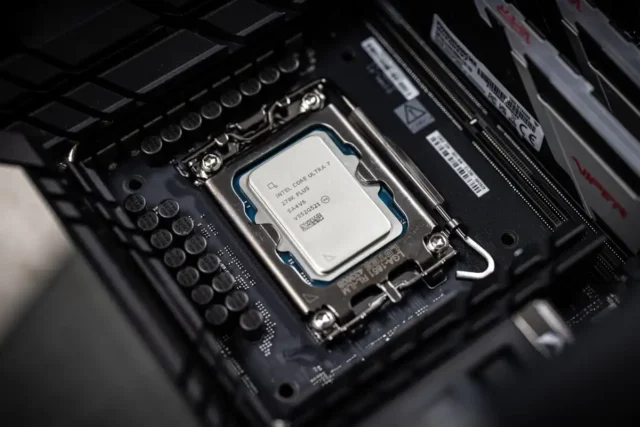
Intel’s position in the desktop CPU market is no longer what it once was. A decade ago, the company could still rely on clear dominance in many performance segments, but that advantage has eroded. Several recent processor launches failed to generate much excitement, largely because the real-world gains were too small to shift buying decisions in a meaningful way. At the same time, AMD has taken full advantage of that hesitation and pushed much harder in both gaming and enthusiast desktop performance.
That makes the arrival of the new Core Ultra 200S Plus lineup more important than it may seem at first glance. These Arrow Lake Refresh chips are not a full replacement for the 2024 stack, but rather an expansion of it. Even so, one model in particular stands out: the Intel Core Ultra 7 270K Plus.
On paper, it does not look like the star of the range. In actual testing, however, it turns into one of the most interesting desktop CPUs Intel has released in quite some time. Once performance, efficiency, price, and platform value are considered together, the Core Ultra 7 270K Plus becomes much more compelling than its name alone suggests.
It performs above expectations
Looking only at Intel’s naming structure, most buyers would assume the Core Ultra 9 285K remains the more capable chip. It carries the higher-tier branding, and its specifications suggest a stronger flagship-class position. But benchmark results show that the 270K Plus is not simply a step down.
In several workloads, it actually edges past the 285K. That includes content creation, gaming, and selected productivity tasks, with gains that in some cases reach double digits. Depending on the application, the newer chip can outperform its more expensive sibling by as much as 12 percent, which is not a minor margin.
That makes the 270K Plus unusual in the current desktop CPU market. It is positioned below a higher-numbered model, yet in practice it can deliver better overall results in multiple scenarios. For buyers who focus on real performance rather than product hierarchy, that changes the conversation immediately.
Single-core and multi-core results are both solid
The processor does not rely on one isolated win. Its advantage appears across different benchmark types, which makes the result more credible.
In lightly threaded work, the gains are noticeable. In Cinebench 2026 single-core testing, the 270K Plus posts a modest but real lead over the 285K. A similar pattern appears in Adobe Photoshop workloads, where responsiveness and burst performance matter. These are not massive jumps, but they are large enough to matter for users who spend time in creative applications and want strong day-to-day snappiness.
The multicore story is also positive, though more restrained. In rendering and production-focused workloads, the 270K Plus tends to stay ahead by a smaller margin. Even then, a few percent improvement over a supposedly superior model is meaningful, especially when that improvement comes without moving into a higher price bracket.
This gives the chip a balanced profile. It is not just tuned for one headline benchmark. Instead, it appears capable across a broad mix of desktop tasks, which is exactly what many mainstream enthusiasts and prosumers want from a new CPU.
Gaming improves, but AMD still leads
Gaming performance is one of the most closely watched areas for any new desktop processor, and here the 270K Plus shows clear progress. Compared with the 285K, frame rates are higher in multiple titles, and in some games the uplift is surprisingly healthy. That is especially relevant because one of the main criticisms of earlier Intel desktop launches was that gaming improvement often felt too small to justify attention.
With the 270K Plus, that criticism becomes harder to make. The chip can produce a measurable jump in frame rate and deliver a better gaming experience than the 285K in several modern titles. For Intel, that is a welcome correction.
Even so, the broader competitive picture does not change. AMD’s top X3D-class desktop CPUs still remain ahead, especially in games where cache-sensitive performance makes a major difference. When compared against a Ryzen 9 9850X3D-level product, Intel’s new chip can fall behind by a substantial margin in demanding titles. That gap is not cosmetic. In some cases, it is large enough to affect the buying decision immediately for anyone building a gaming-first machine.
So while Arrow Lake Refresh improves Intel’s gaming position, it does not put the company back at the top of the chart. Buyers focused primarily on frame rates will still find AMD difficult to ignore.
It is much stronger in heavy multithreaded work
Where the Core Ultra 7 270K Plus becomes especially attractive is in creator-class workloads. Rendering, 3D work, heavily parallel production tasks, and other multicore-heavy jobs remain areas where Intel’s architecture can show real muscle.
Against AMD’s gaming-focused X3D processors, the difference in these workloads can be dramatic. In rendering tests and multithreaded benchmarks, the 270K Plus can open a very large lead. That makes sense architecturally, since gaming-optimized chips do not always prioritize the same type of sustained throughput that content creation demands.
For users who spend serious time in applications like Blender, or who regularly run export, encode, compile, or render jobs, this matters far more than a narrow gaming loss. A workstation or hybrid production system benefits from multicore consistency, and the 270K Plus appears much better positioned there than a processor built mainly for top-tier gaming numbers.
This also makes it a sensible option for streamers and advanced multitaskers running a single-PC setup. If the system needs to game, stream, record, and handle background tasks at the same time, stronger multithreaded behavior can translate into a smoother overall experience.
Power draw is higher under full load
Performance does not come without trade-offs. One of the more important caveats is power efficiency under heavier workloads.
When pushed hard in multicore tests, the Core Ultra 7 270K Plus draws more power than the 285K. That means Intel has extracted the extra performance partly by allowing the chip to consume more energy under sustained pressure. In other words, better results come with a cost in efficiency.
This matters most for users who routinely run prolonged all-core workloads. Higher power draw can mean more heat, more demanding cooling requirements, and potentially a less efficient system overall. For builders who care about thermals, acoustics, and power budgets, this is not a minor footnote.
The good news is that the difference appears much less significant in lighter scenarios. During gaming, idle use, and everyday desktop workloads, power behavior is much closer between the two Intel chips. That helps preserve the 270K Plus as a practical desktop option rather than turning it into a niche, power-hungry part.
So the efficiency penalty is real, but it is concentrated mainly in the kind of sustained heavy workloads where performance users may already expect increased consumption.
The price changes everything
The strongest argument in favor of the Core Ultra 7 270K Plus may not be performance alone. It may be value.
At around $299, the chip enters the market at a level that immediately makes it far more interesting than many higher-tier desktop CPUs. Once that number is placed next to the much higher asking price of the 285K, the 270K Plus starts to look like one of the more rational choices in Intel’s current desktop portfolio.
If a lower-priced processor can outperform a more expensive sibling in several meaningful tasks, the pricing gap becomes impossible to ignore. The money saved can go toward a better motherboard, improved cooling, faster storage, or higher-capacity DDR5 memory. In a modern desktop build, that kind of budget flexibility has real value.
The comparison with AMD also becomes more nuanced once pricing enters the discussion. AMD may still have the stronger gaming products at the top end, but if Intel offers a cheaper chip with excellent productivity behavior and respectable gaming performance, some buyers will view that as the more balanced purchase.
This is especially true for users building a mixed-use system rather than a pure gaming machine. In that context, price-to-performance matters more than raw benchmark leadership.
IBOT could improve results in supported games
Another notable part of the Arrow Lake Refresh story is Intel Binary Optimization Tool, or IBOT. This feature is designed to improve performance in supported games by applying targeted optimizations based on the software and the hardware configuration in use.
In practice, that means some titles may run better when IBOT is enabled than they do at stock settings. This creates a second layer to evaluating the 270K Plus, because out-of-box performance may not represent the chip’s full potential in every supported game.
There are limitations, though. IBOT is not enabled automatically, so users need Intel’s software tools to turn it on. Support is also limited to a relatively small number of games at launch, which reduces its immediate impact for many buyers. A feature like this becomes much more important only when title coverage expands and activation is more seamless.
Still, it is an interesting addition. Intel is clearly trying to build a broader optimization ecosystem around its CPUs, and IBOT is part of that effort. If support grows over time, it could help narrow the gap in selected gaming scenarios where AMD currently holds a strong lead.
For Linux users, the long-term plan appears promising as well, though timing remains unclear. That makes IBOT more of a future-facing advantage than a fully mature platform feature today.
Who should consider the Core Ultra 7 270K Plus
The Intel Core Ultra 7 270K Plus is not the fastest gaming CPU on the market, and it does not restore Intel to undisputed desktop leadership. That part is clear. But it does deliver something that may matter more to many buyers: a better overall package than expected.
It can outperform the 285K in multiple workloads, deliver solid gaming gains over earlier Intel positioning, offer strong content creation capability, and do all of that at a much lower price. Its main weakness is higher power consumption under sustained multicore load, along with the fact that AMD still holds the upper hand in gaming-first builds.
For creators, multitaskers, streamers, and users building a versatile desktop rather than a pure esports machine, the 270K Plus looks like a far more serious option than its model number implies. And in a market where desktop CPU value has become just as important as headline speed, that may be exactly what Intel needed.
The Core Ultra 7 270K Plus looks like one of the most sensible Arrow Lake Refresh processors for buyers who want strong mixed-workload performance, better-than-expected real-world results, and a much more attractive price than Intel’s higher-tier alternatives.
Image(s) used in this article are either AI-generated or sourced from royalty-free platforms like Pixabay or Pexels.
This article may contain affiliate links. If you purchase through these links, we may earn a commission at no extra cost to you.
Get the weekly RF & IT briefing
Radio guides, RF calculators, AI, Windows, Linux and satellite communication explainers. One useful email per week. No spam.