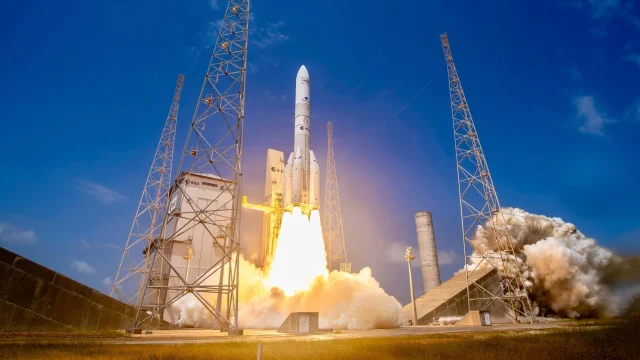
Amazon leo has enough satellites for its first commercial rollout, but the real race is only beginning
Amazon Leo has reached a decisive point in its long and expensive attempt to challenge Starlink in the low Earth orbit broadband market. After another successful satellite launch, Amazon now says it has enough spacecraft in orbit to support continuous service across its first target latitudes. That does not mean global availability is around the corner, and it certainly does not mean the company can immediately match the scale or maturity of SpaceX’s Starlink network. It does mean, however, that Amazon Leo is moving from a long development phase into the early commercial reality of satellite internet.
The latest mission added 29 Amazon Leo satellites to low Earth orbit, bringing the active constellation close to the 400-satellite mark. For a traditional satellite communications project, that number would already sound enormous. For a modern low Earth orbit megaconstellation, it is only the beginning. Amazon’s long-term plan is to build a network of more than 3,200 satellites, creating a broadband system capable of serving homes, businesses, governments, mobile users, remote communities and areas where terrestrial internet infrastructure is weak, expensive or unavailable.
The important shift is not simply the number of satellites. It is the point at which a constellation becomes useful. A low Earth orbit broadband network does not behave like a conventional geostationary satellite system, where a small number of spacecraft can cover huge geographic areas from very high altitude. LEO satellites orbit much closer to Earth, which helps reduce latency and improve performance, but it also means that each satellite covers a smaller moving area. To provide stable service, there must always be another satellite ready to take over as the previous one moves beyond the user terminal’s view. Reaching continuous coverage at selected latitudes is therefore a major operational milestone.
Amazon Leo is not yet a global Starlink equivalent. It is more accurately a developing network that has crossed the threshold from experimental deployment into limited initial service capability. That distinction matters. Early customers may get access to a promising new broadband option, but they should not expect the polished, dense and widely available experience of a mature constellation from day one. The first phase will likely be selective, capacity-limited and geographically constrained. The real value of the milestone is that Amazon can now begin learning from real customers, real traffic patterns and real-world network behavior.
Why amazon leo matters
The satellite internet market has changed dramatically over the past decade. For years, satellite broadband was associated with high latency, expensive hardware, limited data and a user experience that could not compete with fiber, cable or even decent fixed wireless access. That reputation was largely shaped by older geostationary systems, which operate more than 35,000 kilometers above Earth. At that distance, signals must travel so far that latency becomes an unavoidable problem, especially for video calls, online gaming, cloud applications and interactive work.
Low Earth orbit networks changed the logic. By placing satellites much closer to Earth, operators can reduce latency to levels that feel much closer to terrestrial broadband. This is the technical foundation that made Starlink successful and that now gives Amazon Leo a real commercial opportunity. The promise is not merely internet “from space,” but broadband that can be fast enough and responsive enough for everyday use.
Amazon has several reasons to enter this market. The most obvious is connectivity revenue. Millions of households and businesses still lack reliable high-speed internet, even in developed countries. Rural areas, islands, farms, ships, aircraft, emergency operations, research sites and temporary industrial locations all represent potential customers. But Amazon Leo also fits into a broader Amazon strategy. A satellite broadband network can support cloud services, logistics, edge computing, enterprise connectivity, Internet of Things deployments and government contracts. In other words, Leo is not only a consumer internet product. It can become infrastructure.
That is why the comparison with Starlink is unavoidable but incomplete. Starlink created the modern LEO broadband market at scale, but Amazon does not necessarily need to copy every part of the Starlink model to build a viable business. Amazon can package Leo with AWS, enterprise support, logistics services and commercial partnerships. It can sell connectivity not only as a standalone subscription but as part of a larger technology stack. For corporate, industrial and public-sector customers, that may become an important differentiator.
The meaning of the 396 satellite milestone
A constellation of around 400 satellites is not enough for full global coverage with high capacity, but it is enough to begin useful service in defined areas. This is the stage where a satellite network starts to become more than a technical demonstration. The satellites are no longer only proving that the hardware works. They begin forming a real network, one that can carry traffic continuously in selected regions and support early customers under controlled conditions.
For Amazon Leo, this is particularly important because the company has been under pressure to prove that its satellite program can move quickly enough. The LEO broadband market rewards speed. The faster an operator deploys satellites, the faster it can improve coverage, increase capacity, reduce service gaps and attract users. A constellation with hundreds of satellites can provide early access. A constellation with thousands can become a true mass-market platform.
The difference between these stages is enormous. A user does not care how ambitious a constellation is on paper. The user cares whether the terminal connects, whether the speed is stable, whether video calls work, whether outages are rare, whether the service remains usable during bad weather and whether the monthly price makes sense. Amazon’s next challenge is therefore not only orbital deployment, but service quality.
This is where the early rollout phase becomes critical. Even if Amazon has enough satellites for continuous service in initial latitudes, that service will still depend on network density, ground stations, user terminals, software routing, spectrum management, weather conditions and the number of customers using the system at the same time. Satellite internet is not simply a question of putting hardware in orbit. It is a complete network architecture, and every layer must mature.
Why early users should expect a gradual rollout
Amazon’s own messaging around Leo suggests a careful approach rather than an instant mass-market launch. That is realistic. Satellite broadband networks do not become fully mature overnight. They improve as the constellation grows, as software is updated, as terminals are refined and as operators understand how customers actually use the service.
Starlink’s early beta phase is a useful comparison. When Starlink first opened access to limited users, it already had a much larger satellite base than Amazon Leo has today. Even then, the service began with geographic restrictions, performance variation and a controlled customer base. Speeds were promising, latency was far better than older satellite services, but the network still needed time to scale. Over the following years, Starlink improved through relentless launch cadence, user terminal development, inter-satellite link upgrades, software optimization and broader ground infrastructure.
Amazon Leo will likely follow a similar pattern. The first commercial customers may receive a service that is technically impressive but not yet universal. There may be waiting lists, regional limitations, capacity constraints and uneven performance depending on location. This does not indicate failure. It is the normal development path for a LEO broadband constellation.
The most important early customers may not be ordinary households. Amazon could prioritize enterprise users, government partners, mobility customers, telecom backhaul, remote business operations and selected regions where the network has enough capacity. These customers often have clearer use cases and may tolerate early limitations if the alternative is poor or unavailable connectivity. A mining site, research station, maritime operator or disaster-response unit may value any reliable broadband option more than a suburban household that already has fiber.
The starlink problem
Amazon Leo’s biggest challenge is not proving that LEO broadband can work. Starlink has already done that. The problem is that Starlink has also built a massive lead. It has far more satellites in orbit, a mature launch pipeline, a large customer base, established terminals, global brand recognition and years of operational experience. This gives SpaceX a structural advantage.
Starlink benefits from vertical integration. SpaceX builds rockets, launches satellites, operates the constellation and sells the service. That allows rapid iteration and extremely high launch cadence. Amazon, by contrast, depends on several launch partners. That can reduce dependence on a single rocket system, but it also adds scheduling complexity. If one partner faces delays, technical problems or launch failure, Amazon must rearrange its deployment plan.
This is not a minor issue. LEO constellations require constant replenishment. Satellites in low Earth orbit have limited operational lifetimes and must eventually be replaced. The business is therefore not only about reaching an initial constellation size. It is about sustaining a launch rhythm for years. A company that cannot launch frequently enough will struggle to maintain coverage, capacity and competitiveness.
At the same time, Amazon is not entering the market as a small startup. It has capital, engineering resources, cloud infrastructure, consumer reach and enterprise relationships. It can afford a long campaign. The question is not whether Amazon can launch a few hundred satellites. It clearly can. The question is whether it can deploy thousands fast enough, operate them efficiently enough and sell the service aggressively enough to become a serious second force in LEO broadband.
Launch capacity is the bottleneck
Amazon’s satellite manufacturing and network planning only matter if the satellites can reach orbit at scale. That makes launch capacity one of the central constraints of the Leo program. The latest Atlas V mission shows that Amazon can continue building the constellation with existing launch vehicles, but it also highlights the limits of that approach.
Atlas V is a proven rocket, and it has played an important role in Amazon Leo deployment. However, its payload capacity for Leo missions is limited compared with the larger launch systems Amazon wants to use in the future. Carrying 29 satellites per mission is useful, but a constellation of more than 3,200 satellites requires a much faster rhythm if Amazon wants to close the gap with Starlink.
This is why the future role of heavier vehicles matters so much. Blue Origin’s New Glenn was expected to provide a major boost to Amazon’s deployment capacity, with the ability to carry significantly more Leo satellites per launch than Atlas V. A rocket that can deploy dozens of satellites at once changes the economics and timeline of the constellation. It reduces the number of launches required, improves cadence and helps Amazon move more quickly from limited service to broader coverage.
The problem is that rocket development is difficult, and recent setbacks have made the situation more complicated. Any delay involving New Glenn affects Amazon’s ability to accelerate Leo deployment. The company can compensate by relying more heavily on other launch providers, including ULA, Arianespace and SpaceX, but replacement capacity is never frictionless. Launch manifests are crowded, rockets have their own certification schedules, and every mission requires planning, integration and regulatory coordination.
ULA’s Vulcan may become an important part of the solution once it is fully available for Leo deployment. With greater payload capacity than Atlas V, Vulcan could improve Amazon’s launch efficiency. But until multiple heavy-lift options are operating reliably, Amazon’s constellation growth will remain tied to the practical realities of launch scheduling.
Why amazon may still have an advantage
Despite Starlink’s lead, Amazon Leo has strategic advantages that should not be underestimated. Amazon does not need to build its entire business from scratch. It already has one of the world’s strongest cloud platforms in AWS. It already sells to enterprises, governments and developers. It already understands large-scale logistics, customer support, device ecosystems and subscription services.
That matters because satellite internet is becoming less isolated from the rest of the technology market. A LEO network can connect directly to cloud workloads, remote sensors, mobile platforms, industrial automation systems and emergency communications environments. Amazon can design Leo as part of a broader digital infrastructure layer, not merely as a consumer broadband product.
For businesses, this could be attractive. A company operating remote facilities may not want to buy internet service from one provider, cloud infrastructure from another, device management from a third and security services from a fourth. Amazon can potentially bundle these capabilities. It can also use AWS regions, edge services and cloud security tools to create a more integrated enterprise offering.
There is also a retail angle. Amazon has enormous experience selling hardware directly to consumers. If Leo terminals become compact, easy to install and competitively priced, Amazon could use its marketplace and customer service infrastructure to simplify adoption. Starlink has already shown that satellite terminals can become consumer products rather than specialist equipment. Amazon may try to push that idea further.
What leo could mean for rural broadband
The strongest public-facing use case for Amazon Leo is rural broadband. Many regions still suffer from poor connectivity because laying fiber is expensive, mobile coverage is weak or fixed wireless networks are limited by geography. In these areas, LEO satellite internet can be more than a convenience. It can be the difference between being digitally connected and being left behind.
A mature Leo network could serve households that have no realistic fiber option. It could support remote education, telemedicine, home offices, farms, small businesses and local public services. In countries with large rural areas, mountainous terrain or fragmented islands, satellite broadband can fill gaps that terrestrial networks struggle to cover.
However, LEO broadband should not be seen as a universal replacement for fiber. Fiber remains superior where it is available, especially for capacity, stability and long-term scalability. The best role for Leo is not to replace every terrestrial connection, but to provide high-quality connectivity where terrestrial economics fail. That is still a very large market.
The arrival of Amazon as a second major LEO broadband provider could also put pressure on pricing and service quality. Competition matters. Starlink has dominated the category for years, but a credible Amazon alternative could force faster innovation, better plans and more targeted offerings. Even if Leo begins slowly, its presence may reshape expectations across the satellite internet industry.
The business and government market
The government and enterprise market may be even more important than residential broadband. Modern organizations need resilient communications. Natural disasters, conflict zones, remote energy operations, maritime routes, aviation, construction sites and emergency services all require connectivity that does not depend entirely on local infrastructure.
LEO satellite networks are especially relevant for resilience. If terrestrial networks fail because of storms, earthquakes, cyberattacks or physical damage, satellite systems can provide an independent path. This makes Amazon Leo potentially valuable for disaster response and national infrastructure planning. Governments are increasingly aware that communications redundancy is not optional.
There is also a defense and security dimension. Space-based connectivity has become strategically important, and the success of LEO systems in real-world conflict environments has changed how governments think about satellite communications. Amazon will have to navigate regulatory, security and geopolitical questions carefully, but government demand for resilient broadband is unlikely to disappear.
For enterprise customers, Leo could support remote operations with broadband that is faster and lower-latency than older satellite services. Energy companies, logistics firms, offshore platforms, mining operations, scientific expeditions, shipping companies and aviation providers may all represent meaningful demand. These customers often pay more than residential users and value reliability, support and service-level agreements.
Technical expectations for the first phase
The first commercial phase of Amazon Leo should be judged by realistic technical expectations. The key questions will be coverage, latency, download speed, upload speed, terminal reliability and congestion behavior. Early performance may vary widely by location and time of day. That is normal for a young constellation.
Latency should be one of the strongest selling points compared with traditional satellite broadband. Because Leo satellites operate in low Earth orbit, signal travel time is much shorter than with geostationary satellites. This makes video calls, cloud work, online collaboration and interactive applications more practical. But latency is not determined by orbit alone. Routing, ground station placement, network load and software architecture also matter.
Download speed will receive most of the marketing attention, but upload speed and consistency are just as important for many users. Remote workers, content creators, businesses and field teams need stable upstream capacity. If Amazon wants Leo to appeal beyond basic consumer browsing and streaming, it must deliver credible upload performance as well.
The user terminal will also be central. A satellite network can be technically advanced, but if the terminal is expensive, difficult to install or unreliable, adoption slows. Starlink’s success was partly due to making the terminal experience simple enough for non-specialists. Amazon will need to match or improve that level of usability.
The long path to global coverage
Amazon’s target of more than 3,200 satellites shows the scale of the ambition. Reaching that number will take years, not months. The pace will depend on satellite production, launch availability, regulatory approvals, ground infrastructure, orbital operations and capital spending. Every one of these elements can affect the schedule.
The company has now demonstrated that deployment is real and accelerating, but the hardest part may still lie ahead. Moving from hundreds of satellites to thousands requires industrial discipline. It is a manufacturing problem, a logistics problem, a launch problem, a software problem and a customer-service problem at the same time.
The constellation will also need ongoing maintenance and replacement. LEO satellites do not stay operational forever. They experience radiation, thermal stress, orbital decay, component aging and collision-avoidance demands. A mature Leo network will therefore require continuous launches even after the initial constellation is complete. The business model must support that permanent operational cycle.
This is one reason why Amazon’s broader ecosystem matters. A satellite network is expensive to build and expensive to maintain. The strongest operators will be those that can spread the value across multiple markets. Residential subscriptions alone may not be enough to justify the full system at attractive margins. Enterprise, cloud, government, mobility and wholesale connectivity could become essential parts of the revenue mix.
A second major player could reshape satellite internet
The most important impact of Amazon Leo may be competitive. Starlink has become the default name in LEO satellite internet, and in many markets it has had little comparable competition. Amazon’s entry changes the structure of the market. Even before Leo reaches global scale, it gives customers, regulators and enterprise buyers another credible option to watch.
Competition could influence prices, hardware design, service plans and regional availability. It could also push innovation in antennas, satellite capacity, inter-satellite links, traffic management and integration with terrestrial networks. A stronger competitive environment may benefit customers even if Starlink remains the larger network for years.
There is also a strategic communications angle. Governments and large enterprises often dislike depending on a single provider for critical infrastructure. A second major LEO network can improve redundancy and bargaining power. For Amazon, this may be one of the most valuable openings. It does not need to beat Starlink everywhere immediately. It needs to become credible enough that major customers consider Leo a serious alternative.
That credibility now looks more realistic than it did during the earlier development phase. A constellation approaching 400 satellites, a public commercial timeline and continued launch activity all indicate momentum. The remaining question is whether Amazon can sustain and accelerate that momentum.
What happens next
The next phase for Amazon Leo will be defined by launch cadence and early service quality. If the company can keep placing satellites into orbit at a steady rhythm, the network will become more useful with every mission. Coverage will expand, capacity will improve and the number of practical service regions will grow. If launch delays accumulate, the rollout may remain limited for longer than Amazon wants.
The New Glenn setback makes this more complicated, but it does not stop the program. Amazon has already used multiple launch providers and will likely continue to diversify its launch strategy. Atlas V, Ariane 6, Falcon 9 and Vulcan all have potential roles in keeping the constellation moving. The more launch options Amazon can activate, the less exposed it becomes to delays from any single rocket system.
Commercial service in 2026 will be an important symbolic moment, but it will not be the finish line. It will be the beginning of a long scaling phase. The first users will test not only the satellites but Amazon’s entire service model. Installation, support, billing, performance, reliability and customer communication will all matter.
If Amazon handles that phase well, Leo could become the first truly large-scale alternative to Starlink. If it struggles, the network may still grow, but the gap with Starlink will remain difficult to close. In the LEO broadband market, time is a competitive weapon.
Amazon leo is entering the market, not conquering it
Amazon now has enough Leo satellites in orbit to begin the first stage of commercial service, and that is a major achievement. The company has moved beyond theory, prototypes and isolated launches. It has a real constellation, a developing service plan and enough orbital infrastructure to start serving selected customers.
But the scale of the challenge remains enormous. Starlink is far ahead, launch capacity is still a bottleneck, and Amazon must prove that Leo can deliver not only coverage but a reliable broadband experience. The early rollout will not transform global internet access overnight. It will be gradual, selective and technically imperfect.
That does not make it unimportant. On the contrary, this is exactly how major communications networks are built. They begin with limited coverage, improve through repeated deployment and become more valuable as density increases. Amazon Leo has reached the point where the concept can become a service. The next few years will determine whether it becomes a niche alternative, an enterprise connectivity platform or one of the central players in the future of satellite broadband.
Image(s) used in this article are either AI-generated or sourced from royalty-free platforms like Pixabay or Pexels.
This article may contain affiliate links. If you purchase through these links, we may earn a commission at no extra cost to you.
Get the weekly RF & IT briefing
Radio guides, RF calculators, AI, Windows, Linux and satellite communication explainers. One useful email per week. No spam.