
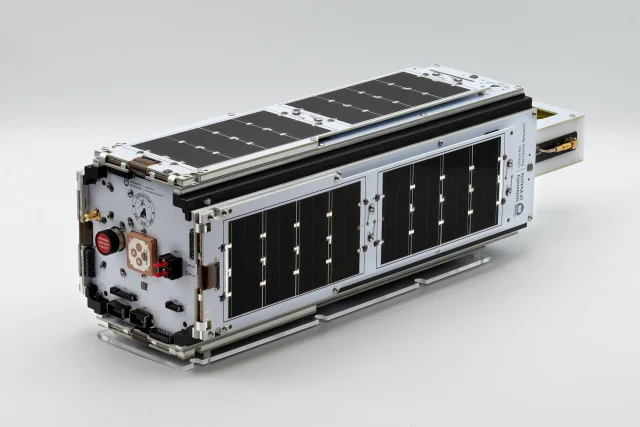
MARMOTsat: Receiving Digital Television From Space With a 10 Meter Amateur Radio Satellite
Somewhere hundreds of kilometers above Earth, a tiny spacecraft is racing around our planet at nearly eight kilometers per second. It is not part of a massive commercial satellite constellation, it does not provide broadband internet to millions of users, and it was not built by a large telecommunications company. Instead, it represents something very different: the experimental spirit that has connected amateur radio and space exploration for more than six decades. With the right antenna, a receiver, and a computer, radio enthusiasts on Earth can capture signals from these small satellites as they pass overhead, creating a direct connection between a home station and an object traveling through space.
The MARMOTsat amateur radio satellite continues this long tradition, but it adds a particularly unusual technological experiment. By combining a CubeSat platform, the 10 meter amateur radio band, software-defined radio receivers, and digital television transmission technology, it brings together several generations of communication history. It connects the world of classic HF radio operators with modern digital signal processing and satellite engineering. While most people associate satellite video transmission with large dishes and professional equipment, experiments like this demonstrate that space communication can still be explored by individuals, students, engineers, and hobbyists.
For many radio amateurs, the most exciting part is not simply receiving a signal. It is understanding the complete journey behind that signal. A digital video stream may begin inside a small satellite computer, pass through encoding and modulation stages, travel hundreds of kilometers through space as a weak radio signal, and finally arrive at an antenna connected to a software-defined radio receiver. Within seconds, software can transform invisible electromagnetic waves back into information. This process combines physics, electronics, computer science, and space technology in a way few other hobbies can offer.
Amateur radio satellites: when experimenters reached space
The relationship between amateur radio and satellites began almost as soon as humanity entered the space age. In the late 1950s and early 1960s, space technology was dominated by governments, military organizations, and national research programs. Satellites were symbols of technological power, built by large teams with enormous resources. At that time, the idea that a group of radio enthusiasts could design and operate their own spacecraft seemed almost unrealistic.
That changed in 1961 with the launch of OSCAR 1, the first amateur radio satellite. Compared with modern spacecraft, OSCAR 1 was extremely simple. It carried no cameras, no advanced computers, and no complex scientific instruments. Its main function was to transmit a small beacon signal that could be received by amateur radio operators around the world. Technically, it was a modest mission, but historically it proved something much larger: space communication was not limited only to governments and major institutions.
The success of OSCAR 1 started a movement that continued for decades. Later amateur satellites became increasingly sophisticated, following the same technological evolution seen in the wider communication industry. Basic beacon transmitters developed into voice repeaters, allowing operators separated by thousands of kilometers to communicate through a spacecraft passing overhead. Digital systems introduced telemetry, packet radio, data communication, and experimental transmission methods. Each new generation became a small laboratory in orbit where engineers could test ideas under real conditions.
Unlike commercial satellites, amateur satellites were never created to provide a large-scale service. Their purpose has always been experimentation and education. A small spacecraft orbiting Earth provides challenges that cannot be fully simulated in a classroom or laboratory. Limited power, changing temperatures, radiation, antenna restrictions, and orbital movement all create real engineering problems. Solving these problems is exactly what makes amateur satellite projects valuable.
From traditional satellites to the CubeSat revolution
For decades, building a satellite was an enormous undertaking. Traditional communication satellites often weighed hundreds or thousands of kilograms and required years of development. They were designed with powerful transmitters, large antennas, complex control systems, and significant budgets. Access to space was limited to organizations capable of supporting projects at that scale.
The CubeSat concept changed this completely. Instead of treating every spacecraft as a unique custom project, engineers introduced a small standardized satellite platform that dramatically lowered the barrier to entry. Universities, research teams, and smaller organizations suddenly had a realistic way to send experiments into orbit. A CubeSat may be tiny compared with a traditional satellite, but inside it still contains many of the same fundamental systems: power generation, batteries, computers, communication hardware, antennas, and mission software.
The challenge is fitting all of this technology into an extremely limited space. A CubeSat engineer cannot simply install a larger battery, increase transmitter power, or attach a large antenna whenever a problem appears. Every component affects weight, energy consumption, and reliability. This forces engineers to create efficient solutions, and communication experiments such as MARMOTsat demonstrate how much can be achieved with careful design.
MARMOTsat is interesting because it does not only follow established satellite communication methods. Instead, it explores a less common combination by bringing the 10 meter amateur radio band into a modern CubeSat environment. This connects one of the oldest areas of radio communication with one of the newest forms of small satellite engineering.
Why a 10 meter satellite signal is different
Most amateur radio satellites operate on VHF and UHF frequencies because these bands offer practical advantages. The antennas are small enough to fit on compact spacecraft, the equipment is widely available, and the frequencies provide reliable performance for low Earth orbit communication. A satellite operating around 145 MHz or 435 MHz fits naturally into the design limitations of a CubeSat.
The 10 meter amateur band around 28–29 MHz belongs to a completely different part of the radio spectrum. It is located at the upper edge of HF communication, a region traditionally associated with worldwide radio contacts, solar cycles, and changing propagation conditions. Many amateur operators know 10 meters as a band that can appear almost silent one day and suddenly allow communication across continents the next when solar conditions improve.
Using this frequency range from a satellite creates a fascinating combination of HF characteristics and orbital communication. A 29 MHz satellite signal behaves differently from typical UHF satellite links. The lower frequency reduces free-space path loss, which can be useful when working with the extremely limited transmitter power available on a small spacecraft. Another advantage is the reduced Doppler effect. Because a low Earth orbit satellite moves so quickly, its received frequency constantly shifts during a pass. At UHF frequencies this correction can be significant, while at 29 MHz the change is much smaller and easier to manage.
However, the advantages come with engineering challenges. A 10 meter wavelength naturally requires larger antennas, and creating an efficient antenna system for a tiny CubeSat is not simple. The frequency range is also more influenced by solar activity, ionospheric effects, and electrical noise generated on Earth. These difficulties are part of what makes the experiment scientifically interesting: it tests what is possible when traditional radio concepts are combined with modern miniature spacecraft technology.
From simple satellite signals to digital television from orbit
The first amateur satellites were designed around a very simple goal: send a signal back to Earth and prove that the spacecraft was alive. In the early years of satellite communication, even a weak beacon received from orbit was an impressive achievement. Radio operators would carefully tune their receivers, search through the noise, and wait for a signal that had traveled hundreds or thousands of kilometers from a small object moving through space. That moment created a direct connection between an individual operator and a spacecraft — something that remains one of the most unique experiences in amateur radio.
As electronics improved, satellites became capable of carrying more advanced communication systems. The same transformation that happened in everyday technology also happened in orbit. Simple signals evolved into voice communication, then into digital data transmission, telemetry systems, and more complex experimental modes. Modern amateur satellites are no longer only repeating voice signals between operators. They can collect information, process data, and transmit sophisticated digital signals back to Earth.
Digital video transmission is one of the most interesting steps in this evolution. Sending pictures through amateur radio is not a new concept. Amateur Television, usually called ATV, has existed for decades and allowed operators to transmit moving images long before internet video streaming became common. Early systems were analog and worked in a way similar to traditional television broadcasting. A camera generated a video signal, a transmitter converted it into radio waves, and a receiver reconstructed the image.
Analog television had a certain simplicity, but it also had limitations. Weak signals gradually produced more noise, distortion, and image problems. Anyone who remembers old analog television broadcasts has seen this effect: the picture became snowy, unstable, or full of interference as reception conditions became worse. Digital Amateur Television, known as DATV, completely changed this process by treating video not as a changing electrical waveform, but as information.
Once video becomes digital data, everything changes. The image can be compressed, protected against errors, transmitted efficiently, and reconstructed by software. Instead of trying to preserve the original signal exactly, a digital system focuses on delivering enough correct information to rebuild the content at the receiver. This approach is the foundation of almost every modern communication technology, from streaming video services to satellite television.
How DVB-S technology entered amateur radio
DVB-S, short for Digital Video Broadcasting – Satellite, was originally created for a very different purpose. It was designed to deliver television channels from large commercial satellites to millions of homes around the world. For decades, a satellite dish on a rooftop receiving DVB-S signals was one of the most common ways people accessed digital television.
The technology behind those systems proved extremely useful beyond commercial broadcasting. Radio amateurs quickly realized that the same principles could be adapted for experimental communication. A system originally designed for large satellites could also become a powerful tool for sending digital video between amateur stations — and eventually from small spacecraft.
The scale is dramatically different, but the basic idea remains the same. A commercial satellite television system may use a large spacecraft with powerful transmitters and carefully designed antennas. A CubeSat has only a tiny fraction of those resources. It must achieve communication using limited power, compact antennas, and hardware small enough to fit inside a miniature spacecraft.
This is where the efficiency of digital technology becomes important. A raw video stream contains an enormous amount of information. Sending every pixel of every frame directly would require far too much bandwidth and transmitter power. Before transmission, the video must be compressed using advanced algorithms that remove unnecessary information while keeping the image understandable.
Modern video compression works by recognizing that most video contains repeated information. A background may remain almost unchanged between frames. Objects may move only slightly. Instead of transmitting everything again and again, compression systems describe the changes. This dramatically reduces the amount of data required and makes digital video communication possible even through limited radio links.
After compression, the data must survive the journey through space. A satellite signal becomes weaker as it spreads across distance. Noise, interference, antenna movement, and changing signal strength can all introduce errors. Unlike a cable connection, a radio link from a moving spacecraft is never perfect.
DVB systems solve this problem with forward error correction. Extra information is added to the transmission so the receiver can detect and repair many errors automatically. The receiver does not need to ask the satellite to send the information again. It uses mathematics to reconstruct missing or damaged parts of the data stream.
This capability is especially valuable for satellite communication. A CubeSat passing overhead may only be visible for several minutes. There is no time for constant retransmission. The system must make the best possible use of every second of contact.
DVB-S2 and the evolution of efficient digital communication
The original DVB-S standard was already a major improvement over analog television, but communication technology continued to develop. DVB-S2 introduced more advanced methods that improved both reliability and efficiency, making it particularly interesting for experimental radio applications.
At the heart of every digital radio system is modulation — the process of turning information into a radio wave that can travel through space. DVB-S commonly uses QPSK modulation, which provides a good balance between efficiency and resistance to noise. DVB-S2 expanded these possibilities with additional modulation schemes and significantly improved error correction.
The result is that more information can fit into the same amount of radio spectrum, or the same information can be transmitted more reliably when signals are weak. For commercial satellite operators this means more television channels and better quality. For amateur radio experiments, it means doing more with limited equipment.
Small satellites benefit greatly from these improvements because they operate under strict limitations. A CubeSat cannot compete with the power output of a commercial satellite. Instead, it depends on efficient communication techniques that extract as much performance as possible from every watt of available energy.
Another important concept is symbol rate. In simple terms, the symbol rate describes how quickly information changes in the transmitted signal. Higher symbol rates can carry more data but usually require more bandwidth and stronger signals. Lower symbol rates reduce data speed but can make reception easier under difficult conditions.
Amateur DATV experiments often involve finding the right balance between image quality, bandwidth, transmitter capability, and receiver performance. This balance between limitations and creativity is exactly what has always defined amateur radio experimentation.
Receiving a digital television signal from a moving spacecraft
Receiving digital video from a satellite sounds similar to watching normal satellite TV, but the experience is completely different. A household satellite television system is designed to hide all technical complexity. The satellite appears fixed in the sky, the dish does not move, and the receiver automatically handles the signal processing.
A low Earth orbit amateur satellite behaves very differently. It appears above the horizon, moves across the sky, reaches its highest point, and disappears again — often in less than fifteen minutes. During that short window, the receiving station must capture the signal while distance, angle, and signal strength constantly change.
This makes every successful reception a technical achievement. The antenna must collect enough of the weak signal. The receiver must remain stable. The software must process the digital stream correctly. Everything must work together during a very limited opportunity.
Digital signals also create a different experience compared with traditional analog radio. An analog signal gradually becomes worse as conditions decline. A weak voice signal may become noisy but still understandable. A digital video transmission can remain almost perfect until the receiver no longer has enough information to reconstruct the data.
Then the image can disappear suddenly.
This behavior, often called the digital cliff effect, is a defining characteristic of digital communication. It is also one reason why receiving DATV from a small satellite is so interesting. The operator is not only detecting a signal; they are successfully completing an entire chain of digital communication from space to screen.
How software-defined radio changed satellite reception
For many decades, experimenting with unusual radio signals required specialized equipment. A receiver was usually designed around a specific purpose, and its capabilities were mostly determined by the electronic circuits inside. If a radio was built for voice communication, receiving a completely different type of digital signal often required additional hardware or an entirely different device.
Software-defined radio changed this relationship between hardware and communication. Instead of building a separate physical circuit for every function, an SDR receiver captures radio signals and converts them into digital information. After that conversion, much of the work happens inside a computer. Filtering, demodulation, decoding, and analysis can be controlled by software instead of fixed electronic components.
This approach completely transformed amateur satellite reception. A single SDR receiver can explore many different parts of the radio spectrum and many different communication modes. The same small device might receive traditional HF signals, aircraft transmissions, weather satellite images, telemetry from spacecraft, and experimental digital modes developed by the amateur radio community.
For projects like MARMOTsat, this flexibility is especially important. Experimental satellites often use communication methods that are different from everyday radio operation. In the past, receiving a new type of signal could require building dedicated equipment. Today, software developers and radio enthusiasts can adapt existing SDR platforms, create new decoding tools, and analyze signals in ways that were impossible with older hardware.
The visual nature of SDR software also changed how people interact with radio. Traditional operators searched for signals mainly by listening. Modern SDR users can actually see the radio spectrum. A waterfall display shows signals appearing and disappearing over time, making invisible electromagnetic activity visible on a computer screen. When tracking a satellite, this creates a completely different experience: the operator can watch a signal emerge from the noise as the spacecraft rises above the horizon.
Building a ground station for modern amateur satellites
A satellite ground station may sound like something that requires a large antenna facility, but amateur radio has always challenged that assumption. Many satellites are intentionally designed so that ordinary operators can receive their signals using realistic equipment. The goal is not only communication but participation.
The antenna remains the most important part of any receiving system. No amount of software processing can recover a signal that never reaches the receiver. For traditional VHF and UHF amateur satellites, many operators use directional antennas that follow the spacecraft across the sky. Some systems are manually aimed, while more advanced stations use computer-controlled rotators.
A 10 meter satellite signal creates a different situation. Many amateur radio operators already have antennas capable of receiving around 29 MHz because the band has been used for decades for HF communication. Vertical antennas, dipoles, and other common 10 meter designs may become part of experiments with signals in this range.
The receiver side has become much more accessible thanks to SDR technology. Depending on the signal requirements, enthusiasts use everything from affordable USB receivers to advanced wideband SDR systems. The important factor is not only frequency coverage but also bandwidth, stability, and the ability to process the required digital signal.
The computer has become an essential part of the modern radio station. It can calculate satellite passes, predict where the spacecraft will appear, compensate for frequency changes, display the received spectrum, record signals, and run decoding software. The combination of radio hardware and computing power creates capabilities that would have required professional equipment only a few decades ago.
Receiving a digital television signal adds another layer of complexity. The system does not stop at detecting a carrier or hearing an audio signal. The received waveform must be demodulated, error correction must be applied, and the original video stream must be reconstructed. It is a complete communication chain where every step matters.
Tracking a satellite moving faster than a bullet
One of the most fascinating parts of low Earth orbit satellite communication is that the target is constantly moving. A geostationary television satellite appears fixed because it orbits at the same rate Earth rotates. A dish can point at the same position for years without adjustment.
A CubeSat in low Earth orbit is completely different. It circles the planet roughly every 90 minutes and only becomes visible to a specific ground station for a short time. A successful contact depends on knowing exactly when and where the satellite will appear.
Satellite tracking software uses orbital data to predict these passes. Before the satellite rises above the horizon, the operator already knows its path across the sky, maximum elevation, distance, and expected signal behavior.
During a pass, everything changes quickly. At first, the spacecraft is far away and low on the horizon. As it approaches, the signal becomes stronger. Near the highest point of the pass, conditions are usually best. Then the satellite moves away again until the signal disappears.
This short communication window creates a very different experience from normal radio operation. There is limited time, changing conditions, and a clear sense that the signal is coming from a moving object in space rather than a fixed transmitter on Earth.
Amateur satellites in the age of Starlink
Modern satellite technology is advancing faster than at any point in history. Large constellations containing thousands of spacecraft now provide internet access, global communication, Earth observation, and navigation services. Systems like Starlink represent an incredible engineering achievement, using mass-produced satellites, advanced antennas, and automated networks operating on a global scale.
At first glance, a small amateur CubeSat may seem insignificant compared with these enormous systems. It cannot deliver high-speed internet. It cannot compete with commercial infrastructure. It was never designed to.
Its purpose is completely different.
Commercial satellites are optimized products. They are built to deliver reliable services. Amateur satellites are experiments. They exist to test ideas, teach engineering principles, and allow people outside major organizations to participate in space technology.
This difference is important. Many technologies begin as experiments before becoming practical applications. A small satellite project gives students and engineers experience with real problems that exist in all spacecraft: limited energy, thermal control, communication reliability, software stability, and system design.
The lessons learned from a tiny CubeSat are often connected to the same principles used in much larger missions.
Why experiments like MARMOTsat still matter
Technology often advances because people test ideas without knowing exactly where they will lead. Amateur radio has always existed in this space between hobby and engineering research. Operators experiment, modify equipment, discover unexpected results, and sometimes create solutions that influence professional systems.
MARMOTsat represents this tradition in a modern form. It combines radio concepts from different generations: HF communication, satellite engineering, digital television, software-defined radio, and advanced signal processing.
A signal transmitted from a tiny spacecraft using amateur radio frequencies is more than just a technical demonstration. It shows how accessible advanced technology has become. The same concepts that once required national research programs can now be explored by universities, small engineering teams, and individual enthusiasts.
Receiving digital information from space is still a remarkable achievement. The radio wave leaving a CubeSat travels through hundreds of kilometers of empty space, reaches an antenna on Earth, enters a receiver, becomes digital information, and finally appears as something humans can understand.
That process combines more than a century of radio development with the newest generation of space technology.
MARMOTsat is not important because it replaces modern communication systems. It is important because it continues the original spirit of experimentation that created many of them.
More than sixty years after the first amateur satellite entered orbit, radio enthusiasts are still finding new ways to communicate with space.
Image(s) used in this article are either AI-generated or sourced from royalty-free platforms like Pixabay or Pexels.
This article may contain affiliate links. If you purchase through these links, we may earn a commission at no extra cost to you.
Get the weekly RF & IT briefing
Radio guides, RF calculators, AI, Windows, Linux and satellite communication explainers. One useful email per week. No spam.


