The Smartest Ball on the Pitch: How Sensor-Packed Footballs Are Changing FIFA Matches
For more than a century, the football at the center of the world’s biggest matches seemed like the last simple object in an increasingly complicated sport. Stadiums grew into broadcast fortresses, referees gained microphones and video rooms, coaches studied heat maps, and players wore GPS vests under shirts that once carried nothing more than sweat and mud. Yet the ball itself remained almost mythically pure: a stitched or bonded sphere, kicked by instinct, chased by crowds, and argued over by generations. In the public imagination, it was still just leather, air, geometry, and luck. Then, at the FIFA World Cup, the ball quietly became something else. Inside the official match ball, hidden from the cameras and invisible to the players, a sensor began measuring movement hundreds of times per second, turning every touch, deflection, acceleration, and impact into data.
That transformation is more than a clever engineering trick. A sensor-filled FIFA match ball changes the relationship between sport and evidence. It gives referees a new instrument for moments that used to depend on eyesight, timing, and television angles. It helps semi-automated offside systems identify the exact instant a teammate played the ball. It can distinguish a clean cross from a microscopic touch, a headed goal from a shoulder graze, and a dramatic celebration from a decision that will be reviewed in a windowless video operation room. FIFA describes connected ball technology as a system that captures acceleration and fine three-dimensional movements 500 times per second, sending real-time data into the officiating workflow. The same idea returned for the adidas TRIONDA, the official match ball of the FIFA World Cup 2026, with FIFA saying its 500Hz motion sensor chip provides precise ball-movement data to the VAR system.
This is why the modern FIFA match ball is no longer just sporting equipment. It is a connected device operating inside one of the most emotionally charged environments on earth. It must survive elite players striking it at high speed, water, heat, cold, spin, pressure, collisions, ball boys, goal nets, corner flags, and the paranoia of millions of viewers who believe every call is either justice or conspiracy. It must preserve the feel of a professional football while carrying electronics, power, communication hardware, and a suspension system that keeps the sensor stable without changing the flight. It must be precise enough to help decide a World Cup knockout match, yet unobtrusive enough that players forget it exists. That tension—between invisibility and authority—is what makes the sensor-packed FIFA football one of the most fascinating technologies in modern sport.
From Leather Sphere to Data Source
The football has always been a technology story, even when it looked like nostalgia. Early balls were irregular, heavy, water-absorbing objects whose behavior changed dramatically with rain and wear. The move from leather panels to synthetic materials, from hand-stitching to thermal bonding, from inflated bladders to carefully engineered surface textures, gradually turned the match ball into a precision product. Every World Cup ball carried a design philosophy. Some were celebrated for consistency; others became notorious for unpredictability. The 2010 adidas Jabulani, with its famously lively flight, became a cultural symbol of how even small aerodynamic differences could become tournament-defining. Later balls such as Brazuca, Telstar 18, Al Rihla, and TRIONDA reflected a different design ambition: not only to look iconic on television, but to behave predictably under the feet of the best players in the world.
The engineering challenge was never simply to make a round object. A football is a compromise between softness and responsiveness, between stable flight and creative movement, between the needs of goalkeepers, strikers, broadcasters, sponsors, and governing bodies. Panel geometry affects how air separates from the surface. Grooves and textures influence drag, lift, swerve, and knuckleball effects. Bonded seams change water absorption and weight consistency. Even the printed surface matters because elite players are sensitive to touch, grip, and visual rotation. Research on World Cup ball aerodynamics has shown that surface texture and construction can significantly alter trajectories, which helps explain why each new tournament ball is tested obsessively before it appears in a competitive match.
The connected football represents the next logical step in that evolution. Once the ball became stable enough to be engineered with microscopic attention, it became possible to ask a more ambitious question: could it also report what was happening to it? The answer required a philosophical shift. A traditional ball is passive. It waits to be struck and then obeys physics. A connected ball is active in the information ecosystem of a match. It does not decide anything by itself, but it produces evidence that other systems can interpret. In FIFA’s use case, that evidence is especially valuable because football’s most controversial decisions often depend on two things that are very hard for human beings to perceive perfectly at live speed: where bodies are at a precise instant, and exactly when the ball was played.
That second problem sounds simple until one watches an offside replay frame by frame. A player’s foot meets the ball over a fraction of a second, not a single clean moment visible to everyone from every angle. Broadcast cameras run at finite frame rates. The ball may be partly hidden. A defender may step forward at the same time an attacker leans in the opposite direction. The assistant referee has to watch the passer and the defensive line simultaneously. VAR can help, but traditional video review still depends on selecting a frame that represents the “kick point.” A one-frame difference can turn a legal run into an offside offense. The connected ball was built to reduce that uncertainty by providing a highly precise signal of contact and movement.
FIFA’s semi-automated offside technology combines this ball data with stadium camera tracking. For the 2022 World Cup system, FIFA explained that 12 dedicated tracking cameras mounted beneath the stadium roof tracked the ball and up to 29 data points on each player 50 times per second, including limbs and extremities relevant to offside decisions. The combination of limb tracking, ball tracking, and artificial intelligence then helped alert video match officials when an attacker received the ball in an offside position, while officials still validated the proposed decision. The connected ball does not replace the referee. It narrows the space in which the referee and VAR team must make a judgment.
The Hidden Sensor Inside the FIFA Ball
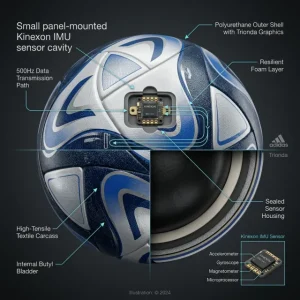
The most remarkable thing about the FIFA connected match ball is that it must disappear. Players cannot feel a hard lump inside it. Goalkeepers cannot complain that it wobbles because electronics are off-center. Broadcasters cannot pause a match because a battery door has popped open. The ball must pass all the old tests of weight, circumference, rebound, water absorption, pressure retention, and durability, while secretly behaving like a sensor platform. That is why the key invention is not merely the chip. It is the way the chip is suspended.
When adidas introduced Al Rihla as the first FIFA World Cup official match ball featuring connected ball technology, the company said its suspension system allowed a motion sensor to sit inside the ball and track every touch at 500 times per second. The raw data was designed to support fast and accurate offside decisions by giving the VAR team precise real-time ball data. KINEXON, the sports technology company associated with the ball-tracking system, describes the ball sensor as being incorporated through a suspension system developed and patented by adidas, with connected ball technology serving officiating, performance analysis, and fan engagement use cases.
At the heart of the system is an inertial measurement unit, often shortened to IMU. In everyday life, IMUs are found in smartphones, drones, cars, watches, and game controllers. They typically combine accelerometers and gyroscopes to measure acceleration, rotation, and orientation. In a football, that means the sensor can detect sudden changes caused by a kick, header, touch, bounce, or deflection. It is not “watching” the pitch like a camera. It is feeling the ball’s motion from within. When the ball is struck, the acceleration pattern changes sharply. When it spins, the gyroscope data reflects that rotation. When it is nudged almost imperceptibly, the signal may still show a small but meaningful event.
The 500Hz figure matters because football is fast. A sensor sampling 500 times per second records one measurement every two milliseconds. That is a very different kind of timing from conventional broadcast footage. A player’s foot can compress the ball, roll across it, and release it in less time than a viewer takes to blink. A glancing touch may not look obvious on a replay, but it can create a distinct acceleration signature. This is why connected ball technology has been compared informally to cricket’s “Snicko,” though the underlying implementation is different: cricket’s familiar broadcast tool historically relies on sound and visual timing, while the football system uses internal motion data from the ball. The similarity is cultural rather than technical. Both systems make tiny contacts visible to audiences who otherwise might never believe they happened.
Power is another engineering problem hidden inside the spectacle. A connected match ball must be active throughout warmups, halves, stoppage time, extra time, penalties, and repeated ball changes. It must transmit data reliably in a stadium full of wireless noise, broadcast equipment, phones, security systems, and tracking infrastructure. Reports on the 2022 implementation noted that the sensor used an induction-rechargeable battery, while the connected match-ball version was not simply the same product sold to fans in retail stores. That distinction is important. The ball a fan buys may look like the World Cup ball and may share construction principles, but the actual connected match ball is part of a controlled officiating system. It is not just a souvenir with a chip.
The suspension system also has to solve a subtle physics problem. If the sensor package were attached to the inner wall, it could affect balance or create stress points. If it floated freely, it could rattle, shift, or lag behind the ball’s motion. The answer is to keep the sensor near the center, isolated from the most violent deformation of the outer shell but coupled closely enough to measure what the ball is doing. That requires materials and geometry able to withstand repeated impacts while preserving symmetry. In a laboratory, one can instrument almost anything. In a World Cup match, instrumentation must be invisible, durable, and trusted by people who have spent their lives noticing the smallest imperfection in a ball’s feel.
Why FIFA Needed the Ball to Speak
Football resisted technology for decades because its culture valued flow, human judgment, and the universality of a game that could be played almost anywhere. That resistance was not irrational. A football match has a rhythm unlike American football, cricket, or tennis. There are no natural pauses after every play. The ball stays alive, emotions accumulate, and the crowd reads the game as a continuous drama. Every interruption threatens to cool the atmosphere. At the same time, the stakes of elite football became too high for obvious errors to remain acceptable. World Cups, Champions League finals, continental tournaments, and domestic title races are global media events worth enormous sums of money. A mistaken goal, missed offside, or wrongly awarded penalty can reshape careers and national memories.
Goal-line technology was the first major compromise. It addressed a binary question: did the whole ball cross the whole line? Compared with offside, that problem is beautifully simple. The ball either crossed or it did not. Camera-based systems could deliver an answer quickly and privately to the referee’s watch. VAR was more ambitious and more controversial. It expanded review into goals, penalties, red cards, and mistaken identity, but it also introduced delays, subjective interpretation, and the now-familiar image of referees drawing lines on frozen screens while fans waited in confusion. Semi-automated offside technology emerged as an attempt to keep the benefits of video review while reducing the slowest and most disputed parts of the process.
The offside law is uniquely suited to technological assistance because it is geometric but not purely mechanical. The key factual questions are measurable: the positions of attackers, defenders, and the ball at the moment the ball is played. Yet the law still requires interpretation about involvement in active play, deliberate actions by defenders, and whether an offside-positioned player interferes with an opponent. Technology can assist with position and timing, but it cannot turn football into a spreadsheet. FIFA’s system reflects that compromise. The cameras produce skeletal tracking. The connected ball helps identify the kick point. Algorithms generate an alert. Human officials check the data and make the final decision. The result is “semi-automated,” not fully automated, because the game has not surrendered its laws to machines.
The ball is especially valuable because the kick point is the hinge of the entire offside decision. Imagine an attacker sprinting behind a defensive line while a midfielder shapes to pass. At 50 camera frames per second, each frame is separated by 20 milliseconds. That sounds precise until one considers how far elite players move in that time. A sprinter at high speed can cover several centimeters between frames, enough to matter in marginal offside calls. The ball sensor, sampling motion at 500Hz, offers a finer temporal signal. It does not replace the camera view of limbs, but it helps the system choose the moment at which limb positions should be evaluated. That combination—high-frequency ball data plus multi-camera player tracking—is the core of FIFA’s modern offside stack.
There is also a psychological reason FIFA wanted the ball to speak. Fans often distrust lines drawn on television pictures because the images look imperfect. Camera angles distort perspective. Freeze frames can seem arbitrary. Limbs are hidden behind other bodies. The ball may be blurred. When a decision turns on a toenail or shoulder edge, viewers wonder whether precision has become theater. A connected ball gives officials another source of evidence, one that is not dependent on whether a camera had a perfect view of the contact. It can show that the ball was touched, when it was touched, and how its movement changed. That does not end controversy, but it changes the evidentiary conversation.
The Stadium as a Machine
The sensor-packed ball is only one piece of a much larger machine. A connected football without stadium infrastructure would be like a smartphone with no network. In FIFA’s system, the ball communicates with a surrounding environment of antennas, calibrated cameras, timing systems, software, and video officials. The stadium becomes a measurement instrument. Every camera position must be known. The pitch dimensions must be mapped. Player tracking must identify bodies and limbs even as athletes overlap, slide, jump, and collide. The ball signal must be synchronized with video frames and tracking data. The VAR team must receive outputs quickly enough to help without turning every attack into a court case.
This is where modern sports technology becomes less glamorous and more difficult. The public sees the animation: a clean 3D rendering of players, a line, a ball, a decision. Engineers see calibration, latency, packet loss, synchronization, edge cases, and failure modes. What happens if the ball is replaced? What happens if a sensor signal is interrupted? How does the system distinguish a player’s kick from the ball hitting the ground? How are timestamps aligned across different devices? How are false positives filtered without missing real touches? How does the software handle a crowded penalty area where ten players swing at the ball within a second? The brilliance of the system is not that it collects data. The brilliance is that it must collect usable data under hostile conditions.
Multi-camera tracking has its own limits. The ball is small, fast, often airborne, and frequently occluded by bodies. Academic work on football tracking repeatedly points to the difficulty of automated ball detection in real match environments, especially because the ball can disappear behind players, move quickly across wide-angle footage, or blend into visual clutter. One 2023 paper on multi-camera football detection described small-object detection in three dimensions as a frontier problem with challenges including occlusion, motion, and low-light conditions. Another study on ball trajectory inference noted that reliably tracking a small football on a wide pitch remains difficult when obstacles and occlusions occur. Connected ball data helps because it adds a source of truth from inside the object everyone is trying to track.
Still, the connected ball cannot do everything. An IMU can measure acceleration and rotation, but it does not by itself know the ball’s absolute position on the pitch in the way a camera system or radio-based tracking network might. It is excellent at detecting events and motion signatures, but it must be integrated with other systems to produce officiating decisions. That integration is why FIFA’s public explanation emphasizes the combination of limb and ball tracking data. The ball provides temporal precision. The cameras provide spatial context. The software joins them. The humans validate the result.
Latency is another quiet battlefield. In a perfect world, every decision would be instant. In a real match, data must be captured, transmitted, processed, checked, and communicated. The longer the delay, the more awkward the spectacle becomes. A team celebrates, the crowd erupts, broadcasters replay the goal, and then everyone waits. Semi-automated systems aim to shorten that interval by pre-processing the difficult geometry and alerting officials quickly. Yet speed is dangerous if it undermines trust. A fast wrong decision is worse than a slow correct one. The system must therefore balance responsiveness with verification. In technology, milliseconds matter. In sport, credibility matters even more.
The result is a strange hybrid of automation and ritual. The machine identifies a possible offside. The VAR team reviews it. The referee may receive confirmation. The stadium may see an animation. The crowd reacts. The law remains the law, but the evidence has changed. Football’s ancient argument—“Was he offside?”—is now answered partly by computer vision, partly by a suspended sensor, partly by human judgment, and partly by the willingness of fans to accept that a ball can know something they did not see.
What Players Feel—and What They Should Not
For players, the most important feature of a smart ball is that it should not feel smart. Elite footballers are tactile experts. They know how a ball sits under the boot, how it lifts from the turf, how it bends in cold air, how it skids on wet grass, and how it responds when struck with the instep, laces, sole, or outside of the foot. They may not speak in engineering terms, but they are extraordinarily sensitive measuring instruments. If a connected ball felt dead, heavy, lopsided, or strange, the technology would fail before the first VAR decision.
That is why adidas and FIFA had to preserve the traditional performance requirements while adding electronics. The official match ball still has to behave like a top-tier professional ball. TRIONDA, for example, was introduced by adidas with a new four-panel construction and design elements reflecting the three host nations of the 2026 World Cup: Canada, Mexico, and the United States. FIFA’s page on the ball highlights the continuation of connected ball technology and the use of a 500Hz motion sensor chip, while adidas emphasizes the ball’s panel construction and performance design. The electronics are part of the story, but they cannot dominate the player experience.
This creates a design tension between two audiences. The first audience is the footballer, who wants consistency, touch, and trust. The second audience is the officiating system, which wants clean signals, dependable power, and stable transmission. A heavier sensor might produce better battery life or signal strength but risk affecting balance. A more isolated sensor might protect electronics but reduce measurement fidelity. A more aggressively textured surface might improve grip but alter aerodynamics. A more robust internal structure might improve durability but change the ball’s rebound. The final product must satisfy all of these constraints while appearing effortless.
The public often imagines sports technology as something added to the game, but in this case the better description is something absorbed into the ball’s identity. The sensor is not taped on. It is not an external tracker. It is part of the official match ball’s internal architecture. That matters because football has strict equipment standards and because players need to trust that every match ball behaves consistently. In a tournament, multiple balls are used during a match so play can restart quickly. Each connected ball must be prepared, charged, tested, and integrated into the match environment. The system is therefore logistical as much as technical.
There is also an emotional dimension. Players may say they ignore the sensor, but the knowledge that the ball records tiny touches changes the psychology of borderline moments. A striker claiming a goal from a teammate’s cross may later learn that the ball data showed no contact. A defender insisting the ball never brushed him may be contradicted by the signal. A midfielder who flicks the ball unintentionally may reset an offside phase. In earlier eras, these moments lived in ambiguity. Now, at least in elite FIFA matches, some ambiguities are converted into data points.
The Broadcast Problem: Making Invisible Evidence Visible
Technology does not merely have to be correct. It has to be legible. One of VAR’s great weaknesses has always been communication. Fans in the stadium often do not know what is being checked. Television viewers see angles selected by broadcasters, not necessarily the same interface used by officials. Commentators speculate. Social media fills the silence with outrage. By the time the decision arrives, the emotional verdict may already be formed. Semi-automated offside and connected ball technology attempt to solve part of this by generating visual explanations, including 3D animations of offside situations.
The connected ball creates a particular broadcast challenge because its most important evidence is invisible. A camera replay can show a player’s foot. A line can show offside position. But how does one show an internal acceleration spike? Broadcasters and governing bodies have experimented with visualizations that turn sensor data into simplified graphics, similar in spirit to how other sports translate complex measurement into audience-friendly images. The danger is oversimplification. A clean animation may make the decision look more certain than the underlying process. A dramatic spike may convince viewers even when the legal interpretation remains complicated. The art is to make the evidence understandable without pretending football has become frictionless.
This is where the smart ball becomes a media object. It produces data not only for referees but potentially for storytelling: shot power, spin rate, pass speed, contact detection, trajectory analysis, and moments of possession. KINEXON’s own description of connected ball technology includes fan engagement and performance analysis alongside officiating. That broader potential is enormous. Imagine broadcasts that can show how a free kick’s spin changed after brushing the wall, how a goalkeeper’s punch altered the ball’s trajectory, or how a striker generated a dipping shot from a specific contact point. Some of this is already possible through optical tracking and radar-like analysis, but a sensor inside the ball adds another layer.
Yet FIFA must be careful. Fans accept technology more readily when it supports justice than when it feels like a gimmick. Shot speed graphics are fun. Offside calls are existential. If the same ball data is used both for entertainment and decisive officiating, the line between spectacle and authority must remain clear. The official system must be robust, audited, and governed. Broadcast enhancements can be playful, but refereeing evidence cannot appear theatrical. The more powerful the technology becomes, the more important transparency becomes.
The stadium experience is even harder. A viewer at home may see replays, graphics, and commentary. A fan in the upper tier sees players waiting and a referee touching an earpiece. FIFA and other competitions have gradually improved in-stadium VAR communication, but connected ball decisions can still feel alien if the evidence is not explained. The phrase “sensor detected a touch” may be technically true, but emotionally insufficient. Football crowds do not want to be lectured by machines. They want to understand why the goal they just celebrated no longer exists.
Advantages, Limits, and the New Controversies
The strongest argument for sensor-packed FIFA balls is fairness. Human perception is limited, and football’s most important matches deserve the best available evidence. A connected ball can help identify the kick point more precisely than video alone. It can support semi-automated offside decisions. It can detect subtle touches that might change possession, offside phases, or goal attribution. It can reduce the time spent manually searching for the correct frame. In a sport where one goal often decides everything, better evidence matters.
The second argument is consistency. Traditional officiating varies with angle, referee positioning, assistant referee timing, and broadcast footage. A standardized system installed across tournament stadiums offers a more uniform basis for decisions. The same sensor specification, camera architecture, and VAR workflow can be applied match after match. That does not eliminate human judgment, but it reduces certain kinds of randomness. For FIFA, which must oversee matches involving teams from radically different football cultures, consistency is politically and competitively valuable.
The third argument is historical accountability. Football has a long memory for injustice. Phantom goals, missed handballs, wrongly disallowed winners, and offside mistakes are replayed for decades. Technology does not prevent controversy, but it can prevent some obvious errors from becoming folklore. The connected ball is part of a broader effort to make elite matches less vulnerable to the limits of human eyesight. It is not romantic, but neither is losing a World Cup because an official could not see what millions later saw in slow motion.
The criticisms are equally serious. The first is that precision can become tyranny. Football’s laws were written for a flowing human game, not for nanoscopic forensic review. When offside is decided by a shoulder leaning a few centimeters ahead or a barely detectable touch that resets a phase of play, some fans feel the spirit of the law has been swallowed by instrumentation. The technology may be correct and still feel unsatisfying. That is not an engineering failure. It is a governance problem. The laws may need to evolve if measurement becomes far more precise than the original spirit of enforcement.
The second criticism is opacity. Fans are asked to trust a system they cannot inspect. Where exactly is the sensor? How is it calibrated? What threshold distinguishes contact from noise? How are errors handled? Who owns the raw data? How often does the system fail? FIFA and technology partners provide public explanations, but the full technical and operational details are not experienced by the audience in real time. Trust therefore depends on institutional credibility as much as measurement accuracy. In football, that is always a fragile foundation.
The third criticism concerns inequality. Connected ball technology and semi-automated offside systems require expensive infrastructure. They are realistic for FIFA World Cups, major continental tournaments, and wealthy leagues, but not for most football competitions. This creates a widening gap between elite football and the game as played elsewhere. The laws may be the same, but enforcement quality differs radically. A Sunday league match, a lower-division game, and a World Cup semifinal now inhabit different technological realities. Football has always contained inequality, but officiating technology makes it more visible.
The fourth criticism is mission creep. Once the ball becomes a sensor, the temptation grows to use its data everywhere: tactical analysis, commercial graphics, player scouting, betting markets, training platforms, and fan products. Some of these uses are exciting. Others raise questions about data ownership and competitive advantage. If ball data can reveal tactical patterns, who gets access? FIFA? Teams? Broadcasters? Technology providers? Sponsors? The connected football is not personal biometric data, but it is still valuable match data produced by players in competition. As sports become data industries, even the ball becomes part of a larger economy.
Why the Smart Ball Matters Beyond Offside
Although officiating is the public face of connected ball technology, its deeper significance lies in how it changes football’s data layer. Modern elite clubs already track players intensely. GPS vests, optical tracking, event data providers, video analysis, and wearable systems have transformed scouting, training, and tactical preparation. Yet ball data has historically been harder to capture with the same continuity and precision. The ball moves faster than players, disappears behind bodies, and changes possession constantly. Manual event data—passes, shots, tackles, carries—has been valuable but limited because humans or semi-automated systems must annotate what happened.
A connected ball offers the possibility of richer event detection. It can help identify touches, kicks, impacts, bounces, and changes in motion. Combined with player tracking, it could improve automatic recognition of passes, deflections, interceptions, shot contacts, and set-piece routines. Academic work on automatic event detection in football has explored how tracking data can be used to infer possession and identify match events, highlighting the value of more granular data for analysis. A ball that contributes its own motion signal could make those systems more accurate, especially in crowded or ambiguous moments.
For coaches, the most useful future may not be a dramatic sensor graphic but a quieter improvement in training feedback. A connected ball can measure strike characteristics, spin, timing, and motion patterns. In controlled environments, that could help players refine free kicks, long passes, finishing technique, goalkeeper distribution, and set pieces. Youth academies could use ball data to study development. Medical and performance teams could examine how fatigue changes striking mechanics. Analysts could compare not only where a pass went but how it was struck. The match ball would become a bridge between biomechanics and tactics.
For broadcasters, the possibilities are more visible. A free kick could be explained through spin rate and launch angle. A long diagonal pass could be shown as a combination of velocity, curve, and drop. A goalkeeper save could be analyzed by the ball’s speed before and after contact. A penalty could be broken down by strike force and direction. These details would not replace storytelling; they would enrich it. Football has always been a game of feeling, but good data can deepen feeling when used carefully. The best sports graphics do not make viewers think less. They help viewers notice what experts already see.
For fans, however, the future will depend on restraint. Football is not baseball, where statistics fit naturally into pauses, nor Formula 1, where telemetry is part of the spectacle. Too much data during live football can feel intrusive. The game’s beauty lies partly in its continuity and ambiguity. A sensor-packed ball should illuminate the decisive moments, not smother every pass in numbers. The smartest use of smart-ball data may be selective: decisive officiating support, occasional broadcast insight, deeper post-match analysis, and specialized training applications.
The Future Ball: Smarter, Quieter, More Powerful
The next generation of connected footballs will likely become more capable and less noticeable. Sensors will shrink. Batteries will improve. Wireless systems will become more robust. Synchronization with stadium tracking will get faster. Machine learning models will become better at distinguishing contact types, filtering noise, and combining ball motion with player behavior. Eventually, the ball may contribute to a near-complete live model of the match: not just where players are, but what the ball is doing physically at every instant.
The biggest technical advances may come from sensor fusion. An IMU alone is powerful but limited. Cameras alone are powerful but limited. Radio-frequency tracking, ultra-wideband systems, computer vision, inertial data, and machine learning each see different aspects of the game. The future will belong to systems that combine them gracefully. The ball’s internal data could help cameras recover tracking after occlusion. Camera data could help interpret the ball’s absolute position. Player skeletal data could help classify whether contact came from a foot, head, arm, or torso. The more sources agree, the more reliable the decision.
There may also be a future in which smart balls are used outside FIFA’s most elite stages. Costs will fall, and scaled-down systems could appear in professional leagues, academies, and training facilities. But full tournament-grade connected ball officiating will remain demanding because the ball is only one part of the system. Without calibrated cameras, communication infrastructure, trained officials, and governance, the sensor is just a source of raw motion data. The dream of a cheap smart ball that can automatically referee any match is seductive but unrealistic in the near term.
The legal and regulatory future may be just as important as the technical one. Football’s lawmakers will have to decide how precise they want the game to become. If technology can detect every tiny touch, should every tiny touch matter? If offside can be measured to a few centimeters, should the law maintain its current threshold? If a sensor shows contact that no player, referee, or spectator perceived, is that always the truth the sport wants? These are not questions engineers can answer alone. They belong to FIFA, IFAB, players, coaches, referees, broadcasters, and fans.
The most likely future is not a fully automated referee but a more instrumented human referee. The referee will remain the visible authority because football needs a human figure to manage emotion, advantage, dissent, context, and the flow of play. But behind that authority will sit more data than ever before. The ball will report motion. Cameras will report bodies. Software will report patterns. VAR officials will report checks. The referee will make decisions inside a web of evidence. Whether that feels like progress or surveillance will depend on how well the system respects the game.
The Ball That Changed the Argument
The sensor-packed FIFA football is easy to misunderstand because it looks ordinary. From the stands, it is still a bright sphere rolling across grass. On television, it is still the object around which 22 players arrange their hopes. Children will still copy the shots they see. Goalkeepers will still blame swerve. Strikers will still kiss the ball before penalties. Yet inside that familiar shape is a new kind of witness. It does not cheer, forget, panic, blink, or choose sides. It measures.
That does not make it infallible, and it certainly does not make football simple. In some ways, it makes the game more complicated because it exposes details that the old game allowed to remain unresolved. The connected ball can reveal a touch too small for the crowd to see. It can help select a kick point that changes an offside decision. It can support a system that turns the chaos of a penalty area into coordinates and timestamps. But football is not only a matter of coordinates and timestamps. It is also rhythm, interpretation, tolerance, and shared belief. Technology can strengthen that belief when it corrects injustice. It can weaken it when it feels like the game has been taken away from human eyes.
The future of FIFA match balls will therefore not be decided only in laboratories. It will be decided in the emotional courtroom of live sport: in the silence before a VAR announcement, in the roar after a goal is confirmed, in the anger after one is erased, and in the slow cultural process by which fans decide what kinds of truth they are willing to accept. The smart football has already crossed the line from experiment to official instrument. It is now part of the World Cup’s architecture, as essential to the modern tournament as camera gantries, goal-line systems, and the video operation room.
The old football carried stories because people projected meaning onto it. The new football carries stories and data. That combination may define the next era of the sport. A ball filled with sensors will not make football less human by itself. It will make human arguments more precise, more visible, and sometimes more uncomfortable. In a game built on inches, timing, and memory, the ball has finally been given a voice. The question now is not whether FIFA can hear it. The question is how much of what it says football truly wants to know.
Image(s) used in this article are either AI-generated or sourced from royalty-free platforms like Pixabay or Pexels.
This article may contain affiliate links. If you purchase through these links, we may earn a commission at no extra cost to you.
Get the weekly RF & IT briefing
Radio guides, RF calculators, AI, Windows, Linux and satellite communication explainers. One useful email per week. No spam.