Elon Musk’s first AI data center in space could be huge — and it may use replaceable AI hardware
Elon Musk and SpaceX have spent years turning rockets, satellites and orbital infrastructure into practical business tools. Reusable Falcon rockets changed the economics of launch. Starlink turned low Earth orbit into a commercial broadband network. Now, the next step in that strategy may be even more ambitious: putting artificial intelligence data centers into space.
The concept sounds like science fiction at first. Instead of building another massive AI facility on Earth, SpaceX would place large computing satellites in orbit. These platforms would generate power from enormous solar arrays, run AI hardware in space, radiate waste heat into the vacuum and communicate with Earth through high-speed optical or radio links.
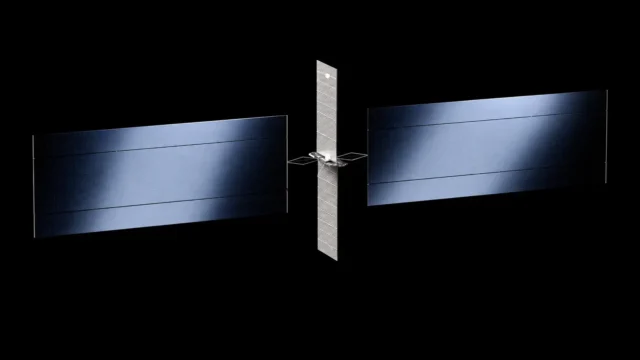
According to the latest reported details, the first major platform in this direction could be the SpaceX AI1 satellite, a large orbital compute system designed around roughly 150 kW of peak computing power. With its solar wings deployed, the spacecraft could reach a span of around 70 meters, making it wider than the wingspan of a Boeing 747. That single figure shows why this is not a normal communications satellite. It is closer to a flying AI infrastructure node.
The most interesting part is not only its size. The AI1 concept is reportedly being designed with replaceable AI hardware. In other words, SpaceX does not want to launch one fixed computing payload and leave it technologically frozen for years. The company appears to be thinking about orbital data centers as modular platforms that can be upgraded as AI accelerators improve.
That matters because AI hardware becomes obsolete quickly. A GPU, ASIC or accelerator that looks powerful today may be inefficient within three or four years. If space-based AI infrastructure is to become economically serious, it cannot behave like a traditional satellite that keeps the same electronics for its entire mission life. It needs a path toward hardware refreshes, standardization and potentially in-orbit servicing.
Why would anyone put an AI data center in space?
At first glance, space looks like a terrible place for a data center. Launch is expensive. Repairs are difficult. Radiation is harsh. Thermal control is complex. Hardware must survive vibration, vacuum, temperature cycles and long operational periods with limited human access.
Yet the idea is gaining attention because terrestrial AI infrastructure is running into several bottlenecks at once.
Modern AI training and inference require enormous amounts of electricity. Large clusters of GPUs or specialized accelerators can consume megawatts or even hundreds of megawatts at full scale. On Earth, that means data centers need access to grid capacity, land, cooling water, fiber connectivity, planning permission, backup power and long-term energy contracts. These are not small problems. In many regions, grid interconnection has become one of the hardest parts of building new AI capacity.
Space offers one major theoretical advantage: sunlight is abundant and predictable in orbit. A satellite in the right orbit can receive solar energy more consistently than a solar farm on Earth, especially if the system is designed to minimize time spent in Earth’s shadow. There is no need to buy land for solar farms, no need to negotiate with local grid operators, and no direct competition with residential or industrial electricity demand.
There is also a strategic angle. If AI becomes one of the most important economic and military technologies of the century, then orbital compute infrastructure could become part of the next generation of critical infrastructure. It could support defense applications, low-latency satellite processing, autonomous spacecraft, Earth observation analysis, global AI services and deep-space missions.
That does not mean orbital AI data centers are automatically practical. The engineering is brutal. But the motivation is clear: AI is hungry for power, and SpaceX controls the launch vehicles, satellite manufacturing base and orbital communications network that could make such an idea at least plausible.
SpaceX AI1: what the reported specifications suggest
The reported SpaceX AI1 satellite would be a large orbital platform, not a small experimental CubeSat. The most discussed specifications include a deployed width of around 70 meters, a peak compute power envelope of about 150 kW, an average operating power closer to 120 kW and an orbital altitude around 600 kilometers.
Those numbers are important because they place AI1 in a strange middle ground. It would be tiny compared with a modern terrestrial hyperscale data center, but huge compared with most satellites. A 150 kW computing payload is modest by ground data center standards, where a single AI hall can consume many megawatts. But in orbit, 150 kW is a serious power and thermal management challenge.
The comparison with an Nvidia GB300 rack is useful. A high-end AI rack can require well over 100 kW under heavy load. That means AI1 would not be a space version of a complete hyperscale data center. It would be closer to a single high-density AI rack, redesigned for orbital operation.
The reported 70 kW per ton power density also hints at the design challenge. Space hardware must be light enough to launch economically, but powerful enough to justify the mission. Every kilogram matters. Solar arrays, radiators, pumps, power electronics, structure, shielding, communication systems and compute hardware all compete for mass budget.
This is where SpaceX may have an advantage. The company can design satellites and launch vehicles together. If Starship becomes a reliable heavy-lift vehicle, the mass and volume constraints for large orbital platforms may become less severe than they were in the traditional satellite industry. That could make architectures possible that previously looked unrealistic.
Replaceable AI hardware could be the most important feature
The reported replaceable AI hardware concept is one of the most technically and commercially significant parts of the AI1 project.
Traditional satellites are usually built around long qualification cycles. Their electronics are selected, tested, radiation-hardened and integrated years before launch. Once the satellite is in orbit, the hardware is fixed. Software can be updated, but the physical compute platform remains the same.
That model is poorly matched to artificial intelligence. AI accelerators improve quickly. Performance per watt changes rapidly. Memory bandwidth, interconnect technology and model architectures evolve. A platform launched with today’s hardware could be inefficient by the time it reaches full operational deployment.
A modular AI satellite changes the logic. If the compute tray, accelerator module or processing unit can be swapped, the satellite becomes more like infrastructure than a disposable spacecraft. The solar arrays, radiators, power system and communications architecture might remain in service for years, while the AI hardware is periodically replaced.
This raises several possibilities:
Vendor flexibility
Musk has reportedly suggested that SpaceX would not need to commit permanently to one chip supplier. That is strategically important. Today, Nvidia dominates the AI accelerator market, but AMD, Google, Amazon, Tesla, custom ASIC developers and future specialist chip companies may all compete for specific workloads. A modular platform could use whichever hardware offers the best performance per watt at the time of upgrade.
Lower obsolescence risk
If the AI hardware is replaceable, the satellite does not become obsolete as quickly. The most expensive parts of the orbital platform — launch, structure, power generation, thermal control and communications — could remain useful while the compute payload evolves.
A path toward SpaceX’s own chips
SpaceX and Musk-linked companies have strong incentives to develop custom silicon. Tesla already has experience with AI inference hardware for vehicles, and xAI’s needs are closely tied to large-scale AI compute. If SpaceX eventually produces its own AI chips in volume, an upgradeable orbital platform could transition from commercial accelerators to proprietary hardware.
Easier experimentation
Early orbital data centers may not be optimized from the beginning. A modular design allows SpaceX to test different cooling plates, interconnect layouts, accelerators, memory configurations and power profiles across successive hardware generations.
This modular strategy is not simple. In-orbit replacement requires mechanical docking, secure connectors, thermal interfaces, power handling, robotic manipulation and highly reliable latching systems. But without some kind of upgrade path, orbital AI infrastructure risks becoming outdated before it becomes economically useful.
The thermal problem: electricity becomes heat
The largest technical issue for AI1 may not be compute performance. It may be heat.
In a data center, nearly every watt consumed by IT equipment becomes heat. A 150 kW compute payload therefore creates roughly 150 kW of heat that must be removed continuously. On Earth, engineers can use air cooling, liquid cooling, chillers, cooling towers, heat exchangers and the surrounding atmosphere. In space, there is no air. Heat cannot be carried away by convection.
That leaves radiation. The spacecraft must move heat from the chips into a liquid loop, send it to radiator panels and radiate infrared energy into space.
This is much harder than it sounds. Radiators need surface area. Pumps need redundancy. Fluids must survive vacuum-compatible operation and temperature extremes. The system must avoid freezing, boiling, leaks, pressure loss and single-point failures. Thermal interfaces must remain stable over many years.
The reported AI1 design may use around 110 square meters of radiator area. If the compute system really approaches 150 kW, that would be an aggressive thermal design. It implies high radiator efficiency, high operating temperatures, advanced materials or a very carefully optimized architecture.
The International Space Station provides a useful comparison. The ISS uses large external thermal control systems to reject heat from its internal systems and equipment. SpaceX AI1 would need to manage a large heat load in a much more compact package. That does not make the concept impossible, but it does make cooling one of the central engineering risks.
Why cooling in space is different from cooling on Earth
To understand why AI1 is difficult, it helps to compare the three main heat-transfer mechanisms:
Conduction
Conduction moves heat through solid materials or direct contact. In AI hardware, heat moves from chips into heat spreaders, cold plates and structural elements. This still works in space, but it only moves heat from one part of the spacecraft to another. It does not remove heat from the spacecraft.
Convection
Convection uses moving fluid or air to carry heat away. This is the basis of most familiar cooling systems. Fans move air through a PC case. Air handlers move air through a data hall. Water loops move heat to cooling towers. In open space, natural air convection does not exist because there is no atmosphere.
Radiation
Radiation emits heat as electromagnetic energy. This is the only way a spacecraft can ultimately get rid of heat without dumping mass. Radiators must be sized and positioned so they can emit heat into cold space while avoiding excessive solar heating, Earth infrared radiation and reflected sunlight.
For AI workloads, this creates a density mismatch. Compute chips are small and extremely power-dense. Radiators are large and relatively low-density. That means the visible structure of a space data center may be dominated not by the computers themselves, but by solar panels and thermal radiators.
This is why the AI1 satellite could have a 70-meter deployed span even though the actual compute hardware may occupy a relatively compact central module.
Solar power is attractive, but it is not free
A common argument for space-based data centers is that solar power in orbit is “free.” That is only partially true.
The sunlight itself is free. But collecting, converting, regulating and distributing that energy is not. Solar arrays add mass, cost and structural complexity. They must survive launch loads, deployment, micrometeoroids, radiation, thermal cycling and attitude-control constraints. Power electronics must convert solar output into stable power for AI hardware. Batteries or other energy storage may be required for orbital eclipse periods, depending on the orbit and duty cycle.
A 150 kW-class compute satellite would need much more than 150 kW of solar generation capacity. The platform must also power communications, pumps, control electronics, attitude systems, heaters, battery charging and conversion losses. If the satellite passes through Earth’s shadow, it must either reduce compute load, rely on stored energy or use an orbit and architecture designed to minimize interruptions.
The solar wings therefore become a core part of the system, not an accessory. A 70-meter span suggests SpaceX is designing around large deployable power structures. That introduces mechanical risk, but it also reflects the basic physics: high-performance computing in space requires very large power collection surfaces.
Radiation and reliability: AI chips are not normal space electronics
Another major challenge is radiation.
Commercial AI accelerators are designed for terrestrial data centers. They are not normally built to survive years in low Earth orbit. In space, electronics face trapped particles, solar events, cosmic rays and single-event upsets. These can corrupt memory, crash processors or permanently damage components.
Traditional satellites often use radiation-hardened electronics, but those chips are usually far behind commercial processors in raw performance. AI workloads need cutting-edge semiconductor process nodes, high-bandwidth memory and dense interconnects. That means SpaceX may have to use commercial off-the-shelf AI hardware with shielding, redundancy and error correction rather than fully radiation-hardened chips.
This creates a design trade-off:
- More shielding improves survivability but adds mass.
- More redundancy improves reliability but increases cost and power.
- More error correction improves data integrity but can reduce performance.
- More frequent replacement reduces lifetime requirements but requires servicing infrastructure.
A space data center may not need to operate exactly like a scientific satellite. Some AI workloads can tolerate occasional hardware failures if the system is designed with enough redundancy. But for commercial cloud-like services, reliability expectations remain high. Customers will not accept unpredictable compute availability just because the hardware is in orbit.
Communications: computing in space still needs data movement
An AI data center is not useful unless it can move data in and out efficiently.
For some workloads, space-based compute makes direct sense. Earth observation satellites, military sensors, weather platforms or future space infrastructure could process data in orbit before sending only the useful results back to Earth. This reduces downlink bandwidth and latency for orbital systems.
For general AI inference or training, the communications problem is harder. Data must travel from Earth to the satellite and back. Latency depends on orbit, ground station location, routing and network design. Low Earth orbit can offer relatively low latency compared with geostationary satellites, but it still requires tracking, handoffs and a large communications architecture.
SpaceX has an obvious advantage here: Starlink. The company already operates a massive satellite communications network and is developing inter-satellite laser links. If AI data center satellites can connect into that network, SpaceX could create an orbital compute layer integrated with global connectivity.
That could enable several use cases:
Edge processing for satellite networks
AI satellites could process Starlink traffic optimization, network management, security analytics or signal intelligence closer to the network layer.
Earth observation analytics
Instead of downlinking huge raw image datasets, satellites could perform object detection, change detection, disaster mapping or environmental monitoring in orbit.
Defense and autonomous systems
Military users may value resilient, distributed orbital compute that is harder to disable than centralized ground facilities.
Global AI inference
In theory, orbital compute could serve AI inference workloads globally, especially where terrestrial data center access is limited. However, this depends heavily on latency, bandwidth cost and regulatory approval.
Deep-space support
Future Moon and Mars missions may need local compute infrastructure. Space-based AI platforms could become part of a broader off-Earth computing architecture.
Why SpaceX may be better positioned than traditional cloud providers
Google, Amazon, Microsoft and Meta understand data centers better than SpaceX. They have decades of cloud experience, enormous customer bases and sophisticated AI infrastructure teams. But SpaceX has something they do not: vertically integrated access to orbit.
SpaceX builds rockets, launches payloads, manufactures satellites and operates a global satellite network. That combination matters. A company that must buy launch capacity from someone else faces higher coordination costs and less design freedom. SpaceX can potentially design the spacecraft, compute payload and launch system as one integrated product.
This could reduce costs in several ways:
- Launch cost optimization through internal capacity
- Standardized satellite manufacturing
- Reuse of Starlink-derived components
- Shared ground infrastructure
- Integrated laser communications
- Faster iteration cycles
- Use of Starship for larger payloads
The Starlink program is particularly relevant. SpaceX has already shown it can build and operate satellites at a scale unusual for the space industry. If AI1 borrows manufacturing, power, thermal, communications and operational lessons from Starlink, it may avoid some of the slow, expensive development cycles typical of traditional aerospace.
However, AI data centers are not just bigger Starlink satellites. The heat density, power demand, hardware replacement concept and commercial service model are different. SpaceX’s experience helps, but it does not remove the fundamental physics.
The economics: impressive vision, uncertain business case
The business case for orbital AI data centers depends on several assumptions.
First, launch costs must continue falling. If every kilogram remains expensive to place in orbit, terrestrial data centers will remain cheaper for most workloads.
Second, space hardware must last long enough to justify the investment. A data center satellite that fails after a short period would be economically unattractive.
Third, the system must deliver useful compute at a competitive cost per token, per inference or per training operation. AI customers ultimately care about cost, availability, performance and reliability.
Fourth, the thermal and power systems must scale. A 150 kW satellite may be a prototype or early commercial unit. But meaningful AI infrastructure would require many such satellites, or much larger platforms.
Fifth, there must be workloads that benefit from orbital placement. If the same AI job can be done more cheaply in Texas, Finland, Germany, Singapore or the Middle East, most customers will choose Earth. Space-based compute must offer some combination of energy advantage, regulatory advantage, geographic reach, resilience or integration with space-based data sources.
This is why AI1 should be seen as a strategic infrastructure experiment rather than a direct replacement for terrestrial hyperscale data centers. It may not need to beat Earth-based data centers immediately. It may only need to prove that orbital compute can work, scale and improve over time.
The IPO context: why the timing matters
The timing of the AI1 discussion is not accidental. SpaceX is reportedly moving toward a historic public listing, with analysts and investors focusing not only on rockets and Starlink, but also on future AI infrastructure.
For investors, the AI data center story adds a new growth narrative. SpaceX is no longer just a launch provider or satellite internet company. It can be presented as an infrastructure company for the AI age: rockets to reach orbit, satellites to generate power, communications to move data and orbital platforms to run computation.
That story is powerful, but it also raises valuation risk. AI-related narratives can inflate expectations quickly. A space-based data center fleet would require years of engineering, regulatory approval, launch capacity, capital expenditure and operational proof. The gap between a compelling prototype and a profitable global infrastructure network could be large.
For this reason, the AI1 satellite should be evaluated with both interest and caution. It is a technically fascinating project, but it is not yet evidence that space-based AI compute will soon replace ground data centers.
What makes AI1 different from previous space computing ideas?
Computing in space is not new. Satellites have always needed onboard computers. Spacecraft already process telemetry, navigation, imaging and control data. What is new is the attempt to treat space as a location for high-density AI infrastructure.
AI1 appears different in several ways:
It is designed around high power consumption
Most satellites are designed to minimize power use. AI1 is reportedly built around a compute payload requiring more than 100 kW. That changes everything: solar array size, radiator area, structure, power electronics and failure modes.
It may use commercial AI hardware
Instead of relying only on traditional space-grade processors, the platform may use modern AI accelerators. That could deliver far higher performance, but it introduces radiation and reliability risks.
It may be modular
Replaceable AI hardware would shift the satellite from a fixed spacecraft to an upgradeable orbital platform.
It is part of a larger network vision
AI1 is not just a standalone experiment. It fits into SpaceX’s broader ecosystem: Starship, Starlink, xAI, satellite manufacturing and potentially future space-based energy infrastructure.
It targets AI workloads directly
The payload is not merely a satellite computer. It is intended to run serious AI computation, making it part of the wider AI infrastructure race.
The biggest technical risks
Even if the concept is attractive, several risks stand out.
Thermal control failure
If the cooling system cannot reject heat fast enough, the AI hardware must throttle or shut down. Pump failures, fluid leaks, radiator degradation or thermal interface problems could reduce performance.
Radiation-induced failures
Commercial AI hardware may suffer from memory errors, logic faults or permanent damage unless SpaceX uses robust shielding and fault-tolerant system design.
Solar array deployment issues
Large deployable structures are always risky. A partial deployment failure could reduce available power and cripple the mission.
Hardware replacement complexity
Replaceable AI modules sound attractive, but in-orbit servicing is difficult. The mechanical, electrical and thermal interfaces must be extremely reliable.
Cost overruns
Space systems often become more expensive than expected. If AI1 requires specialized hardware, extensive testing and frequent servicing, the economics may weaken.
Market mismatch
The platform may work technically but still fail commercially if terrestrial compute remains cheaper and easier to use.
The potential upside if SpaceX succeeds
If SpaceX can make AI1 work, the implications could be significant.
First, it would prove that high-density AI compute can operate in orbit. That alone would be an important aerospace and computing milestone.
Second, it could create a new class of satellite: the orbital data center node. Instead of satellites only collecting or transmitting data, they would also process large AI workloads.
Third, it could strengthen Starlink by adding compute to connectivity. A future Starlink network with embedded AI processing could support routing optimization, cybersecurity, edge inference and autonomous network management.
Fourth, it could support Earth observation and defense applications. Processing data in orbit could reduce latency and bandwidth needs for time-sensitive intelligence.
Fifth, it could prepare infrastructure for deep-space operations. Future lunar bases, Mars missions and autonomous spacecraft will need local compute. Orbital AI data centers may be a stepping stone.
Finally, it could give SpaceX a new business line that sits between aerospace, cloud computing and AI infrastructure. That is exactly the kind of story investors tend to reward, provided the technical execution follows.
Why the radiator area debate matters
One of the most debated parts of the AI1 concept is the radiator area. If the satellite must dissipate more than 100 kW of heat, radiator sizing becomes central.
A radiator’s ability to reject heat depends on its temperature, emissivity, orientation and exposure to external heat sources. Higher-temperature radiators can reject more heat per square meter, but the electronics and cooling loop must tolerate those temperatures. Lower-temperature systems are easier on hardware but require more area.
If AI1 uses only around 110 square meters of radiator surface for a roughly 150 kW peak heat load, that suggests a highly optimized system. Possible explanations include:
- The peak compute load may not be sustained continuously.
- The average operating power may be lower than the maximum.
- The radiators may operate at relatively high temperatures.
- The system may use advanced materials or coatings.
- The compute hardware may be designed for very high allowable temperatures.
- The stated radiator area may refer to a specific subsystem rather than all heat rejection surfaces.
This is where public specifications should be treated carefully. Early numbers often simplify complex engineering realities. Still, the radiator discussion is valuable because it shows the core issue: in space, cooling is not a secondary design problem. It is one of the main limits on computing power.
Could space-based AI data centers become common?
In the short term, no. Earth-based data centers will continue to dominate AI infrastructure. They are easier to build, easier to repair, easier to connect and far cheaper for most workloads.
In the medium term, orbital data centers may become useful for specialized tasks. Earth observation, defense, satellite network processing and remote inference could justify early deployments. These use cases benefit from being close to space-based data sources or from global reach.
In the long term, the picture is more open. If launch costs fall dramatically, solar power in orbit becomes easier to harvest, robotic servicing improves and AI demand continues rising, space-based compute could become a serious complement to terrestrial data centers.
The likely future is not one giant data center in space. It is a distributed network of many smaller orbital compute nodes, each balancing power, cooling, communications and reliability. AI1 could be one of the first large steps toward that architecture.
The strategic meaning of AI1
The SpaceX AI1 satellite is important because it combines several megatrends:
- The explosive growth of artificial intelligence
- The rising energy demand of data centers
- The commercialization of low Earth orbit
- The falling cost of launch
- The growth of satellite internet
- The move toward modular space infrastructure
- The investor appetite for AI-related platforms
If successful, AI1 would not merely be another satellite. It would be a proof of concept for orbital computing as a new infrastructure layer.
That is why the project matters even if the first version is small compared with Earth-based facilities. The first Starlink satellites were not the final form of satellite broadband. The first reusable Falcon landings were not the final form of reusable launch. Similarly, AI1 may not be the final form of space-based AI. It may be the first serious hardware demonstration of a much larger idea.
A realistic view: brilliant idea, difficult execution
SpaceX has a history of making difficult engineering problems look inevitable after solving them. Reusable rockets once seemed unrealistic to many observers. Mass-produced low Earth orbit broadband satellites also looked risky. Both became operational businesses.
But space-based AI data centers may be harder in a different way. Rockets are mechanical and operational systems. Starlink is a communications and manufacturing system. AI1 is a combined power, thermal, computing, radiation, servicing and communications problem. It brings together some of the hardest parts of spacecraft engineering and data center engineering.
The concept is credible enough to take seriously, but difficult enough to question aggressively.
The central question is not whether a 150 kW AI satellite can be built. With enough money and engineering effort, it probably can. The real question is whether it can operate reliably, be upgraded economically and deliver compute at a price that makes sense.
If SpaceX answers that question, AI1 could become the first member of a new class of orbital infrastructure. If it fails, it may still teach the industry valuable lessons about the limits of high-density compute in space.
Either way, the project marks a shift in how the technology industry thinks about orbit. Space is no longer only a place for communications, navigation and observation. It is becoming a potential extension of the data center.
Image(s) used in this article are either AI-generated or sourced from royalty-free platforms like Pixabay or Pexels.
This article may contain affiliate links. If you purchase through these links, we may earn a commission at no extra cost to you.
Get the weekly RF & IT briefing
Radio guides, RF calculators, AI, Windows, Linux and satellite communication explainers. One useful email per week. No spam.