
How solar radiation and the solar cycle affect radio wave propagation
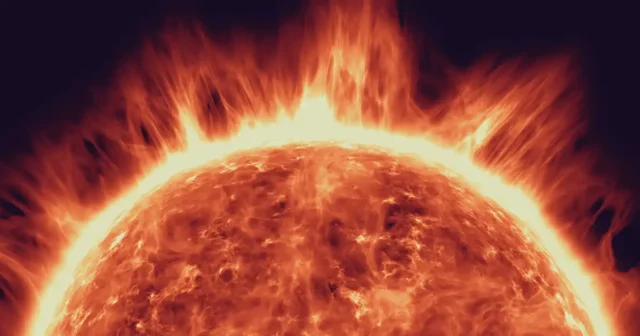
Radio wave propagation on Earth is influenced not only by terrestrial conditions, but also by the Sun — our closest star. Solar radiation and solar activity can dramatically change how different frequency bands behave, impacting amateur radio, aviation and maritime communications, navigation systems, and disaster communications. In this article, we explore how solar activity (sunspots, flares, coronal mass ejections, solar wind) interacts with Earth’s ionosphere to influence radio wave propagation. We examine both the underlying physics and practical implications for radio operators — from HF amateurs to mission-critical communication systems.
Understanding solar activity: sunspots, flares, and the 11‑year cycle
What are sunspots and the solar (sunspot) cycle
The Sun goes through an approximately 11‑year activity cycle, during which the number of sunspots rises to a peak (“solar maximum”) and then declines toward a minimum (“solar minimum”).
Sunspots are relatively “cooler” regions on the Sun’s surface caused by intense magnetic activity. They often appear in clusters, and their size can vary broadly — from small “pores” to groups spanning tens of thousands of kilometers. At solar maximum, there are more sunspots and the Sun is overall more active. Magnetic distortions associated with sunspots increase the chance for explosive events such as solar flares or coronal mass ejections (CMEs).
To quantify sunspot activity, astronomers use metrics such as the “sunspot number” or indices like the 10.7 cm solar flux (F10.7), measured in Solar Flux Units (SFU). This flux correlates well with ionospheric ionization levels and is a widely used indicator for assessing radio propagation conditions.
Solar flares, CMEs and solar wind — sudden outbursts of activity
Beyond the gradual sunspot cycle, the Sun can produce sudden, dramatic events — solar flares and coronal mass ejections (CMEs). Solar flares are bursts of electromagnetic radiation (X‑rays, extreme ultraviolet) that reach Earth in about 8 minutes. These flares can significantly increase ionization in the lower ionospheric layers (e.g., the D region).
CMEs on the other hand are massive clouds of charged plasma and magnetic field ejected from the Sun’s corona. If a CME is directed toward Earth, it may take 1–5 days to arrive, and then interact strongly with Earth’s magnetic field — causing geomagnetic storms that disrupt the ionosphere globally.
The constant “solar wind” — a stream of charged particles flowing from the Sun — also affects the ionosphere. Depending on the state of the solar wind and the Earth’s magnetic field, this can lead to varying ionospheric conditions.
In sum: solar activity is composed of slow, cyclic variation (sunspot cycle) and sudden, often unpredictable events (flares, CMEs, solar wind). Both have a strong influence on the ionosphere and hence on radio propagation.
The ionosphere — the engine of HF radio propagation
Layers of the ionosphere and their role
The ionosphere is a region of Earth’s upper atmosphere (roughly 50 km to 500+ km altitude) where solar radiation ionizes atmospheric gases, creating free electrons and ions. These free electrons are what make long-range HF (“skywave”) radio propagation possible.
The ionosphere is often described in layers:
- D layer (~50–90 km) — present during daytime; tends to absorb HF and lower frequencies, rather than reflect them.
- E layer (~90–140 km) — can reflect medium frequencies; has some influence on MF/VHF‑lower bands.
- F region (F1 ~140–210 km, F2 ~above 210 km) — the most important for HF (3–30 MHz) and even higher frequencies under optimal conditions. The F2 layer remains even at night, enabling long-distance skywave communications.
When the free-electron density is high (often due to increased solar radiation), the ionosphere can reflect higher-frequency waves. At lower electron densities, only lower-frequency waves are reflected (if at all).
Thus, whether a given HF frequency will “skip” and reach distant stations — or will be absorbed or lost — depends largely on the ionosphere’s current state, which in turn depends on solar activity and time of day.
Day vs night, seasonality, and geometry
During daytime, solar radiation maintains ionization in D, E and F layers. However, the D layer tends to absorb lower HF frequencies. At night, D and E layers largely dissipate (free electrons recombine), leaving the higher-altitude F2 layer — often enabling better long-distance (DX) propagation on lower HF frequencies.
Season, latitude, and the geometry of the signal path all matter too. The “skip” distance, hop angles, number of hops, and presence of multiple reflections all vary with these factors, making prediction complex.
Understanding how solar radiation and the solar cycle affect radio wave propagation is crucial for anyone working with HF radio systems — from amateur radio hobbyists to aviation, maritime, and emergency service professionals. By monitoring solar activity and understanding its influence on the ionosphere, radio operators can better plan communications, anticipate disruptions, and take advantage of favorable propagation conditions.
While the Sun is a source of both opportunity and challenge for radio communications, it remains a fascinating and dynamic partner in our global information network.
Image(s) used in this article are either AI-generated or sourced from royalty-free platforms like Pixabay or Pexels.
This article may contain affiliate links. If you purchase through these links, we may earn a commission at no extra cost to you. This helps support our independent testing and content creation.


