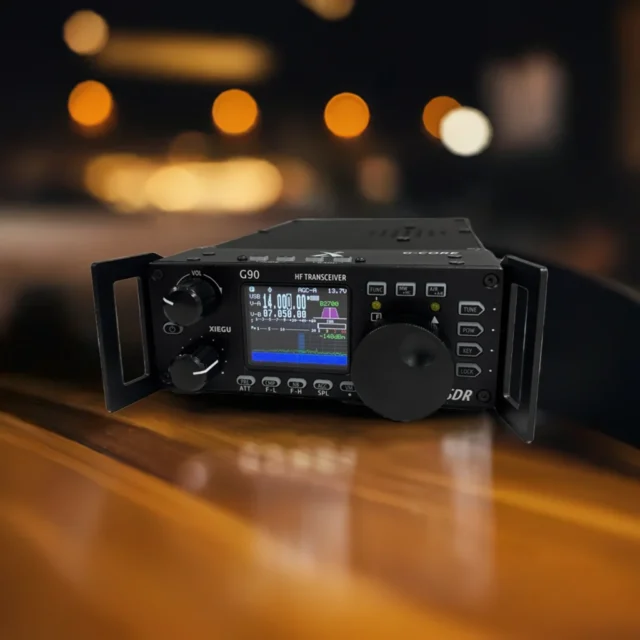
Artificial Intelligence in Modern Amateur Radio Technologies
Artificial intelligence (AI) is rapidly transforming the amateur radio world. What was once driven purely by analog circuitry and operator skill is now increasingly enhanced by machine learning (ML), neural networks, and intelligent digital signal processing (DSP). These technologies are not replacing the operator — they are amplifying capabilities, improving efficiency, and enabling tasks that were previously impossible with traditional methods.
Why ai matters in amateur radio
Amateur radio operators face a much more complex RF environment today than even a decade ago. Noise levels are higher, the spectrum is denser, and digital modes have exploded in popularity. AI offers solutions that work in real time and adapt dynamically to RF conditions.
Key benefits include:
-
Superior signal recognition in heavy noise
-
Faster and more accurate decoding
-
Automated spectrum monitoring and interference detection
-
Smart antenna control and adaptive beamforming
-
Predictive propagation modeling
-
Automated logging, callsign recognition, and cluster optimization
These capabilities allow operators to achieve more reliable contacts, detect weak signals, and operate more efficiently across all bands and modes.
Ai-powered sdr systems
Software Defined Radio (SDR) already revolutionized amateur radio by shifting RF processing into software. Adding AI elevates SDR into an intelligent RF analysis platform.
Neural-network noise reduction
AI-based noise reduction (e.g., RNNoise, DeepFilterNet, and custom CNN models) can distinguish between actual RF signals and various noise sources.
This is especially beneficial for:
-
HF bands during high atmospheric noise
-
Urban QRM-heavy environments
-
Weak-signal digital modes such as FT8
The result: clearer audio, higher decoding rates, and more stable connections.
Automatic signal classification
Machine learning classifiers can identify:
-
Modulation types
-
Known digital modes
-
Interfering transmissions
-
Spread-spectrum or low-probability-of-intercept signals
Instead of manually sweeping the spectrum, operators receive automated, real-time tagging of signals — ideal for contesting, monitoring, and experimentation.
Intelligent demodulation
Neural demodulators adapt to changing RF conditions, outperforming classic matched filters in:
-
Selective fading
-
Multipath
-
Doppler-shifted signals (satellites, balloons, aircraft scatter)
This leads to improved decode performance even at extremely low SNR.
Ai in antenna systems
Antennas are no longer passive elements. With AI-driven control systems, dynamic optimization is possible.
Adaptive beamforming
Neural algorithms can:
-
Track a moving signal source
-
Adaptively steer the lobe toward satellites or high-altitude platforms
-
Suppress interference or intentional jamming
This is increasingly relevant for:
-
QO-100 satellite operations
-
Meshtastic and LoRa experiments
-
Microwave and EME communication
Automatic antenna tuning
AI-based ATU systems learn the behavior of the antenna across bands and can predict the optimal tuning in milliseconds.
This provides:
-
Faster band changes during contesting
-
Better efficiency for portable operators
-
More precise matching for non-resonant antennas
Spectrum analysis and interference hunting
AI excels at pattern recognition, making it ideal for spectrum monitoring.
Real-time anomaly detection
Algorithms can identify:
-
Interference patterns
-
Illegal transmissions
-
Faulty equipment
-
Repetitive broadband noise sources
This is useful both for hobby monitoring and for supporting national regulatory agencies.
Long-term spectrum analytics
With AI, operators can log and visualize months of RF activity, discovering trends:
-
Band openings
-
Propagation anomalies
-
Solar effects
-
Repeated interference at specific times
This turns raw spectrum data into actionable insight.
Ai in digital modes and decoding
AI-enhanced decoders for FT8, JT65, JS8Call, and CW bring performance improvements, especially in low SNR conditions.
Intelligent cw decoding
Neural CW decoders outperform classical algorithms by learning operator-specific keying styles.
They can decode:
-
Imperfect timing
-
Fading
-
Background conversations
This is valuable for contesting and emergency communication.
Enhanced weak-signal decoding
AI models detect patterns below the noise floor.
They enable:
-
More FT8 spots
-
Better WSPR detection
-
Longer-distance QSOs with minimal power
These techniques push the boundaries of QRP operation.
Ai in amateur radio satellites
CubeSats and ham satellites increasingly rely on machine learning modules for:
-
Attitude control
-
Autonomous operation
-
Onboard image processing
-
Optimized downlink scheduling
Ground stations with AI-based demodulators also decode faint satellite signals more effectively.
Ai-assisted emergency communications
In emergency and disaster scenarios, AI enhances:
-
Automatic message routing
-
Identifying usable frequencies
-
Predicting propagation in rapidly changing environments
-
Filtering critical messages from noise
This significantly improves the reliability of ham radio during crisis response operations.
Future trends and innovations
AI is still in its early stages in amateur radio. The next 5–10 years will bring:
Fully autonomous sdr transceivers
Radios that:
-
Auto-detect the best band
-
Auto-select modes
-
Self-optimize filters
-
Automatically tune antennas
Real-time conversational ai for voice and digital modes
Systems that:
-
Convert speech to text
-
Translate communications
-
Log contacts automatically
Ai-driven mesh networking
LoRa, Meshtastic, and AREDN networks will use AI to:
-
Optimize routing
-
Predict link quality
-
Balance traffic
Enhanced propagation prediction
Neural models trained on decades of solar, geomagnetic, and ionospheric data will provide minute-by-minute forecasts.
The convergence of artificial intelligence and radio technology is no longer the future — it is one of the most exciting areas of development today.
Image(s) used in this article are either AI-generated or sourced from royalty-free platforms like Pixabay or Pexels.
This article may contain affiliate links. If you purchase through these links, we may earn a commission at no extra cost to you. This helps support our independent testing and content creation.