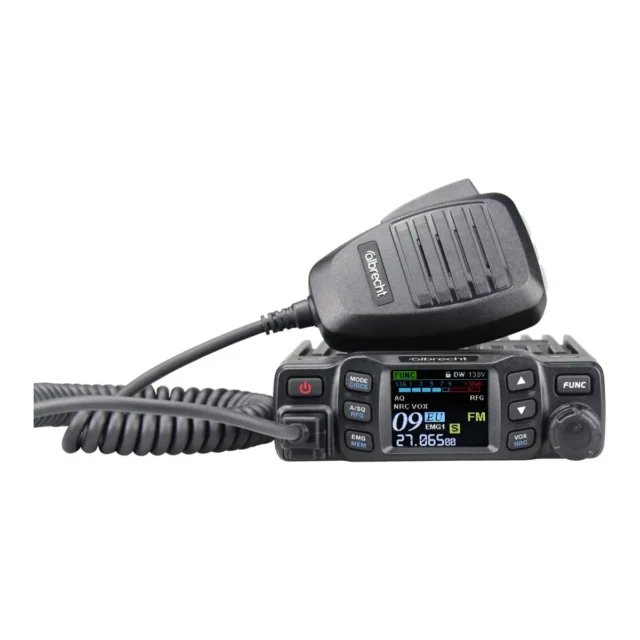
Introducing the Anytone AT-5000 hf transceiver
The Anytone AT-5000 is a compact HF transceiver designed with a very clear and disciplined goal: extract the maximum practical performance from the 10-meter amateur band without drifting into the complexity, cost, and installation burden of full multi-band HF radios.
Although it is frequently grouped together with “export radios” or CB-derived designs, the AT-5000 deserves a more precise classification. It is a single-band amateur transceiver, intentionally engineered around the electrical, propagation, and operational characteristics of the upper HF spectrum.
Understanding this intent is the key to understanding why the AT-5000 behaves the way it does on the air, why it remains popular years after its introduction, and why it appears so often in discussions that also reference CB-market radios.
The 10-meter band as a design target
The 10-meter band is technically unique among HF allocations. From a radio design perspective, it sits at the intersection of HF and VHF behavior.
Key characteristics that influence radio design include:
-
relatively low atmospheric noise compared to 40 or 80 meters
-
manageable antenna dimensions for mobile and portable use
-
rapid and sometimes dramatic propagation changes
-
strong signals during solar maxima
-
coexistence of SSB, AM, FM, and beacon activity
By focusing entirely on this band, the AT-5000 avoids the compromises that arise when a radio must perform acceptably across wildly different frequency ranges. Everything from front-end filtering to PA matching can be optimized for a narrow operating window.
This is one of the main reasons why the AT-5000 feels “clean” and stable when operating on 10 meters, even though its overall architecture remains relatively simple.
Platform architecture and engineering choices
Internally, the AT-5000 follows a traditional superheterodyne HF layout enhanced by digital signal processing.
The simplified block structure includes:
-
a dedicated RF front end centered on the upper HF range
-
a stable local oscillator suitable for narrow SSB bandwidths
-
an IF section feeding a DSP block for filtering and noise control
-
a solid-state power amplifier optimized for voice duty cycles
Because the radio does not need to accommodate multiple HF bands, it eliminates:
-
complex relay-based band switching
-
wide-range tracking filters
-
multi-band impedance matching compromises
This reduction in complexity directly benefits reliability, particularly in mobile environments where vibration, temperature changes, and electrical noise are constant factors.
Receiver performance philosophy
The AT-5000 receiver is not designed to win laboratory sensitivity contests. Instead, it is designed to be usable and predictable in real environments.
The RF front end is intentionally conservative in gain, reducing the likelihood of overload when strong local signals or nearby transmitters are present. This design choice makes the radio particularly tolerant of urban and mobile installations, where RF conditions are rarely ideal.
In practical operation, users typically experience:
-
stable SSB copy without frequency drift
-
smooth AGC action that avoids pumping
-
reasonable selectivity for crowded band segments
-
reduced fatigue during long listening sessions
The DSP noise reduction complements this approach by addressing impulse and broadband noise without attempting aggressive suppression that would compromise audio naturalness.
DSP behavior and audio character
The DSP implementation in the AT-5000 focuses primarily on voice intelligibility, not extreme signal manipulation.
On receive, the DSP:
-
shapes the audio bandwidth for clarity
-
reduces repetitive and impulse noise
-
minimizes listening fatigue
On transmit, it helps produce a clean, articulate audio profile that cuts through noise without excessive compression or distortion.
This tuning makes the radio well suited for:
-
mobile SSB operation
-
long QSOs during band openings
-
casual operating where comfort matters more than absolute selectivity
Transmitter chain and PA design
The transmitter section reflects its export-class lineage but avoids the extremes often associated with that category.
The PA stage is capable of output power well above CB-legal limits, but it is not driven to the edge of its components’ ratings. This conservative approach improves thermal stability and long-term reliability, particularly in compact enclosures.
Key transmitter traits include:
-
solid SSB performance with stable frequency
-
usable AM and FM modes for local operation
-
predictable output behavior across modes
-
manageable heat generation under voice duty cycles
As with most radios in this class, extended high-duty modes require sensible operating practices and adequate airflow.
Mobile operation considerations
One of the AT-5000’s strongest use cases is mobile operation.
The combination of:
-
compact physical size
-
focused band coverage
-
manageable power requirements
-
simple control layout
makes it well suited for vehicle installations. Antenna systems for 10 meters are significantly easier to implement than those for lower HF bands, and the AT-5000’s stable behavior helps mitigate the compromises inherent in mobile antennas.
For many operators, the AT-5000 serves as an effective bridge between CB mobile operation and licensed amateur HF mobile work.
User interface and operating logic
The user interface reflects the radio’s amateur orientation without overwhelming the operator.
The color display provides clear frequency and mode information, while physical controls handle the most common adjustments. Menus are shallow and logically structured, avoiding unnecessary nesting.
This design supports:
-
quick adjustments while mobile
-
intuitive operation for CB-experienced users
-
straightforward frequency-centric control for amateurs
The absence of excessive customization options is intentional, reinforcing the radio’s role as a focused tool rather than a feature showcase.
On-air behavior during propagation openings
When the 10-meter band opens, the AT-5000 demonstrates why it continues to be popular.
With even modest antennas, operators regularly achieve:
-
strong regional coverage
-
long-distance DX during solar peaks
-
stable SSB QSOs over extended periods
The radio’s predictable behavior under changing propagation conditions reduces operator effort and allows focus on operating rather than constant adjustment.
Relationship to CB-market variants in search context
In Europe, radios based on the same OEM platform appear under different branding, most notably the Albrecht AE-5900. This model frequently appears in searches related to the AT-5000 because the two share the same internal hardware architecture.
The AE-5900 is sold as a CB radio and shipped in a restricted configuration that enforces:
-
channelized operation
-
CB-legal power limits
-
CE and ETSI compliance
From a technical standpoint, the underlying hardware is the same. The differences lie entirely in factory configuration, firmware state, and regulatory positioning.
Including this context is important not only for technical accuracy but also for search visibility, as many users encounter information about the AT-5000 while researching the AE-5900 and vice versa.
Why the AT-5000 still has a place today
Despite rapid advances in SDR-based HF radios, the AT-5000 remains relevant because it solves a specific problem very well.
It offers:
-
disciplined single-band optimization
-
reliable performance without excessive complexity
-
compact size for mobile and space-limited stations
-
a gentle learning curve for new amateur operators
For users whose primary interest lies in the 10-meter band, the AT-5000 continues to deliver a balanced combination of performance, simplicity, and practicality that many larger radios struggle to match.
Understanding it as a focused engineering solution, rather than as a generic export radio, reveals why it has earned a lasting place in the modern amateur radio landscape.
Image(s) used in this article are either AI-generated or sourced from royalty-free platforms like Pixabay or Pexels.
This article may contain affiliate links. If you purchase through these links, we may earn a commission at no extra cost to you.