Can you hear Artemis II on your ham radio?
When NASA sends astronauts around the Moon again, radio enthusiasts inevitably start asking the same question: will it be possible to listen in from Earth?
It is a fair question, and it comes with a slightly frustrating answer.
In one sense, yes. Artemis II will absolutely be a radio event. Orion will be transmitting, the mission will depend on complex communications links, and the flight will be of real interest to advanced hobbyists who work with SDRs, microwave reception, weak-signal techniques, or passive tracking. But in the way many people instinctively imagine it — tuning a radio and hearing astronauts talk as if this were a giant spaceborne HF contact — the answer is much closer to no.
That distinction matters, because it changes how the mission should be understood.
Artemis II is not likely to become famous as an easy listening event. It is far more likely to become memorable as a technical monitoring challenge. For casual space fans, the mission will be best followed through public broadcasts and official coverage. For serious radio hobbyists, the attraction lies elsewhere: in detecting real spacecraft transmissions, analyzing signal behavior, following Doppler shift, and seeing whether a well-built station can observe a crewed spacecraft operating in cislunar space.
That is a very different kind of radio experience from the one many people associate with Apollo. It is also, in some ways, a more interesting one.
Why Artemis II matters far beyond normal space enthusiasm
Artemis II is historically important before a single antenna is even mentioned. It is NASA’s first crewed mission in the Artemis program and the first time since the Apollo era that humans will fly around the Moon. That alone gives it a weight that most missions do not have.
For the radio community, however, the importance goes beyond symbolism.
This is one of the rare crewed missions where outside observers are not merely curious bystanders. Orion’s flight profile, communications methods, and passive tracking interest make Artemis II relevant to people who care about receiver stability, antenna gain, weak-signal work, microwave hardware, and RF measurement. Even if the mission does not produce a public “space radio moment” in the old romantic sense, it still creates something arguably more valuable: a real engineering problem.
That is why the mission appeals so strongly to a particular type of hobbyist. Not the person looking for an easy conversation from space, but the person who wants to prove that a carefully built station can detect, follow, and characterize a distant spacecraft signal under demanding conditions.
In that sense, Artemis II is less of a listening event and more of a benchmark.
The first misconception: receiving is not the same as listening
A lot of confusion around lunar missions comes from a basic wording problem. People say “Can I hear it?” when what they really mean is one of several very different things.
They may mean: can I follow the mission audio?
They may mean: can I detect the spacecraft on my own equipment?
They may mean: can I decode something intelligible?
They may mean: can I measure the signal well enough to confirm tracking data or observe Doppler behavior?
Those are not the same task.
Public mission audio is one thing. RF detection is another. Recovering understandable information from a modern deep-space link is something else again. Technical observation for passive tracking is yet another category.
Artemis II almost certainly belongs more to the second and fourth categories than to the first or third for private hobby stations. That is the key expectation shift people need to make before the mission even flies.
If that sounds disappointing, it should not. In practice, “I can see the Orion downlink and log its behavior” is often a more meaningful technical achievement than “I heard a sentence of public voice traffic.”
Why this will not be an Apollo-style listening experience
Apollo continues to shape how many people think about lunar communications. Even today, the idea persists that determined hobbyists might somehow monitor a moon mission in a fairly direct way if they are clever enough.
Artemis II is operating in a different technological world.
The spacecraft is part of a modern communications environment built around layered networks, digital systems, mission-grade control architecture, and high-capacity data pathways. This is not a simple era of broadly accessible analog-style monitoring. Orion is designed to communicate reliably, securely, and efficiently with Earth through systems optimized for operations, not for hobbyist transparency.
That means the old mental model does not transfer cleanly.
Apollo rewarded people who were curious and persistent listeners. Artemis II is much more likely to reward those who approach the mission as an RF systems problem. The romance is different. The skills are different. The equipment expectations are different. And the possible reward is different too.
Instead of hearing history in the classic sense, you may be able to watch it emerge as a moving signal trace, a shifting carrier, a measurable Doppler curve, a fleeting but undeniable presence in the noise floor.
For many technically minded operators, that is more compelling than voice.
Orion is part of a hybrid communications future
One of the most interesting aspects of Artemis II is that it reflects where deep-space communications are going, not where they have been.
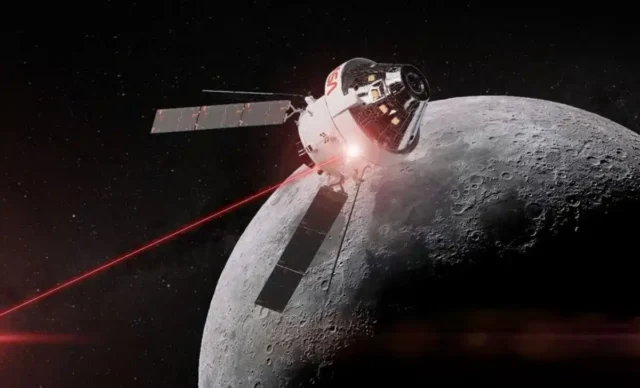
Traditional radio remains essential. Orion still depends on RF systems because radio is robust, proven, and operationally indispensable. But Artemis II is also notable because it incorporates optical communications — in other words, a laser-based data path designed to move much larger volumes of information than RF alone can comfortably handle.
That combination says a lot about the future.
Radio is not disappearing. It is being assigned a clearer role. It remains the backbone for dependable connectivity, command, tracking, and operational resilience. Optical communications are there to expand throughput and support the growing appetite for imagery, video, procedures, mission files, and other heavy data loads.
For hobbyists, this has two important consequences.
First, it confirms that Artemis II is not built around open listener convenience. This is a modern exploration system, not a public listening project.
Second, it makes the radio component even more interesting, because it is no longer the whole story. It is the sturdy, mission-critical layer inside a broader and more advanced communications stack. Monitoring any part of that stack becomes a way of touching the real engineering behind the mission.
Why S-band is where the difficulty starts
Once people move from the general idea of “space radio” to the practical question of how Artemis II might actually be observed, they quickly run into S-band.
This is where the hobbyist fantasy begins to separate from engineering reality.
S-band is not impossible territory, but it is demanding territory. It pushes the operator into a much less forgiving environment than the one most people know from ordinary amateur radio work. A weak-signal problem at microwave frequencies exposes every weakness in the system. Antenna gain is no longer an afterthought. Feed design becomes critical. Front-end noise performance becomes critical. Stability becomes critical. Even tiny imperfections that might be irrelevant elsewhere begin to matter.
That is why Artemis II is not a natural target for casual gear.
A person with a handheld transceiver and general enthusiasm is not entering the same game as someone with a directional microwave antenna, low-noise front end, stable SDR chain, and careful logging workflow. These are not two versions of the same attempt. They are fundamentally different levels of capability.
In lower-frequency hobbies, improvisation can sometimes get surprisingly far. In deep-space microwave observing, the system is much less forgiving. The signal does not care how interested you are. It only cares whether your station is good enough.
Why passive tracking may be the most realistic goal
If there is one concept that best captures what makes Artemis II radio-interesting, it is passive tracking.
This is the point where the mission becomes more than a vague question about listening and turns into a serious measurement problem. If your receiving setup is stable and sensitive enough, then a detected signal is not merely proof that Orion exists. It becomes a source of technical information.
The most important of these observable effects is Doppler shift.
As Orion moves relative to Earth, the received frequency changes slightly. That change is not random. It reflects real motion. If you can measure it accurately over time, then the spacecraft is effectively telling you something about its trajectory through nothing more than its radio presence.
That is what makes passive tracking so satisfying. You do not need to decode a dramatic message to learn something real. The signal itself, even without intelligible content, can still be informative.
It also explains why Artemis II appeals to people who enjoy the scientific side of radio. Passive tracking is not about collecting sound bites. It is about extracting meaning from disciplined measurement.
That is a very different mindset from casual listening, but it is one of the purest technical pleasures the hobby can offer.
Why this is much harder than a normal satellite project
It is tempting to compare Artemis II to amateur satellite work, but the comparison only goes so far.
Low Earth orbit satellites are close. They move quickly, but they are still nearby in radio terms. Their signals are often strong enough that modest gear can do something useful, and the barrier to entry is relatively low.
A crewed spacecraft heading toward the Moon is a different problem entirely.
The path losses are far greater. The receive margins are smaller. The importance of antenna performance increases dramatically. Frequency stability stops being a nice bonus and becomes essential. The signal environment is less forgiving. Small station weaknesses that might be masked in ordinary work become fully visible.
This is why Artemis II is such a good stress test for advanced hobby stations. It does not just ask whether your equipment works. It asks how well every part of the chain works under demanding conditions. Your antenna, front end, receiver stability, pointing discipline, logging, and analysis habits all matter at once.
That is also why the mission is likely to separate wishful thinking from real station capability very efficiently.
What kind of station would make sense for Artemis II observation
There is no single perfect equipment recipe, and that fact sometimes frustrates readers who want a one-line answer. But it is also the truth.
Artemis II is not the kind of target for which one can honestly say, “Buy this one box and you are ready.” The mission does not reduce neatly to a shopping list because success depends on system quality, not on one magic component.
A realistic station for observing Orion would revolve around gain, low noise, stability, and analysis capability.
That usually implies a directional microwave antenna or dish, a suitable feed, a very good front end, a receiver or SDR with enough frequency stability for serious work, and software that allows long-duration observation, spectral analysis, waterfall monitoring, and logging. The mechanical side matters too. Good pointing, whether manual or assisted, becomes part of the station’s performance envelope.
This is where many technically curious readers make a useful mental transition. Instead of asking, “What radio do I need?”, they start asking, “How good is my whole receive system?”
That is the right question.
With Artemis II, no individual component matters as much as the total receive chain. A weak antenna can waste a fine SDR. A noisy front end can cripple a good antenna. Poor stability can make otherwise interesting data much less useful. The mission rewards stations that are balanced, not just expensive.
Why mission geometry is half the challenge
People sometimes talk about receiving space missions as if frequency were the main issue. It is not. Frequency matters, but geometry often matters more.
Artemis II is a cislunar mission, which means the relative positions of Earth, Moon, spacecraft, and ground station shape the observation problem from start to finish. Launch date matters. Trajectory matters. Range matters. Line of sight matters. The angle at which the spacecraft presents itself to the observer matters. The timing of mission phases matters.
For a serious observer, that means the mission cannot be approached casually.
You do not merely point vaguely moonward and hope. You think in windows, geometry, relative motion, and expected signal behavior. A launch slip can alter useful details. The return path is different from the outbound path. A deep-space object does not behave like a local station, and even less like a terrestrial signal source.
This is one of the reasons Artemis II is likely to be so educational for the hobby community. It forces operators to think beyond frequency charts and equipment catalogs. It pushes them into the geometry of radio, where physics and celestial mechanics shape what the station can or cannot do.
The importance of the lunar blackout
One of the most elegant reminders of that geometry comes when Orion passes behind the Moon.
From a general audience perspective, a communications blackout sounds dramatic, even cinematic. From a radio perspective, it is something else: a clean and unavoidable demonstration that geometry rules everything. When the Moon blocks line of sight, it blocks line of sight. There is no clever workaround that defeats simple celestial obstruction.
That fact is useful because it strips the topic down to essentials.
Space communications are not magic. They are a practical negotiation between transmitter power, antenna performance, receiver sensitivity, path loss, and geometry. The moment Orion disappears behind the Moon, the geometry wins. When it reappears, the link becomes possible again.
For hobbyists, this is not just an operational detail. It is part of the educational value of the mission. Artemis II offers a real-world reminder that the sky is not merely a collection of frequencies. It is a three-dimensional moving environment governed by line-of-sight realities on a planetary scale.
Why most people should follow the mission through official coverage
None of this means casual space fans are shut out of the experience. It simply means they should choose the right access method.
If your real interest is hearing the astronauts, understanding the mission timeline, following major events, and enjoying the human side of the flight, then official mission coverage is the right choice. That is where the intelligible audio, public context, and curated updates will be. It is the most efficient way to experience the mission as a story.
Trying to force ordinary equipment into a deep-space monitoring role usually produces frustration rather than insight. Many people who say they want to “listen” to the mission actually want to feel connected to it. Public coverage does that very well.
The private radio path is different. It is not mainly about comfort, clarity, or easy access. It is about technical involvement. That matters to some people, but not to everyone.
There is no reason to confuse the two.
Why advanced hobbyists may find Artemis II more satisfying than a simple voice contact
Paradoxically, the very thing that makes Artemis II less friendly to ordinary listeners may make it more attractive to serious experimenters.
Easy voice contacts are fun, but they are not especially demanding once the system is understood. Deep-space signal observation is something else. It tests equipment choices, operator discipline, measurement practice, and interpretive skill. It asks more of the station and more of the person behind it.
That is why a mission like Artemis II can become so memorable within the technical community. Even a modest success — a repeatable detection, a clear shift pattern, a well-logged observation — may feel more meaningful than a brief piece of monitored audio. It reflects work, preparation, and system quality.
In that sense, Artemis II may do something good for the culture of the hobby. It may encourage more people to move beyond simple reception and into careful observing. It may push them toward better antennas, better front ends, better timing, better analysis, and better understanding of what radio can do when treated as an engineering discipline rather than just a listening pastime.
What the mission says about the future of radio observation
Artemis II also matters because it hints at where monitoring itself may be heading.
As space missions become more digital, more networked, and more dependent on hybrid communications, the old idea of public eavesdropping becomes less central. But that does not mean the hobby loses relevance. It means the form of relevance changes.
The future may belong less to the casual listener and more to the skilled observer.
That observer might not decode dramatic mission audio. But they may still contribute meaningful measurement. They may document signal presence. They may analyze Doppler curves. They may characterize equipment performance against real deep-space targets. They may even help prove that non-government stations can play a useful supporting role in future exploration environments.
That is a more mature and more technically demanding vision of the hobby, but also a more durable one.
The real answer, stripped of fantasy
So, can you receive Artemis II on radio?
Yes — if by receive you mean detect, observe, track, or analyze Orion’s transmissions with capable equipment and realistic expectations.
Can most hobbyists sit down with ordinary amateur gear and directly listen to astronaut conversations from lunar distance?
No — that is not the realistic model for this mission.
Should that be seen as a disappointment?
Not really.
Artemis II is not interesting because it is easy. It is interesting because it is difficult in exactly the right way. It sits at the crossroads of deep-space RF, measurement practice, microwave technique, mission geometry, and the future of hybrid communications. It is a mission that asks more of the observer, but gives more back in technical meaning. For the average viewer, it will be a public spectacle best followed through official streams. For the serious signal hunter, it may become one of the most compelling radio challenges of the decade. And in the end, that may be a better legacy than simple listening could ever have offered.
Image(s) used in this article are either AI-generated or sourced from royalty-free platforms like Pixabay or Pexels.
This article may contain affiliate links. If you purchase through these links, we may earn a commission at no extra cost to you. This helps support our independent testing and content creation.