
FT2 Digital Mode: When a QSO Becomes a Stopwatch Exercise on HF
A new experimental digital mode, FT2, has entered early on-air testing—and as expected, it has already triggered debate. Promising full structured QSOs in as little as 7–11 seconds, FT2 aims to push the limits of what timing compression can achieve within the WSJT digital ecosystem.
This is not the first time a digital mode has divided amateur radio. When FT8 emerged from the WSJT-X project, it was highly controversial. Critics argued it reduced radio to automated exchanges. Supporters pointed to its extraordinary weak-signal performance and global accessibility.
The outcome is measurable: today, FT8 dominates HF digital activity. Based on aggregated spotting data and cluster statistics, roughly 60–70% of all HF digital QSOs worldwide are conducted in FT8. Whether one likes it or not, network effect won.
Its “younger sibling,” FT4, never reached comparable adoption. Technically faster, but slightly less sensitive, FT4 remains a niche mode. Interestingly, that limited popularity became its operational advantage: FT4 sub-bands are typically quieter, less congested, and therefore tactically easier for operators trying to stand out in moderate pile-ups.
Now FT2 enters the picture—faster than FT4, far faster than FT8, and unapologetically optimized for throughput rather than weak-signal performance.
What FT2 Actually Is
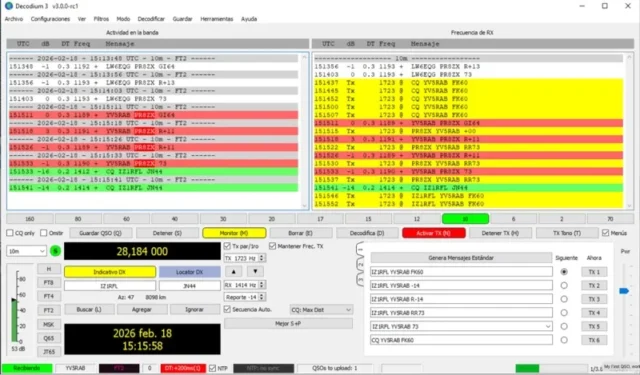
FT2 is currently an experimental fork of WSJT-X v3.0.0-rc1, distributed under the name “Decodium 3.” It is not part of an official WSJT-X release and remains in limited alpha circulation.
The development is attributed to IU8LMC, reportedly with support from the ARI Caserta Team. Early activity has been logged on 40m and 80m, with additional test frequencies across multiple HF bands.
The core objective is simple: compress transmission/reception cycles to the practical minimum while maintaining structured 77-bit message compatibility.
Technical Characteristics
FT2 achieves its speed through aggressive timing reduction and bandwidth expansion.
Early test parameters
-
Cycle length: ~3.75–3.8 seconds
-
Full QSO completion: ~7–11 seconds
-
Modulation: 8-GFSK (same family as FT8/FT4)
-
Payload: 77-bit structured message
-
Bandwidth: ~150 Hz
-
Decoding threshold: approximately −12 to −14 dB
-
Clock accuracy requirement: ±50 ms
For comparison:
-
FT8: 15-second cycle, ~50 Hz bandwidth, decoding down to ~−20 dB
-
FT4: 7.5-second cycle, ~83 Hz bandwidth, decoding to ~−17 dB
The trade-offs are explicit: FT2 sacrifices sensitivity and spectral efficiency for speed.
Throughput Mathematics
The throughput argument is central to FT2’s design philosophy.
| Mode | Cycle Length | Typical QSO Duration | Approx. QSOs/Hour |
|---|---|---|---|
| FT8 | 15 s | ~60 s | ~60 |
| FT4 | 7.5 s | ~30 s | ~120 |
| FT2 | ~3.8 s | ~11 s | ~240 |
Under ideal conditions, FT2 can theoretically triple the contact rate of FT8.
In high-rate digital contesting or DXpedition pile-ups, that difference is strategically meaningful. When scoring depends on contact volume within fixed time windows, seconds translate directly into competitive advantage.
Outside those environments, the value proposition becomes less clear.
The Sensitivity Trade-Off
FT8’s greatest strength is weak-signal performance. Its ability to decode at −20 dB or lower fundamentally changed HF digital operation.
FT2 does not attempt to compete in that domain. With an observed decoding threshold around −12 to −14 dB, it positions itself between FT4 and traditional narrowband modes such as RTTY or PSK31.
This means:
-
FT2 is not optimized for marginal propagation.
-
QRP deep-noise work remains FT8 territory.
-
Strong, stable signal paths are required for consistent performance.
The mode is therefore specialized, not universal.
Bandwidth Implications
At approximately 150 Hz per signal, FT2 occupies roughly:
-
Three times the bandwidth of FT8
-
Nearly double that of FT4
In crowded digital sub-bands, this reduces the number of simultaneously usable slots within a fixed spectral window. On narrow bands such as 30m, this becomes particularly relevant.
The bandwidth increase is not incidental. It is the cost of compressing a 77-bit payload into a 3.8-second frame.
Spectral efficiency decreases. Temporal efficiency increases.
Timing Precision Requirements
FT2’s ±50 ms clock tolerance is four times tighter than FT8’s ±200 ms allowance.
In practical terms:
-
Accurate NTP synchronization becomes mandatory.
-
Systems with drifting clocks may fail to decode.
-
Operating discipline becomes more critical.
The compressed cycle leaves very little margin for timing error.
Intended Operational Niche
FT2 is clearly designed for:
-
High-rate digital contesting
-
DXpeditions handling heavy pile-ups
-
Special event stations
-
Strong-signal, low-fading conditions
It is not designed to replace FT8’s weak-signal DX capability.
In many ways, it resembles a structured modernization of RTTY contesting—automated, standardized, and faster.
Sociotechnical Perspective
FT8 was not controversial because of its modulation scheme. It was controversial because it shifted the balance between human interaction and automated exchange.
FT2 continues that trajectory.
The QSO becomes:
Call → Report → Confirmation → Done
In 11 seconds.
For some operators, this is efficiency. For others, it further distances amateur radio from conversational engagement.
Yet one must also recognize that many real-world non-contest QSOs today already resemble highly compressed transactions. The philosophical debate may therefore be lagging behind actual operating practice.
Early Operating Frequencies
Testers have reportedly used the following calling points:
-
160m: 1.843 MHz
-
80m: 3.578 MHz
-
60m: 5.360 MHz
-
40m: 7.052 MHz
-
30m: 10.144 MHz
-
20m: 14.084 MHz
-
17m: 18.108 MHz
-
15m: 21.144 MHz
-
12m: 24.923 MHz
-
10m: 28.184 MHz
Activity has been visible via PSKReporter during early tests.
Pro And Contra Analysis
Advantages
-
Extremely high contact throughput
-
Efficient pile-up handling
-
Structured compatibility with WSJT logic
-
Contest-optimized cycle timing
-
Potential replacement for RTTY in digital competitions
Limitations
-
Reduced weak-signal sensitivity
-
Larger bandwidth footprint
-
Stricter clock synchronization requirements
-
Limited advantage outside contest scenarios
-
Further automation of structured exchanges
Adoption Outlook
FT4 demonstrated that technical improvement does not guarantee widespread adoption. Network effect remains the dominant force in digital mode ecosystems.
For FT2 to move beyond niche experimentation, three conditions are likely necessary:
-
Integration into an official WSJT-X release
-
Contest rule recognition and logging software support
-
Critical mass of early adopters
Without those, it may remain a specialized high-rate tool rather than a mainstream digital standard.
FT2 is not a weak-signal innovation. It is a speed optimization experiment. It trades sensitivity and spectral density for temporal efficiency. In contest and DXpedition environments, that trade-off makes sense. In everyday operating, its advantage is less obvious.
And perhaps the most ironic observation: even an 11-second structured FT2 QSO is only slightly longer—or at best comparable in duration—to many of today’s everyday non-contest exchanges, which often compress into a rapid “call sign – 59 – 59 – 73 – QRZ?” sequence delivered in under 10 seconds.
In that sense, FT2 may not be accelerating amateur radio dramatically. It may simply be formalizing what daily operating practice has already reduced to near-minimalist efficiency.
Ask the expert below:
Image(s) used in this article are either AI-generated or sourced from royalty-free platforms like Pixabay or Pexels.
This article may contain affiliate links. If you purchase through these links, we may earn a commission at no extra cost to you. This helps support our independent testing and content creation.


