
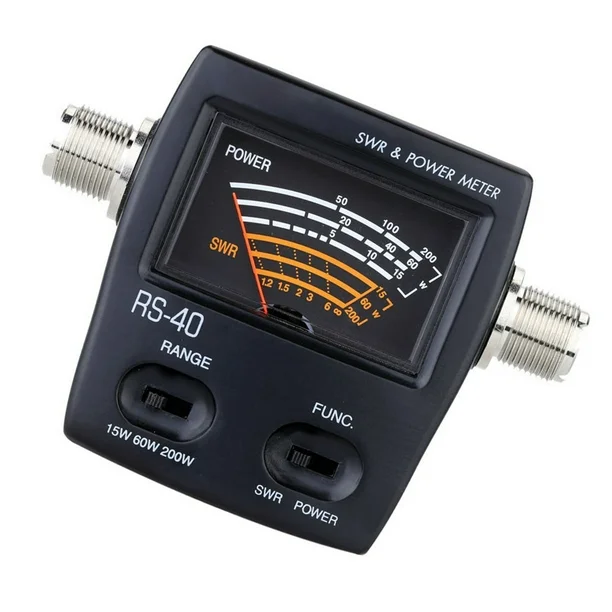
SWR: The Key to Radio Efficiency
In the world of amateur radio, the term SWR is frequently mentioned, yet for many newcomers, it remains a mysterious concept. However, this three-letter acronym is far more than just a technical metric: it defines how effectively your antenna operates, how reliable your communication is, and how well your equipment is protected. In this expanded guide, we cover everything you need to know about SWR measurements and antenna tuning—designed for beginners and advanced users alike.
Understanding the Basics: What Happens Around the Antenna?
When a transmitter sends a signal to the antenna, the ideal scenario is that all energy is radiated into the air. But if the antenna’s impedance doesn’t match the transmitter’s output (usually 50 ohms), some of that energy is reflected back. This reflected energy interferes with the incoming wave, forming a standing wave—hence the term Standing Wave Ratio (SWR).
The SWR Formula
Technically, SWR is calculated as:
SWR = (1 + |Γ|) / (1 – |Γ|)
where Γ (gamma) is the reflection coefficient. The goal is to minimize Γ to achieve an SWR as close to 1:1 as possible.
Why Does SWR Matter?
Equipment Protection
High SWR levels can overheat and damage transmitters, especially at high power. Many modern radios include automatic power reduction when SWR rises—a built-in safety feature.
Transmission Efficiency
Poor impedance matching reduces effective radiated power and can distort signal quality, which is particularly problematic with digital modes like FT8 or PSK31.
Regulatory Compliance
In some countries, amateur radio operators are required to minimize unwanted emissions. An ill-matched antenna can cause spurious emissions and interfere with other services.
Case Study: Same Antenna, Different SWR
A popular dipole antenna was tested in two locations:
- Setup A: Mounted 10 meters high, away from metallic objects → SWR 1.2:1
- Setup B: Installed in an attic near electrical wiring → SWR 3.8:1
Identical antennas and feedlines, yet vastly different results due to environmental factors. Antenna placement plays a critical role.
Recommended Tools for Beginners
Basic SWR Meters (Budget: $10–$100)
- MFJ-822 – Compact analog meter for VHF/UHF
- Diamond SX-200 – Wide-range analog meter
- AV-CN-240 – Digital display, 0.1–200 MHz
Antenna Analyzers (Budget: $100–$400)
- NanoVNA – Affordable, USB-powered, 10 kHz–1.5 GHz
- RigExpert AA-35 ZOOM – Color screen, 0.06–35 MHz
- MFJ-259C – Classic, standalone battery-powered device
Acceptable SWR by Band
| Band | Max Acceptable SWR | Notes |
|---|---|---|
| 160 m | 2.5:1 | Wideband, harder to tune |
| 80 m | 2:1 | Moderate tuning range |
| 40–10 m | 1.5:1 | Ideal range for adjustment |
| VHF/UHF | 1.2:1 | Critical tuning required |
Advanced Measurement Techniques
Measuring at Multiple Points
SWR can vary along a feedline. If you see discrepancies:
- Suspect coax issues
- Check all connectors
- Investigate grounding and shielding problems
Power-Level Testing
Some reflections only occur at high power. Try measuring at both 5W and 50W to spot inconsistencies.
Antenna Modeling Software
- MMANA-GAL – Free, ideal for dipoles, verticals, yagis
- EZNEC – Premium software, highly accurate
- 4NEC2 – Powerful free tool with graphical output
These tools help simulate your antenna’s SWR curve, resonance, and radiation pattern—before building anything.
SWR and Interference
A poorly tuned antenna can:
- Emit harmonics on unintended bands
- Cause EMI in home electronics
- Feed RF back into the transceiver or microphone
Correct SWR helps prevent these issues.
What is an SWR Sweep?
An SWR sweep scans across a frequency range and records the SWR at various points. It helps visualize how well the antenna is matched across a band.
Example:
- Minimum SWR at 7.100 MHz → Resonant frequency
- SWR < 2.0 between 6.950–7.250 MHz → Usable bandwidth
This gives you a complete picture of where your antenna performs best.
Portable Operation and Field Tuning Tips
- Use automatic tuners like Elecraft T1 for QRP
- Carry a NanoVNA in the field, powered by USB or power bank
- Choose flexible wire antennas (e.g., EFHW, W3EDP) for fast deployment and easy tuning
Practical Example: QRP Antenna Adjustment
A 20-meter end-fed wire antenna was adjusted for a 5W QRP rig:
- Initial SWR: 3.2:1
- After extending the wire by 20 cm: 1.9:1
- Replacing balun and adding better radial: 1.3:1
Small changes can make a big difference in performance and safety.
Achieving optimal SWR is more than just a technical goal—it’s a gateway to efficient, clear, and safe radio communication. Whether you’re operating from a home station, portable setup, or experimenting with digital modes, understanding and managing SWR will empower your amateur radio journey.
Try our VSWR to Return Loss & Power Calculator to easily convert and calculate various values.
Image(s) used in this article are either AI-generated or sourced from royalty-free platforms like Pixabay or Pexels.
This article may contain affiliate links. If you purchase through these links, we may earn a commission at no extra cost to you. This helps support our independent testing and content creation.


