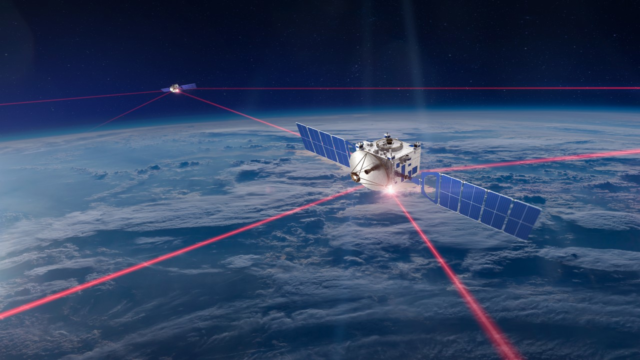
How inter-satellite communication links work
Inter-satellite communication links (ISLs), also referred to as satellite-to-satellite links, are direct communication paths established between spacecraft without involving ground stations in every transmission. These links allow satellites to exchange data, control information, and routing metadata while remaining entirely in space.
ISLs transform a group of satellites into a distributed, autonomous network rather than a collection of isolated nodes.
In modern space systems, inter-satellite links are no longer an optional enhancement. They are a core architectural element that determines latency, coverage, resilience, and scalability.
Why inter-satellite links are needed
Early satellite systems followed a strict bent-pipe model: satellites acted as passive relays, forwarding signals directly to Earth. This approach works for simple broadcast services but scales poorly for modern requirements.
Ground-dependent architectures suffer from:
-
Incomplete global coverage, especially over oceans and polar regions
-
High latency caused by store-and-forward operation
-
Bottlenecks at gateway stations
-
Vulnerability to ground infrastructure outages or geopolitical constraints
Inter-satellite links move a significant part of the network intelligence into space. Data can be routed dynamically across satellites to reach the best downlink point or another satellite, reducing dependency on terrestrial infrastructure and enabling continuous service worldwide.
Orbital architectures using inter-satellite links
Low earth orbit constellations
Low Earth orbit constellations operate at altitudes where satellites move rapidly relative to both Earth and each other. In these systems, ISLs form time-varying networks with predictable but fast-changing topology.
Each satellite typically maintains:
-
Intra-plane links to neighbors ahead and behind
-
Inter-plane links to satellites in adjacent orbital planes
These links must be frequently reconfigured as satellites pass one another. The advantage is very low propagation delay, making LEO ISL networks attractive for latency-sensitive services such as broadband internet and real-time data delivery.
Medium earth orbit systems
Medium Earth orbit systems are often used for navigation and regional coverage services. Satellites move more slowly relative to each other, allowing longer-lived inter-satellite links.
Routing in MEO systems is simpler than in LEO, but latency is higher due to increased distance. ISLs in MEO are commonly used to synchronize navigation signals, distribute timing references, and route control data.
Multi-layer and relay architectures
Modern space networks increasingly use multi-layer designs combining LEO, MEO, and GEO satellites. Inter-satellite links connect these layers, creating a hierarchical space backbone.
Lower layers focus on data collection and user access, while higher layers aggregate, relay, and route traffic. This architecture improves efficiency and reduces the number of required ground stations.
Physical technologies behind inter-satellite links
Radio frequency links
RF inter-satellite links operate using well-understood electromagnetic principles. The vacuum of space eliminates atmospheric attenuation, but free-space path loss remains significant due to long distances.
Key design considerations include:
-
Antenna gain and beamwidth
-
Transmit power and amplifier efficiency
-
Doppler shift compensation
-
Spectral efficiency and modulation schemes
Higher frequency bands enable greater bandwidth but require more precise pointing and higher power density.
Optical and laser-based links
Optical inter-satellite links use coherent laser beams to transmit data through free space. Because beam divergence is extremely small, optical links achieve very high signal-to-noise ratios and data rates.
However, optical systems impose strict requirements:
-
Extremely accurate attitude determination
-
Stable mechanical structures
-
Precise thermal control
-
Advanced acquisition and tracking algorithms
Despite this complexity, optical ISLs are becoming the dominant technology for high-capacity satellite networks.
Link establishment and maintenance
Predictive visibility modeling
Unlike terrestrial networks, satellites do not discover neighbors through random scanning alone. Orbital mechanics allow precise prediction of when two satellites will have line-of-sight.
Each spacecraft continuously calculates future visibility windows based on orbital elements. This enables pre-scheduled link activation and minimizes acquisition time.
Acquisition, tracking, and handover
Link acquisition involves initial alignment, frequency or wavelength matching, and signal detection. Once established, links must be actively tracked to compensate for relative motion and structural vibration.
As satellites move, links are handed over to new neighbors in a controlled manner to avoid data loss. This process resembles cellular handover but operates on orbital timescales and three-dimensional geometry.
Network topology and routing strategies
Deterministic topology management
Inter-satellite networks are not random graphs. Their topology evolves deterministically according to orbital mechanics. This allows routing algorithms to exploit predictability rather than reacting to unexpected changes.
Routing tables can be computed in advance, accounting for:
-
Future link availability
-
Expected latency
-
Bandwidth constraints
-
Power budgets
Store-carry-forward operation
In cases where no continuous end-to-end path exists, satellites store data onboard and forward it when a suitable link becomes available. This principle is fundamental in sparse constellations and deep-space missions.
Store-carry-forward enables reliable delivery even with long communication delays and intermittent connectivity.
Performance characteristics
Latency
Inter-satellite routing reduces latency by minimizing ground hops and terrestrial backhaul. In many cases, routing through space is physically shorter than routing through optical fiber due to Earth’s curvature.
This makes ISLs attractive for:
-
Intercontinental data transport
-
Financial and trading networks
-
Time-critical command and control
Throughput
Throughput depends on link technology, antenna or optical terminal design, and available power. Optical ISLs provide orders of magnitude higher capacity than traditional RF links, enabling dense traffic flows within large constellations.
Reliability and redundancy
Mesh-based inter-satellite networks can reroute traffic around failed nodes or degraded links. This redundancy significantly improves system availability compared to ground-dependent architectures.
Power, thermal, and mechanical constraints
Inter-satellite links compete with payload instruments, propulsion, and onboard processing for limited spacecraft resources.
Power systems must support peak transmission demands without destabilizing the platform. Thermal management is critical, particularly for optical terminals that generate localized heat.
Mechanical stability directly affects pointing accuracy. Reaction wheels, solar array motion, and structural flexing must be carefully managed to maintain link integrity.
Security considerations
Inter-satellite links reduce exposure to terrestrial interception, but they introduce new security challenges.
Security measures typically include:
-
End-to-end encryption
-
Mutual authentication between satellites
-
Secure key distribution in space
-
Protection against spoofing and replay attacks
Optical links offer additional physical security due to their narrow beams and low detectability.
Role of ISLs in autonomous satellite systems
Inter-satellite links enable satellites to cooperate without constant ground supervision. Constellations can autonomously:
-
Balance traffic loads
-
Reroute around failures
-
Share situational awareness data
-
Coordinate formation flying
This autonomy reduces operational costs and increases resilience in contested or remote environments.
Applications enabled by inter-satellite links
ISLs support a wide range of modern and emerging applications:
-
Global broadband connectivity
-
Continuous Earth observation and data fusion
-
Space-based navigation augmentation
-
Military and governmental secure networks
-
Scientific missions and deep-space exploration
In many of these use cases, inter-satellite links are not merely beneficial but essential.
Future evolution of inter-satellite communication
Ongoing development focuses on higher data rates, lower power consumption, and greater interoperability. Trends include fully optical backbones, software-defined payloads, AI-assisted routing, and standardized interfaces.
As constellations grow larger and more complex, inter-satellite communication will increasingly resemble a true space internet, extending networking principles beyond Earth and laying the foundation for interplanetary communication infrastructures.
Inter-satellite communication links fundamentally reshape how satellites operate and interact. By embedding networking intelligence directly into space systems, ISLs enable scalable, resilient, and low-latency communication architectures that define the present and future of satellite networks.
Image(s) used in this article are either AI-generated or sourced from royalty-free platforms like Pixabay or Pexels.
This article may contain affiliate links. If you purchase through these links, we may earn a commission at no extra cost to you.