
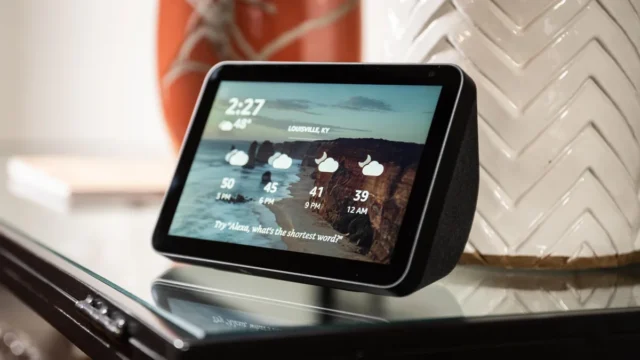
Amazon Echo Show 8 review
The Echo Show 8 is a mid-size smart display that combines a touchscreen, a smart speaker, and a voice-controlled assistant into a single always-on device. It is positioned as the most balanced member of the Echo Show family, targeting users who want visual feedback without committing to a large rotating display or settling for a very small screen.
The device is designed and sold by Amazon, and it fits especially well into households already using Alexa-enabled products. Typical use cases include kitchens, shared living spaces, home offices, and bedrooms where glanceable information, voice interaction, and light media consumption matter more than raw performance.
The Echo Show 8 is not intended to replace a tablet or a laptop. Instead, it acts as a passive, ambient interface: something that is always there, always listening, and always ready to respond without friction.
Design philosophy and physical construction
The overall design of the Echo Show 8 prioritizes neutrality and practicality. The device consists of an 8-inch glass display mounted on a fabric-wrapped speaker enclosure. Color options are intentionally understated, allowing the unit to blend into a wide range of interior styles without becoming visually dominant.
Build quality is solid and consistent with Amazon’s higher-end Echo devices. The fabric cover is tightly fitted, the display glass feels durable, and the base provides sufficient weight to prevent accidental tipping when interacting with the touchscreen.
On the top edge, physical controls include volume up/down buttons and a combined microphone and camera mute button. A dedicated mechanical camera shutter slides over the lens, offering a tangible privacy safeguard that many users consider essential for devices placed in private spaces.
Display characteristics and usability
The Echo Show 8 uses an 8-inch HD display with a resolution of 1280×800 pixels. While this resolution does not compete with modern tablets or smartphones, it is well suited for the device’s intended viewing distance and usage pattern.
Text readability is good for calendars, weather forecasts, recipe steps, subtitles, and smart home dashboards. Icons and interface elements are large enough to be easily tapped, even with wet or dirty hands in kitchen environments.
Brightness levels are sufficient for indoor use, and the display automatically adjusts based on ambient lighting. Color accuracy favors warm tones, which improves perceived comfort during prolonged passive viewing and video calls, even if it slightly reduces contrast compared to high-end panels.
Touch input is responsive and reliable. The interface is optimized for simple gestures, minimizing the need for precision tapping. Combined with voice control, the touchscreen serves as a complementary input method rather than a primary one.
Audio system and sound profile
Audio quality is one of the most noticeable improvements over smaller Echo Show models. The Echo Show 8 features dual speakers that deliver clearer mids and better stereo separation than entry-level smart displays.
Speech clarity is excellent, which is critical for voice responses, podcasts, and video calls. Music playback is balanced, with enough low-end presence to avoid sounding thin, although it cannot match the depth of dedicated speakers or larger Echo models with subwoofers.
The sound profile is tuned for near-field listening, making it ideal for kitchens, desks, and bedrooms. For users who primarily consume spoken content or background music, the Echo Show 8 offers a satisfying audio experience without external speakers.
Microphones and voice recognition performance
The integrated microphone array performs consistently well across different environments. Alexa reliably detects wake words even when music is playing or when the user is several meters away.
Noise suppression algorithms handle common household sounds such as running water, cooking noise, or typing. This reliability is crucial for maintaining the hands-free promise of a smart display.
Latency between command and response is minimal under normal network conditions, reinforcing the impression of a responsive, conversational assistant rather than a delayed voice interface.
Alexa ecosystem and software experience
Alexa is the core of the Echo Show 8 experience, acting as both voice assistant and system interface. Voice commands cover a wide range of tasks, from simple queries and timers to complex smart home routines.
Visual responses add significant value. Weather queries show forecasts and charts, reminders appear as persistent cards, and recipes are displayed step by step with hands-free navigation. This multimodal interaction is where the Echo Show 8 clearly outperforms audio-only smart speakers.
The home screen rotates through configurable widgets such as clock faces, calendar events, photo slideshows, news snippets, and smart home controls. While customization options exist, deeper control and fine-tuning still rely on the Alexa mobile app.
Smart home control and automation
The Echo Show 8 functions as a central control point for Alexa-compatible smart home devices. Users can control lights, switches, thermostats, cameras, and sensors using voice commands or on-screen controls.
The visual smart home dashboard allows quick access to frequently used devices and routines. Live camera feeds and doorbell previews are particularly useful, transforming the Echo Show 8 into a lightweight monitoring station.
Automation through routines is a major strength. Users can combine triggers such as time, voice commands, or sensor states with multiple actions, enabling complex behaviors without scripting or technical expertise.
Video calling, drop-in, and communication
The front-facing camera enables video calling between Echo devices and supported external platforms. Video quality is optimized for indoor lighting and conversational framing rather than high-resolution capture.
Drop-in functionality allows instant connections between Echo devices within the same household. This effectively turns the Echo Show 8 into a room-to-room intercom, which is especially practical in larger homes or multi-story buildings.
For families and shared households, these communication features add everyday value beyond novelty use.
Privacy controls and data handling
Privacy considerations are central to the Echo Show 8’s design. Hardware-based controls include a physical camera shutter and a microphone/camera mute button that electrically disables sensors.
Visual indicators clearly show when microphones or the camera are inactive. On the software side, users can review stored voice interactions, delete recordings, and manage privacy settings via the Alexa app.
Although cloud processing is required for most Alexa features, the available transparency and physical safeguards reduce perceived risk for many users.
Performance, stability, and long-term use
In day-to-day operation, the Echo Show 8 feels stable and predictable. Interface transitions are smooth, crashes are rare, and software updates typically install unobtrusively in the background.
Amazon continues to add features and refinements through firmware updates, extending the usable lifespan of the device. This long-term support model improves the overall value proposition compared to devices that rely on static firmware.
Placement scenarios and real-world use
In kitchens, the Echo Show 8 excels as a recipe assistant, timer hub, and entertainment device. Hands-free operation and visual guidance significantly improve usability during cooking.
In home offices, it functions as a secondary display for calendars, reminders, music playback, and quick video calls, reducing the need to interrupt workflow.
In bedrooms and living rooms, it replaces traditional alarm clocks and radios while adding smart home control and communication features.
Comparison within the Echo Show lineup
Compared to the Echo Show 5, the Echo Show 8 offers a meaningfully larger display and noticeably better sound. Compared to the Echo Show 10, it sacrifices screen movement and size in exchange for a smaller footprint and lower cost.
For most users, the Echo Show 8 represents the most balanced choice in the lineup, delivering strong core functionality without unnecessary complexity.
Strengths and limitations
Key strengths include balanced screen size, reliable audio, responsive voice recognition, strong smart home integration, and solid privacy controls. Limitations include modest display resolution, dependence on cloud services, and limited interface customization without the companion app.
These trade-offs are consistent with the device’s positioning and price category.
The Amazon Echo Show 8 succeeds as a practical, everyday smart display that integrates smoothly into modern homes. It does not aim to impress with cutting-edge hardware specifications, but instead focuses on reliability, usability, and ecosystem integration. For users invested in Alexa and smart home automation, it remains one of the most sensible and versatile smart display options available.
Image(s) used in this article are either AI-generated or sourced from royalty-free platforms like Pixabay or Pexels.
This article may contain affiliate links. If you purchase through these links, we may earn a commission at no extra cost to you.


