The Raspberry Pi is far more than a tiny circuit board with ports. It is a story of how a simple idea, born out of frustration in a Cambridge classroom, ended up inspiring millions of people worldwide. Since 2012, this low-cost, credit-card-sized computer has sold tens of millions of units and become a go-to tool for students, hobbyists, engineers, and even space agencies.
In this long read, we’ll walk through the history of the Raspberry Pi: why it was created, how it evolved, what it has achieved in education and industry, and why it matters for the future of technology.
The academic problem that inspired the Raspberry Pi
In the early 2000s, computer science teachers at the University of Cambridge noticed something troubling. Students arriving at university were less skilled in programming than their predecessors. Back in the 1980s and 1990s, children learned coding on machines like the BBC Micro, the Commodore 64, or the ZX Spectrum. These computers encouraged tinkering. Kids wrote their own code, explored how the hardware worked, and built a natural relationship with computing.
By contrast, modern students had grown up using polished, sealed systems. Windows PCs, game consoles, and smartphones didn’t invite hacking or experimenting. As a result, many young people could use computers but had little idea how they worked.
This was the starting point for Eben Upton and his colleagues. They wanted to put a modern version of the BBC Micro into the hands of every child who showed even a spark of curiosity.
The birth of the Raspberry Pi Foundation
In 2008, the Raspberry Pi Foundation was set up as a UK-based charity. Its mission was bold but simple: to make computing and digital creation accessible to everyone, not just those who could afford expensive equipment.
The name itself was carefully chosen. “Raspberry” followed the tradition of fruit-based computer names like Apple and Acorn, while “Pi” stood for “Python interpreter,” highlighting Python’s importance as an easy-to-learn language for beginners.
From the very beginning, the foundation was built around community. It wasn’t just about shipping hardware; it was about inspiring people to learn, create, and share.
Prototypes and the first working models
The earliest prototypes were rough and limited, but they proved the idea was feasible. The real breakthrough came when Eben Upton, who worked at Broadcom, found the BCM2835 chip—a low-cost ARM processor with decent graphics capability. Suddenly, it was possible to design a small computer that could run Linux and cost less than a dinner out.
In 2011, the team released a video of a prototype running Quake III Arena. The internet exploded with excitement. A $25 computer playing 3D games? The demand was clear long before the first Raspberry Pi went on sale.
The launch of Raspberry Pi Model B
On February 29, 2012—Leap Day—the first Raspberry Pi Model B was released. It had:
A 700 MHz ARM11 CPU
256 MB of RAM (later doubled to 512 MB)
HDMI and RCA outputs
Two USB ports
Ethernet connectivity
The price was $35, and it sold out within hours. So many people tried to buy one that distributor websites crashed. For the first time, anyone could own a general-purpose computer for less than the cost of a video game.
The evolution of Raspberry Pi models
The Raspberry Pi has gone through several generations, each more powerful and capable than the last.
Raspberry Pi 1 (2012–2014)
The first wave included Models A, B, A+, and B+. They topped out at 512 MB of RAM and introduced the famous 40-pin GPIO header that made hardware hacking accessible.
Raspberry Pi 2 (2015)
With a quad-core Cortex-A7 CPU and 1 GB of RAM, it was six times faster than the original. For the first time, it felt like a real PC in miniature.
Raspberry Pi 3 (2016–2018)
This generation brought 64-bit computing, built-in Wi-Fi, and Bluetooth. Suddenly, the Pi could connect to the internet without extra accessories.
Raspberry Pi 4 (2019)
A huge leap forward, with up to 8 GB of RAM, USB 3.0, Gigabit Ethernet, and support for two 4K monitors. The Pi had moved from being a teaching aid to a serious desktop replacement.
Raspberry Pi 400 (2020)
A Raspberry Pi built into a keyboard, echoing 1980s machines like the ZX Spectrum. It was designed for classrooms and families—just plug in a monitor and go.
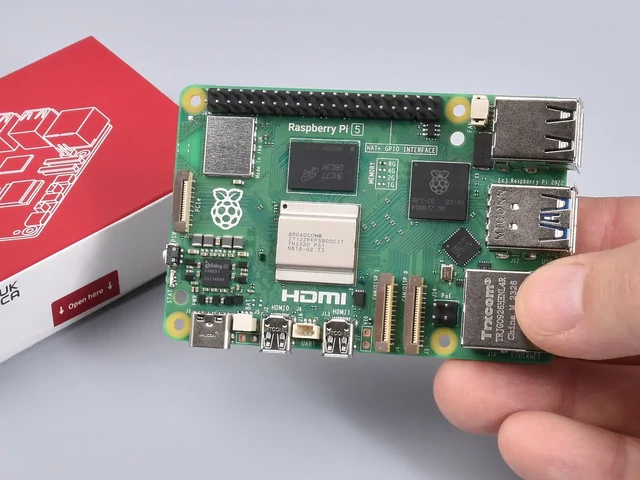
Raspberry Pi 5 (2023)
The most powerful Pi yet, with a custom RP1 chip, PCIe support, faster graphics, and a Cortex-A76 CPU running at up to 2.4 GHz. This model pushed the Raspberry Pi firmly into the realms of AI, edge computing, and advanced industrial applications.
Raspberry Pi 6 – what could come next?
While the Raspberry Pi 5 represents a major architectural leap in CPU performance and I/O capabilities, attention is already turning toward the next generation. The Raspberry Pi 6 is expected to focus on sustained performance, stronger PCIe bandwidth, improved storage integration, and possibly Wi-Fi 6-class networking. Rather than a simple speed bump, it could mark a shift toward more serious homelab, NAS, and edge AI workloads.
Read the full Raspberry Pi 6 forecast here
Raspberry Pi model comparison table
| Model & Release Year | CPU | RAM Options | Key Features | Typical Price at Launch |
|---|---|---|---|---|
| Raspberry Pi 1 Model B (2012) | ARM11, 700 MHz | 256 MB → 512 MB | HDMI, 2× USB, Ethernet, Composite video | $35 |
| Raspberry Pi 1 A / A+ (2013–2014) | ARM11, 700 MHz | 256 MB → 512 MB | Lower power, no Ethernet, single USB | $25 |
| Raspberry Pi 2 Model B (2015) | Quad-core ARM Cortex-A7, 900 MHz | 1 GB | 6× faster than Pi 1, 4× USB, HDMI | $35 |
| Raspberry Pi 3 Model B (2016) | Quad-core ARM Cortex-A53, 1.2 GHz | 1 GB | Built-in Wi-Fi and Bluetooth | $35 |
| Raspberry Pi 3 Model B+ (2018) | Quad-core ARM Cortex-A53, 1.4 GHz | 1 GB | Faster networking, better Wi-Fi | $35 |
| Raspberry Pi 4 Model B (2019) | Quad-core ARM Cortex-A72, 1.5 GHz | 2 GB, 4 GB, 8 GB | Dual micro-HDMI 4K, USB 3.0, Gigabit Ethernet | $35 (2 GB) – $75 (8 GB) |
| Raspberry Pi 400 (2020) | Quad-core ARM Cortex-A72, 1.8 GHz | 4 GB | Built into a keyboard, 2× micro-HDMI | $70 |
| Raspberry Pi Zero (2015) | ARM11, 1 GHz | 512 MB | Ultra-small, very low power, 1× mini-HDMI | $5 |
| Raspberry Pi Zero W (2017) | ARM11, 1 GHz | 512 MB | Wi-Fi and Bluetooth added | $10 |
| Raspberry Pi Zero 2 W (2021) | Quad-core ARM Cortex-A53, 1 GHz | 512 MB | 5× faster than original Zero, Wi-Fi, BT | $15 |
| Raspberry Pi 5 (2023) | Quad-core ARM Cortex-A76, up to 2.4 GHz | 4 GB or 8 GB | PCIe support, RP1 I/O chip, faster GPU | $60 (4 GB) – $80 (8 GB) |
| Compute Module series (2014–ongoing) | Varies by generation | Varies | Slim form factor for industrial use | From $25 |
| Raspberry Pi Pico (2021) | Dual-core RP2040 microcontroller, 133 MHz | 264 KB SRAM, 2 MB Flash | GPIO rich, for embedded and electronics projects | $4 |
Special editions and side projects
The Raspberry Pi Foundation didn’t stop at the main line.
The Raspberry Pi Zero, introduced in 2015, cost just $5 and later gained Wi-Fi in the Zero W.
The Compute Module series provided stripped-down versions for embedding in industrial products.
The Raspberry Pi Pico, launched in 2021, was the foundation’s first microcontroller board, based on their own RP2040 chip.
These additions opened doors to even more use cases, from robotics to mass-produced smart devices.
The Raspberry Pi in the maker movement
Perhaps the Raspberry Pi’s greatest achievement is how it empowered ordinary people. Suddenly, anyone could afford to build projects that once required specialized equipment. The Pi became the heart of the global maker movement.
People used it to build retro gaming consoles, weather stations, media centers, smart mirrors, home automation systems, drones, and robots. Entire communities sprang up around tutorials, YouTube channels, and forums dedicated to sharing Pi projects.
What made it unique was the balance of affordability, versatility, and community support. If you had an idea, chances were someone had already documented how to do it with a Pi.
Transforming education
The Raspberry Pi Foundation always kept education at the core of its mission. Through initiatives like Code Club and CoderDojo, it provided opportunities for children to learn programming and electronics in fun, creative ways.
In classrooms, Raspberry Pis were used to teach Python, Scratch, and even machine learning. In developing countries, they became a gateway to the internet and modern digital skills.
For many children, the Raspberry Pi was their very first computer—something personal, cheap enough not to be intimidating, but powerful enough to do real work.
Industrial and commercial uses
Although the Raspberry Pi started as an educational tool, it quickly spread into industry. Businesses realized that it could serve as a reliable, low-cost solution for many applications.
It is now used in digital signage, kiosks, IoT devices, factory automation, robotics, and even medical equipment. Startups embraced it as a prototyping tool, while large corporations deployed it in production environments. The Pi blurred the line between hobbyist gear and professional-grade hardware.
Cultural significance
The Raspberry Pi has become more than hardware—it is a cultural phenomenon. It has appeared in museums, maker fairs, and exhibitions. NASA used Raspberry Pis on the International Space Station for educational experiments.
By 2025, more than 50 million units had been sold, making it one of the best-selling computers in history. Its influence can be seen in classrooms, workshops, homes, and businesses all over the world.
Challenges and criticisms
Of course, the journey hasn’t been without problems. Supply chain shortages, particularly during the COVID-19 pandemic, made it difficult for people to buy one. Competition from Arduino, BeagleBone, and Nvidia Jetson boards has been strong. And while the Raspberry Pi is more beginner-friendly than many platforms, the learning curve of Linux can still be intimidating.
But these challenges haven’t stopped its momentum. The foundation continues to improve documentation, release new models, and expand into microcontrollers.
Looking to the future
The Raspberry Pi story is far from over. Future models are expected to bring more power, better GPUs, and deeper integration with AI and machine learning. The Compute Module line is expanding into industrial markets, and the RP2040 chip is giving birth to a whole family of microcontrollers.
At the same time, the educational mission remains strong. The foundation continues to invest in global outreach, making sure children in every corner of the world have access to the tools of digital creation.
Why the Raspberry Pi matters
The Raspberry Pi matters because it embodies a philosophy: that technology should be open, affordable, and available to everyone. It lowered the barriers to entry for learning programming, building electronics, and creating solutions to real-world problems.
From a Cambridge classroom to outer space, the Raspberry Pi has shown that a small board can have a big impact. It is not just a piece of hardware—it is a movement, a community, and a revolution in how we think about computers.
Image(s) used in this article are either AI-generated or sourced from royalty-free platforms like Pixabay or Pexels.
This article may contain affiliate links. If you purchase through these links, we may earn a commission at no extra cost to you.
Get the weekly RF & IT briefing
Radio guides, RF calculators, AI, Windows, Linux and satellite communication explainers. One useful email per week. No spam.