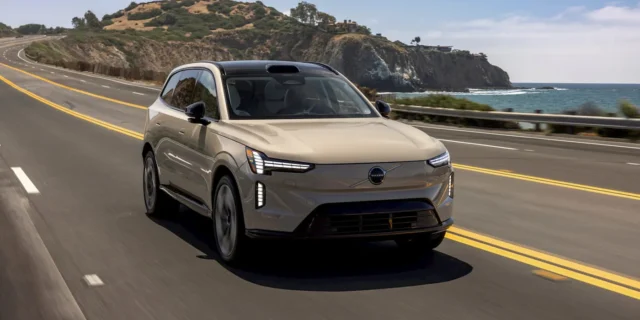
The Volvo EX60 represents a decisive shift in how modern vehicles are designed, engineered, and differentiated. While it enters the market as a premium electric SUV, its true importance lies far beyond body style or drivetrain. The EX60 is one of the first production cars conceived explicitly as an AI-centric computing platform, where software intelligence and chipset architecture define the experience as much as mechanical engineering ever did.
Volvo’s strategy with the EX60 is built on three deeply integrated technology pillars:
NVIDIA for AI-driven driver assistance and automated driving compute
Qualcomm for infotainment, connectivity, and in-cabin user experience
Google, delivering Android Automotive and, for the first time in a production vehicle, Gemini AI
For a technology-focused audience, the EX60 is compelling because it demonstrates how artificial intelligence, heterogeneous automotive chipsets, and cloud-native software converge inside a safety-critical consumer product designed to last more than a decade.
From vehicle to AI computing platform
For most of automotive history, vehicles were defined by engines, transmissions, suspension geometry, and crash structures. In the EX60, these fundamentals still matter, but they are no longer the primary differentiators. Instead, the vehicle’s character is shaped by:
AI inference capability
Software architecture and update strategy
Sensor fusion accuracy
Fault tolerance and redundancy
Volvo positions the EX60 as a software-defined vehicle, where hardware provides raw capability and software determines behavior. This mirrors the evolution of smartphones and cloud servers, but with dramatically higher reliability and safety requirements. In this context, AI is not an add-on feature—it is part of the vehicle’s nervous system.
Nvidia and the AI foundation of driver assistance
At the heart of the EX60’s driving intelligence is NVIDIA’s automotive AI platform, widely expected to be based on the DRIVE Orin generation.
Why Nvidia matters
NVIDIA’s role is not limited to raw performance measured in TOPS. The real value lies in the end-to-end AI ecosystem:
GPU and dedicated deep-learning accelerators for neural networks
Mature perception, prediction, and planning frameworks
Functional safety support up to ASIL-D
A unified toolchain from model training to in-vehicle deployment
This allows the EX60 to run multiple AI workloads simultaneously:
Object detection and classification
Lane and road-edge recognition
Free-space estimation
Multi-sensor fusion using camera, radar, and ultrasonic data
Real-time trajectory planning
Instead of rigid rule-based logic, the vehicle increasingly relies on learned behavior, refined continuously as models improve. This is a defining trait of AI-first vehicles: intelligence scales through software, not hardware replacement.
AI beyond driving: continuous inference across the vehicle
A common misconception is that AI in cars exists only for driver assistance. In the EX60, AI operates continuously across many subsystems.
Examples include:
Driver monitoring AI, detecting attention and fatigue
Occupant detection, optimizing airbag deployment and climate zoning
Energy optimization models, adapting power usage to route, weather, and driving style
Predictive diagnostics, identifying early signs of component wear
Thermal management AI, balancing battery, motors, and compute cooling
These models are typically smaller than perception networks but run persistently. The challenge is not peak performance, but sustained, power-efficient inference, which strongly influences chipset choice and system design.
Qualcomm and the separation of infotainment compute
While NVIDIA hardware handles safety-critical AI workloads, infotainment and connectivity are powered by Qualcomm Snapdragon Automotive SoCs. This separation is intentional and architecturally significant.
Why compute domains are split
Running all vehicle functions on a single processor increases risk and complexity. Volvo instead adopts a domain-oriented architecture:
NVIDIA for real-time, safety-critical systems
Qualcomm for UI, media, connectivity, and user interaction
This delivers:
Deterministic latency for driving systems
Smooth, responsive infotainment under all conditions
Independent update cycles
Fault isolation between domains
For users, this means fluid interfaces even when advanced driver assistance is active. For engineers, it reflects a design philosophy closer to modern distributed systems than legacy automotive ECUs.
Gemini AI: the real paradigm shift
The most transformative element of the EX60 is not silicon, but software: Gemini AI, embedded directly into the vehicle’s operating system.
This marks a fundamental change in how humans interact with vehicles.
From commands to intent-based interaction
Traditional in-car assistants rely on:
Predefined voice commands
Narrow intent sets
Limited awareness of vehicle context
Gemini introduces:
Natural language understanding
Contextual reasoning across vehicle systems
Multi-step task execution
Conversational interaction
Drivers no longer issue commands—they express intent:
Planning routes with charging constraints
Asking why the car behaved a certain way
Adjusting multiple systems with a single request
Receiving proactive suggestions based on context
Crucially, Gemini runs natively within Android Automotive, not via smartphone projection. This grants direct access to vehicle APIs, enabling deeper integration than phone-based assistants could ever achieve.
Android Automotive as a long-term software foundation
Unlike Android Auto, Android Automotive is a full operating system running on the car’s hardware. This has profound implications for lifecycle management.
Key advantages:
Native access to vehicle data and controls
Predictable performance and latency
Integrated security updates
Long-term OS support aligned with vehicle lifespan
For Volvo, this reduces fragmentation and accelerates feature deployment. For owners, it means the EX60 behaves less like a static product and more like a continuously evolving platform.
AI model lifecycle: from data to deployment
Behind the scenes, the EX60 relies on a rigorous AI lifecycle that balances innovation with safety.
Typical stages include:
Fleet data collection within regulatory limits
Centralized training on large-scale compute
Simulation and synthetic data generation for rare edge cases
Offline validation against safety benchmarks
Shadow-mode testing in vehicles
Gradual activation via OTA updates
This pipeline allows Volvo to improve AI behavior without exposing drivers to unvalidated changes. Every EX60 contributes—indirectly and anonymously—to improving the intelligence of the entire fleet.
Edge cases and uncertainty management
AI systems excel in common scenarios. The real challenge lies in edge cases:
Unusual road layouts
Temporary construction zones
Extreme weather conditions
Unpredictable human behavior
The EX60 manages uncertainty by:
Estimating confidence levels in perception
Falling back to conservative behaviors when confidence drops
Handing control back to the driver smoothly
Redundant sensors and overlapping models reduce the likelihood of single-point failure, while deterministic safety layers ensure predictable behavior even when AI confidence is low.
Functional safety and AI coexistence
AI does not replace traditional safety systems—it operates alongside them.
Key principles:
AI proposes actions, deterministic systems validate them
Hard safety constraints override learned behavior
Time-critical decisions remain rule-based
AI enhances adaptability without bypassing safety envelopes
This layered approach allows Volvo to harness AI’s strengths without compromising compliance with automotive safety standards.
Explainability and human trust
Trust in AI-driven vehicles depends on transparency as much as performance.
The EX60 addresses this through:
Clear visual feedback for assistance actions
Natural-language explanations via Gemini
Consistent intervention thresholds
Predictable behavior across similar scenarios
When drivers understand why the vehicle acts, acceptance and confidence increase significantly.
Personalization without fragmentation
The EX60 uses bounded personalization:
Driving suggestions adapt, safety limits do not
Climate and comfort adjust freely
Navigation and media preferences evolve over time
Core vehicle dynamics remain consistent
This prevents unpredictable behavior while still delivering a personalized experience.
Data privacy as a design constraint
AI thrives on data, but vehicles demand stricter privacy controls than consumer electronics.
The EX60’s architecture reflects this:
Sensitive processing occurs locally whenever possible
Cloud interaction is minimized for personal data
User profiles are isolated
Regulatory compliance is built into system design
This balance enables intelligent features without turning the vehicle into a surveillance device.
Power, thermal limits, and AI efficiency
Running multiple AI models continuously has real physical costs.
The EX60 must manage:
Heat from high-performance SoCs
Power draw from sustained inference
Interaction between compute cooling and cabin comfort
Solutions include:
Shared cooling loops
Dynamic throttling under extreme conditions
Intelligent workload scheduling
This highlights a key difference between automotive and data-center AI: efficiency and predictability matter more than peak throughput.
The vehicle fundamentals still matter
Despite its technological focus, the EX60 remains a Volvo.
Expected characteristics include:
A dedicated EV platform
Advanced passive and active safety systems
High-voltage battery architecture
Fast DC charging capability
Conservative engineering margins
These fundamentals provide the trust foundation that allows aggressive AI integration without alienating traditional buyers.
Why the EX60 matters beyond automotive
Even readers uninterested in owning an electric SUV should care about what the EX60 represents.
It demonstrates:
AI entering safety-critical consumer products
Chip vendor ecosystems shaping product capability
Software updates defining long-term value
The convergence of automotive, cloud, and AI industries
Technologies proven here will migrate into:
Lower-cost vehicles
Commercial fleets
Logistics and delivery platforms
Other embedded, AI-driven machines
The Volvo EX60 is therefore best understood not just as a car, but as a real-world deployment of applied AI at scale, where silicon, software, cloud intelligence, and safety converge into a single, continuously evolving system.
Image(s) used in this article are either AI-generated or sourced from royalty-free platforms like Pixabay or Pexels.
This article may contain affiliate links. If you purchase through these links, we may earn a commission at no extra cost to you.
Get the weekly RF & IT briefing
Radio guides, RF calculators, AI, Windows, Linux and satellite communication explainers. One useful email per week. No spam.