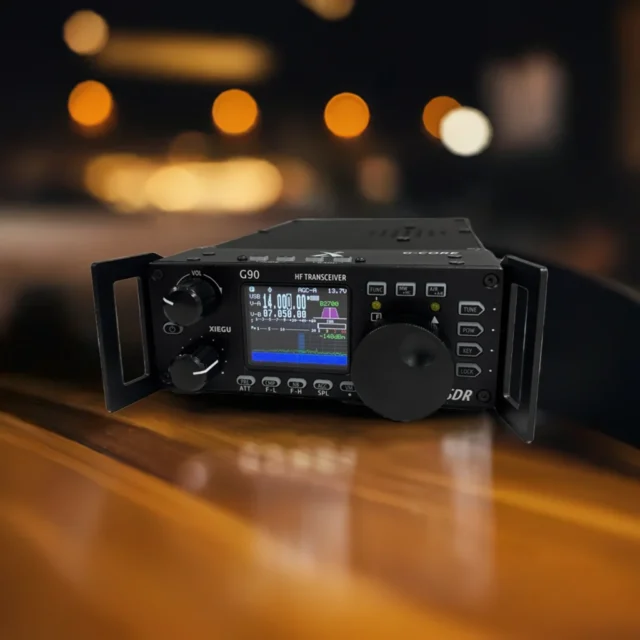
The Xiegu G90 and the Yaesu FT-891 are often mentioned together when portable HF operation is discussed, especially in the context of SOTA (Summits On The Air) and POTA (Parks On The Air). While both radios cover the same HF + 6 m spectrum, their design philosophy, power strategy, and real-world field behavior are fundamentally different.
This article takes a strictly practical view: how these radios behave in the field, on battery power, with real antennas, and under typical SOTA/POTA constraints. Manufacturer specs are included, but equal weight is given to anonymized operator opinions and accumulated field experience.
Design philosophy and target audience
The G90 is built as a compact, semi-SDR transceiver optimized for low-to-moderate power portable use. It targets operators who accept 20 W as a practical compromise between QRP and full power.
The FT-891, in contrast, is essentially a mobile/base-class HF radio compressed into a portable-capable form factor. It is designed around 100 W output, excellent receiver performance, and long-term reliability, even if that means higher current draw and system weight.
In short:
G90: portable-first, power-limited
FT-891: performance-first, power-flexible
Core technical specifications comparison
| Parameter | Xiegu G90 | Yaesu FT-891 |
|---|---|---|
| Frequency coverage | HF + 6 m | HF + 6 m |
| Max TX power | 20 W | 100 W |
| Architecture | SDR-based | Superheterodyne + DSP |
| RX current (idle) | Low | Moderate |
| TX current @ max | Low–medium | High |
| Weight | ~1.4 kg | ~1.9 kg |
| External ATU required | No (internal) | Yes (optional) |
| Cooling | Passive + small fan | Active fan |
| Typical street price | Lower (See the latest Xiegu G90 offers at Radioddity) (or on AliExpress) | Higher |
Numbers alone already suggest the trade-off: energy efficiency vs RF authority.
Transmit power in real sota and pota conditions
On paper, the difference between 20 W and 100 W looks dramatic. In practice, the effect depends heavily on mode, antenna efficiency, and activation style.
Anonymous field observations consistently report:
On CW or digital modes, 20 W is rarely a limiting factor.
On SSB, especially with compromise antennas, the FT-891’s extra power is clearly audible.
A recurring practical pattern:
20 W SSB works well when propagation is good and antennas are efficient.
100 W SSB significantly improves first-call success rate, reducing calling time and battery drain per QSO.
This creates a paradox:
Although the FT-891 consumes more current, it often finishes the activation faster.
Receiver performance and weak-signal handling
Receiver quality matters more than output power once pileups begin.
The FT-891 is consistently described as:
Quieter front-end
Better close-in dynamic range
More effective DSP noise reduction under heavy QRM
The G90 receiver is considered:
Perfectly usable
Slightly noisier in crowded HF segments
More sensitive to strong adjacent signals
In sparse SOTA conditions this difference is minor; in busy POTA activations, it becomes noticeable.
Internal antenna tuner vs external tuner strategy
One of the G90’s strongest advantages is its built-in wide-range ATU.
Field implications:
Faster deployment
Less cabling
More tolerance for non-resonant EFHW or random wires
The FT-891 requires:
A resonant antenna or
An external ATU (adding weight, cables, failure points)
However, operators note:
At 100 W, antenna system quality matters more
A poorly matched antenna wastes the FT-891’s main advantage
In other words:
G90 forgives antenna imperfections
FT-891 rewards good antenna engineering
Power supply realities in portable operation
Battery voltage sensitivity
G90 operates comfortably from 12.0–13.8 V
FT-891 is happiest close to 13.8 V
On LiFePO₄ batteries:
G90 delivers near-full output even as voltage drops
FT-891 output falls noticeably below ~13.0 V
Many portable FT-891 users therefore:
Limit output to 40–50 W
Use heavier batteries
Accept shorter operating windows
This is one of the most common real-world compromises.
Thermal behavior and duty cycle
G90 runs cool due to lower RF output
FT-891 generates significant heat at high power, especially in SSB
Anonymous reports mention:
FT-891 fan noise is audible but effective
Thermal throttling is rare if airflow is unobstructed
G90 remains nearly silent and stable over long sessions
For digital modes with high duty cycle, power reduction on the FT-891 is often recommended.
Ergonomics and field usability
G90:
Dense front panel
Small display
SDR-style spectrum scope useful for band scanning
FT-891:
Clearer display
Better tactile feedback
Menu system optimized for mobile use
Gloved operation and cold-weather use consistently favor the FT-891.
Reliability and long-term field durability
Yaesu’s long-standing reputation is reflected here:
FT-891 units show strong resistance to temperature extremes
Mechanical controls age well
Connectors feel robust
The G90 is generally reliable, but:
Perceived as less rugged
Build quality is “adequate”, not over-engineered
This difference matters more for frequent activators than occasional users.
HAM operator opinions
On the G90:
“Perfect balance between QRP and usability.”
“The internal tuner changes everything.”
“Receiver is good, not great, but good enough for portable work.”
On the FT-891:
“Feels like cheating in POTA pileups.”
“Heavy, but never lets me down.”
“At 50 W it’s the sweet spot.”
Interestingly, many experienced operators end up owning both, using them for different activation styles.
Which radio fits which activation style
Choose the Xiegu G90 if:
Weight matters more than power
You prefer wire antennas and quick setups
You operate mostly CW, FT8, or relaxed SSB
Choose the Yaesu FT-891 if:
You prioritize SSB performance
You activate busy parks or rare summits
You accept higher system complexity for stronger signals
Practical takeaway
From a SOTA/POTA perspective, this is not a matter of “better” or “worse”, but operational philosophy.
The G90 emphasizes efficiency, simplicity, and flexibility.
The FT-891 emphasizes signal authority, receiver quality, and reliability.
Both radios are proven in the field. The correct choice depends less on specifications and more on how you prefer to operate when every gram, watt, and minute matters.
Image(s) used in this article are either AI-generated or sourced from royalty-free platforms like Pixabay or Pexels.
This article may contain affiliate links. If you purchase through these links, we may earn a commission at no extra cost to you.
Get the weekly RF & IT briefing
Radio guides, RF calculators, AI, Windows, Linux and satellite communication explainers. One useful email per week. No spam.