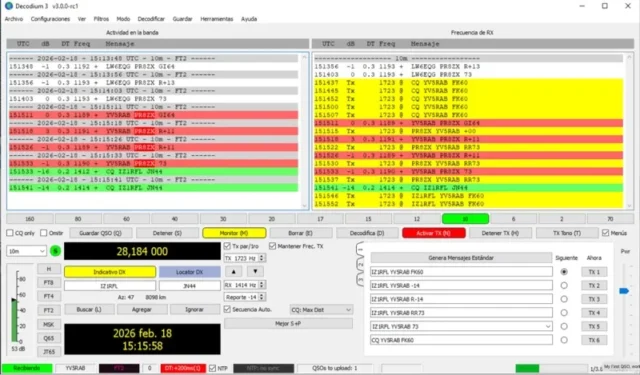
This article explores the question from a signal-processing, information-theory, HF propagation, spectral-efficiency, hardware, and community-adoption perspective.
Understanding the Physics: Processing Gain and Shannon Limits
At its core, the idea of FT16 relies on one simple principle: longer coherent integration increases processing gain.
For additive white Gaussian noise (AWGN), doubling integration time theoretically provides approximately +3 dB improvement in SNR. This comes directly from energy accumulation over time:
SNR ∝ Signal Energy / Noise Energy
Since signal energy increases linearly with time while noise integrates statistically, longer symbol durations improve decodability — assuming the channel remains coherent.
However, Shannon capacity places a hard boundary on what is achievable:
C = B log2(1 + SNR)
As SNR becomes extremely negative, improvements require exponentially more integration time or stronger coding. Therefore, gains beyond 6–8 dB rapidly become inefficient unless bandwidth is reduced dramatically.
This is precisely why WSPR achieves extreme sensitivity: not only long integration (~110 s), but extremely narrow bandwidth (~6 Hz).
An FT16 implementation that keeps ~50 Hz bandwidth cannot approach WSPR-level performance indefinitely through time extension alone.
Channel Coherence on HF
HF propagation is not a static channel. It is a time-varying, frequency-selective, multipath environment.
Key constraints:
Fading (QSB) time constants: typically 5–20 seconds
Selective fading across narrow frequency spans
Doppler spread in dynamic ionospheric conditions
Rapid signal amplitude variation during greyline transitions
If the coherence time of the channel is shorter than the transmission duration, coherent integration efficiency degrades.
For example:
15 s integration → often within fading coherence window
60 s integration → likely spans multiple fading cycles
In practice, this means the theoretical +6 dB gain at 60 seconds may compress to +3–4 dB on real HF paths.
Therefore, FT16’s practical improvement is constrained by propagation physics, not algorithmic limitations.
Coding Considerations: Stronger FEC vs Longer Frames
Sensitivity improvements can be achieved through:
Longer integration
Lower symbol rate
Stronger forward error correction
Narrower bandwidth
Hybrid combinations
Stronger FEC (e.g., lower code rate LDPC) increases redundancy but reduces net information throughput. Message length must remain constrained to preserve practical QSO exchange timing.
FT8’s structured message format is optimized for minimal overhead. Extending redundancy further would increase robustness but reduce spectral efficiency.
FT16 would likely need:
Lower code rate (e.g., 1/3 instead of ~1/2)
Deeper interleaving to combat fading
Improved time-frequency synchronization tolerance
Each addition improves sensitivity but increases decoding complexity and CPU demand.
Hardware and Stability Requirements
Longer transmissions place stricter demands on:
Frequency stability (TCXO minimum)
Time synchronization (sub-second NTP accuracy)
Receiver phase noise performance
SDR dynamic range
In practice, many stations operating FT8 today use consumer-grade oscillators with modest drift. FT16 may implicitly raise the hardware baseline.
This could limit adoption in portable or budget setups unless decoder algorithms incorporate drift compensation mechanisms.
Energy Efficiency and Portable Operation
One strong argument in favor of FT16 is energy efficiency.
Portable QRP operation is constrained by:
Battery capacity
Solar charging limitations
Thermal dissipation in compact transceivers
If FT16 reduces required transmit power by 3 dB, energy consumption halves for equivalent link reliability.
However, longer transmissions also increase duty cycle per QSO attempt. Total energy per completed QSO must be considered, not just instantaneous power.
Energy per QSO becomes:
E = P × T × retransmissions
If longer transmissions reduce retransmissions due to better decodability, total energy efficiency may improve despite longer airtime.
This area deserves quantitative modeling.
Network Effect and Adoption Dynamics
Digital modes succeed not only due to technical merit but due to adoption density.
FT8 became dominant because:
It solved a real problem (weak-signal DX)
It was integrated into widely used software
It had immediate global participation
It occupied well-defined sub-bands
FT4, despite technical validity, remains secondary due to narrower use-case demand.
FT16 risks entering the same category unless it clearly differentiates itself.
Adoption depends on:
Visible performance advantage
Backward compatibility
Community advocacy
Demonstrable DX results
Without these, technical superiority alone does not ensure success.
Band-Specific Considerations
The utility of FT16 may vary by band:
160 m and 80 m:
High noise floor
Longer fading cycles
Greater benefit from extra sensitivity
20 m:
High activity density
Moderate fading
Mixed benefit
10 m:
Rapid sporadic E fading
Short coherence times
Limited benefit from long integration
Thus, FT16 may find its niche on low bands during solar minimum.
Competitive Alternatives: Adaptive Modes
Instead of creating a separate FT16 mode, an adaptive architecture could be considered:
Dynamic cycle length based on SNR
Automatic fallback to longer frames
SNR-aware coding rate adjustments
Hybrid fast/slow response protocol
Such an approach would minimize fragmentation while enabling extended sensitivity when required.
This could represent a more forward-looking evolution than a fixed-length “FT16.”
Quantitative Link Budget Illustration
Consider:
20 m path
10,000 km
10 W transmit
0 dBi antenna
–120 dBm noise floor
If marginal FT8 decoding occurs at –24 dB SNR, a +3 dB FT16 gain shifts the margin significantly in deep-fade scenarios.
However, if path loss variability exceeds 10 dB due to QSB, the incremental gain may not change success probability dramatically.
Statistically, the probability-of-decode curve shifts modestly rather than fundamentally.
Psychological and Operational Factors
Operator satisfaction also matters.
FT8 already faces criticism for:
Automation
Minimal operator interaction
Structured exchanges
FT16 would further slow exchanges without adding conversational depth.
Unless it incorporates enhanced messaging capability, it may not satisfy those seeking more interactive digital communication (e.g., JS8Call philosophy).
Is There a Compelling Strategic Case?
The strongest arguments for FT16:
Measurable sensitivity gain
QRP friendliness
Marginal DX experimentation
Low-band weak-signal exploration
The strongest counterarguments:
Limited incremental benefit
Increased latency
Spectrum occupancy concerns
Community fragmentation risk
Hardware stability demands
Technically, FT16 is coherent and feasible.
Strategically, it must justify its existence by delivering a clearly visible advantage under real-world conditions, not only under laboratory assumptions.
Conclusion
Developing FT16 would not violate any physical constraints, nor would it represent a trivial modification. It would meaningfully explore the sensitivity–latency trade space in weak-signal digital communication.
However, its gains are bounded by ionospheric coherence time, oscillator stability, and spectral practicality. The improvement would likely be evolutionary rather than transformative.
If FT2 represents optimization toward temporal efficiency and responsiveness, FT16 would represent optimization toward marginal decodability and QRP efficiency.
Whether that direction is worth pursuing depends less on signal theory and more on community appetite for trading speed for depth in the next phase of digital mode evolution.
Image(s) used in this article are either AI-generated or sourced from royalty-free platforms like Pixabay or Pexels.
This article may contain affiliate links. If you purchase through these links, we may earn a commission at no extra cost to you.
Get the weekly RF & IT briefing
Radio guides, RF calculators, AI, Windows, Linux and satellite communication explainers. One useful email per week. No spam.