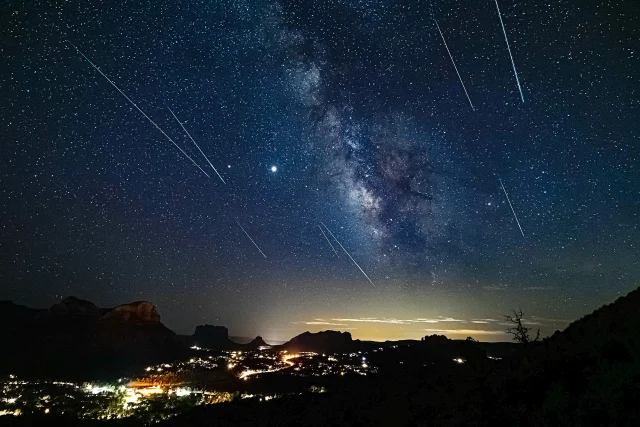
Every August, the Perseids return with the kind of reliability that makes them feel almost personal. They are not a rare eclipse, not a once-in-a-lifetime comet, not a celestial accident that demands frantic travel and a cloud-free horizon on one specific evening. They are a summer ritual, a familiar crossing of Earth through the dusty wake of Comet Swift-Tuttle, and for many people they mean blankets on the grass, dark country roads, thermos flasks, and a patient gaze toward the northeast before dawn. Yet for radio amateurs, VHF contesters, UHF experimenters, SHF operators, and anyone who has ever watched a digital waterfall glow in a quiet shack at three in the morning, the Perseids are something more than a visual spectacle. They are a temporary communications medium, a natural scattering system in the upper atmosphere, a brief season when dust grains from deep space become radio mirrors above our heads.
The 2026 Perseid maximum is particularly promising. The shower is active from mid-July to late August, but the most interesting period will fall around the night of August 12–13, with the predicted maximum occurring on August 13. For observers and radio operators in Central Europe, the exact mathematical peak occurs during daylight hours, but that does not make the event uninteresting. Meteor activity is not a switch that turns on and off at one exact minute. The Earth passes through a broad stream of comet debris, and the useful radio and visual activity builds, peaks, and fades over several nights. The best practical observing windows will be the late-night and pre-dawn hours around August 12–13, with worthwhile activity also on the preceding and following nights. In 2026 the Moon will not be a serious problem, which makes the shower attractive for visual observers and gives radio amateurs the pleasing possibility of comparing what is seen by eye with what is heard, decoded, or recorded on VHF.
For the general public, the Perseids are usually advertised through the language of “shooting stars” and hourly meteor counts. For a radio amateur, the experience is more subtle and often more fascinating. The useful question is not simply how many meteors will appear in the sky, but how many of them will leave ionized trails strong enough to scatter radio signals, how long those trails will last, which frequencies will be favored, and what kind of contacts or receptions may become possible. During a good Perseid night, a quiet VHF frequency can suddenly come alive with sharp pings, short fragments of distant speech, bursts of telemetry, distorted FM audio, or digital decodes that appear out of nowhere and vanish before the operator has fully reacted. On 50 MHz, 70 MHz, 144 MHz, and sometimes higher, the sky becomes a dynamic, unstable, natural reflector. For a few tenths of a second, or occasionally several seconds, stations separated by hundreds or even more than a thousand kilometers may find themselves connected by a trail of plasma left by a speck of comet dust.
From Comet Dust to Radio Propagation
The Perseids originate from Comet 109P/Swift-Tuttle, a large periodic comet whose orbit intersects the path of Earth every August. Over many revolutions around the Sun, the comet has shed dust, grains, and small fragments into space. These particles continue to travel along roughly similar orbital paths, forming a stream of debris through which Earth passes once a year. When these particles enter the upper atmosphere, they do so at tremendous speed, often around 59 kilometers per second. At that velocity, even a tiny grain carries enough kinetic energy to compress and heat the air ahead of it, creating the visible streak we call a meteor. The streak is brief because the particle is rapidly destroyed, but its atmospheric effect does not always vanish instantly. Behind the meteor remains a thin, elongated trail of ionized gas.
That trail is the key to meteor scatter. A radio signal that would normally continue into space or disappear beyond the horizon may encounter this ionized column and scatter back toward Earth. In practical terms, the meteor trail behaves like a temporary, irregular reflector located roughly 80 to 110 kilometers above the surface. It is not a smooth mirror, and it is not stable. It forms rapidly, changes shape, diffuses, drifts in high-altitude winds, and then fades as the electrons recombine and the ionization weakens. But while it exists, it can support communication over distances that are far beyond ordinary VHF line-of-sight range.
The exact behavior depends heavily on frequency. Lower VHF bands tend to be more forgiving because the ionized trails can reflect or scatter them more efficiently. The 50 MHz band is often generous during meteor showers, and the 70 MHz band, where available, can also be very productive. The 144 MHz band is perhaps the classic playground for modern amateur meteor scatter, especially with digital modes such as MSK144. Above that, on 432 MHz and into the microwave bands, meteor scatter becomes more demanding. Reflections tend to be weaker and shorter, and successful operation requires more antenna gain, better station stability, accurate timing, good operating discipline, and realistic expectations. Still, the challenge is precisely what makes UHF and SHF meteor work attractive to serious experimenters. It is a meeting point of astronomy, radio engineering, propagation science, and competitive operating skill.
A meteor trail may produce two broad kinds of radio events. An underdense trail is produced by a smaller meteor and reflects only a small portion of the incident radio energy. It usually lasts a fraction of a second and creates the familiar short ping. These pings can be too brief for ordinary voice communication but are excellent for high-speed digital modes designed to squeeze callsigns, reports, and confirmations into very short bursts. An overdense trail is produced by a larger or brighter meteor. It can reflect more strongly and last longer, sometimes for several seconds or more. These longer burns are the events that make operators look up from their screens. They may allow a voice fragment, a complete digital exchange, or even a surprisingly solid moment of propagation on a path that was dead a second earlier.
What the Ordinary Radio Amateur May Notice
The first surprise for many beginners is that they do not need to see a meteor to hear one. The radio path depends on the location and geometry of the ionized trail relative to the transmitting and receiving stations. A meteor that is visually invisible from the operator’s location may still produce a usable radio reflection. Conversely, a spectacular meteor overhead may not scatter the desired signal into the receiving antenna. The radio sky and the visual sky overlap, but they are not identical. This is why meteor scatter can be compelling even under suburban skies where light pollution makes visual observing disappointing. The radio receiver does not care whether streetlights wash out the Milky Way. It cares about frequency, geometry, signal strength, noise, timing, and the momentary existence of ionized plasma in the right part of the atmosphere.
A simple radio amateur with a modest VHF station may hear sudden bursts from distant beacons, repeaters, broadcast transmitters, or amateur stations. On FM, the effect can be uncanny. A frequency that has been silent may suddenly produce a half-second of speech, music, squelch tail, or data. The sound may be clipped, warbling, fluttery, or distorted by Doppler shift and rapid fading. On SSB or CW, meteor reflections often sound like sharp pings, rising tones, raspy bursts, or brief flashes of signal that appear well above the noise and vanish just as quickly. On a waterfall display, they may appear as vertical streaks or slanted traces, depending on the signal, the duration of the reflection, and the amount of frequency shift.
For operators using WSJT-X or similar software, the 2026 Perseids will likely be a productive opportunity on 50 MHz and 144 MHz. The modern digital mode most closely associated with amateur meteor scatter is MSK144, a fast mode designed specifically for brief ionospheric and meteor-burst propagation. It sends structured messages quickly and can decode signals that would be difficult or impossible to copy by ear. During the peak of a strong shower, the screen may fill with decodes from stations that are normally unreachable. The operator’s task becomes a blend of patience and speed: transmit in the correct period, maintain accurate computer time, aim the antenna sensibly, respond quickly to partial decodes, and avoid creating chaos on crowded calling frequencies.
The ordinary station does not need to be heroic. A typical 2-meter station with a reasonable Yagi, moderate power, low-loss coax, and correctly configured software can make meteor scatter contacts during a major shower. On 6 meters, even smaller stations may have success because propagation is more forgiving. However, expectations matter. Meteor scatter is not like opening a repeater. Contacts may require repeated attempts, incomplete messages, patience, and an understanding of the rhythm of the mode. The path is not continuously open. It opens in fragments. The operator is not using a stable ionospheric layer or a satellite transponder, but a random sequence of microscopic cosmic impacts.
The VHF Contester’s Perspective
For the VHF contester, the Perseids are both an opportunity and a test of discipline. Meteor scatter can turn an otherwise limited station into a regional or continental performer for brief moments, but it rewards preparation more than improvisation. Good contest operators know their station timing, antenna headings, locator strategy, band plan, and logging workflow before the shower begins. During the Perseids, there may be enough activity to make casual operating enjoyable, but serious work still depends on choosing paths intelligently. The best meteor scatter geometry is not always the same as simply pointing directly at the other station. The effective reflection point lies somewhere along the great-circle path, typically high in the atmosphere between the two endpoints. For many practical amateur contacts, pointing antennas toward the other station works well enough, especially with wider-beam antennas, but narrow-beam systems and longer paths benefit from more deliberate aiming.
Distance is one of the most interesting features of meteor scatter. Too short a path may not benefit much because normal propagation or tropospheric effects may already dominate, and the geometry may be less favorable. Very long paths become more difficult because the reflection angle and trail position become less cooperative. In European VHF practice, meteor scatter contacts commonly occur over several hundred to roughly two thousand kilometers, depending on band, power, antennas, mode, and conditions. This makes the Perseids highly relevant for grid chasing and contest scoring. Stations that are usually beyond the VHF horizon can become workable in short bursts, allowing operators to fill locator squares that would otherwise require aircraft scatter, tropospheric ducting, sporadic E, or exceptional conditions.
The 144 MHz band is the most familiar contesting arena for meteor scatter because it combines manageable equipment with meaningful propagation challenge. A well-equipped 2-meter station using MSK144 can work a surprising number of stations during a good shower, especially across Europe where amateur activity density is high. The operator will notice that the band has a rhythm. There are quiet minutes when nothing decodes, then sudden clusters of pings as Earth encounters denser parts of the stream or as local geometry becomes favorable. Around dawn, activity can become particularly productive because the observer’s location is rotating into the direction of Earth’s motion through space. This “morning enhancement” is one reason pre-dawn meteor scatter is often so rewarding, even when the predicted shower maximum falls at an inconvenient hour.
Contest strategy also has to respect the difference between random and scheduled contacts. Random calling can produce pleasant surprises, especially during a busy shower, but scheduled attempts remain valuable for difficult paths, rare locators, and higher bands. A scheduled meteor scatter contact can feel strangely old-fashioned despite the digital software: two operators agree on frequency, time sequence, antenna direction, and procedure, then wait for the sky to provide a suitable trail. When it works, the sense of achievement is out of proportion to the short amount of data exchanged. The contact may consist of little more than callsigns, reports, and acknowledgments, but behind it is a chain of engineering assumptions and natural timing that had to align perfectly.
What Happens on UHF and SHF
The higher the frequency, the less forgiving meteor scatter becomes. On 432 MHz, meteor reflections are possible, but they are generally shorter and weaker than on 144 MHz. Antenna gain becomes more important, system noise matters more, and station stability becomes less optional. Operators who are accustomed to 2-meter meteor scatter may find 70 centimeters less generous. A burst that would produce a clean decode on 144 MHz may be marginal or invisible on 432 MHz. Still, during a major shower like the Perseids, strong meteors can create usable reflections, and skilled UHF operators may exploit them for difficult contacts.
On SHF and microwave bands, the situation becomes even more specialized. Meteor scatter at 1.2 GHz and above is not impossible, but it is not an everyday casual operating mode. Signals may be extremely brief, and the scattering physics becomes less favorable. Many microwave operators are more familiar with aircraft scatter, rain scatter, tropospheric enhancement, ducting, and line-of-sight hilltop work than with meteor scatter as a routine tool. However, the Perseids can still be interesting to SHF experimenters because they create intense, short-lived ionization events that may interact with radio signals in measurable ways. The result may not always be a complete two-way contact. It may be a burst on a beacon, a curious trace on a spectrum display, or a single decoded fragment that suggests the path briefly existed.
For telecommunications engineers and technically minded radio amateurs, the Perseids offer a natural laboratory in transient propagation. Unlike commercial systems designed for reliability, meteor scatter is probabilistic. The path does not exist, then briefly exists, then disappears. This makes it unsuitable for ordinary modern telecommunications, but historically meteor burst communication did have practical uses, especially for remote data links where low throughput was acceptable and infrastructure was limited. The principle remains elegant: instead of building a tower, launching a satellite, or relying on an ionospheric layer that changes with solar conditions, the system waits for nature to write temporary reflectors into the sky.
Modern commercial VHF, UHF, and SHF networks are generally engineered to avoid dependence on such randomness. Cellular systems, microwave links, public safety networks, broadcasting infrastructure, and fixed wireless access need predictable coverage, controlled interference, licensing discipline, and high availability. A meteor burst is not a service-level agreement. Yet service providers and spectrum professionals may still notice meteor effects as short anomalies, especially in sensitive receiving systems, monitoring stations, or networks operating near the edge of coverage. A distant transmitter that should be geographically irrelevant can appear briefly. A monitoring receiver may catch a burst of unexpected signal. In most commercial contexts this is noise, interference, or curiosity. In the amateur context, it is the entire point.
How the Shower Feels in the Shack
There is a particular atmosphere to a good Perseid radio night. The room is dark except for the monitor. The antenna rotator clicks occasionally. The receiver noise is steady enough to become part of the furniture. Outside, the air may still be warm from the day, but the best hours tend to arrive when the rest of the neighborhood is asleep. The operator has one eye on the waterfall, one eye on the clock, and one eye, metaphorically at least, on the sky. Then a trace appears. A signal rises sharply out of the noise, bright and narrow, perhaps lasting only 300 milliseconds. A callsign decodes. Another one follows. A partial report arrives. The operator transmits in the next period, hoping that another particle from a comet will enter the atmosphere in just the right place before the other station gives up.
This is why meteor scatter has retained its charm even in the age of internet-linked repeaters, remote receivers, global spotting networks, and software-defined everything. It is technologically modern but emotionally ancient. The operator is using digital signal processing, GPS-disciplined timing, low-noise preamplifiers, carefully modeled antennas, and computer-assisted decoding. Yet the communication path depends on dust older than civilization, moving through space on an orbit shaped by gravity and time. A meteor scatter contact is not only a radio achievement. It is a physical event shared by two stations and a piece of Solar System debris that neither operator can control.
For newcomers, the experience can be confusing at first because nothing behaves like normal propagation. A strong station may be absent for minutes, then suddenly decode perfectly. A weaker station may appear repeatedly because the geometry is favorable. A frequency may sound dead by ear while the software quietly collects decodable fragments. The operator may be tempted to increase power, swing the antenna wildly, or change settings too often, when the better approach is usually patience, correct timing, and stable operation. Meteor scatter rewards calm. It is a mode in which the sky does much of the switching.
The sound itself is worth attention. Many amateurs know the clean tones of FT8, the conversational texture of SSB, the sharp elegance of CW, or the rough utility of FM. Meteor scatter adds something more percussive. It is radio propagation as impact. Pings arrive like small electrical sparks. Longer burns can smear and ripple as the trail evolves. Doppler effects may bend the received tone. The signal can rise explosively, flutter, split, or decay in a way that reminds the listener that the reflector is not a machine but a rapidly expanding tube of plasma in high-altitude wind. Even when no contact is completed, monitoring meteor reflections can be satisfying because every burst is evidence of a real event overhead.
Visual Observing and Radio Observing Together
The 2026 Perseids will be visually favorable because moonlight will not dominate the sky near the peak. That matters even for radio operators, because the best Perseid nights are often those that combine both worlds. A radio amateur can leave a receiver monitoring a known frequency while stepping outside between transmit periods to watch the sky. The visual radiant of the Perseids lies in the constellation Perseus, but meteors may appear across a wide area of the sky. The longest and most dramatic visual meteors often appear some distance away from the radiant, streaking across broad regions of the heavens. For radio work, however, the important geometry is not simply where the eye sees the meteor, but where the ionized trail forms relative to the radio path.
The contrast between visual and radio observing teaches an important lesson about meteor showers. A visual observer counts what the eye can see from one location under a particular sky. A radio observer detects what a transmitter, receiver, antenna system, and scattering geometry make possible. The two records will not match perfectly. During cloudy weather, radio may continue while visual observing fails completely. During bright twilight, radio remains useful. During daylight, strong meteor scatter still occurs even though the meteors are invisible to the eye. This makes radio observation a powerful complement to visual astronomy, especially in regions where summer weather is unpredictable.
For an amateur who wants to experience the shower without immediately making contacts, the simplest method is passive reception. Monitoring distant VHF transmitters, beacons, or suitable signals can reveal meteor pings with modest equipment. In some parts of the world, powerful broadcast transmitters or dedicated meteor radar transmitters are commonly used for this purpose. A software-defined radio with a basic VHF antenna can show the sudden traces clearly on a waterfall display. This approach is educational because it separates the phenomenon from the pressure of operating. The listener can simply watch the sky write itself into the spectrum.
Active two-way meteor scatter is more demanding but also more rewarding. It requires attention to band plans, legal power limits, operating procedures, frequency discipline, and courtesy. During major showers, popular frequencies can become crowded, and the efficiency of digital modes can create the illusion that procedure no longer matters. It does. Good operators avoid unnecessary calling, keep messages structured, respect regional practices, and remember that a weak-signal frequency is a shared scientific and sporting space. The sky may be random, but the humans do not need to be.
Why Timing Matters So Much
Meteor scatter is strongly affected by the daily rotation of Earth. In the hours after midnight and especially before dawn, an observer’s location is rotating into the direction of Earth’s orbital motion. In simple terms, the morning side of Earth is the leading side, sweeping into more meteoroids. This is why meteor rates tend to be higher before dawn than in the evening. For the Perseids, this makes late-night and early-morning sessions especially important, even when the official peak time falls during the day for a particular region. Operators in Hungary and Central Europe should therefore treat the nights around August 12–13 as the main opportunity, with pre-dawn hours on August 13 likely to be especially valuable.
The predicted maximum is useful, but meteor showers are not perfectly deterministic. The Perseid stream contains filaments, older trails, and density variations created by the long history of Swift-Tuttle’s orbit and gravitational perturbations from planets. Some years produce enhanced activity. Other years are merely good. Radio operators may notice this as changes in burst rate, burst strength, and the number of long-duration events. A shower night can feel alive in waves. For twenty minutes the band may seem disappointing; then, suddenly, multiple stations decode, long pings occur, and operators rush to complete exchanges before the activity relaxes again.
Accurate station timing is essential for digital meteor scatter. Modes such as MSK144 rely on synchronized transmit and receive periods, commonly alternating in short sequences. If a computer clock is significantly wrong, the station may transmit at the wrong time or fail to decode properly. This is one of the least glamorous but most important technical requirements. A good antenna and amplifier cannot compensate for bad timing. In the modern shack, network time synchronization or GPS-based timing is as much a part of meteor scatter readiness as coax connectors and rotator cables.
There is also strategic timing over several days. Many casual observers focus only on the advertised peak night, but radio operators can benefit from activity before and after maximum. The nights leading into the peak may offer less crowding and still produce many useful bursts. The night after the maximum may remain active enough for productive contacts, especially if weather, sleep, work schedules, or local noise interfere with the main night. A practical operator treats the Perseids as a campaign, not a single appointment.
Equipment Expectations for Different Operators
A modest 6-meter station may have the easiest entry into Perseid meteor scatter. The 50 MHz band is sensitive to several propagation modes, including sporadic E, tropospheric enhancement, and meteor scatter, which can sometimes overlap during summer. This makes it lively but also complicated. A station hearing a sudden burst on 50 MHz during August may reasonably suspect a meteor, but other propagation modes can also be present. The advantage is that 6 meters can produce strong reflections with relatively modest antennas. A small beam or even a good omnidirectional antenna may provide enjoyable reception, and digital modes can extend the usefulness of limited stations.
On 2 meters, station quality becomes more important, but the band remains accessible. A directional antenna, clean receiver, reasonable transmit power, and low-loss feedline make a significant difference. Many successful stations use Yagi antennas with enough gain to focus energy along desired paths. A low-noise preamplifier can help, especially if feedline loss is significant, though it must be used carefully in strong-signal environments. The operator should pay close attention to local noise sources. Switching power supplies, computers, LED lighting, solar inverters, and nearby electronics can raise the noise floor enough to hide weak bursts. Meteor scatter is often a game of short margins, and a few decibels of improvement may determine whether a burst becomes a decode.
On 70 centimeters, the technical demands rise again. Antenna gain, accurate aiming, and station sensitivity become more critical. The shorter wavelength allows compact high-gain antennas compared with lower bands, but losses in coax and connectors become more punishing. Operators experimenting on 432 MHz during the Perseids should be prepared for fewer decodes and shorter opportunities. The reward is that each successful contact carries more weight. It represents not only favorable sky conditions, but also a station engineered well enough to exploit them.
For SHF operators, the Perseids are less likely to be a casual communications bonanza and more likely to be a field of experiments. Microwave stations with dishes, transverters, stable oscillators, and careful receive chains may look for brief anomalies on beacons or attempt scheduled paths with similarly equipped stations. At these frequencies, aircraft scatter may be more predictable and useful than meteor scatter, but meteor events can still provide intriguing observations. The serious microwave experimenter is often less interested in easy contacts than in understanding what the signal did, how long it lasted, what the Doppler looked like, and whether the event can be correlated with known meteor activity.
The Role of Software and Digital Modes
Meteor scatter has always favored speed. In earlier decades, operators used high-speed CW, tape recorders, specialized procedures, and later computer-assisted methods to capture information during short bursts. Modern digital modes have made the practice far more accessible. MSK144 is designed to transmit structured information quickly and decode brief, weak signals efficiently. It does not make meteor scatter automatic, but it changes the threshold of success. A burst that would once have been only a mysterious ping in the headphones can now become a callsign, a locator, and a report.
This shift has changed the culture of meteor scatter. It has lowered the entry barrier, increased activity, and made casual participation possible with stations that would once have struggled. At the same time, it has introduced new forms of dependence. Operators now rely on software configuration, computer timing, audio levels, interface stability, and correct sequencing. A misconfigured sound device or incorrect period setting can ruin an otherwise capable station. The radio art has not disappeared; it has migrated into the interaction between RF engineering and digital signal processing.
There is a temptation to treat decodes as the whole experience, but that would be a mistake. The best operators still listen, observe the waterfall, understand propagation, and make strategic choices. Software can decode a burst, but it cannot fully replace judgment. It cannot know whether the antenna heading is poor, whether local noise is masking signals, whether a frequency is too crowded, or whether a scheduled station would be better worked on another path. Meteor scatter remains an operator’s mode because the environment changes too quickly for passive automation to be truly satisfying.
The digital record also has scientific value. Logs of burst times, signal strengths, durations, Doppler behavior, and reception paths can reveal patterns in shower activity. Amateur observations are not a replacement for professional meteor radar networks, but they form part of a broader culture of citizen science and technical curiosity. The same station that completes a contest contact may also be documenting the behavior of a natural ionization event. In that sense, the Perseids connect amateur radio with atmospheric science, astronomy, and space weather.
What a Telecommunications Professional Might Recognize
A telecommunications provider usually designs networks to suppress surprises. Link budgets, fade margins, frequency planning, antenna patterns, site diversity, modulation schemes, and error correction exist to make communication predictable. Meteor scatter is almost the opposite: a propagation mode built from short-lived natural uncertainty. Yet precisely because it is unpredictable, it can teach useful lessons about the radio environment. The VHF and UHF spectrum is not bounded only by the optical horizon. Under certain conditions, energy travels far beyond where network planners might expect it, even if only briefly.
For commercial systems, meteor reflections can appear as transient interference or anomalous reception. A distant transmitter may briefly become audible. A monitoring system may log a signal from beyond the normal service area. A receiver near threshold may experience an unexplained burst. In most cases, these effects are too brief to matter operationally, but they remind engineers that the atmosphere is not a passive empty volume. It is an active, changing medium influenced by solar radiation, weather, ionization, aircraft, precipitation, terrain, temperature layers, and meteors.
Historically, meteor burst communication was explored and used for specialized long-distance data links, especially where infrastructure was sparse. Such systems took advantage of the same basic phenomenon that radio amateurs exploit during showers: short bursts of propagation created by ionized meteor trails. The data rates were low by modern standards, and latency was inherent because the system had to wait for suitable meteors. But for remote telemetry, military communication, environmental monitoring, or polar-region links, the approach had practical appeal. Today, satellites, cellular networks, fiber, microwave backhaul, and low-Earth-orbit constellations have changed the communications landscape, but meteor scatter remains a beautiful example of engineering with nature rather than against it.
The amateur VHF contest station sits somewhere between professional RF engineering and experimental play. It uses serious antennas, carefully measured noise figures, frequency stability, digital processing, and disciplined operating procedures. Yet it is also free to chase effects that would be unacceptable in a commercial service. No mobile operator wants a base station that works only when comet dust cooperates. But the radio amateur does. That difference is part of what keeps amateur radio scientifically alive.
Limitations, Frustrations, and False Expectations
The Perseids can be spectacular, but they are not magic. A beginner may read about a major meteor shower and expect continuous long-distance VHF propagation throughout the night. That is not what happens. Even at the peak, meteor scatter consists of bursts separated by silence. Many bursts are too weak, too short, or geometrically unsuitable for a particular path. Some periods will feel strangely quiet. Other operators may be stronger, better located, or using more effective antennas. Local noise may ruin reception. Software may decode only fragments. A promising contact may fail after several partial exchanges because the necessary final confirmation never arrives.
Another source of confusion is the difference between meteor rate and radio usefulness. A visually rich shower does not guarantee that every operator will experience extraordinary radio propagation. The size distribution of meteoroids, radiant geometry, station locations, operating frequency, antenna direction, and local conditions all matter. A faint visual meteor may produce a useful radio ping, while a bright one may be irrelevant to a particular path. The operator is sampling the shower through an RF system, not watching it directly.
Crowding can also be a problem during major showers. Popular meteor scatter frequencies may become busy, and digital modes can produce dense activity that requires discipline. Strong stations may dominate. Poorly timed transmissions, excessive calling, incorrect message sequencing, and overdriven audio can reduce everyone’s success. The solution is not merely technical. It is cultural. Meteor scatter works best when operators understand that they are sharing both spectrum and opportunity. Every unnecessary transmission may cover someone else’s brief burst.
Weather can still matter, though not in the same way it matters for visual observing. Clouds do not block VHF meteor scatter, but storms, static crashes, wet antennas, wind-loaded arrays, and safety concerns can affect operating. Summer thunderstorms are not trivial for stations with towers, rotators, masthead preamplifiers, and long feedlines. A good Perseid night is not worth risking equipment or personal safety. The sky will produce more meteors next year. Lightning is less forgiving.
The 2026 Opportunity
The 2026 Perseids offer a favorable combination of strong annual shower activity and dark skies near maximum. For Central European operators, the exact peak timing means that the most practical sessions will be the nights surrounding August 12–13, especially the pre-dawn hours. Visual observers should benefit from the lack of moonlight, while radio operators should enjoy elevated burst rates across the usual meteor scatter bands. The days before and after maximum should not be ignored, particularly by operators who prefer less congestion or who want to test equipment before the busiest night.
For the “simple” radio amateur, the best goal may be observation rather than ambition. Listen to a known VHF signal. Watch a waterfall. Try MSK144 on 50 MHz or 144 MHz. Compare what the screen shows with what the eye sees outside. Learn the sound of pings and burns. Notice how activity changes through the night. The first successful meteor scatter decode or contact is memorable because it changes the way the operator imagines the atmosphere. The sky is no longer just a background. It becomes part of the station.
For the VHF competitor, 2026 is a chance to work locators that are normally difficult, test station readiness, refine operating procedures, and exploit one of the most reliable annual propagation events. For the UHF and SHF experimenter, it is a chance to search for rarer effects, measure short reflections, monitor beacons, and push station capability against a natural limit. For telecommunications-minded observers, it is a reminder that radio systems exist inside a planetary environment that is never completely still.
The Perseids are popular because they are beautiful, but for radio amateurs they are beautiful in a second way. They reveal that communication is not always carried by cables, towers, satellites, or planned infrastructure. Sometimes it is carried by a glowing wound in the upper atmosphere, made by a dust grain from a comet, lasting less than a second, just long enough for a callsign to cross a continent.
Image(s) used in this article are either AI-generated or sourced from royalty-free platforms like Pixabay or Pexels.
This article may contain affiliate links. If you purchase through these links, we may earn a commission at no extra cost to you.
Get the weekly RF & IT briefing
Radio guides, RF calculators, AI, Windows, Linux and satellite communication explainers. One useful email per week. No spam.