How to choose the right coaxial cable for ham radio, SDR and RF antennas
Antenna discussions usually start with gain, height, radiation pattern, take-off angle and matching. The coaxial cable is often treated as a secondary detail, something bought after the antenna and radio have already been chosen. In real RF systems, that small black cable between the transceiver and the antenna can decide whether a station feels sharp, efficient and quiet — or weak, noisy and frustrating.
A poor coaxial cable does not fail dramatically. It simply turns RF energy into heat. On transmit, part of the power that should reach the antenna disappears before it ever leaves the shack. On receive, weak signals are attenuated before the receiver has a chance to hear them. The effect is especially brutal on VHF, UHF and microwave frequencies, where a cable that seems acceptable on shortwave can become a serious bottleneck.
This guide explains how to choose coaxial cable for amateur radio, SDR receivers, scanners, VHF/UHF antennas, portable operation and fixed home stations. It covers common cable types such as RG-58, RG-8X, RG-213, LMR-400, Aircell 7, Ecoflex 10 and Ecoflex 15, and explains why the right choice depends less on brand names and more on frequency, cable length, installation type and acceptable loss.
Why coaxial cable matters more than many operators expect
Every coaxial cable has loss. This loss is normally specified in decibels per 100 metres, or sometimes per 100 feet, at a given frequency. The important part is not just the number itself, but what it means in practice.
A 3 dB loss means roughly half of the power is gone. A 6 dB loss means only about one quarter remains. A 10 dB loss means only one tenth of the original signal survives. These values apply in both directions. If the feed line loses power during transmission, less energy reaches the antenna. If it loses signal during reception, weak stations become even weaker before they reach the receiver input.
This is why coax selection is not only a transmit-power issue. Many operators think about cable loss only when asking how much of their 100 watts will reach the antenna. That matters, but receive performance can be just as important. With a lossy feed line, a distant repeater, satellite downlink, weak SSB signal or marginal SDR signal may simply vanish into the cable.
Cable loss also scales with length. If a cable has 5 dB loss per 100 metres at a certain frequency, then 20 metres of that cable will have about 1 dB loss at the same frequency. If the same cable run is extended to 40 metres, the loss doubles to about 2 dB. This makes the real installation length one of the first numbers to calculate before choosing a cable.
What coaxial cable is actually doing
A coaxial cable is designed to carry radio-frequency energy while keeping that energy confined inside the cable. It does this by using a central conductor surrounded by insulation, shielding and an outer jacket. The geometry of these layers creates a controlled impedance, most commonly 50 ohms in radio communication systems.
The centre conductor carries the RF current. Around it is the dielectric, an insulating material that keeps the centre conductor separated from the shield. In many older or cheaper cables this dielectric is solid polyethylene. In many modern low-loss cables it is foamed polyethylene, which reduces dielectric loss and changes the velocity factor.
Outside the dielectric is the shield. This may be a simple copper braid, a tinned-copper braid, aluminium foil, copper foil, or a combination of foil and braid. The shield has two jobs. It forms the return path for the RF current, and it protects the signal from external interference. In real installations this shielding can matter a lot. A poorly shielded cable may pick up noise from switching power supplies, LED lighting, solar inverters, computers, routers and other local electronics.
The final layer is the outer jacket. This is often ignored until the cable has spent a few years outdoors. A good jacket resists ultraviolet radiation, rain, temperature change, abrasion and cracking. A cheap indoor-grade cable may work electrically at first, but deteriorate quickly on a roof, mast, balcony or mountain installation.
The quality of the cable is not only about attenuation. Mechanical stability, shielding effectiveness, water resistance, bend radius and connector compatibility all affect long-term performance.

50 ohm and 75 ohm coax are not the same choice
Most transmitters, transceivers, antenna tuners, dummy loads and amateur-radio antennas are designed around 50 ohms. This is the standard impedance for radio communication because it is a practical compromise between power handling and loss.
By contrast, 75 ohm cable is common in television, satellite TV, broadband distribution and video systems. Some 75 ohm cables can have low attenuation and are perfectly useful in receive-only applications, especially for SDR, scanner listening, broadcast reception and measurement experiments. RG-6, for example, is inexpensive, widely available and often surprisingly good for receiving.
The problem appears when 75 ohm coax is used in a 50 ohm transmit system. The impedance mismatch is not catastrophic in every situation, but it is an additional complication. It can change SWR, affect matching and create uncertainty in a system where the radio, tuner and antenna expect 50 ohms. For serious transmitting, especially when power is involved, 50 ohm coax is the normal and safer choice.
There are exceptions. Some advanced antenna systems deliberately use 75 ohm coax as an impedance transformer or phasing line. That is different from using it randomly as a feed line. For general amateur radio operation, 50 ohm coax is the default answer.
Cable loss rises sharply with frequency
The most important rule in coax selection is simple: the higher the frequency, the more cable loss matters.
On the HF bands, from 1.8 MHz to 30 MHz, many ordinary coaxial cables perform acceptably over moderate lengths. A 20 or 25 metre run of RG-213 on 20 metres or 40 metres is usually not a major problem. Even if a better cable has slightly lower loss, the practical difference may be small compared with antenna efficiency, ground losses, local noise and propagation.
At 144 MHz, the situation changes. Cable loss becomes large enough that a poor feed line can noticeably reduce both transmitted and received signals. At 432 MHz, the difference between a basic cable and a low-loss cable can be dramatic. Above that, on 23 cm, Wi-Fi frequencies, satellite work or microwave experiments, the cable can become one of the most critical parts of the entire station.
This is why RG-58 can be acceptable as a short patch cable in the shack, but a poor choice for a long run to a 70 cm antenna on the roof. The cable has not changed. The frequency has.
Typical loss figures for common coaxial cables
Exact attenuation varies by manufacturer, construction and measurement standard, but typical figures are good enough to understand the differences. The following values are approximate and rounded, expressed as dB per 100 metres.
| Cable type | Around 14 MHz | Around 144 MHz | Around 432 MHz |
|---|---|---|---|
| RG-58 | about 5 dB | about 20 dB | about 35 dB |
| RG-8X / Mini-8 | about 3 dB | about 15 dB | about 28 dB |
| RG-213 / RG-8 | about 2 dB | about 9 dB | about 17 dB |
| Aircell 7 | about 2.5 dB | about 7.5 dB | about 14 dB |
| LMR-400 | about 1.5 dB | about 5 dB | about 9 dB |
| Ecoflex 10 | about 1.5 dB | about 5 dB | about 9 dB |
| Ecoflex 15 | about 1 dB | about 3.5 dB | about 6 dB |
| RG-6, 75 ohm | about 2–2.5 dB | about 9 dB | about 17 dB |
These numbers show why context matters. At 14 MHz, the difference between RG-213, LMR-400 and Ecoflex 10 over a typical domestic cable length is often modest. At 432 MHz, the same comparison becomes much more important. On 70 cm, RG-58 over a long run can waste most of the signal, while LMR-400 or Ecoflex 10 keeps the system far more usable.
For a quick example, imagine a 25 metre feed line for a 70 cm antenna. If the cable is RG-58, the loss may be roughly 8 to 9 dB. That means a 50 watt transmitter may deliver only around 6 to 8 watts to the antenna before connector losses and mismatch losses are considered. With LMR-400 or Ecoflex 10, the same cable length might lose around 2 to 2.5 dB, leaving a much larger share of the power at the antenna.
The receiver sees the same problem in reverse. A weak signal from a distant repeater or satellite may be reduced by several S-units before it reaches the radio if the feed line is badly chosen.
Why RG-58 is still useful, but often misused
RG-58 has a poor reputation in many amateur-radio discussions, but that reputation needs context. It is not useless. It is flexible, cheap, easy to route and convenient for short indoor connections. For patch cables between radio, tuner, SWR meter, antenna switch and dummy load, RG-58 can be perfectly adequate, especially on HF and at moderate power.
The problem is using RG-58 where it does not belong. A 20 metre RG-58 run to a VHF or UHF roof antenna is usually a bad compromise. The cable may physically work, the SWR may look acceptable, and contacts may still be possible, but the system will be throwing away signal all day.
RG-58 is best treated as a short cable solution. It is useful in the shack, in test setups, for temporary QRP stations and for lightweight field use where cable length is very short. It is not a good general-purpose outdoor feed line for long VHF/UHF runs.
Why RG-213 remains a strong HF choice
RG-213 is one of the classic 50 ohm coaxial cables for amateur radio. It is thicker and less flexible than RG-58, but it has lower loss, better power handling and generally better mechanical robustness. For many HF stations, RG-213 remains one of the most sensible choices.
On shortwave, the difference between RG-213 and more expensive low-loss cables is often not large enough to justify the cost unless the cable run is long, the station uses high power, or the installation must also support VHF and UHF. For a fixed HF antenna with a 15 to 30 metre feed line, RG-213 is often a practical balance between price, durability and performance.
It also handles typical 100 watt amateur-radio power levels easily on HF. In many cases, power rating is not the limiting factor. Loss, shielding, weather resistance and connector quality are more important.
RG-213 is less attractive when the same feed line must serve 2 metres or 70 centimetres over a long distance. It is better than RG-58, but not in the same class as LMR-400, Ecoflex 10 or larger low-loss cables.
LMR-400, Ecoflex 10 and similar low-loss cables
Cables such as LMR-400 and Ecoflex 10 are popular because they offer substantially lower attenuation than RG-213 at VHF and UHF while remaining manageable for many home installations. They are thicker and stiffer than RG-58 or RG-8X, but not as heavy or difficult as very large hardline-style cables.
For a roof-mounted VHF/UHF antenna, collinear vertical, dual-band antenna, satellite antenna or mast-mounted directional antenna, this class of cable is often the correct choice. It reduces wasted power and improves receive performance without becoming completely impractical to install.
Ecoflex 10, LMR-400 and similar cables are also useful when one feed line must cover multiple bands. A station that uses HF, 6 metres, 2 metres and 70 centimetres through different antennas or switches benefits from lower loss across the upper bands.
There are still trade-offs. These cables require larger connectors, careful routing and respect for minimum bend radius. If forced around tight corners, crushed under a window or repeatedly flexed in portable use, their internal geometry can be damaged. Low-loss cable is not automatically better if the installation abuses it mechanically.
When larger cable such as Ecoflex 15 makes sense
Very low-loss cables such as Ecoflex 15 become attractive when the cable run is long and the frequency is high. A 35 or 40 metre feed line to a UHF antenna on a mast can lose so much signal in ordinary cable that the extra cost and stiffness of a larger cable become justified.
This is especially relevant for 70 cm weak-signal work, satellite ground stations, remote antennas, long mast runs, repeater installations and high-performance VHF/UHF stations. If the antenna is high, distant and expensive to access, the cable should not be the weakest component.
However, larger cable is not always the best answer. It is heavier, more expensive, harder to route and less suitable for temporary or portable use. For a 5 metre cable from a portable radio to a small field antenna, Ecoflex 15 would usually be absurd. The loss improvement would be tiny, while the weight and stiffness would make the station less practical.
The right cable is not the most expensive cable. It is the cable that fits the frequency, length, environment and operating style.
Portable operation changes the priorities
Portable radio operation has a different logic from a fixed station. At home, the cable may be installed once and left in place for years. On a hilltop, in a park, during SOTA or POTA activity, the operator carries every gram. The cable is often only 3 to 10 metres long. In that situation, weight and flexibility can matter more than the last fraction of a decibel.
For portable HF operation, RG-58, RG-174, RG-316, RG-8X and Aircell 7 all have their place depending on power, frequency and antenna type. A QRP station with a short feed line to a linked dipole or end-fed antenna does not need a heavy low-loss cable. A portable 2 metre or 70 cm station with a small Yagi may benefit from better cable, but only if the run is long enough for the difference to matter.
This is where operators often over-engineer. Carrying a stiff, heavy cable up a mountain may reduce loss slightly, but if it makes the station slower to deploy or unpleasant to carry, the overall solution is worse. Portable equipment must be judged as a system, not as a collection of theoretically ideal parts.
Fixed outdoor stations need durability as much as low loss
A permanent antenna installation has different risks. The cable may be exposed to sunlight, rain, snow, ice, wind and temperature changes. Water can enter connectors, travel along the braid and permanently increase loss. UV exposure can crack the jacket. Repeated movement in wind can fatigue poorly supported cable. A sharp bend near a connector can deform the dielectric and create an impedance discontinuity.
This is why outdoor coaxial cable should be selected for mechanical and environmental performance as well as attenuation. A slightly more expensive cable with a UV-resistant jacket and good shielding may be cheaper in the long run than replacing a failed cable after two winters.
Outdoor connectors must be sealed. A typical method is to use self-amalgamating rubber tape directly over the connector joint, followed by a protective layer of UV-resistant electrical tape. The purpose is not only to keep rain out during storms, but also to prevent moisture from slowly entering through capillary action and condensation.
In mountain regions, coastal areas and exposed rooftops, sealing is not optional. Temperature swings cause materials to expand and contract. Moisture finds tiny gaps. Once water enters coax, the cable may still show continuity on a multimeter, but RF loss can rise sharply.
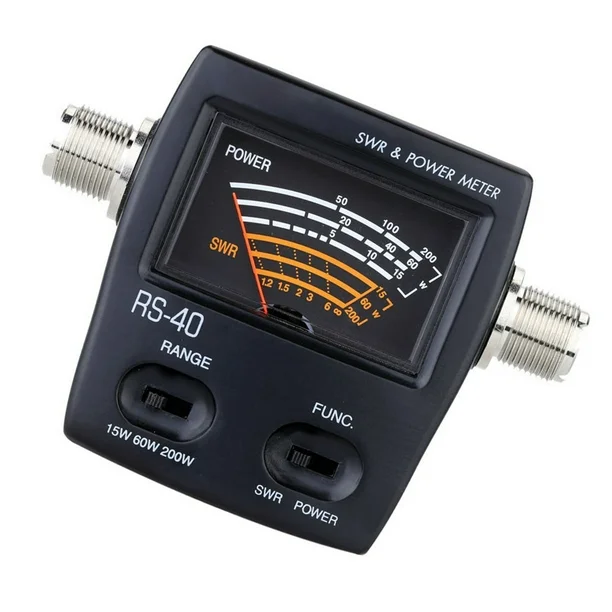
The SWR meter can hide cable loss
A low SWR reading in the shack does not necessarily mean the antenna system is efficient. This is one of the most common traps in amateur radio.
When the antenna is mismatched, some power is reflected back toward the transmitter. That reflected power must travel through the coaxial cable again. If the cable is lossy, part of the reflected power is absorbed before it reaches the SWR meter. The result can be a deceptively low SWR reading at the radio end.
In other words, a bad cable can make a bad antenna look better than it is. The station may show a comfortable SWR, while the actual antenna receives only a fraction of the transmitter power. This is particularly misleading with long runs of RG-58 at VHF or UHF.
The best way to understand the real antenna behaviour is to measure near the antenna feed point with an antenna analyser or VNA. A NanoVNA, RigExpert or similar instrument can reveal what the antenna actually looks like before the cable transforms and masks the result. For permanent installations, comparing measurements at the antenna and in the shack can also expose hidden feed-line problems.

Connector choice is part of the RF system
Coaxial cable performance depends not only on the cable itself, but also on the connectors. A good cable with poorly installed connectors is not a good feed line.
The PL-259 and SO-239 combination, often called the UHF connector despite its name being historically misleading, is still common in amateur radio. It is rugged, widely available and easy to use on HF. For shortwave and moderate VHF use, it is usually acceptable. On UHF and above, its impedance characteristics are less ideal, and better connectors are preferred.

The N connector is a true RF connector designed for higher frequencies. It maintains controlled impedance, is more suitable for VHF, UHF and microwave use, and is commonly available in weather-resistant forms. For outdoor VHF/UHF antennas, N connectors are often the better technical choice.

BNC connectors are convenient for QRP radios, test equipment, SDR devices, handhelds and temporary setups. They are quick to connect and disconnect, and proper 50 ohm versions perform well. They are not usually the best choice for high-power outdoor installations or mechanically stressed mast connections.

SMA connectors are common on handheld radios, SDR dongles and compact equipment. They are useful at high frequencies, but mechanically small and less tolerant of repeated stress. Heavy coax should not hang directly from an SMA socket. A short flexible adapter or pigtail is often a better solution.

Connector installation quality matters. Poor soldering, overheated dielectric, loose crimping, wrong connector size, stray braid strands and inadequate strain relief can all create faults. Some faults are obvious. Others only appear as extra loss, intermittent noise or strange SWR behaviour.
Shielding and local noise
Modern radio stations often operate in electrically noisy environments. Computers, USB chargers, solar inverters, LED lamps, Ethernet equipment, switching power supplies and household electronics can generate wideband interference. The antenna receives some of this noise directly, but the feed line can also become part of the problem if its shielding is poor.
A coaxial cable with weak braid coverage may allow local noise to couple into the received signal. Better cables often use both foil and braid, which improves shielding effectiveness. This is especially useful in urban stations, apartment installations, balcony antennas and radio rooms full of digital electronics.
Shielding does not solve every interference problem. Common-mode current on the outside of the coax can still bring noise into the receiver or disturb the radiation pattern. In those cases, ferrite chokes, proper grounding and better antenna placement may be needed. Still, a well-shielded coaxial cable gives the station a better starting point.
For receive-only SDR installations, shielding can be just as important as attenuation. A cheap cable may feed the SDR not only with the wanted signal, but also with noise picked up along the route from the antenna to the computer.
Velocity factor and when it matters
The velocity factor of coaxial cable describes how fast an RF signal travels through the cable compared with the speed of light in free space. Solid polyethylene cables often have a velocity factor around 0.66. Foamed dielectric cables may be around 0.80 to 0.85, depending on construction.
For ordinary feed-line use, velocity factor is often not important. If the goal is simply to connect the radio to the antenna, attenuation, impedance and durability matter more. But velocity factor becomes important when the cable length is part of the RF design.
Examples include phasing lines, impedance transformers, quarter-wave matching sections, coaxial traps, stub filters and some antenna systems where cable length is deliberately chosen. In those cases, using the wrong velocity factor can shift the electrical length and make the design behave incorrectly.
This is also why cutting coax to a “magic length” to fix SWR is usually the wrong approach. Changing feed-line length may change the impedance seen in the shack, but it does not automatically fix the antenna. It may only move the mismatch to a more convenient-looking point.
Power handling is usually not the first limitation
Many operators ask how much power a coaxial cable can handle. The answer depends on frequency, SWR, temperature, cable construction and duty cycle. Digital modes, FM and RTTY stress cable more than casual SSB because the average power is higher.
However, in typical 100 watt amateur-radio stations, cable loss is often a more important issue than maximum power rating. Even relatively small cables can handle 100 watts on HF under reasonable conditions. The bigger problem is whether the cable delivers that power efficiently to the antenna, especially at higher frequencies.
Power handling becomes more important with amplifiers, high-duty-cycle modes, high SWR, compact cables and UHF operation. A cable that is acceptable for 100 watt SSB on 20 metres may not be acceptable for high-power digital operation into a mismatched antenna. Heat buildup inside the cable can damage the dielectric and permanently degrade performance.
The safest approach is to avoid using coax as a heater. Match the antenna properly, keep cable loss low and choose a cable with a comfortable safety margin for the intended power and mode.
Choosing cable for HF antennas
For HF antennas such as dipoles, verticals, end-fed half-wave antennas, off-centre-fed dipoles, trapped verticals and beams, coax choice depends mostly on length and power.
For short to moderate runs, RG-213 is often a strong all-round choice. It is durable, widely supported by connectors and has acceptable loss across the HF spectrum. For very short runs, especially indoors or in temporary setups, RG-58 or RG-8X may be sufficient. For long runs, high power or multi-band installations that also include 6 metres, LMR-400 or Ecoflex 10 may be worth the upgrade.
HF vertical antennas can be more sensitive to the entire ground and feed system than to small differences in coax loss. If the antenna has a poor radial system, improving the coax will not solve the main efficiency problem. Similarly, a badly placed indoor antenna may remain limited by building losses and noise even with excellent cable.
The practical rule is to avoid wasting money in the wrong place. On HF, a better antenna location, improved radials, reduced common-mode current or lower local noise may bring more improvement than changing from RG-213 to a premium low-loss cable.
Choosing cable for 6 metres, 2 metres and 70 centimetres
On 50 MHz, cable quality starts to matter more, especially over longer runs. On 144 MHz it becomes important. On 432 MHz it becomes critical.
For a short 2 metre feed line, RG-213 may be acceptable. For a longer run to a rooftop antenna, LMR-400, Ecoflex 10 or a similar low-loss cable is usually a better choice. On 70 centimetres, low-loss cable should be considered the normal standard for permanent outdoor antennas. RG-58 should be avoided except for very short indoor jumpers or temporary use.
The higher the antenna and the better the radio, the more absurd it becomes to lose the signal in the feed line. A good VHF/UHF antenna installed high above the roof can be heavily compromised by a poor cable. Conversely, upgrading the cable may noticeably improve repeater access, weak-signal reception, satellite downlinks and general station reliability.
For dual-band verticals, mast-mounted preamplifiers and long feed lines, cable loss should be calculated before installation. It is much easier to choose the right cable before climbing onto the roof than to replace it later.
Choosing cable for SDR receivers and scanners
Receive-only systems have slightly different requirements. Power handling is irrelevant, but loss, shielding and impedance still matter.
For wideband SDR reception, cable loss can reduce sensitivity at VHF and UHF. A cheap thin cable may be acceptable for a short run to a local FM broadcast antenna, but not for weak ADS-B, weather satellite, airband, marine, VHF utility or UHF monitoring signals. If the antenna is outdoors and the SDR is indoors, a better cable often produces a visible improvement.
75 ohm RG-6 can be a practical choice for receive-only systems because it is inexpensive, low-loss for its price and widely available with good shielding. The impedance mismatch between 75 ohms and a 50 ohm SDR input is usually tolerable for many receiving applications, especially compared with the benefit of lower loss and better shielding.
However, for measurement work, transmitting, calibrated systems or antennas designed precisely for 50 ohms, proper 50 ohm cable remains preferable.
Common mistakes when buying coaxial cable
One common mistake is choosing cable by price alone. Very cheap coax may use poor shielding, thin braid, copper-clad steel conductors or a jacket that is not suitable for outdoor use. It may be fine for TV distribution or short indoor experiments, but not for a serious RF feed line.
Another mistake is buying a cable that is electrically good but mechanically unsuitable. Some low-loss cables are stiff and dislike repeated bending. They are excellent for fixed runs, but poor for portable use where the cable is coiled, uncoiled and moved frequently.
A third mistake is ignoring connectors. A station may use excellent coax but cheap adapters, badly soldered plugs or unsealed outdoor joints. Every transition is a possible failure point. A chain of adapters between SMA, BNC, PL-259 and N connectors can add loss, instability and mechanical strain.
The most expensive mistake is water ingress. Once water enters the braid or dielectric, the cable can become lossy even after it appears dry. Outdoor cable should be routed with drip loops, supported properly and sealed carefully at every exposed connector.
A practical way to decide
The best coaxial cable is selected by calculation, not guesswork. Start with the highest frequency you plan to use. Then determine the real cable length, including routing around walls, windows, masts, rotators and equipment. Next, decide how much loss is acceptable.
For many stations, a total feed-line loss below 1 to 2 dB is a good target. On HF, slightly more may still be acceptable depending on circumstances. On VHF/UHF weak-signal work, lower is better. For casual repeater operation, the tolerance may be higher, but excessive loss still reduces reliability.
After loss comes mechanical suitability. Can the cable bend where it needs to bend? Is it too heavy for the antenna socket or mast? Can the connectors be installed properly? Is the jacket suitable for sunlight and outdoor weather? Will the cable be moved frequently, or installed once and left alone?
Finally, compare cost against real benefit. Spending extra money on low-loss cable for a 3 metre HF jumper is pointless. Spending extra money on low-loss cable for a 30 metre run to a 70 cm antenna is often one of the best upgrades available.
Recommended cable choices by use case
For short HF patch leads inside the shack, RG-58 is usually acceptable if the power level is modest and the connectors are good. It is flexible and convenient.
For general fixed HF antennas, RG-213 remains a reliable and cost-effective standard. It is not the lowest-loss option, but on shortwave it is often good enough and mechanically robust.
For portable HF and QRP operation, RG-8X, RG-58, RG-316 or Aircell 7 can make sense depending on how short the cable is and how much weight matters. Flexibility is often more important than absolute minimum loss.
For fixed 2 metre antennas, RG-213 is the lower practical limit for moderate lengths, while LMR-400, Ecoflex 10 or similar cable is better for longer runs.
For 70 centimetres and higher, low-loss cable should be treated as the default for permanent installations. LMR-400, Ecoflex 10, Ecoflex 15 or comparable cables are far more appropriate than RG-58.
For receive-only SDR stations, good RG-6 can be a cost-effective option, especially where low loss and shielding matter more than 50 ohm purity. For transmit-capable stations, stay with 50 ohm cable unless there is a deliberate technical reason not to.
The invisible half of the antenna system
A radio station is not only the transceiver and antenna. The feed line is part of the antenna system, and sometimes it is the part that silently limits everything else.
A poor coaxial cable can waste transmitter power, reduce receive sensitivity, hide antenna problems, collect local noise and fail slowly after water enters the shield. A well-chosen cable does the opposite. It preserves signal, keeps measurements honest, reduces unwanted pickup and allows the antenna to perform closer to its real capability.
The practical lesson is simple. Use light and flexible cable when the run is short and portable. Use robust RG-213 where HF performance, durability and cost matter. Use serious low-loss cable when the frequency rises, the feed line gets long, or the antenna is difficult to access. Seal every outdoor connector, avoid sharp bends, measure at the antenna when possible, and do not trust a low SWR reading without understanding what the cable may be hiding.
Coaxial cable is not glamorous, but it is one of the easiest places to lose performance without noticing. Choosing it correctly is one of the most effective upgrades in any ham radio, SDR or RF antenna installation.
Image(s) used in this article are either AI-generated or sourced from royalty-free platforms like Pixabay or Pexels.
This article may contain affiliate links. If you purchase through these links, we may earn a commission at no extra cost to you.
Get the weekly RF & IT briefing
Radio guides, RF calculators, AI, Windows, Linux and satellite communication explainers. One useful email per week. No spam.