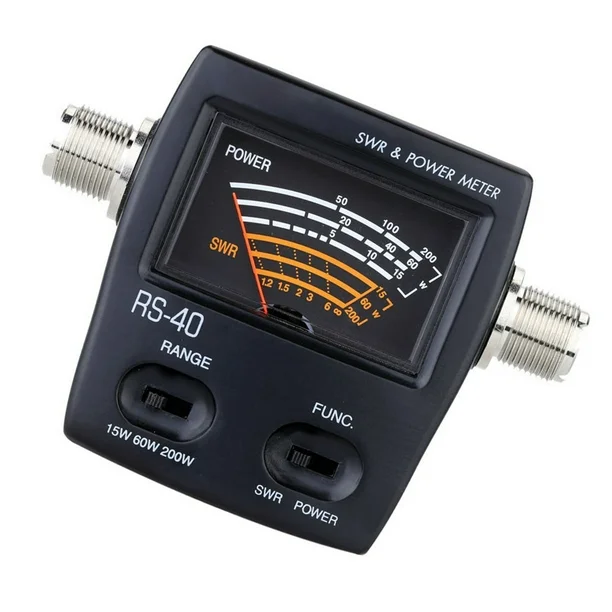
What swr really means
SWR, or Standing Wave Ratio, is one of the most important technical indicators in any transmitting radio system. It applies to CB radios, amateur radio transceivers, commercial mobile radios, marine radios, aviation ground stations, base stations, portable field setups, and almost every RF system where a transmitter feeds power into an antenna.
At its simplest, SWR tells you how well RF power is being transferred from your transmitter through the feed line and into the antenna system. In most radio systems, the transmitter expects to see a 50-ohm load. The coaxial cable is usually 50 ohms, the output stage is designed for 50 ohms, and the antenna system should be adjusted so that it presents a reasonably close match to that impedance at the operating frequency.
When the match is good, most of the transmitter’s power travels toward the antenna and is radiated. When the match is poor, part of that power is reflected back toward the radio. That reflected power creates stress in the feed line, the output network, and the final amplifier stage. In severe cases, it can generate enough heat, voltage stress, or current stress to damage the radio’s final transistors.
This is why SWR is not just a “range” issue. It is a survival issue for the transmitter.
Why final transistors fail
The final transistors, often called “finals,” are the power devices responsible for turning a low-level RF signal into usable transmit power. They may be MOSFETs, bipolar RF transistors, LDMOS devices, or other RF power semiconductors, depending on the radio.
These parts are designed to operate into a defined load impedance. In a typical mobile or base station radio, that means a nominal 50-ohm antenna system. When the antenna system is properly matched, the finals operate inside their expected voltage, current, and thermal limits.
A bad antenna match changes that environment. Reflected power returns from the antenna system and interacts with the forward power from the transmitter. Depending on the phase relationship, this can create high-voltage points, high-current points, overheating, distortion, instability, or excessive stress in the output stage.
The damage is not always instant. Sometimes a radio survives repeated abuse for a while, but the finals gradually weaken. The output power may drop, the signal may become distorted, or the radio may eventually fail completely on transmit. In other cases, especially with high power, long key-down times, or no antenna connected, the failure can happen very quickly.
The difference between forward power and reflected power
Forward power is the RF energy leaving the transmitter and traveling toward the antenna. Reflected power is the portion of that energy that the antenna system does not accept and sends back toward the transmitter.
A perfectly matched system would have forward power but no reflected power. In real installations, a small amount of reflected power is normal. The goal is not always mathematical perfection. The goal is a safe, stable, efficient antenna system.
A low SWR usually means the transmitter is seeing a friendly load. A high SWR means the transmitter is working into an unfriendly load. The higher the reflected power, the more the radio has to tolerate.
The important point is this: reflected power does not simply disappear. It is dissipated somewhere in the system. It may become heat in the cable, heat in the tuner, stress in the output network, or stress at the transmitter output.
What the common swr numbers mean
An SWR of 1:1 is the theoretical ideal. It means the antenna system is perfectly matched to the feed line and no measurable power is reflected.
An SWR around 1.2:1 or 1.5:1 is excellent in real-world use. Most transmitters will be perfectly happy at this level.
An SWR around 2:1 is usually still usable for many modern radios, but it is already a warning zone. Some radios will begin reducing output power at or near this point, especially on HF or high-power modes.
An SWR around 3:1 should be treated as a serious problem. Some radios may tolerate it briefly, but it is not a condition for normal operation.
An SWR above 3:1 usually means something is wrong enough that transmission should stop until the antenna system is checked.
Extreme SWR readings, such as 10:1, 20:1, or an infinite reading, may indicate an open circuit, a short circuit, a disconnected antenna, a broken coaxial cable, a failed connector, or an antenna being used far outside its intended frequency range.
Why transmitting without an antenna is dangerous
Never press PTT without a proper antenna or a suitable dummy load connected.
This rule applies to CB radios, amateur transceivers, VHF/UHF mobile radios, HF radios, marine radios, and most other transmitters. When the transmitter has no proper load, it cannot deliver RF power normally. The output stage may see extreme mismatch conditions, and the resulting voltage and current stress can destroy components.
A dummy load is different from an antenna. It is a non-radiating 50-ohm load designed to absorb RF power safely. It allows you to test the transmitter without relying on an antenna system. A dummy load is one of the most useful safety tools in a radio workshop.
The worst practice is “just tapping the PTT for a second” to see whether the radio works. Some radios survive. Some do not. The repair cost of a damaged final stage is usually far higher than the cost of a basic SWR meter or dummy load.
Why modern protection circuits are not enough
Many modern radios include SWR protection, thermal protection, over-current protection, and automatic power foldback. These are useful features, but they are not magic shields.
SWR protection normally works by detecting reflected power or abnormal load conditions. If the mismatch is high, the radio may display a warning, reduce output power, or block transmission. This can save the finals from serious damage.
However, protection circuits have limits. They may not react instantly. They may not detect every fault condition. They may be calibrated for emergency protection rather than conservative everyday use. They may also behave differently depending on frequency, mode, power level, and duty cycle.
This matters especially in mobile and off-road installations. An antenna can be damaged by a branch, a parking garage, a roof rack, a loading bay, a car wash, or simple vibration. A system that measured well in the driveway can become unsafe later.
If your radio allows the SWR warning threshold to be adjusted, it is usually wise to set it conservatively. A warning around 2.5:1 or 3:1 is much more useful than a very high threshold that only reacts when the antenna system has already become severely faulty.
Why antenna tuning matters
An antenna is not automatically correct just because it is new, expensive, or sold for a certain band. Most mobile antennas, CB antennas, and many amateur radio antennas require adjustment after installation.
The correct length depends on frequency, mounting position, ground plane, surrounding metal, cable routing, and sometimes even nearby accessories. On a vehicle, the same antenna may behave differently on the roof, trunk lid, mirror bracket, bumper, or fender mount.
A CB antenna, for example, must usually be trimmed or lengthened so that its best match falls in the desired part of the 27 MHz band. If it is too long, the lowest SWR point may fall below the channels you use. If it is too short, the lowest SWR point may fall above them.
This effect is much easier to understand when you can see it visually. Our antenna length and SWR simulator lets you change the radiator length and watch how the estimated SWR curve responds. It is a practical way to see why an antenna that is only slightly too long or too short can still create a poor match on the frequency you actually want to use.
HF antennas are even more sensitive to installation details. Height above ground, nearby objects, wire angle, counterpoise length, balun type, soil conductivity, and feed point placement can all affect the impedance.
The antenna system is more than the antenna
A radio installation is a complete RF system. The antenna is only one part of it.
The system includes the transmitter, coaxial cable, connectors, mounts, grounding, counterpoise, antenna base, loading coil, tuner, balun or unun, lightning protection, and the physical environment around the antenna.
A poor connector can ruin an otherwise good antenna. A wet coaxial cable can create losses and mismatch. A corroded mount can break the RF ground path. A badly installed PL-259 connector can create intermittent faults. A magnetic mount placed on a poor surface can make a mobile antenna unstable.
This is why SWR troubleshooting should never focus only on the whip or radiator. The whole signal path matters.
Coaxial cable can hide problems
Coaxial cable is not just a piece of wire. It is a transmission line with characteristic impedance, loss, shielding, velocity factor, and frequency-dependent behavior.
A lossy coaxial cable can make SWR look better at the radio than it really is at the antenna. This happens because part of the forward and reflected power is absorbed as heat in the cable. The meter at the radio may show an acceptable SWR, while the antenna itself is still poorly matched.
This is especially important at VHF and UHF, where cable loss rises quickly. A long, cheap coax run at UHF can waste a large portion of your power before it reaches the antenna. The SWR reading may not look terrible, but the radiated signal may be weak.
For serious installations, cable quality matters. Use the right cable for the frequency, power level, and length. Keep runs as short as practical. Avoid sharp bends, crushed sections, moisture ingress, and poor connectors.
The myth of “low swr means good antenna”
Low SWR does not automatically mean that the antenna is efficient.
A dummy load has an excellent SWR, but it does not radiate a useful signal. A very lossy antenna system can also show a low SWR because the RF energy is being absorbed as heat instead of being reflected.
This is a critical distinction. SWR measures impedance match. It does not directly measure radiation efficiency, pattern quality, takeoff angle, ground loss, or real-world communication performance.
A good antenna system should have a reasonable SWR and good radiation efficiency. Both matter. Chasing 1.0:1 SWR at all costs can be misleading if the method used to achieve it simply adds loss.
Antenna tuners: useful but often misunderstood
An antenna tuner does not really “tune the antenna” in the physical sense. It matches the impedance presented by the antenna system to the impedance expected by the transmitter.
From the radio’s perspective, this can be extremely useful. The transmitter sees a safer load, the finals are protected, and the radio can deliver power without immediately folding back.
But the tuner does not eliminate all losses. If the antenna is too short, too low, poorly grounded, or extremely mismatched, the tuner may allow the radio to transmit while much of the power is lost in the tuner, feed line, coil, counterpoise, or surrounding environment.
On HF, a tuner is often a normal part of the station. On CB, VHF, and UHF, the better solution is usually to physically adjust the antenna system.
Mobile radio installations and swr drift
Mobile radio systems are exposed to a hard life. Vibration, weather, salt, heat, cold, dust, mud, and mechanical impact can all change antenna behavior.
A roof-mounted antenna may loosen. A magnetic mount may shift. A coaxial cable may be pinched by a door. A whip may be bent by a tree branch. A connector may corrode. A grounding strap may break. A loading coil may fill with water.
This means SWR should not be measured once and then forgotten. It should be checked after installation, after antenna adjustment, after mechanical impact, before major trips, after off-road use, and whenever the radio starts behaving differently.
A sudden loss of range is often an antenna system problem, not a radio problem.
Ground plane and counterpoise problems
Many antennas need something to work against. In a mobile CB installation, the vehicle body often acts as the ground plane. In a vertical HF antenna, radials or a counterpoise may serve that role. In an end-fed antenna, the coax shield may become part of the antenna system if no proper counterpoise or choke is used.
When the counterpoise is poor, the antenna impedance can become unpredictable. SWR may rise, RF may return along the outside of the coax, and the radio may suffer from RF feedback.
On a vehicle, paint, plastic body panels, poor bonding, rust, and isolated mounting brackets can all create ground-plane problems. A mount may look mechanically solid but still be poor at RF.
Good RF grounding is not always the same as DC continuity. A mount that shows continuity on a multimeter may still behave poorly at RF if the connection is narrow, corroded, or badly positioned.
Common causes of high swr
High SWR can come from many faults. The most common are an antenna cut to the wrong length, a loose connector, a shorted coax, an open coax, a bad solder joint, a broken antenna element, a missing ground plane, water inside the cable, a damaged loading coil, an incorrect antenna for the band, or a transmitter being used on the wrong frequency range.
Environmental causes are also common. Nearby metal objects, roof racks, solar panels, gutters, masts, towers, balcony railings, and vehicle accessories can detune the antenna.
In portable operation, the operator’s body, wet ground, wire height, wire slope, battery leads, and radio placement can all affect the system.
The important habit is to treat high SWR as a symptom. Do not simply force the radio to transmit. Find the cause.
How to measure swr correctly
The basic method is simple: place an SWR meter between the radio and the antenna, use low power, transmit briefly, and read the result. But accurate measurement requires attention.
The meter must cover the frequency range you are using. A meter intended for HF or CB may not be accurate on VHF/UHF. A VHF/UHF meter may not be suitable for HF. Power rating also matters.
Use the lowest practical transmit power during testing. This reduces risk if the antenna is badly mismatched. Keep transmissions short, especially on modes with continuous carrier.
For CB antennas, measure at the low, middle, and high parts of the channel range. The SWR curve tells you whether the antenna is too long or too short. For amateur HF antennas, sweep the band with an antenna analyzer if possible. This gives much better information than checking one frequency only.
Why antenna analyzers are valuable
An antenna analyzer is safer and more informative than testing only with transmitter power. It sends a low-level signal into the antenna system and measures parameters such as SWR, impedance, resistance, reactance, and resonance.
With an analyzer, you can find where the antenna is actually resonant. You can see whether the system is capacitive or inductive. You can adjust the antenna without repeatedly keying the transmitter.
For field work, an analyzer can save time and prevent damage. For permanent installations, it helps diagnose whether the issue is the antenna, cable, connector, matching network, or environment.
A basic SWR meter tells you that something is wrong. A good analyzer often helps explain why.
SWR at the radio vs swr at the antenna
Where you measure matters.
Measuring SWR at the radio tells you what the transmitter sees. This is important for protecting the finals. Measuring closer to the antenna can reveal what is actually happening at the feed point.
If the coax is short and low-loss, the difference may be small. If the coax is long or lossy, especially at VHF/UHF, the difference can be significant.
For troubleshooting, it can be useful to test the antenna with a short known-good cable directly at the feed point. If the antenna measures well there but poorly from the shack, the feed line or connectors are likely suspects. If it measures poorly at the antenna feed point, the antenna or its mounting environment is the likely issue.
Duty cycle makes swr risk worse
The danger of high SWR depends not only on the SWR number but also on power level, mode, duty cycle, and transmission duration.
FM, AM carrier, RTTY, FT8, digital voice, packet, and other high-duty-cycle modes can heat the finals quickly because the transmitter is producing significant output for sustained periods.
SSB voice has a lower average duty cycle, but it is not immune. Speech processing, compression, long overs, and high power can still create serious thermal load.
A mismatch that might be tolerated for a brief low-power test can become dangerous during extended high-power operation.
Heat is the silent killer
Heat is one of the main enemies of RF power stages. High SWR can increase heating, but heat can also come from poor ventilation, high ambient temperature, dust buildup, long transmissions, excessive power settings, and inadequate power supply voltage.
When a radio becomes hot, protection circuits may reduce output power or shut down transmission. This is not a nuisance. It is a warning.
Do not cover the radio with bags, clothing, papers, or dashboard clutter. Do not install a high-power mobile radio in a sealed space with no airflow. Do not assume that a heatsink can do its job if it is trapped under a seat in summer heat.
A good antenna system protects the finals electrically. Good cooling protects them thermally. Both are necessary.
SWR and power supply problems
Not every transmit problem is caused by SWR. A weak power supply, undersized wiring, bad fuse holder, poor battery connection, or voltage drop can also cause low output, shutdown, distortion, or unstable operation.
However, SWR and power issues can appear together. A radio working into a poor antenna may draw abnormal current or heat up more quickly. A poor electrical installation may make the radio more vulnerable to stress.
For mobile radios, use proper gauge power cable, good fuses, clean battery connections, and solid grounding. Do not power a high-current radio through a cigarette lighter socket unless the manufacturer specifically allows it.
CB radio swr considerations
CB radio users often encounter SWR problems because mobile CB antennas are physically short compared with the wavelength. They rely on loading coils, ground planes, and careful installation.
A CB antenna should be tuned after installation. The adjustment may involve moving a whip in or out, trimming a stainless steel radiator, adjusting a tuning screw, or changing the mounting position.
A good CB SWR reading across the intended channels is more important than obsessing over one perfect reading on one channel. If you mainly use the middle of the CB band, tune for that area. If you use the entire band, aim for a balanced curve.
SSB CB operation makes antenna quality even more important. SSB users often care about longer-distance communication, where efficiency and clean output matter.
Amateur radio hf considerations
HF amateur radio introduces wider frequency ranges and more complex antenna behavior. A dipole may be excellent on one band and unusable on another. A multiband vertical may need radials. An end-fed antenna may require a transformer, counterpoise, and choke. A random wire may require a tuner and careful RF management.
On HF, SWR is only one part of station performance. Common-mode current, feed line radiation, noise pickup, ground loss, and antenna height can all dominate real-world results.
A radio may show a good match through a tuner, yet the station may still perform poorly if most of the energy is heating lossy components. For best results, tune the antenna system itself as well as practical, then use a tuner for final matching.
VHF and UHF considerations
At VHF and UHF, small mechanical details matter. A few centimeters of radiator length can shift resonance. Connector quality becomes more important. Cable loss becomes more severe. Mounting position has a strong influence on radiation pattern.
A mobile VHF/UHF antenna on the center of a metal roof usually performs much better than the same antenna on a poor bracket with limited ground plane. A handheld radio connected to a proper external antenna can dramatically outperform its rubber duck.
On UHF, cheap or water-damaged coax can waste much of the signal. In some cases, improving the feed line gives more benefit than increasing transmitter power.
Marine and outdoor installations
Marine antennas face moisture, salt, vibration, UV exposure, and corrosion. A high SWR reading on a marine VHF installation can indicate water intrusion, a corroded connector, a cracked antenna base, or a damaged coax run inside the vessel.
Because marine radio can be safety-critical, SWR problems should not be ignored. Range loss may not be obvious until the radio is needed in poor conditions.
Outdoor base antennas also need periodic inspection. Weatherproofing, self-amalgamating tape, UV-resistant cable ties, strain relief, and proper drip loops help prevent long-term failures.
Base station installations
A base station antenna system may seem stable, but it is exposed to wind, rain, ice, lightning effects, mechanical fatigue, and corrosion.
Periodic checks should include SWR trend, feed line inspection, connector sealing, mast hardware, grounding, lightning protection, and signs of water ingress.
If SWR slowly rises over months, suspect moisture, corrosion, or mechanical movement. If SWR changes suddenly after a storm, suspect physical damage.
A base antenna failure can be more dangerous than a mobile antenna failure because base radios often run higher power and longer transmissions.
The role of dummy loads
A dummy load is essential for safe testing. It provides a known 50-ohm load so the transmitter can be tested without using an antenna.
If the radio produces normal power into a dummy load but behaves badly on the antenna, the antenna system is the problem. If the radio still behaves badly into a dummy load, the issue may be inside the radio, the power supply, or the test setup.
Use a dummy load rated for the frequency and power involved. A small low-power dummy load can overheat quickly if used with a high-power transmitter. Some loads are rated for short tests only, not continuous duty.
Practical swr troubleshooting sequence
Start with the obvious. Is the antenna connected? Is the coax connected to the correct socket? Is the antenna intended for the frequency? Is the radio on the right band?
Then inspect the coax and connectors. Look for loose plugs, poor soldering, crushed cable, water ingress, corrosion, broken strain relief, or damaged insulation.
Test with a known-good dummy load. If the radio is normal into the dummy load, move outward. Test with a known-good short coax. Then test the antenna directly if possible.
If the problem is mobile, check the mount and ground plane. If it is a base station, check weatherproofing and mast-side connectors. If it is a portable wire antenna, check transformer wiring, counterpoise, wire length, and choke placement.
Do not change five things at once. Change one variable, measure, and record the result.
Safe swr limits in practical use
For most general radio use, 1.0:1 to 1.5:1 is excellent.
From 1.5:1 to 2.0:1 is usually acceptable, though improvement may still be possible.
From 2.0:1 to 3.0:1 is a caution zone. Many radios may tolerate it at reduced power, but it should not be considered ideal.
Above 3.0:1, stop and troubleshoot.
These are general practical guidelines. The manufacturer’s manual always has priority. Some radios are more tolerant than others. Some fold back early. Some older radios are less protected.
Why lowering swr warning thresholds makes sense
Some radios allow the user to configure an SWR warning or protection threshold. If the factory default is extremely high, that setting may be intended as a last-resort emergency alarm rather than a daily protection limit.
A more conservative threshold, such as 2.5:1 or 3.0:1, can protect the operator from continuing to transmit into a failing antenna system.
This is especially useful for mobile CB, off-road, trucking, expedition, and field radio use. The antenna may be hit, bent, loosened, or disconnected without the operator noticing immediately.
Early warning is better than late failure.
High swr and signal quality
High SWR can reduce effective radiated power, but it can also affect signal cleanliness indirectly. If the transmitter is stressed, overheated, or folding back power, the transmitted signal may become unstable, distorted, or weaker than expected.
On SSB, a poor setup may sound rough, compressed, or inconsistent. On FM, range may drop. On digital modes, decoding may become unreliable. On AM, carrier stability and audio quality may suffer if the radio is under stress.
A clean signal starts with a stable transmitter and a proper load.
Why “more watts” is not the first solution
Many operators try to solve range problems by increasing power. In reality, improving the antenna system often produces a larger real-world improvement.
A badly mounted antenna with high loss and poor ground plane will waste power. Increasing transmitter output may only create more heat and more stress.
A well-placed, well-tuned antenna with low-loss cable can outperform a higher-power radio connected to a poor antenna.
Before buying an amplifier or higher-power radio, fix the antenna system.
Antenna placement and real range
SWR does not tell you whether the antenna is in a good location. An antenna can have low SWR and still perform poorly if it is mounted too low, blocked by metal, surrounded by buildings, or placed near noise sources.
Height, clearance, ground plane, radiation pattern, and local noise level all affect communication range.
For VHF and UHF, height is often decisive because propagation is largely line-of-sight. For HF, height and antenna orientation influence takeoff angle and directionality. For mobile CB, mounting position on the vehicle can strongly affect both SWR and radiation pattern.
RF feedback and common-mode current
A high SWR problem may be accompanied by RF feedback. This happens when RF current flows where it should not, often on the outside of the coax shield, microphone cable, power cable, or equipment chassis.
Symptoms include distorted transmitted audio, hot microphone cases, computer interference, USB devices disconnecting, speakers buzzing, or touch-sensitive electronics behaving strangely.
Common-mode chokes, better grounding, proper counterpoise, balanced feeding, and improved antenna placement can help.
Low SWR alone does not guarantee the absence of common-mode current. A station can show a decent match and still have RF in the shack.
Weatherproofing and long-term reliability
Many SWR problems are caused by water. Moisture inside coaxial cable or connectors changes impedance, increases loss, and causes corrosion.
Outdoor connectors should be sealed properly. Use suitable weatherproofing methods, strain relief, and drip loops. Avoid leaving connectors exposed to standing water. Inspect installations after storms and seasonal temperature changes.
In mobile installations, connectors near the antenna base should be protected from road spray, salt, and vibration. In marine environments, corrosion prevention is even more important.
Recording swr readings
A simple log can be useful. Record the date, frequency, SWR, power level, antenna configuration, and any changes made.
This helps detect slow degradation. If a base antenna measured 1.3:1 last year and now measures 2.2:1 on the same frequency, something has changed. Without records, slow failure is easier to miss.
For mobile and field users, a short pre-trip check can prevent equipment damage.
Safety checklist before transmitting
Before pressing PTT, confirm that the antenna or dummy load is connected, the correct antenna port is selected, the coax is secure, the antenna is intended for the frequency, the power level is appropriate, and the SWR has been checked after installation or major changes.
If the system is new, repaired, moved, or exposed to mechanical stress, measure before serious use.
If the radio reports high SWR, stop transmitting and inspect the system.
The correct mindset
SWR is not something to fear, but it is something to respect. It is a diagnostic tool. It tells you whether your transmitter is seeing a reasonable load.
A good operator does not ignore SWR warnings. A good operator does not blame the radio before checking the antenna. A good operator does not transmit into unknown loads. A good operator understands that the antenna system is the real heart of the station.
The finals are expensive. The antenna system is critical. The meter is your early warning instrument.
SWR is one of the simplest measurements in radio, but it carries serious consequences. A low SWR helps protect the transmitter and indicates that the antenna system is presenting a reasonable load. A high SWR means reflected power, wasted energy, possible overheating, reduced performance, and increased risk to the final amplifier.
Never transmit without a proper antenna or dummy load. Tune new antennas before real use. Check mobile antennas regularly. Inspect coaxial cable and connectors. Do not rely blindly on protection circuits. Use conservative SWR warning limits when available. Treat sudden SWR changes as real faults, not minor annoyances.
A radio with protected finals, clean power, good cooling, low-loss coax, solid connectors, and a properly tuned antenna system will transmit farther, sound cleaner, and last longer. In radio, the smartest watt is not the one forced into a bad load. It is the one that actually reaches the antenna and gets radiated into the air.
Image(s) used in this article are either AI-generated or sourced from royalty-free platforms like Pixabay or Pexels.
This article may contain affiliate links. If you purchase through these links, we may earn a commission at no extra cost to you.
Get the weekly RF & IT briefing
Radio guides, RF calculators, AI, Windows, Linux and satellite communication explainers. One useful email per week. No spam.