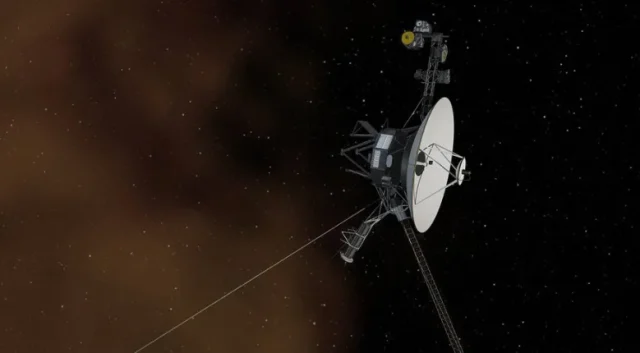
Far beyond the planets, beyond the bright geometry of the inner solar system, beyond even the protective bubble carved by the Sun into interstellar gas, two machines from the 1970s are still alive. They do not glide through space with the muscular glow of science fiction engines. They do not unfold new solar arrays, refuel, reboot from a nearby technician’s laptop, or wait for rescue. They survive on heat—quiet, inevitable, radioactive heat—released atom by atom inside compact power units built when microprocessors were young, Saturn had not yet been seen up close, and the idea of a human-made object leaving the solar wind for interstellar space belonged more to speculative imagination than to mission operations.
These machines are NASA’s Voyager 1 and Voyager 2, and the “nuclear batteries” that keep them speaking are radioisotope thermoelectric generators, or RTGs. In the strictest engineering sense, they are not batteries at all: they do not store a finite charge the way a chemical cell does, and they are not recharged by sunlight or by an engine. Instead, they convert the heat from the natural radioactive decay of plutonium-238 into electricity through thermocouples, with no moving parts and almost nothing to wear out in the conventional mechanical sense. NASA describes RTGs as devices that convert plutonium oxide decay heat into electrical power, and notes that their lack of moving parts is central to their durability in deep-space missions.
Yet “nuclear battery” remains the phrase that captures their almost mythic appeal. A battery is something you expect to fade; these have faded for nearly half a century and still have enough left to run instruments, heaters, computers, radios, and the faint thread of command that connects Earth to machines more than 15 billion miles away. Voyager 2 launched first, on August 20, 1977; Voyager 1 followed on September 5, 1977. Both are still listed by NASA as active missions, each powered by three Multi-Hundred Watt Radioisotope Thermoelectric Generators, or MHW-RTGs, whose launch-era output was about 158 watts each.
There are older nuclear power systems still in space as objects. Some early satellites that carried radioisotope power sources remain in orbit, and their radioactive material continues to decay because physics does not retire when a mission does. But if the question is which nuclear batteries are still running in the meaningful operational sense—still supporting an active spacecraft, still enabling communication and science—the answer points to the Voyagers. The Lincoln Experimental Satellites 8 and 9, launched in 1976, were older and RTG-powered; LES-8 was decommissioned in 2004, and LES-9 in 2020 after 44 years of service, according to MIT Lincoln Laboratory. That leaves the Voyagers, launched in 1977 and still operating in 2026, as the oldest active nuclear-powered spacecraft and the most famous demonstration of what radioisotope power can do when distance makes sunlight nearly irrelevant.
A Power Source Built for Places Where the Sun Becomes a Star
The story of the oldest nuclear batteries still running in space begins with a simple failure of sunlight. Solar power is elegant near Earth. It is clean, light, and replenished every orbit or every planetary day. In the inner solar system, it has powered everything from communications satellites to Mars rovers. But sunlight follows the inverse-square law: double the distance from the Sun and the available solar energy drops to one quarter; go to Jupiter, and sunlight is roughly twenty-five times weaker than at Earth; move outward toward Saturn, Uranus, Neptune, Pluto, and interstellar space, and solar panels become less a practical power plant than a heroic structural burden. A spacecraft can carry huge arrays, as some modern Jupiter missions do, but the farther the mission travels, the more every watt becomes a negotiation with mass, risk, pointing, temperature, and engineering patience.
This is why radioisotope power emerged as one of the enabling technologies of deep-space exploration. The U.S. Department of Energy traces the first U.S. nuclear-powered spacecraft to the Navy’s Transit 4A navigation satellite in 1961, which carried a small RTG developed by the Atomic Energy Commission. That device produced only 2.7 watts of electrical power, but it proved the essential idea: a spacecraft could make electricity from radioactive heat without relying on sunlight, combustion, or mechanical generators. In the decades that followed, radioisotope power systems migrated from experimental satellites to lunar surface packages, planetary landers, outer-planet orbiters, and interstellar probes. They became less a curiosity than a quiet infrastructure for missions that would otherwise be impossible.
The great practical advantage of an RTG is not raw efficiency. Thermoelectric conversion is modest: much of the plutonium’s heat is radiated away rather than turned into electricity. The advantage is reliability under extreme conditions. A radioisotope generator does not care whether the spacecraft is in darkness, under dust, behind a planet, inside a cold shadow, or so far from the Sun that solar panels would produce a fraction of their former output. It does not need a turbine spinning at high speed or a pump circulating working fluid. In the classic RTG architecture, heat flows from a hot radioactive source across thermoelectric materials to a colder radiator surface. The temperature difference drives charge carriers through thermocouples, producing current through the Seebeck effect. The physics is old, the conversion efficiency is limited, and the beauty lies precisely in that stubborn simplicity.
Voyager’s MHW-RTGs were built for a mission that already sounded audacious in the 1970s. The twin spacecraft would exploit a rare planetary alignment to visit the outer giants, using gravity assists to leap from world to world. Voyager 2 would eventually fly by Jupiter, Saturn, Uranus, and Neptune, becoming the only spacecraft ever to visit the last two planets up close. Voyager 1 would take a faster path past Jupiter and Saturn, then turn toward interstellar space after its encounter with Titan. NASA lists Voyager 1 as entering interstellar space on August 25, 2012, and Voyager 2 on November 5, 2018. The mission that began as a grand tour of planets became a long-duration experiment in spacecraft aging, power management, and the survival of electronics in the most unforgiving operating environment humanity has ever used.
By the standards of modern electronics, the Voyagers are absurdly old. Their computers are primitive, their memory tiny, their cameras long silent, their tape recorders relics of another technological era. But the RTGs belong to a different category of time. They were never meant to be fast, smart, or flexible. They were meant to sit on a boom, glow with invisible heat, and decline slowly enough that engineers on Earth could keep negotiating with the remaining watts. That slow decline is the central drama of the Voyager endgame. The spacecraft are not dying from a single catastrophic failure. They are being dimmed.
The First Space Nuclear Batteries and the Long Road to Voyager
The RTG did not arrive in space as a mature deep-space power plant. It began as a compact answer to military and scientific needs in Earth orbit. Transit 4A, launched in 1961, was a navigation satellite, not a planetary explorer, and its SNAP-3B7 generator was tiny by later standards. Still, its importance was enormous because it shifted nuclear power in space from reactor speculation to radioisotope practicality. The Department of Energy notes that Transit 4A’s RTG had no moving parts, converted plutonium-238 decay heat into electricity using thermocouples, and helped the satellite become the oldest broadcasting spacecraft of its first decade in orbit. That lineage matters because the same underlying principle now supports spacecraft on Mars and beyond the heliosphere.
The early era was also an era of experimentation and mistakes. RTGs appeared in navigation satellites, weather satellites, lunar science stations, and planetary probes. Some missions failed, some systems exceeded expectations, and each generation of hardware taught engineers more about fuel encapsulation, thermoelectric materials, launch safety, thermal design, and long-duration degradation. The U.S. space nuclear program used plutonium-238 because it is an especially useful isotope for this purpose: it releases substantial heat, has a half-life long enough for decades-long missions, and emits mainly alpha particles that are comparatively easy to shield when the fuel is properly encapsulated. The result is not a miniature nuclear reactor. There is no chain reaction inside Voyager’s RTGs. There is only decay, steady and statistically predictable.
Before Voyager, some of the most important nuclear-powered spacecraft were the Pioneer probes. Pioneer 10 launched in 1972 and flew past Jupiter; Pioneer 11 launched in 1973 and later visited Saturn. They carried SNAP-19 RTGs and helped prove that radioisotope-powered spacecraft could cross the outer solar system. But Voyager required more power and more ambition. Its instruments, telecommunications, attitude control, heaters, and computers had to function through multiple planetary encounters and then continue into the dark. The MHW-RTG represented a step up: a multi-hundred-watt class generator using plutonium-238 heat sources and silicon-germanium thermoelectric conversion. Each Voyager carried three of them, arranged on a boom away from the main spacecraft bus to reduce radiation and thermal interference with instruments.
The Lincoln Experimental Satellites 8 and 9 occupy a fascinating place in this history because they were older than Voyager and used the same broad MHW-RTG family. Launched in March 1976, LES-8 and LES-9 were experimental military communications satellites developed by MIT Lincoln Laboratory. Unlike typical communications satellites, they used radioisotope generators rather than solar panels. Their long service life was remarkable: LES-8 was decommissioned in 2004, while LES-9 remained operational until May 20, 2020, earning recognition from MIT Lincoln Laboratory as the longest continuously operating communications satellite in U.S. history. For decades, if one asked about the oldest nuclear-powered spacecraft still operating, LES-9 complicated the answer. After 2020, the crown passed clearly to the Voyagers.
There is another wrinkle. Objects like Transit 4A, LES-8, and LES-9 may still physically contain radioisotope fuel, and that fuel still produces heat at some diminished rate. In that literal nuclear sense, their sources are still “running,” because radioactive decay cannot be switched off. But engineering language usually cares about function. A power system is operational when it powers a spacecraft, payload, transmitter, heater, or telemetry chain. By that standard, decommissioned satellites become artifacts: radioactive, historically important, perhaps still thermally alive, but not active participants in exploration. Voyager’s nuclear batteries are different because they still support a mission that sends data back to Earth.
How a Voyager RTG Turns Decay Into a Whisper From Interstellar Space
The core of a Voyager RTG is not mystery but disciplined heat management. Plutonium-238 oxide fuel releases heat as the isotope decays. That heat flows outward through the generator structure. Thermoelectric couples—pairs of materials chosen because charge carriers move differently across a temperature gradient—bridge the hot interior and cooler exterior. As long as one side is hot and the other side can radiate heat into space, the system produces voltage. Space, often imagined as simply cold, is really a thermal problem defined by radiation: a spacecraft cannot dump heat into air or water, because there is none. It must radiate energy away, which means the geometry, surface coatings, and temperature limits of the RTG matter as much as the radioactive source.
This arrangement is inefficient but wonderfully robust. A conventional generator on Earth might use heat to boil water, spin a turbine, and generate electricity with far higher efficiency. But turbines have bearings, seals, lubricants, vibration, and failure modes that become daunting over decades in vacuum. An RTG accepts poor efficiency in exchange for silence. Nothing inside needs to spin. No valve has to open every second. No sunlight has to strike a panel at the right angle. No astronaut has to replace a part. NASA’s overview emphasizes that RTGs convert plutonium oxide decay heat into electricity with thermocouples and have no moving parts, a combination that explains their usefulness for long-duration missions far from the Sun.
The electrical decline is unavoidable. Plutonium-238 has an 87.7-year half-life, meaning its thermal output falls gradually over human timescales. On top of that, thermoelectric materials degrade, electrical components age, and the temperature difference across the thermocouples changes. The result is a power budget that shrinks year by year. NASA’s radioisotope power systems page reports that each Voyager MHW-RTG produced about 158 watts at launch, and that total Voyager power was in stable operation at about 225 watts electrical in late 2023 for Voyager 1 and April 2024 for Voyager 2. Compared with the roughly 474 watts available at launch from three generators, that is a dramatic loss. Compared with zero, it is a miracle.
Every watt now has a biography. Some once powered cameras that revealed volcanoes on Io, braided rings at Saturn, methane-blue Uranus, and Neptune’s Great Dark Spot. Some warmed instruments during planetary flybys. Some went to tape recorders and scan platforms and heaters that made sense when the spacecraft was still a planetary tourist. Today, many of those systems are off forever, or nearly so. The cameras were shut down after the famous 1990 “family portrait” era; other instruments have been sacrificed over time as the power margin narrowed. The spacecraft are now less like observatories in the familiar sense and more like minimal life-support systems for a handful of sensors that can still measure charged particles, magnetic fields, plasma waves, and the environment beyond the solar wind.
The distance makes every decision theatrical. When engineers send a command to Voyager 1, it travels at the speed of light and still takes roughly a day to arrive. NASA reported in April 2026 that Voyager 1 was more than 15 billion miles, or 25 billion kilometers, from Earth, and that the command sequence to shut down its Low-Energy Charged Particles instrument would take about 23 hours to reach the spacecraft. That means operations are conducted almost like correspondence with a ship crossing an ocean wider than imagination. A command is written, checked, transmitted, and then everyone waits. The spacecraft either responds, or it does not. If something goes wrong, the earliest hint may come two days after the first human decision.
The irony is that Voyager’s nuclear power system is at once the most exotic and the most predictable part of the spacecraft. Engineers know plutonium decay with high confidence. They can estimate the broad decline of thermal output years in advance. What they cannot fully predict is how ancient electronics, heaters, thrusters, sensors, and flight software will respond as margins disappear. A spacecraft near the end of its power life becomes a system of cascading compromises. Turn off a heater and a fuel line may freeze. Turn off an instrument and science is lost. Leave too much on and a voltage drop could trigger fault protection. Preserve communication and perhaps another detector must go dark. The nuclear battery does not fail dramatically; it forces a long ethics of rationing.
The Oldest Active Nuclear Batteries: Voyager 2, Then Voyager 1
Because Voyager 2 launched on August 20, 1977, sixteen days before Voyager 1, its RTGs are technically the oldest active nuclear batteries still running in space. Voyager 1 is farther away and more famous as the most distant human-made object, but Voyager 2’s power system has been operating slightly longer. NASA still lists both spacecraft as active missions and identifies both as powered by MHW-RTGs. In everyday conversation, it is reasonable to speak of “the Voyagers” together; in a strict chronology of operating nuclear batteries, Voyager 2 comes first.
The mission statuses in 2026 show how close both spacecraft are to the edge. NASA’s current instrument table, updated April 17, 2026, shows Voyager 1 with its Magnetometer and Plasma Wave Subsystem still on, while its Cosmic Ray Subsystem and Low-Energy Charged Particles instrument have been turned off to save power. Voyager 2 still has its Cosmic Ray Subsystem, Magnetometer, and Plasma Wave Subsystem on, while its Low-Energy Charged Particles instrument and Plasma Science instrument have been shut down. These are no longer fully loaded planetary spacecraft. They are survivors configured for the last kind of science only they can do: in situ measurement of the space between stars.
Voyager 1’s April 2026 shutdown of the Low-Energy Charged Particles instrument captured the mood of this final era. NASA said the decision had been planned years in advance, part of an agreed order of instrument shutdowns designed to preserve the mission as the power supply declined. The agency also noted that a tiny motor in the LECP would remain on because it uses only about 0.5 watts, preserving a chance that the instrument might someday be reactivated if engineers find extra power. That half-watt detail is almost painfully intimate. In a world of gigawatt grids and megawatt data centers, the future of a legendary interstellar instrument can hinge on power smaller than an LED night-light.
The Voyagers’ aging power systems have turned mission operations into a discipline of subtraction. The spacecraft cannot be upgraded; they can only be reconfigured. Over time, engineers have shut down heaters they once considered necessary, rerouted power in ways that would have seemed risky earlier in the mission, and operated instruments below original temperature expectations. This is not merely improvisation. It is an evolving body of empirical knowledge about how conservative 1970s engineering behaves when pressed beyond its design life. Components sometimes continue working at temperatures lower than expected. Thrusters can be revived after decades. Fault-protection rules written for one era can become obstacles in another. Every successful workaround becomes a small argument against pessimism.
The same power decline that threatens the mission also makes it scientifically precious. No other active spacecraft is sampling the same interstellar environment from the same vantage points. Voyager 1 and Voyager 2 left the heliosphere at different locations and times, giving researchers two separated measurements of the boundary between the Sun’s domain and interstellar space. Their instruments help characterize cosmic rays, magnetic fields, and plasma oscillations in a region where remote telescopes cannot substitute for direct measurement. The nuclear batteries are therefore not just keeping antique machines alive for nostalgia. They are powering a scientific outpost in a place humanity has barely entered.
Why They Lasted: Conservative Engineering, Redundancy, and a Slow Fuel
The longevity of the Voyager RTGs is sometimes described as if it were a supernatural property of nuclear power. The truth is more interesting. Plutonium-238 gives the mission a slow, predictable energy source, but the spacecraft survived because the rest of the system was designed with margins, redundancy, and a seriousness about failure that reflected the stakes of the Grand Tour. A nuclear battery can provide heat and electricity for decades, but it cannot save a poorly designed radio, a fragile attitude-control system, a flight computer without fallback modes, or a spacecraft that cannot manage thermal stress. Voyager endured because the nuclear power source and the spacecraft architecture were matched to the same philosophy: no service calls, no second chances, no assumption that space will be forgiving.
One key reason RTGs last so long is that they degrade gracefully. A solar panel can be degraded by radiation, dust, micrometeoroids, or pointing problems, and a chemical battery can suffer cycle limits or electrolyte failure. An RTG’s fuel simply keeps decaying. Its output declines, but it does not depend on charge-discharge cycles. It does not need sunlight and does not care whether the spacecraft is near a planet, between planets, or beyond the heliopause. The thermoelectric elements can degrade, and the electrical system around them can fail, but the core heat source is steady on a scale matched to deep-space mission durations. That is exactly why RTGs have powered missions such as Voyager, Galileo, Cassini, New Horizons, Curiosity, and Perseverance. NASA lists Curiosity and New Horizons as active radioisotope-powered missions, with Curiosity using an MMRTG on Mars and New Horizons carrying a GPHS-RTG with about 24 pounds, or 11 kilograms, of plutonium oxide fuel.
The difference between those later missions and Voyager is generational. New Horizons, launched in 2006, is itself a marvel of low-power design, built to fly past Pluto and later Arrokoth with one RTG and less than 200 watts available for spacecraft electronics and instruments, according to a technical paper on the spacecraft. Curiosity and Perseverance operate on Mars, where the MMRTG does double duty by providing heat as well as electricity. But the Voyagers have crossed a different threshold. They are not merely long-lived. They have outlived much of the technological civilization that built them: vendors, test equipment, programming practices, institutional memory, and many of the people who designed their systems.
Their endurance also reflects the deep conservatism of mission design before software ate the world. Voyager’s capabilities were limited by modern standards, but its systems were understandable, redundant, and built for deterministic behavior. The spacecraft did not depend on high-density consumer electronics or fragile commercial components. Its computers were simple enough that small teams can still reason about them. Its power system was overbuilt for a planetary tour, because failure before Uranus or Neptune would have been catastrophic. Once the planetary mission ended, that margin became an inheritance. The spacecraft entered old age with reserves of design discipline that later engineers could spend slowly.
That does not mean the RTGs are immortal. The word “nuclear” can mislead the imagination into thinking of limitless energy, but the math is remorseless. The half-life of plutonium-238 means the heat falls by about half every 87.7 years, and the useful electrical output declines faster because thermoelectric performance also changes. By the 2030s, the remaining electrical power may be too low to keep even one instrument and the communications system operating reliably. NASA has repeatedly extended expectations through careful power management, but no clever command can repeal energy balance. At some point, the spacecraft will either fall silent while still functioning internally in some partial way, or a fault will end the conversation abruptly.
The Engineering Drama of the Last Watts
The final years of Voyager are less about propulsion than power choreography. The spacecraft are not trying to reach a destination in the ordinary mission-planning sense; they are already on escape trajectories. Their course is largely set. What matters now is whether they can remain pointed, warm enough, electrically stable, and communicative. The Deep Space Network must hear their faint signals. Their attitude-control thrusters must keep the high-gain antennas aimed toward Earth. Their computers must continue executing commands. The RTGs must provide enough voltage and current to prevent protective systems from shutting down science.
NASA’s April 2026 update shows how surgical the process has become. Engineers shut down Voyager 1’s LECP to gain about a year of operating margin while preparing a more ambitious power-saving strategy nicknamed “the Big Bang.” The plan, as NASA described it, involves swapping out a group of powered devices at once, turning some systems off and replacing them with lower-power alternatives to keep the spacecraft warm enough to continue gathering science data. Voyager 2 was to be used first because it had slightly more power margin and is closer to Earth, making it the safer test case. The nickname is playful; the underlying work is delicate. On a spacecraft this old, changing several power and thermal assumptions at once is both opportunity and risk.
This is where the romance of the nuclear battery meets the austerity of spacecraft operations. The RTG provides the remaining energy, but engineers must decide which parts of the spacecraft deserve it. A science instrument may be healthy but unaffordable. A heater may protect a component but consume power that could keep a detector alive. A subsystem may have worked for forty-nine years and still be turned off not because it failed, but because the mission can no longer pay its electrical rent. Such decisions are often framed as technical, but they carry emotional weight. Each shutdown is an ending for a device that may have transformed planetary science, survived the vacuum, and performed faithfully for longer than many human careers.
The power numbers are almost absurdly small compared with the symbolic scale of the mission. Voyager began with hundreds of watts, less than a kitchen appliance. Today it survives on roughly the power draw of a few old incandescent bulbs. From that trickle, it runs a radio transmitter whose signal spreads across interstellar distances until it arrives at Earth as an almost vanishing whisper. The Deep Space Network’s giant antennas, precision receivers, and signal-processing systems do the other half of the miracle. The nuclear battery does not shout across the galaxy. It sustains a system capable of whispering long enough that Earth can still hear.
The old RTGs also continue to provide heat, which is easy to overlook. In deep space, power and temperature are inseparable. Electronics must remain within survivable thermal ranges, propellant lines must avoid freezing, and instruments have their own temperature limits. As electrical power falls, heaters become tempting targets for shutdown, but thermal consequences can be nonlinear. A spacecraft can tolerate colder conditions until suddenly it cannot. Engineers have learned that some Voyager systems can survive colder than originally expected, which has bought time. But every heater turned off is an experiment conducted on hardware that cannot be inspected.
This is why Voyager’s last years feel less like a countdown clock than like a high-wire act. The RTGs are predictable, but the spacecraft’s response to low-power survival tactics is not fully knowable. The team can model, test with ground hardware where possible, consult old documentation, and reason from decades of telemetry. But the actual spacecraft are unique historical objects, altered by age, radiation, thermal cycling, and the cumulative consequences of long operation. Their nuclear batteries are still running; the question is how long the rest of each spacecraft can keep using what they provide.
What the Oldest Nuclear Batteries Taught Modern Spaceflight
The Voyagers changed the cultural meaning of spacecraft power. Before them, an RTG was a specialized technology for difficult missions. After them, it became one of the defining symbols of deep-space exploration. The image is now familiar: a compact spacecraft with a boom-mounted nuclear generator, heading into darkness with no dependence on the Sun. Cassini needed RTGs to orbit Saturn for thirteen years. New Horizons needed an RTG to race past Pluto. Curiosity and Perseverance use MMRTGs to work through Martian nights and dusty seasons without the existential anxiety that ended many solar-powered surface missions. NASA’s radioisotope mission list shows the continuity from earlier systems to active missions such as Curiosity, New Horizons, Voyager 1, and Voyager 2.
The lesson is not that nuclear is always better than solar. It is that power technology defines mission architecture. Solar power has advanced enormously; lightweight arrays, efficient cells, and clever deployment systems have pushed solar missions farther outward than older engineers might have expected. NASA’s Juno mission, for example, demonstrated solar operation at Jupiter, though that achievement required enormous arrays and careful power management. For many missions, solar remains cheaper, politically simpler, and operationally excellent. RTGs are reserved for places and profiles where sunlight, dust, darkness, latitude, winter, or mission duration make solar power inadequate.
Radioisotope systems also carry burdens. Plutonium-238 is difficult and expensive to produce. Its supply has shaped mission planning for decades, forcing agencies to ration nuclear power sources for missions with the strongest scientific need. Safety analysis is rigorous because the fuel must survive launch accidents, atmospheric reentry scenarios, explosion, fire, impact, and environmental exposure. NASA notes that modern General Purpose Heat Source modules include rugged, safety-tested features, including added graphite aeroshell material to help contain plutonium-238 under accident conditions. The public conversation around space nuclear power often collapses reactors, bombs, and RTGs into one anxious category, but engineers distinguish sharply between them. An RTG is not a reactor, and plutonium-238 is not the same material profile as weapons plutonium. Still, launching radioactive material demands trust, transparency, and conservative design.
The oldest nuclear batteries in space therefore teach a double lesson: radioisotope power is extraordinarily dependable, and it is never casual. Every RTG mission represents a decision that the destination or operating environment justifies the cost, safety work, and isotope allocation. That is why the Voyagers matter beyond nostalgia. They are the strongest empirical argument ever flown for long-duration radioisotope power. Nearly fifty years after launch, their RTGs still support active spacecraft. Their decline has been slow enough to let engineers plan, adapt, and keep science going far beyond original expectations. Few technologies in aerospace can point to such a clean demonstration of endurance.
There is also a subtler lesson in design humility. The Voyager RTGs did not last because they were optimized for every future scenario. They lasted because their operating principle is simple and their margins were generous. Modern engineering often celebrates complexity: autonomous software, miniaturized electronics, deployable structures, adaptive systems, machine learning, electric propulsion, optical communications. These advances are real and necessary. But Voyager’s nuclear batteries argue for a different virtue: when a mission must last for decades beyond repair, simplicity can be a form of intelligence. A device that does one thing steadily may outlast a device that does many things brilliantly.
The Future After Voyager: Smaller Batteries, New Reactors, and Darker Destinations
The end of Voyager will not be the end of nuclear power in space. If anything, the next era of exploration may need it more. The Moon’s permanently shadowed regions, where water ice may be trapped, are hostile to ordinary solar power. Mars bases will require robust energy through dust storms and night. Outer-planet orbiters, landers on icy moons, Titan aerial vehicles, Kuiper Belt probes, and interstellar precursors all face power problems that sunlight alone may not solve. NASA’s overview notes that the latest flight-qualified radioisotope system, the MMRTG, is designed for both vacuum and planetary atmospheres, including potential use on worlds such as Titan. That flexibility points toward a future where radioisotope heat and power are not exotic exceptions but part of a broader energy toolkit.
At the same time, RTGs are not the only nuclear option. Space reactors, unlike RTGs, use controlled fission chain reactions to produce much higher power. They could support electric propulsion, lunar bases, high-power radar, resource processing, or crewed surface systems. But reactors bring moving parts, control systems, shielding issues, start-up procedures, and a different safety and political profile. They are power plants, not batteries. RTGs remain attractive where the desired output is modest but longevity and reliability are paramount. The future likely belongs to a spectrum: milliwatt betavoltaic devices for tiny sensors, radioisotope heater units for thermal survival, RTGs for deep-space spacecraft and landers, and fission reactors for high-power operations.
Recent commercial interest suggests that “nuclear batteries” may also shrink and diversify. In 2026, reporting described the launch of a commercial satellite carrying a tritium betavoltaic demonstration, a technology that converts beta-particle emissions into electricity through a semiconductor rather than using heat across thermocouples. Such devices are far lower power than Voyager-class RTGs, but they point to a world where nuclear micropower might support clocks, sensors, emergency beacons, or low-duty-cycle systems in places where sunlight is intermittent or unavailable. The old term “nuclear battery” may eventually cover several technologies, from thermal RTGs to direct-conversion semiconductor devices.
Still, no future system will easily surpass the emotional authority of Voyager’s RTGs. They are old in a way that modern technology rarely gets to be old. They have witnessed the transition from analog mission control to networked computing, from Cold War aerospace to commercial launch markets, from first planetary reconnaissance to exoplanet astronomy. They launched before the first space shuttle flight and are still operating after the shuttle became museum hardware. They carry golden records, but their real message may be electrical: a decaying isotope, properly used, can stretch a human intention across half a century and into interstellar space.
When the last Voyager signal finally fades, the nuclear batteries will not instantly stop. The plutonium will continue to decay. Heat will still seep through the generator housings. The spacecraft will continue moving, silent and darkening, through interstellar space. In that sense, the oldest nuclear batteries will outlive the mission that made them famous. But “running” will have changed meaning. They will no longer be part of a conversation. They will be warm relics, carrying the remains of a power source that once turned radioactive decay into planetary discovery, interstellar science, and the longest-running electrical heartbeat in the history of exploration.
The Longest Battery Life in Human History
The phrase “battery life” usually belongs to phones, laptops, cars, and appliances—devices measured in hours, years, or warranty cycles. Voyager gives the phrase a cosmic scale. Its nuclear batteries have run since 1977, not by defying decay but by embracing it. They were designed around a fuel that fades slowly, a conversion method that does not move, and a spacecraft architecture that could survive on less and less. The result is not eternal power. It is something more impressive: useful power across nearly five decades in a place where repair is impossible and sunlight is irrelevant.
The oldest nuclear batteries still running in space are therefore not just engineering hardware. They are a philosophy of exploration made physical. They remind us that the most profound technologies are sometimes not the fastest or the most complex, but the ones that can keep working after the original mission has ended, after the designers have retired, after the planets have fallen behind, and after the Sun itself has become just another bright star behind the spacecraft. Voyager 2’s RTGs, launched first in August 1977, and Voyager 1’s, launched days later, continue to spend their last watts on science and communication.
One day, perhaps soon in historical terms, the final instrument will be switched off or the final signal will fail to arrive. There will be no explosion, no dramatic plunge, no last photograph. The end will likely be a missed tone, a silence where a carrier wave used to be, a line in a mission log noting that Earth listened and heard nothing. But until then, the old nuclear batteries keep doing what they have always done. They turn heat into electricity, electricity into data, and data into the feeling that humanity has managed, however faintly, to touch the dark beyond the planets.
Image(s) used in this article are either AI-generated or sourced from royalty-free platforms like Pixabay or Pexels.
This article may contain affiliate links. If you purchase through these links, we may earn a commission at no extra cost to you.
Get the weekly RF & IT briefing
Radio guides, RF calculators, AI, Windows, Linux and satellite communication explainers. One useful email per week. No spam.