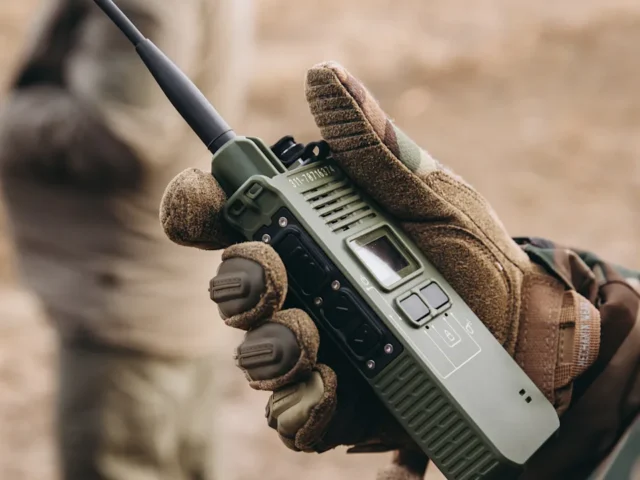
When a rescue team enters steep terrain, radio communication becomes more than a convenience. It becomes part of the rescue system itself. A mobile phone may work in a valley village, fail completely behind the next ridge, briefly return on a wind-exposed saddle, and then disappear again inside a gully. Satellite messengers and emergency beacons have changed the way outdoor emergencies are reported, but once a rescue operation is underway, teams still need controlled, disciplined, real-time communication between search parties, incident commanders, medical staff, helicopter crews and external emergency services.
Mountain rescue radio is therefore not one single frequency, one simple walkie-talkie channel or one universal global system. It is a layered communications environment. At the simplest level, rescuers may use VHF handheld radios between foot teams. At the command level, they may use licensed repeater networks, TETRA, DMR, P25, public safety LTE, satellite data terminals or dedicated emergency service networks. In some countries, a public emergency radio channel exists for distress alerting; in others, all rescue radio traffic is restricted to authorised users and the public is expected to use telephone emergency numbers, emergency apps, PLBs or satellite messengers.
The mountain environment makes radio both essential and difficult. VHF can travel surprisingly well over open terrain, across ridgelines and down valleys, but it does not bend through rock. UHF may be excellent around buildings, inside vehicles and in more compact operational areas, but it can also suffer badly when terrain blocks the line of sight. Digital trunked systems offer secure group calling and dispatch features, but they need network coverage. Analogue simplex may look primitive beside modern encrypted networks, yet it can still be the fallback method when infrastructure fails.
That tension between modern command systems and rugged field simplicity defines mountain rescue communications.
The mountain problem: line of sight, rock and weather
Radio waves behave very differently in mountains than they do in towns or flat countryside. A handheld radio that works perfectly across an open plateau may fail at a distance of only a few hundred metres if the operator steps behind a granite shoulder or descends into a narrow ravine. The limiting factor is usually not transmitter power. It is geometry.
Most VHF and UHF rescue systems depend heavily on line-of-sight propagation. If two operators can “see” each other in radio terms, even if they are several kilometres apart, the link may be strong. If a ridge, cliff, forested slope or building lies between them, the same equipment may become unreliable. This is why mountain rescue teams often place command vehicles, temporary repeaters or relay operators at tactically useful high points.
The weather adds another layer. Rain, snow and ice do not normally stop VHF or UHF communications in the way a mountain ridge does, but they affect operations indirectly. Antennas get covered, connectors become wet, batteries lose performance in cold conditions, microphones become difficult to use with gloves, and rescuers may be forced into positions where radio coverage is poor. A radio plan that works during a summer training exercise may need modification during a winter night rescue in high wind.
Radio discipline also becomes more important in poor conditions. When a casualty is cold, a helicopter is inbound and multiple search parties are moving at once, long undisciplined transmissions can block urgent traffic. Mountain rescue radio is not only about hardware. It is about procedure.
VHF: the classic workhorse of mountain rescue
VHF remains one of the most important frequency ranges for mountain rescue because it offers a practical compromise between range, antenna size and terrain performance. In broad terms, VHF signals can perform well across open country, hillsides, valleys and ridgelines. The antennas are still manageable on handheld radios, and the coverage per repeater site can be better than higher-frequency systems in rural terrain.
This is why many rescue organisations have historically used VHF portable radios for communications between search parties, command posts and aircraft. A UK mountain rescue communications document, for example, describes VHF portable radios as being used between search parties, command-and-control vehicles and SAR helicopters.
VHF is especially useful in simplex mode, where one radio talks directly to another without network infrastructure. Simplex does not provide the same area coverage as a repeater system, but it is resilient. If a rescue team is beyond a trunked network or if a repeater fails, a direct VHF channel can still work between nearby operators, especially if one of them gains height.
Repeater operation extends VHF usefulness dramatically. A repeater placed on a hilltop receives a weak handheld signal and retransmits it from a better location, allowing rescuers in different valleys to communicate. Permanent repeater sites are often carefully chosen for coverage, access, power supply and resilience. Temporary repeaters may also be deployed during major searches or events.
The main limitation is congestion and licensing. VHF land mobile channels are not free-for-all resources. Mountain rescue organisations operate under national licensing rules, and the actual operational channels are normally assigned, coordinated and controlled. In many countries, publishing or casually programming rescue frequencies into private radios is not appropriate and may be illegal to use for transmission.
UHF: shorter range, better control in some environments
UHF systems are also common in public safety, professional mobile radio and rescue communications. Compared with VHF, UHF generally uses shorter antennas and may perform better in dense built environments, around vehicles and in some indoor or semi-enclosed locations. In mountain rescue, UHF may appear in trunked radio networks, local incident communications, command links, cave rescue support systems, vehicle repeaters and interoperability gateways.
The trade-off is terrain. UHF often has less natural reach over open rural landscapes than VHF when all other factors are equal. A UHF handheld in a valley may struggle where a VHF radio might still reach a high repeater. However, this is not a universal rule. Site engineering, antenna placement, receiver quality, network density and operating mode can easily matter more than the band itself.
Modern public safety systems in Europe often use UHF spectrum around the 380–400 MHz region for TETRA networks. Germany’s BOS digital public safety radio system, for example, uses frequencies in the 380–395 MHz range and is based on TETRA technology. That type of network can be highly effective for coordinated emergency services, but its usefulness in mountains still depends on base station coverage, direct mode capability and local planning.
TETRA: secure group communication for public safety
TETRA, short for Terrestrial Trunked Radio, is one of the major professional mobile radio standards used by emergency services and public safety agencies, especially in Europe. It was designed for mission-critical voice and data, group calling, dispatch operation, direct mode, priority handling and secure communications. ETSI continues to maintain TETRA through its critical communications work, including ongoing alignment with professional mobile radio requirements.
For mountain rescue, the value of TETRA is not simply that it is digital. The important feature is operational structure. A rescue team can be placed into talkgroups. Commanders can coordinate multiple teams. Emergency button functions can alert control rooms. GPS and status messages may be available. Interoperability with police, ambulance, fire or civil protection agencies may be possible where the policy and network design allow it.
The UK Airwave network is an example of a national public safety radio environment based on TETRA. UK government guidance describes Airwave as the secure and resilient mobile telecommunications system for police, ambulance and fire and rescue services, also available to organisations that need to communicate with emergency services during incidents. Mountain rescue organisations do not necessarily use TETRA in the same way everywhere, but in countries with national public safety networks, the ability to interoperate with statutory emergency services can be decisive.
Ireland provides another practical example. Mountain Rescue Ireland has been documented as using the TETRA Ireland National Digital Radio Service, with reported benefits including national coverage, GPS location capability, personal safety features and interoperability with partner rescue agencies.
TETRA is not perfect. It is a narrowband system, and although it is extremely capable for voice and operational signalling, it is not the same as broadband data. Coverage in deep mountain valleys can still be challenging. Direct Mode Operation can help when the network is unavailable, but DMO has more limited range than a well-sited repeater network. As a result, many mountain rescue organisations still maintain VHF or analogue fallbacks even when they have access to sophisticated digital public safety networks.
DMR: digital mobile radio in practical rescue use
DMR, or Digital Mobile Radio, is another important technology in the mountain rescue world. Unlike TETRA, which is strongly associated with nationwide public safety networks in many countries, DMR is often used for organisational, regional or private professional radio systems. It can provide two voice time slots on a 12.5 kHz channel, digital signalling, text messaging, GPS, encryption options depending on implementation, and repeater-based wide-area coverage.
A documented example comes from Scotland. Scottish mountain rescue organisations replaced ageing analogue VHF radios with a DMR system using Hytera VHF repeaters, handheld radios and mobile radios. The system was adapted so GPS information could provide a British map grid reference, helping with callout and team management. Scottish Mountain Rescue also described the replacement of older radios with new VHF equipment to improve safety during responses to lost, missing and injured hillwalkers and mountaineers.
The appeal of DMR is practical. It can be deployed as a dedicated network for a rescue organisation without needing the full scale of a national TETRA system. Repeaters can be installed in areas where the organisation actually operates. Handheld radios are widely available in professional form factors. GPS and dispatch integration can be added. The system can remain under the operational control of the rescue organisation or its communications partner.
For mountain rescue, DMR’s digital audio can be an advantage or a disadvantage depending on signal quality. Analogue FM degrades gradually; a weak signal becomes noisy but may still be readable. Digital voice can remain clear up to a threshold and then fail abruptly. In difficult terrain, this behaviour must be understood through field testing rather than assumed from a coverage map.
P25 and North American public safety systems
In North America, Project 25, usually written as P25, is a major public safety radio standard. While European rescue communications discussions often mention TETRA, North American discussions often involve P25 trunked systems, VHF public safety channels, UHF systems, 700/800 MHz public safety networks and interoperability channels.
Mountain rescue in the United States and Canada is highly localised. A sheriff’s office, county search and rescue team, national park service unit, state agency or volunteer SAR organisation may operate under different licensing and governance arrangements. Some teams use VHF high-band systems because they work well in rural terrain. Others rely on county or state trunked networks. Helicopter coordination may involve aviation frequencies, and incident command may include interoperability channels assigned by the relevant authority.
One publicly documented U.S. frequency example is 123.1 MHz, which appears in the FCC frequency allocation table as a frequency for search and rescue communications. This does not mean that hikers should use aviation SAR frequencies casually, nor does it replace local emergency procedures. It simply illustrates that search and rescue communications often cross the boundary between land mobile radio and aviation radio.
Public emergency radio channels: the Swiss example
Switzerland is one of the clearest public examples of an emergency radio channel connected to alpine rescue. The Swiss emergency radio frequency 161.300 MHz is publicly documented by both the Swiss Federal Office of Communications and Rega. The official Swiss information states that the emergency radio network on 161.300 MHz uses the infrastructure of the Swiss Air-Rescue Rega network and is available for raising the alarm in an emergency, while also warning that some regions are not covered and that emergency radio equipment should not be the only safety measure.
Rega’s own emergency radio information says that the 161.300 MHz emergency radio channel can be used throughout Switzerland to call out rescue services if calling by telephone is not possible, and that the channel is monitored by Rega’s Operations Center.
This Swiss model is important because it shows a distinction that is often misunderstood. A public emergency radio frequency is not the same as a general-purpose hiking chat channel. It exists for distress alerting, not routine communication, testing, hobby use or weather discussion. It also does not guarantee coverage everywhere. The user still needs suitable equipment, knowledge, battery power, antenna orientation and a location from which the signal can reach the network.
Most countries do not have an exact equivalent that visitors can simply assume exists. Before travelling, mountaineers should check the official rescue guidance for the specific country or region.
Helicopter rescue communications
Helicopters add complexity to mountain rescue communications. An aircraft may need to speak with air traffic services, its own dispatch centre, ground rescue teams, medical crews and sometimes police or fire command. The aircraft may carry multiple radios covering aviation VHF, public safety networks, rescue organisation channels and satellite or cellular data links.
The radio path between a helicopter and ground rescuers is often better than ground-to-ground communication because the aircraft has altitude. Even a low-power handheld radio may reach a helicopter that is overhead or approaching along a valley. However, rotor noise, terrain, weather, urgency and workload make concise radio procedure essential.
Ground teams may need to pass landing-zone information, wind direction, hazards, casualty status and winch requirements. In many rescue systems, direct communication between the helicopter and ground team is strictly organised through agreed channels or talkgroups. In others, the incident commander relays information through dispatch.
Air-to-ground communication is one reason why mountain rescue radio planning cannot be isolated from the wider emergency services ecosystem. A hill team’s handheld radios, the command vehicle’s base station, the helicopter’s avionics and the ambulance service control room must form a coherent chain.
Repeaters, relay points and temporary coverage
A repeater is one of the most valuable tools in mountain rescue radio engineering. It solves the oldest mountain communication problem: rescuers in different valleys cannot hear each other because the mountain is in the way. By placing a receiver and transmitter at a high site, the repeater becomes the elevated listener and speaker for the entire operational area.
Permanent mountain rescue repeater sites are usually selected with great care. A good site needs coverage, security, power, maintainability and legal authorisation. Solar panels, battery backup and remote monitoring may be used where mains power is unavailable. Antenna systems must survive wind, ice and lightning risk. Access in winter may be difficult, so reliability matters.
Temporary repeaters are equally important during major searches, large outdoor events or incidents in known coverage holes. A transportable repeater may be placed on a ridge, in a vehicle, on a mast or at a forward control point. Some systems also use cross-band repeaters or gateway devices, linking VHF field radios to a UHF or TETRA command system. This can be extremely useful, but it must be engineered carefully to avoid audio delays, feedback loops, accidental retransmission of sensitive traffic or channel congestion.
A human relay can still be useful. In very broken terrain, a rescuer positioned at a col or high point may relay messages between two teams. It is not elegant, but it is resilient, and mountain rescue has always valued methods that keep working when technology becomes awkward.
Analogue FM: old technology that refuses to disappear
Analogue FM radio remains relevant because it is simple, predictable and tolerant of weak signals. A noisy analogue transmission may still be understandable to a trained operator. There is no network registration delay, no encryption key issue, no talkgroup selection problem and no dependence on a core network.
For search parties spread across a hillside, analogue VHF can still be a practical choice. It is also useful for interoperability with older equipment, temporary volunteers, event safety teams or neighbouring agencies that have not fully migrated to digital platforms.
This does not mean analogue is superior in every way. It lacks the advanced features of modern digital systems. It is less spectrally efficient than some digital modes. It does not inherently provide GPS, emergency button data, text messaging or secure authentication. But in rescue communications, the best system is not always the newest system. It is the system that works in the actual terrain, with cold hands, tired operators, wet microphones and imperfect antenna positions.
Digital voice: clearer audio, more features and new failure modes
Digital radio brings valuable capabilities to rescue work. GPS location, unit identification, emergency alert buttons, text messaging, encryption, dispatcher integration and call logging can all improve operational safety. Digital networks can help commanders see where teams are, assign resources more efficiently and maintain better records of a search.
But digital voice has different failure behaviour. With analogue, the operator often hears a signal getting weaker. With digital, the audio may stay clean and then suddenly break into artefacts or disappear. This “cliff edge” effect is familiar to anyone who has tested DMR, TETRA, P25 or other digital systems in marginal conditions.
Training is therefore essential. Teams need to know where their digital system works, where it fails, how direct mode behaves, whether a vehicle repeater can help, how long batteries last under GPS reporting, and how to switch to a fallback channel without confusion.
A radio fleet is only as good as the operational habits around it. A team that trains regularly with its radios will outperform a team with better equipment but poor procedure.
Public safety LTE and broadband rescue communications
The future of emergency communications is not only voice. Modern rescue operations increasingly rely on maps, live location data, photographs, drone imagery, weather feeds, medical telemetry, incident management systems and shared digital logs. Traditional narrowband radio cannot carry all of this effectively.
This is why many countries are developing or adopting public safety broadband systems. In the UK, the Emergency Services Network is designed to provide secure voice, video and data over a 4G-based network for first responders, with improvements to 4G coverage intended to support emergency calling in remote and rural areas.
Broadband systems can transform mountain rescue command. A control point may see team locations on a live map. A medic may send images to a hospital specialist. Drone search imagery may be shared with search planners. Weather warnings may be distributed quickly. However, broadband does not eliminate the need for narrowband radio. Cellular coverage remains imperfect in mountains, and data networks are more complex than simple voice systems.
The likely future is hybrid. Voice radio remains the operational backbone, while broadband data improves situational awareness where coverage exists.
Satellite devices, PLBs and emergency beacons
For the person in distress, radio communication may begin long before the rescue team arrives. Satellite messengers, emergency apps, PLBs and emergency locator beacons have changed the first-alert phase of mountain incidents.
A PLB operating through the international 406 MHz Cospas-Sarsat system can transmit a distress alert with identification and, in modern units, GNSS position data. This is different from a two-way rescue radio. The user does not normally have a voice conversation with a mountain rescue team over a PLB. Instead, the beacon alerts the rescue coordination system.
Satellite messengers can provide two-way text communication, which can be extremely useful when mobile phone coverage is absent. They may allow the casualty to describe injuries, party size, weather, shelter and movement. However, they are not a substitute for rescue team radio once the operation begins. They are part of the alerting and information chain.
The old aviation emergency frequency 121.5 MHz still has historical and operational relevance in some contexts, but modern distress alerting has largely shifted toward 406 MHz beacons for satellite detection. Rescue professionals may still use direction-finding equipment depending on the beacon type and scenario, but hikers should follow the current official guidance for their country and device.
Cave rescue and underground communication
Mountain rescue sometimes overlaps with cave rescue, and underground communication is a different technical world. VHF and UHF signals do not travel through rock in the same useful way they travel through air. Inside caves, mines and deep shafts, normal handheld radios may work only over short distances or around entrances.
Cave rescue has therefore used specialised systems such as through-the-earth radios, inductive systems, leaky feeder cables and wired communication lines. Mountain Rescue England and Wales magazine material describes early UK cave rescue systems including the Molefone, which enabled communication between cave and surface with portable equipment and could communicate to depths over 100 metres in some conditions.
The lesson for mountain rescue is broader: no single radio system covers every environment. A team that handles cliffs, caves, winter hills, forests and remote valleys may need several communication methods, each suited to a different physical problem.
Interoperability: the hardest part is often not the frequency
In a real mountain rescue, many organisations may be involved: volunteer mountain rescue teams, police, ambulance, fire and rescue services, air ambulance, coastguard, park authorities, ski patrol, military aircraft, local government and sometimes amateur radio emergency groups. Each may have its own radio system, procedures, call signs and command structure.
The technical challenge is not just whether two radios can be tuned to the same frequency. The deeper challenge is governance. Are the organisations authorised to talk directly? Are talkgroups pre-planned? Is encryption compatible? Who controls the channel? What language and terminology are used? Can sensitive medical or police information be transmitted? Who logs decisions?
Interoperability is therefore both technical and procedural. Gateways can connect systems. Multi-band radios can help. Shared talkgroups can be established. But without pre-planning, training and authority, the technology may not be used effectively.
This is one reason why national public safety networks are attractive. They can provide structured inter-agency communication rather than a patchwork of improvised links. But mountain rescue still needs local resilience because the national network may not cover every corrie, canyon, forest track or cliff base.
Frequencies: what can be said publicly and what should not be copied blindly
A common online search is “mountain rescue frequencies”. The problem is that the answer is not universal. Frequencies are allocated nationally, licensed locally and assigned operationally. Even where a frequency appears in a public document, that does not mean private users may transmit on it.
There are a few categories that can be discussed safely at a general level.
VHF high-band land mobile channels are widely used by professional and volunteer rescue organisations because they are practical in rural terrain. UHF public safety bands are common in trunked systems and urban or mixed environments. TETRA networks in Europe often operate in public safety allocations around the 380–400 MHz region. DMR systems may be deployed on licensed VHF or UHF channels depending on the country and organisation. Aviation VHF is used for aircraft communications, including certain search and rescue functions. Publicly documented emergency channels exist in some countries, such as Switzerland’s 161.300 MHz Rega emergency radio channel, but they are not general-purpose radio channels.
For outdoor users, the practical advice is simple: do not assume that a frequency found on a forum is legal, current or monitored. Use the official emergency number, official rescue app, PLB, satellite messenger or nationally approved emergency radio method for the area you are visiting.
For radio hobbyists, listening laws also vary by country. In some places, receiving certain emergency service communications is restricted. In others, encrypted digital systems make casual monitoring impossible. Publishing live rescue traffic, personal medical details or tactical information is ethically unacceptable even where reception itself is technically possible.
Why mobile phones did not replace rescue radio
Mobile phones are essential in modern rescue. They provide emergency calling, location data, photographs, mapping, messaging and apps. In many incidents, the first alert comes from a mobile phone. Emergency call centres can sometimes obtain location information from the caller’s device. Rescue teams may use phone calls to speak directly with a casualty before arrival.
But mobile phones are consumer devices connected to commercial networks. They depend on coverage, battery condition, weather exposure, screen usability and network availability. Mountains create coverage shadows. Cold reduces battery performance. Touchscreens are awkward with gloves. A wet phone may fail. A base station may be overloaded during a major outdoor event.
Rescue radio is different. It is designed as an operational tool. A handheld radio has a physical push-to-talk button. It can be used with gloves. It may be waterproof, ruggedised and designed for loud environments. A single transmission can reach an entire group. Priority and emergency functions may exist. Spare batteries can be managed as part of team logistics. A command post can monitor traffic continuously.
The two technologies complement each other. The mobile phone is often the best alerting and information device. The professional radio is often the best team coordination device.
Radio procedure: the invisible technology
A rescue radio network can fail because of terrain, battery depletion or hardware damage. It can also fail because of poor procedure. Long transmissions, unclear call signs, emotional speech, wrong channel selection and missed acknowledgements can create confusion at exactly the wrong moment.
Mountain rescue teams therefore train radio discipline. Messages should be short, structured and relevant. Operators should identify who they are calling and who they are. Important information should be acknowledged. Coordinates should be read carefully, preferably using an agreed format. Casualty information should be passed with appropriate privacy. Urgent traffic should be prioritised.
Good procedure also includes silence. Not every observation needs to be transmitted. A radio channel is a shared operational resource. During a complex rescue, unnecessary chatter can delay a critical message.
This is why professional rescue communication sounds different from recreational radio. It is not about sounding dramatic. It is about reducing ambiguity.
Batteries, antennas and the small details that decide range
In mountain rescue, small radio details matter. A handheld radio carried inside a wet jacket with its antenna pressed against the body will perform worse than the same radio held upright in the clear. A damaged antenna can reduce range dramatically. A speaker microphone cable can fail after repeated flexing. A battery that seemed adequate at the base may collapse in freezing wind.
Teams manage these risks through equipment standards and routines. Radios are charged, checked and assigned. Spare batteries are carried. Waterproof speaker microphones are inspected. Antennas are kept intact. Vehicle chargers and command-post power systems are maintained. After an incident, equipment is dried, cleaned and logged.
Antenna position is especially important. Gaining only a few metres of height can improve communication. Moving from behind a boulder to an open slope can restore a signal. Turning the body, raising the radio or using a longer antenna may help in marginal conditions. These are simple techniques, but they need to be practised before the emergency.
Encryption and privacy in rescue communications
Some rescue radio systems use encryption, especially when integrated with police, ambulance or national public safety networks. Encryption protects personal data, medical details, police-sensitive information and operational decisions. It also prevents casual monitoring and rebroadcasting of rescue traffic.
However, encryption introduces management requirements. Radios must be programmed correctly. Keys must be managed. Lost radios must be disabled or rekeyed. Interoperability with other organisations must be planned. A fully encrypted system that cannot communicate with a partner agency may create problems unless gateway procedures exist.
Not every rescue communication needs encryption, but modern data protection expectations make privacy increasingly important. A mountain rescue incident may involve names, injuries, coordinates, family contact details and police information. Radio systems are no longer treated as informal open channels.
Drones, tracking and the expanding data layer
Drones are increasingly used in search and rescue for visual search, thermal imaging, mapping and hazard assessment. They add another communication layer. Drone pilots need command communication, airspace coordination, data links, battery logistics and sometimes live video distribution.
The drone control link itself is not the same as the rescue radio network, but operationally the two are connected. A drone team may identify a possible casualty location and pass coordinates to search teams by radio. A command post may use broadband data to view imagery while still using VHF or TETRA voice to direct foot teams. Helicopter operations may require drone grounding or strict coordination.
Team tracking is another major development. Digital radios, smartphone apps and dedicated GPS trackers can show the location of rescue parties on a command map. This improves safety because commanders can see which areas have been searched and whether a team has stopped moving unexpectedly. But tracking depends on data coverage, battery management, device discipline and privacy rules.
International differences: why there is no global mountain rescue channel
It would be convenient if every mountain rescue team in the world used the same frequency. In reality, spectrum regulation makes that impossible. Radio bands are allocated nationally and internationally for many competing services: aviation, maritime, public safety, broadcasting, military, satellite, amateur radio, commercial land mobile and more.
Even within one country, mountain rescue may be organised differently by region. A national park team, a volunteer mountain rescue association, a ski patrol, a civil protection agency and a police-led SAR unit may use different systems. Border regions add further complexity. Alpine rescue near national borders may require coordination between countries with different radio networks and languages.
International visitors should therefore avoid bringing assumptions from home. A radio channel used by rescue teams in one country may be illegal or irrelevant in another. The correct preparation is to check official local guidance: emergency numbers, rescue apps, PLB registration rules, avalanche bulletin sources and communication recommendations.
Amateur radio and mountain rescue
Amateur radio operators have a long history of helping during emergencies, public service events and communications failures. In some regions, trained amateur radio emergency groups may support search and rescue with logistics, message handling, APRS tracking, temporary repeaters or backup communications.
However, amateur radio is not a substitute for professional rescue communications. Amateur bands cannot normally be used for encrypted operational traffic, private medical details or routine public safety command unless specific legal frameworks apply. Rescue teams cannot simply move their main traffic to amateur frequencies because convenient equipment exists.
The useful role of amateur radio is usually support, not replacement. Licensed, trained operators can provide backup links, event safety communication, technical expertise and resilience during infrastructure failure. But they must work under the incident command structure and within national regulations.
For outdoor enthusiasts, amateur radio can be a useful personal skill, especially in remote areas where legal amateur repeaters provide coverage. But it should not be marketed as a guaranteed emergency lifeline. The most reliable emergency tool is the one officially recognised, monitored and suitable for the region.
The future: hybrid networks, smarter radios and resilient simplicity
Mountain rescue communications are moving toward hybrid systems. A future rescue team may use a rugged handheld radio that supports digital voice, GPS, emergency alerts, Bluetooth accessories and possibly LTE integration. The command vehicle may combine VHF, UHF, TETRA, DMR, satellite broadband, cellular routers, mapping software and drone video. Dispatchers may see live locations and incident logs. Helicopters may exchange data more easily with ground teams.
At the same time, the mountains will continue to punish complexity. Batteries will still get cold. Valleys will still block signals. A rescuer will still need a push-to-talk button that works with gloves. A simple direct radio channel will still matter when the network is missing.
The best mountain rescue communication systems will therefore not be the most fashionable systems. They will be layered, tested and realistic. They will combine public safety networks with local VHF coverage, digital features with analogue fallbacks, broadband data with voice discipline, and advanced mapping with the old habit of placing a relay operator on high ground when necessary.
Safety advice for hikers, climbers and radio users
For hikers and climbers, the most important communication rule is not to rely on one method. A mobile phone is essential, but it should not be the only option in remote terrain. A satellite messenger or PLB may be appropriate for serious backcountry travel. In Switzerland, properly used emergency radio equipment on 161.300 MHz may be part of the safety picture, but official guidance makes clear that coverage is not universal and that it is intended for emergency alerting.
Before travelling, check the official rescue information for the region. Know the emergency number. Install any official emergency app if recommended. Register your PLB if required. Carry spare power. Keep devices warm and dry. Learn how to give coordinates in the local expected format. Tell someone your route.
For radio enthusiasts, the rule is equally clear: listening, transmitting and programming radios must follow national law. Do not transmit on rescue, aviation, public safety or emergency service channels unless you are authorised or in a legally recognised distress situation where such use is permitted. Do not interfere with rescue traffic. Do not publish sensitive operational communications.
Mountain rescue radio exists because the mountains are indifferent to technology. Signals fade, weather changes, people get injured, and darkness arrives quickly. The radio systems behind rescue work are a blend of engineering, regulation, training and experience. They are not glamorous, but when a search party finds a casualty in bad weather and the message reaches command clearly, every repeater, antenna, battery check and disciplined transmission has done its job.
Image(s) used in this article are either AI-generated or sourced from royalty-free platforms like Pixabay or Pexels.
This article may contain affiliate links. If you purchase through these links, we may earn a commission at no extra cost to you.
Get the weekly RF & IT briefing
Radio guides, RF calculators, AI, Windows, Linux and satellite communication explainers. One useful email per week. No spam.