
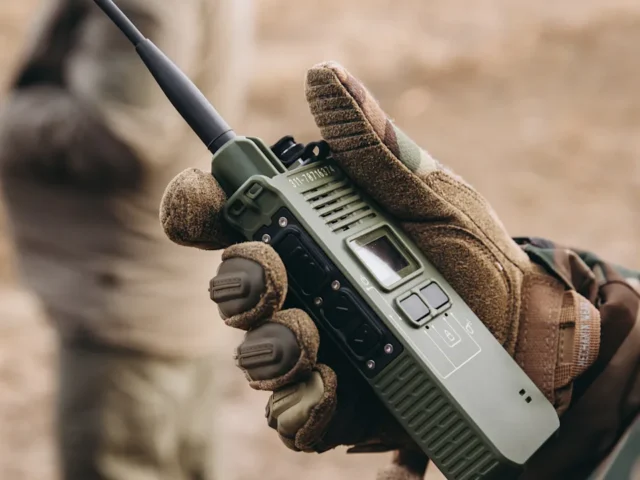
The Ukrainian Himera radio system is one of the most interesting examples of how modern warfare can accelerate the development of communication technology. In a conventional defense industry environment, tactical radios are usually developed through long procurement cycles, expensive certification processes and slow-moving institutional requirements. The war in Ukraine created a very different environment. Soldiers needed secure, lightweight, affordable and rapidly deployable communication devices that could function under constant electronic warfare pressure.
Himera appeared in this context. It is not just another handheld transceiver or a civilian walkie-talkie repackaged for military use. It represents a new generation of tactical radio thinking, where encrypted voice, short data messages, coordinate transmission, mesh networking and software-driven configuration become part of a compact field system. The core idea is to give small units a secure and practical communication tool without forcing them to rely on heavy infrastructure, complex programming procedures or extremely expensive legacy military radios.
The best-known device in this ecosystem is the HIMERA G1 PRO. It is a Ukrainian-developed digital tactical radio designed for encrypted communication, battlefield data exchange and operation in environments where ordinary radio systems may be intercepted, jammed or rendered unreliable. Its importance lies not only in its technical specifications, but also in the conditions under which it was created. Ukraine has become one of the most electronically contested battlefields in the world. Radios are not just voice tools there. They are part of the command network, the reconnaissance chain, the artillery coordination process and the survival system of small mobile units.
For that reason, Himera radios are relevant far beyond Ukraine. They show how tactical communication is changing in the age of drones, electronic warfare, distributed units and real-time digital battlefield management.
What Himera radios are
Himera radios are secure Ukrainian tactical communication devices built for field use, military coordination and resilient short-range networking. The system was developed during the war, when the limits of ordinary commercial radios became increasingly obvious. Many units needed communication equipment quickly, and at the beginning of the full-scale war a large number of commercial handheld radios were used because they were cheap, available and familiar. These radios helped fill an urgent gap, but they were not designed for a battlefield dominated by interception, jamming, signal intelligence and drone-supported artillery.
The Himera concept starts from that operational problem. A tactical radio must not merely transmit voice. It must protect the content of the communication, reduce the usefulness of interception, work under interference, support data exchange and remain simple enough for ordinary soldiers to use under pressure. It must also be affordable and scalable, because in modern war radios are lost, damaged, captured, updated and replaced constantly.
The system includes handheld radios and network extension equipment. The HIMERA G1 PRO is the central handheld model, while devices such as the B1, R1 and E1 expand the network by acting as repeaters, internet bridges or coverage extenders. This makes Himera more than a single radio. It is better understood as a compact tactical communication ecosystem.
Why Ukraine needed a different kind of radio
The Ukrainian battlefield exposed a fundamental weakness in many older communication models. A simple analog or lightly protected digital radio may be sufficient for construction sites, security teams, industrial facilities or outdoor recreation. It is not sufficient when the adversary actively listens, locates, jams and exploits radio traffic.
In Ukraine, radio transmissions can become targeting information. A badly protected radio link can reveal positions, unit movement, command structure or tactical intent. A jammed radio link can isolate a group at exactly the wrong moment. An intercepted message can give the enemy enough information to adjust artillery fire, identify a drone operator or disrupt a maneuver.
This is why secure tactical communication is no longer a luxury. It is a battlefield requirement.
The communication problem is also more complex than traditional voice traffic. Modern units exchange coordinates, drone observations, map updates, short digital reports and unit position data. A commander may need to know where friendly units are located, where a drone has detected movement, where artillery adjustment is required, or whether a small mobile group has reached a specific point. Voice alone is still important, but it is no longer enough.
Himera was created for this type of environment. Its purpose is not to provide glamorous long-distance radio performance in ideal conditions. Its purpose is to make local and tactical communication more survivable, more secure and more useful under battlefield pressure.
The origin of Himera
Himera emerged from wartime necessity rather than from a traditional peacetime defense procurement program. Ukrainian developers saw that soldiers were often forced to rely on available commercial radios, even though these devices were not designed for intense electronic warfare. The first Himera G1 radios appeared as a response to this gap, and the later G1 PRO improved the system based on field feedback.
This is one of the defining characteristics of Himera. The product was not designed in isolation from the battlefield. It was shaped by soldiers, communication specialists and real operational problems. That matters because tactical radios often fail in practice not because the engineering is poor, but because the user experience does not match field reality. A system can have strong encryption, high output power and advanced features, but if it is hard to configure, difficult to teach, slow to deploy or awkward to operate under stress, it becomes less useful.
Himera’s development model appears closer to modern software and electronics startups than to classic defense electronics. Hardware and firmware have reportedly gone through repeated revisions. That kind of iteration is typical in consumer technology, but less common in traditional military radio procurement. In Ukraine, however, battlefield conditions forced a faster rhythm. Devices had to be improved as new problems appeared.
This is why Himera is often discussed as part of Ukraine’s wider defense-technology wave. The same environment that accelerated drone development, situational awareness software and electronic warfare tools also created the conditions for new radio systems.
The HIMERA G1 PRO
The HIMERA G1 PRO is the most important model in the publicly known Himera family. It is a compact digital tactical handheld radio designed for secure voice and data communication. Compared with the earlier G1, the G1 PRO added improvements in signal performance, sound quality, data handling, physical protection and usability.
The device is intended to be practical in field conditions. It has a ruggedized case, a display, encrypted communication features and support for configuration through mobile devices. The fact that it can be configured through an Android smartphone is especially important. Many older professional or military radio systems require specialized programming cables, dedicated software and trained radio technicians. Himera’s approach lowers the operational barrier. A unit can adapt its communication setup more quickly without turning every configuration change into a technical procedure.
This does not mean the radio is a consumer gadget. It means that its designers understood that usability is a tactical feature. A secure radio that soldiers actually use correctly is more valuable than a theoretically powerful system that is too cumbersome in the field.
The G1 PRO also supports more than voice. It is designed to transmit short data, including messages and coordinates. That makes it useful not only as a talking device, but as part of a small tactical data network.
Encrypted voice and data communication
Encryption is one of the central features of Himera radios. In military communication, encryption protects the content of a message from being understood by unauthorized listeners. If an adversary records the transmission but cannot decode the content, the value of interception is greatly reduced.
However, encryption should not be misunderstood. It does not make a radio invisible. It does not prevent the enemy from detecting that a signal exists. It does not automatically stop direction finding or jamming. It protects message content, but communication security also depends on emission discipline, key management, device security and operational procedures.
This distinction is important. A secure radio system is not secure simply because a strong encryption algorithm is mentioned in its marketing material. Real security depends on the entire system. How are keys generated? How are they distributed? What happens if a radio is captured? How quickly can a compromised device be excluded? How easily can users make configuration mistakes? These questions matter as much as the encryption label itself.
Himera’s value is that encryption is integrated into a field-oriented tactical radio rather than being treated as an optional extra. For Ukrainian units, that matters because the difference between open voice communication and encrypted communication can be operationally significant.
Frequency hopping and electronic warfare resistance
Another key concept associated with Himera radios is frequency hopping. In a fixed-frequency radio system, communication takes place on a predictable channel. That makes interception and jamming simpler. If the adversary knows the frequency, they can listen, block or exploit that channel more easily.
Frequency-hopping spread spectrum works differently. Instead of staying on one fixed frequency, the system changes frequency according to a defined pattern. A receiver that knows the pattern can follow the transmission. An adversary that does not know the pattern has a more difficult task. They may need to jam a wider band, detect short bursts, analyze the waveform or use more sophisticated electronic warfare equipment.
This does not make the system invulnerable. No radio is immune to electronic warfare. A powerful enough jammer close enough to the target can disrupt many systems. Wideband jamming, smart jamming and advanced signal analysis can still create problems. But frequency hopping raises the difficulty. It can make jamming less efficient and interception less straightforward.
In Ukraine, that difference matters. A radio does not need to be impossible to jam in order to be useful. It needs to be harder to jam than simpler alternatives, harder to exploit quickly, and resilient enough to keep working in situations where ordinary radios fail.
Himera’s electronic warfare resistance should therefore be understood as layered resilience. Encryption protects content. Frequency hopping complicates interception and jamming. Mesh networking improves local network survivability. Repeaters extend coverage. Software updates allow the system to evolve. Together, these layers create a more robust communication tool.
Mesh networking as a battlefield advantage
One of the most important features of the Himera concept is mesh networking. In a traditional simple radio link, two radios must be able to hear each other directly. If terrain, buildings, vegetation or distance block the signal, communication fails. A repeater can solve this, but conventional repeaters may require fixed infrastructure, planning and installation.
A mesh network changes the model. In a mesh-style radio system, individual nodes can help relay communication. A radio or network device can act as an intermediate point, allowing signals to move through the network even when two users do not have direct contact.
For battlefield use, this is highly relevant. Ukrainian units often operate in forests, trenches, villages, urban ruins and uneven terrain. Line-of-sight is frequently blocked. A handheld radio close to the ground will always face propagation limits. Mesh networking does not eliminate these limits, but it can reduce their impact by allowing the network to route communication through better-positioned nodes.
The value is especially clear for small dispersed teams. A reconnaissance group, drone team, command post and support element may not all be within direct radio range of one another. A mesh-capable system can help maintain local connectivity without relying on civilian cellular networks or fixed infrastructure.
However, mesh networking is not magic. More nodes can also mean more complexity, more battery use and more potential emissions. The network must be planned and managed properly. If too many devices transmit carelessly, they may create additional detectability. If devices are captured, security procedures become critical. Mesh networking is powerful, but it must be treated as a tactical tool, not merely a convenience feature.
Repeaters and network extenders
The Himera ecosystem includes devices designed to extend coverage beyond the limits of handheld-to-handheld communication. This is where the B1, R1 and E1 become important.
The B1 can be understood as a network extender or repeater. Its role is to improve coverage by being positioned where radio propagation is better. Height is one of the most important factors in VHF and UHF communication. A small handheld radio used at ground level has limited range because terrain and obstacles block the signal. A repeater raised on a tower, mast, hill, building, drone or balloon can dramatically improve the coverage area.
The R1 adds another layer by combining repeater functionality with internet relay capabilities. This allows radio traffic and data to be bridged across wider networks when internet connectivity is available. Such a capability can be useful for connecting local tactical radio networks with command structures farther away.
The E1 is associated with extending internet connectivity in difficult areas. In a modern battlefield, radio and internet are not separate worlds. Tablets, mapping systems, drone feeds and situational awareness platforms often require data links. A system that can bridge local radio communication and digital networks becomes more valuable than a simple voice-only radio.
This layered architecture is one of the most important things about Himera. The handheld radio is only the visible part. The real concept is a flexible communication network that can be expanded depending on terrain, mission and available infrastructure.
Realistic range expectations
Radio range is often exaggerated in marketing and misunderstood by users. A single range number can be misleading because actual performance depends on many variables. Terrain, antenna height, vegetation, buildings, weather, interference, output power, receiver sensitivity, antenna quality and the presence of repeaters all matter.
For a handheld tactical radio, direct range near ground level is naturally limited. In open terrain, the range may be significantly better than in urban ruins or forested areas. In a city, reinforced concrete, metal structures and narrow streets can reduce coverage sharply. In a trench or behind a hill, even a strong radio may struggle.
Himera should not be judged as though it were trying to violate the laws of radio propagation. Its strength is not that a small handheld unit can always communicate over very long distances by itself. Its strength is that the system combines secure digital communication with repeaters, mesh networking and flexible network architecture.
A good way to understand Himera is this: it does not make radio physics disappear, but it gives the user more tools to work around the limits of radio physics.
Tactical data and coordinate exchange
Modern radios increasingly act as data devices. This is one of the most important differences between older walkie-talkies and newer tactical systems.
Voice communication is still fast and natural, but it has weaknesses. A spoken coordinate can be misheard. A target description can be ambiguous. A stressed operator can transmit incomplete information. Short digital messages and coordinate exchange reduce some of these problems. A coordinate sent as data can be displayed on a map. A short message can be read later. A unit location can be shared more precisely than through voice alone.
Himera’s ability to transmit coordinates and short data makes it relevant for modern situational awareness. If a unit can share its position, mark an observed target or exchange short tactical messages without relying on public cellular networks, it gains resilience. This is particularly important when internet access is unavailable, jammed or unsafe.
In Ukraine, this capability connects naturally with tablet-based battlefield management tools. A radio that can carry tactical data becomes part of a larger digital command-and-control chain. It allows units to operate even when conventional infrastructure is degraded.
The security implications are serious. Coordinate data is sensitive. Friendly-force tracking can save lives, but if compromised it can also expose units. This is why encryption, device control and disciplined procedures are essential.
Integration with battlefield software
The Himera system is significant because it can interact with wider situational awareness software. In Ukraine, tools such as digital maps, artillery coordination systems and battlefield management applications have become essential. A radio that can exchange data with such systems is more valuable than a standalone voice device.
This is part of a broader trend in military communications. The radio is no longer just a radio. It is a node in a network. It may connect a soldier, a tablet, a drone team, a command post and a repeater. It may carry voice one moment and coordinates the next. It may operate locally when the internet is gone, then bridge back into a wider system when connectivity returns.
This kind of integration is central to modern war. The side that moves information faster, more securely and more reliably often gains an advantage. Faster information flow can shorten the time between detection and decision. Secure information flow can reduce the risk of interception. Resilient information flow can keep units coordinated when infrastructure is under attack.
Himera is important because it fits this logic. It is not merely a communications accessory. It is part of the digitalization of small-unit warfare.
Comparison with ordinary commercial radios
To understand Himera’s position, it helps to compare it with common commercial handheld radios.
Low-cost consumer radios are attractive because they are cheap, easy to buy and simple to operate. Many units around the world use such devices because they are available. In emergencies, a cheap radio is better than no radio. But in a contested military environment, these devices have obvious weaknesses. They often use predictable channels, limited or no encryption, simple analog voice or consumer-grade digital protocols. They may be easy to intercept and easy to jam.
Professional commercial radios from companies such as Motorola or Hytera are much more capable. Many models are rugged, reliable and suitable for public safety, industrial sites, transport fleets and security operations. Some support digital voice, encryption, trunking and advanced fleet management. These systems are mature and well supported.
But even professional commercial radios are not always ideal for Ukrainian battlefield conditions. Cost, availability, licensing, configuration complexity and electronic warfare adaptation all matter. A radio designed primarily for public safety or industrial communication may not be optimized for rapidly changing front-line conditions, mesh networking or low-cost wartime scaling.
Himera occupies a different space. It aims to provide military-relevant features in a compact and scalable form. It is not simply cheaper than high-end systems, and it is not simply more secure than consumer radios. Its real advantage is that it was designed around the particular communication problems of modern Ukrainian combat.
Comparison with legacy military radios
Legacy military radios have advantages that should not be dismissed. They are often extremely rugged, heavily tested, interoperable within established military structures and supported by formal logistics systems. Many have advanced encryption and anti-jam features. For large armies, such systems remain essential.
However, they can also be expensive, slow to procure and difficult to adapt quickly. A modern conflict can expose the weaknesses of slow procurement. If a battlefield problem changes every few months, a system that takes years to update may struggle to keep up.
Himera reflects a more agile model. It is closer to a software-defined, field-updated communication platform than a classic fixed-function radio. That flexibility is valuable in a war where electronic warfare techniques evolve constantly.
The trade-off is that newer systems must still prove long-term reliability, interoperability, lifecycle support and large-scale security management. Himera’s international interest suggests that militaries are paying attention, but adoption beyond Ukraine will depend on testing, procurement requirements and integration with existing command systems.
The role of software
One of the most important lessons from Himera is that modern radio capability increasingly depends on software. Hardware still matters. Antenna design, receiver sensitivity, battery life, casing quality and RF performance remain fundamental. But software determines how the system routes data, manages encryption, updates behavior, connects to mobile apps and integrates with other tools.
This is why firmware updates and mobile configuration are strategically important. A radio that can be improved through software can adapt to new threats. If electronic warfare conditions change, the system may be updated. If users need a better interface, the app can improve. If repeaters need better management, software can address it.
This creates a different lifecycle from older radios. The radio is not finished when it leaves the factory. It becomes part of an evolving ecosystem.
That is a strength, but also a responsibility. Software-driven systems require update discipline, cybersecurity, compatibility management and proper user training. A poorly managed software ecosystem can introduce vulnerabilities. A well-managed one can keep the system relevant far longer than a fixed-function device.
Battlefield usability
Technical capability means little if soldiers cannot use the device effectively. Himera’s design appears to recognize this. The radio is built around practical field use rather than laboratory elegance.
A tactical user needs clear audio, simple controls, fast configuration, rugged construction and predictable behavior. In combat, there is no patience for complicated menus or fragile connectors. A radio must work with gloves, under stress, in bad weather and around other equipment. It must survive being carried, dropped, packed, unpacked and used in dirty environments.
Battery life is also a practical battlefield issue. A radio that requires frequent charging creates logistical burden. Small units may operate away from reliable power. Drones, tablets, night-vision devices and other electronics already compete for batteries and chargers. A communication device must be power-efficient enough to remain useful during extended operations.
Himera’s appeal comes partly from this practical orientation. It is not only about advanced features. It is about packaging those features in a form that can be used by real units in real conditions.
Electronic warfare and the cat-and-mouse problem
Electronic warfare is not static. Every new communication method creates a response. Every anti-jam technique encourages better jamming. Every secure system becomes a target for analysis. This is why tactical radio design is a continuous contest rather than a one-time achievement.
Himera’s frequency hopping and encrypted architecture are useful because they raise the adversary’s workload. But over time, adversaries may adapt. They may deploy wider-band jamming, smarter detection systems, more sensitive direction-finding equipment or cyber-focused attacks against the configuration ecosystem. This is normal in military technology.
The question is not whether Himera can remain permanently ahead of all threats. No system can. The question is whether it can evolve quickly enough and remain useful under pressure. Its Ukrainian development background suggests that rapid iteration is one of its strengths.
This cat-and-mouse dynamic is one reason software updates, field feedback and modular network design matter. A radio system that cannot adapt becomes obsolete faster in an electronic warfare environment.
Civilian and emergency relevance
Although Himera is associated mainly with military use, the underlying concept has relevance in civilian emergency communication, disaster response and critical infrastructure protection.
Natural disasters often damage cellular networks. Floods, earthquakes, fires and storms can disrupt ordinary communication systems. Emergency teams may need local secure communication, position sharing and temporary repeater coverage. A portable mesh-capable radio ecosystem can be valuable in such circumstances.
Security services, border protection, coast guard units, search-and-rescue teams and industrial emergency response groups may also benefit from secure tactical communication. The same features that help a military unit coordinate under electronic pressure can help emergency teams coordinate when infrastructure is unreliable.
However, legal regulation is critical. Tactical radios are not automatically legal for ordinary civilian use. Frequency allocation, encryption rules, licensing requirements and transmission power limits vary by country. A device designed for military or official use may require specific authorization. It should not be treated like a license-free consumer walkie-talkie.
For the civilian market, the most important lesson from Himera may not be the exact device itself, but the direction of the technology: secure, modular, data-capable and infrastructure-independent communication.
Why Himera matters for NATO and allied militaries
Himera has attracted attention outside Ukraine because NATO and allied militaries are studying the communication lessons of the war. Ukraine has shown that even basic tactical communication can become difficult when the electromagnetic environment is heavily contested.
Large modern militaries often possess advanced communication systems, but they also face challenges. High-end radios are expensive. Interoperability is complex. Procurement can be slow. Small units may need simpler, lighter and more scalable systems for specific roles. The Ukrainian experience suggests that agile, lower-cost, rapidly updated communication tools can complement larger military networks.
Himera may therefore be interesting not because it replaces all existing military radios, but because it fills a specific operational niche. It can support small teams, dispersed units, emergency fallback communication, drone-support teams or local tactical data exchange.
For NATO, the broader question is not only whether to buy a particular Ukrainian radio. The broader question is how to design communication systems that are secure, resilient, inexpensive enough to deploy widely and adaptable enough for fast-changing electronic warfare.
Limitations and open questions
A balanced article about Himera should not treat it as a flawless miracle device. Publicly available information gives a strong picture of the concept, but many technical details remain limited. That is understandable for a tactical radio system, but it means independent evaluation is still important.
The exact waveform details, frequency behavior, key management model, resistance against specific jamming systems and long-term reliability data are not fully available in open public sources. Some details are likely intentionally restricted. Others may only be known through field testing.
There is also the issue of interoperability. A radio system is most useful when it fits into a larger communication architecture. Militaries care not only about whether a device works by itself, but whether it integrates with existing encryption policy, logistics, command systems, training structures and procurement rules.
Another open question is long-term support. Startups can innovate quickly, but military users need spare parts, updates, documentation, training, security procedures and predictable supply chains. Himera’s ability to scale production and support international users will be an important factor in its future.
Finally, every secure radio depends on user discipline. A strong system can be weakened by poor procedures. Lost devices, careless configuration, reused keys, unnecessary transmissions or poor antenna placement can reduce effectiveness. Technology helps, but it does not replace communication discipline.
Himera and the future of tactical radio
The most important thing about Himera is not any single feature. It is the direction it represents. Tactical radios are becoming smaller, smarter, more data-oriented and more integrated with software ecosystems. Voice remains essential, but it is now only one part of the communication problem.
Future tactical radios will likely combine encrypted voice, text messaging, coordinate exchange, mesh networking, repeater control, low-probability-of-intercept techniques, integration with drones, connection to battlefield management tools and regular software updates. They will need to survive not only mud and rain, but also jamming, interception, cyber threats and rapid changes in enemy electronic warfare tactics.
Himera is one of the clearest examples of this transition. It shows how a wartime startup can identify a specific battlefield gap and build a system around real operational feedback. It also shows how Ukraine’s defense technology environment has become a laboratory for modern warfare.
The success of such systems will not be measured only by technical elegance. It will be measured by whether they keep units connected when ordinary communication fails.
SEO summary
Ukrainian Himera radios are secure tactical communication devices developed in response to the extreme communication challenges of the war in Ukraine. The HIMERA G1 PRO is the best-known model, offering encrypted voice, short data transmission, coordinate exchange, mobile configuration, electronic warfare resistance and support for mesh networking.
The wider Himera ecosystem includes network extenders and repeaters that expand coverage and help connect local tactical radio networks with broader digital systems. This makes Himera more than a handheld radio. It is a modular battlefield communication platform designed for a world where drones, jamming, signal interception and digital situational awareness shape military operations.
The main reason Himera matters is that it reflects the future of tactical radio. Communication systems must be secure, scalable, software-driven, easy to operate and resilient under electronic attack. Himera does not remove the limits of radio propagation, and it is not immune to all forms of electronic warfare. But it shows how modern tactical communication can adapt to one of the hardest electromagnetic environments in the world.
FAQ
What is a Himera radio?
A Himera radio is a Ukrainian-developed secure tactical radio designed for encrypted voice and data communication. It is mainly associated with military and defense use, especially in environments where ordinary radio communication may be intercepted or jammed.
What is the HIMERA G1 PRO?
The HIMERA G1 PRO is the main handheld model in the Himera family. It is a digital tactical radio designed for secure voice communication, short text messages, coordinate transmission, mobile configuration and use with repeaters or mesh-style networks.
Why are Himera radios important?
They are important because they were developed for one of the most difficult electronic warfare environments in the world. Ukraine’s battlefield requires radios that are not only rugged, but also encrypted, flexible, data-capable and resistant to interception or jamming.
Are Himera radios impossible to jam?
No. No radio is impossible to jam. Himera radios are designed to make jamming and interception more difficult through techniques such as encryption, frequency hopping, network architecture and tactical deployment methods.
What does frequency hopping mean?
Frequency hopping means that the radio does not remain on one fixed frequency. Instead, it changes frequencies according to a controlled pattern. This can make interception and jamming more difficult than with a simple fixed-frequency radio.
Can Himera radios transmit data?
Yes. Himera radios are designed not only for voice, but also for tactical data such as short messages and coordinates. This allows them to support modern battlefield situational awareness.
What is mesh networking?
Mesh networking means that radios or network devices can help relay communication for one another. This can improve coverage when direct radio contact is blocked by terrain, buildings or distance.
What is the B1 in the Himera ecosystem?
The B1 is a network extender or repeater used to expand the coverage of Himera radios. By placing a repeater at a better height or location, the system can improve local communication range.
Can civilians use Himera radios?
Only where legally authorized. Tactical radios may use regulated frequencies, encryption and transmission modes. Civilian use depends on national radio laws, licensing and official permission.
Are Himera radios better than Motorola or Hytera radios?
They are built for a different purpose. Motorola and Hytera professional radios are mature commercial and public-safety systems. Himera is optimized for Ukrainian-style tactical communication under electronic warfare pressure. In some military scenarios, Himera may be more suitable. In ordinary commercial or industrial use, established professional radio systems may still be the better choice.
What is the main lesson from Himera?
The main lesson is that tactical radios are no longer just voice devices. They are becoming encrypted, software-driven network nodes that carry voice, data, coordinates and situational awareness information in difficult electronic environments.
Image(s) used in this article are either AI-generated or sourced from royalty-free platforms like Pixabay or Pexels.
This article may contain affiliate links. If you purchase through these links, we may earn a commission at no extra cost to you.
Get the weekly RF & IT briefing
Radio guides, RF calculators, AI, Windows, Linux and satellite communication explainers. One useful email per week. No spam.


