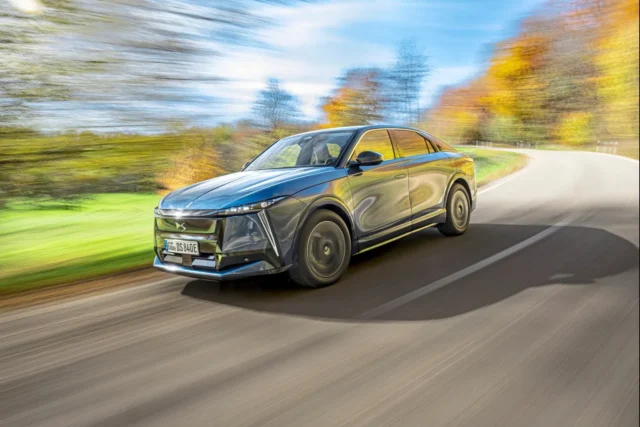
The DS N°8 is one of the most ambitious electric cars to come from France in recent years. It is not simply another battery-powered crossover wearing a luxury badge. It is a statement car for DS Automobiles, a brand that has spent the last decade trying to build a distinct premium identity inside the Stellantis group.
On paper, the ingredients look persuasive. The DS N°8 offers dramatic styling, a large battery, a claimed WLTP range of up to 750 km, a refined interior, executive-class equipment and a clear attempt to revive the old French idea of long-distance comfort. It is also politically symbolic: an armoured version has entered the official fleet of French President Emmanuel Macron, giving the model a level of visibility that most new electric cars can only dream of.
But a flagship electric car cannot live on symbolism alone. It has to prove itself in the real world, where motorway speeds, cold weather, heavy body weight and charging habits matter far more than brochure numbers. The DS N°8 Long Range is therefore an especially interesting car to examine. It promises one of the longest official ranges in its class, yet its actual everyday usability depends heavily on how, where and when it is driven.
A premium French EV with historical weight behind it
The DS name has deep cultural meaning in France. The original Citroën DS was not just a car; it was an engineering icon, a design object and a symbol of national sophistication. Its name was famously linked to the French word “déesse”, meaning goddess, and its most prestigious versions were often associated with state occasions, official transport and executive travel.
Modern DS Automobiles is not Citroën in the old sense, even though the brand was born from Citroën’s premium trim strategy before becoming a standalone marque in 2015. Today, DS is part of Stellantis and operates as a separate premium brand. That gives it access to group technology, platforms and electric drivetrains, but it also creates a difficult challenge: DS must prove that it offers something more emotional and more refined than a Peugeot, Opel, Citroën or Fiat using related hardware.
The N°8 is designed to answer that question. It is intended to be the brand’s electric flagship, a car that does not merely compete on battery capacity or touchscreen size, but on atmosphere, comfort, design and long-distance serenity. In this sense, the car is more important than its sales volume may eventually suggest. It is a brand-defining product.
Not quite a limousine, not quite an SUV
Although the DS N°8 is often described as a limousine or executive car, its body shape is more complicated. It is built on Stellantis’ STLA Medium platform and uses a sleek fastback silhouette rather than a traditional three-box saloon layout. The roofline slopes elegantly toward the rear, giving the car a coupé-like profile and helping aerodynamic efficiency.
This shape gives the N°8 presence. At 4.82 metres long, it is a large car, but it avoids the conservative look of a conventional executive saloon. It sits somewhere between a fastback, a crossover and an electric grand tourer. That ambiguity is deliberate. DS clearly wants the car to feel more distinctive than a standard premium SUV, while still offering the practical advantages that buyers expect from a large electric vehicle.
The aerodynamic work is central to the car’s identity. Long electric range is not achieved only by fitting a large battery. It also depends on drag, tyre choice, motor efficiency, thermal management and software calibration. The sloping roofline is therefore not just a styling decision. It is part of the engineering logic behind the claimed long-range capability.
However, that same roofline has consequences inside the cabin. Rear headroom is not as generous as the exterior length might suggest. Taller passengers may notice that the elegant shape costs some vertical space. This is a common compromise in SUV-coupé and fastback EVs: the silhouette looks expensive and improves airflow, but the rear cabin becomes less limousine-like than the marketing language implies.
Practicality is stronger than expected
Where the DS N°8 compensates convincingly is luggage space. The boot is one of the car’s strongest practical features. With the rear seats in place, it offers 620 litres of cargo capacity, expanding to 1,553 litres when the rear backrests are folded. That is excellent for a premium electric fastback and makes the car much more useful than its dramatic shape might suggest.
The loading area is especially impressive in depth. The distance from the loading edge to the rear seatbacks gives the boot a long, usable floor, making it suitable for suitcases, sports equipment, folded pushchairs or larger everyday cargo. The underfloor storage compartment adds another useful layer, particularly for charging cables and smaller items that should not roll around in the main luggage area.
The 40:20:40 split-folding rear backrest also improves flexibility. It allows the owner to carry long items while still keeping two usable rear seats, which is important in a car aimed at long-distance travel and family use. Combined with a load capacity of up to roughly half a tonne, the N°8 is not just a design-led electric car. It can genuinely function as a practical travel vehicle.
This matters because many premium EVs look impressive but become awkward in daily use. Small boots, shallow storage areas, high loading lips or poorly shaped cargo spaces can reduce real-world practicality. The DS N°8 avoids most of those problems.
Interior design: where DS makes its strongest argument
The cabin is where DS has the best chance of separating itself from the rest of the Stellantis universe. The N°8 does not try to copy German minimalism or Tesla-style reduction. Instead, it uses texture, geometry, decorative lighting and unusual details to create a more theatrical environment.
The interior has a strong visual identity. DS likes diamond-inspired patterns, sculpted surfaces and a slightly extravagant approach to trim design. In the N°8, this gives the cabin a more personal character than many electric rivals. It feels less like a generic technology product and more like a French interpretation of luxury.
Storage is also well considered. Large door pockets, useful compartments around the centre console and a floating console design make the front of the cabin practical as well as decorative. The Alcantara-covered wireless charging tray is a pleasant detail, and the cupholders are integrated in a way that does not dominate the visual layout.
The seats are another highlight. The front chairs are generously padded, supportive and available with inflatable side bolsters. Neck-warming headrests add a comfort feature that feels especially appropriate in an electric car, where efficient local heating can reduce reliance on full-cabin heating in cold weather. In premium EVs, this kind of thermal comfort is not just a luxury detail. It can also help preserve range when used intelligently.
The rear seats are also comfortable, and the adjustable backrest angle improves long-distance relaxation. A 30-degree recline function is a valuable feature in a car that wants to present itself as an electric travel machine rather than a simple commuter EV.
Physical controls are a welcome decision
One of the most sensible choices in the DS N°8 is the continued use of physical controls for several important functions. Many modern cars have gone too far in the direction of touchscreens, capacitive sliders and hidden menu structures. That may look clean in press photos, but it often makes the car worse to use while driving.
The N°8 avoids some of that frustration. Key functions can still be controlled with real buttons, which means drivers can build muscle memory and operate familiar features without constantly looking away from the road. This is not nostalgia. It is good human-machine interface design.
In a car intended for long journeys, this matters more than it may seem. Adjusting climate settings, drive modes, demisting, audio functions or assistance features should not feel like operating a tablet at motorway speed. DS deserves credit for understanding that luxury is not only about materials. It is also about reducing irritation.
That said, the cabin is not perfect. Some plastic surfaces feel less special than the overall design promises. In a car priced in the premium electric segment, small material weaknesses are more noticeable. Buyers comparing the N°8 with Audi, BMW, Mercedes, Volvo, Genesis or Tesla alternatives will expect consistency throughout the cabin, not only in the areas they see first.
The Long Range version: big battery, modest power
The most interesting version from a range perspective is the DS N°8 FWD Long Range. This model uses a 97.2 kWh usable lithium-ion battery and a single front-mounted electric motor. Output is around 180 kW, equivalent to roughly 245 hp, with boost figures varying by market communication.
In isolation, 245 hp sounds respectable. In a heavy electric flagship, however, it is not a performance figure that transforms the driving experience. The N°8 Long Range weighs around 2.2 tonnes, so acceleration is adequate rather than exciting. The 0–100 km/h time is around 8.3 seconds in the tested configuration, which is quick enough for normal driving but clearly not sports-saloon territory.
This is not necessarily a problem. The Long Range model is not supposed to be the performance hero of the line-up. Its purpose is efficiency, refinement and distance. A single-motor front-wheel-drive layout reduces weight, complexity and energy use compared with the all-wheel-drive version. It also helps the car achieve its headline WLTP range.
Buyers who want more power can choose the dual-motor AWD Long Range model, which produces around 350 hp and can accelerate from 0 to 100 km/h in about 5.4 seconds. That version feels much more muscular, but it also costs more and gives up some official range. In several European markets, the top all-wheel-drive version starts at around €75,000, or approximately $87,000 using a recent euro-dollar reference rate. The FWD Long Range version sits lower, commonly around €62,000–€63,000, or roughly $72,000–$73,000 depending on market and exchange rate.
The 750 km promise
The headline figure is the WLTP range of up to 750 km for the most efficient Long Range version. This is the number that attracts attention, and it is one of the strongest selling points of the DS N°8.
A 750 km official range places the car among the more capable long-distance EVs on the European market. It suggests that, at least under favourable conditions, the N°8 can cover serious distances without constant charging stops. For buyers still worried about electric range, that is psychologically important.
However, WLTP range is not the same as real-world range. WLTP testing is more realistic than the old NEDC cycle, but it still cannot fully represent every driver, climate, speed profile and route. Electric cars are especially sensitive to motorway speed, cold temperatures, wind, elevation changes, tyre choice, heating use and driving style.
The DS N°8 demonstrates this gap clearly. In mixed real-world use, consumption around 22.9 kWh per 100 km can translate to roughly 420–450 km of practical range in cooler conditions. That is not poor. In fact, it is a usable and respectable result for a large premium EV. But it is far from 750 km.
With restrained driving, lower speeds and favourable conditions, consumption can drop significantly. An average around 17.3 kWh per 100 km would allow a much longer distance from the same battery, potentially moving toward the 550 km range area in realistic use. But reaching the full WLTP claim in everyday driving is difficult. It requires a very favourable combination of temperature, route, speed and driving discipline.
Why the real-world range gap matters
The difference between WLTP range and real range is not unique to DS. Every electric car shows some difference between official laboratory-style figures and daily use. The issue is how buyers interpret those numbers.
A claimed 750 km range can create the impression of diesel-like long-distance freedom. In reality, the DS N°8 Long Range is more accurately understood as a car that can comfortably cover 450–550 km in many realistic European driving scenarios, depending on conditions. That is still very useful. It means many drivers can complete long trips with one charging stop, and many daily users will charge only occasionally.
The problem is not that the car has insufficient range. The problem is the emotional distance between the advertised number and what the owner may see on the road. If someone buys the N°8 expecting to drive 700 km at motorway speeds in cold weather, disappointment is likely. If they buy it expecting a refined premium EV with a genuinely strong real-world range, the car makes much more sense.
This distinction is critical in electric vehicle communication. Manufacturers often promote the best possible WLTP number, but buyers need realistic expectations. For SEO and buyer guidance, the more useful question is not “Can it do 750 km?” but “What range should a normal driver expect?”
Consumption: acceptable, not miraculous
A real-world consumption figure of 22.9 kWh/100 km in cooler mixed use is acceptable for a large, heavy premium EV. It is not revolutionary, but it is not alarming either. The car’s mass, tyre size, comfort equipment and luxury positioning all work against extreme efficiency.
The more encouraging figure is the 17.3 kWh/100 km result under gentle driving. That shows the aerodynamic concept and efficient single-motor drivetrain can work well when conditions are favourable. It also suggests that the N°8 rewards calm driving. This fits the car’s character. It is not designed to be thrown around corners or driven aggressively. It is at its best when used as a quiet, comfortable, long-legged electric tourer.
The lesson is simple: the DS N°8 Long Range can be efficient, but it is not immune to physics. At motorway speeds, air resistance rises dramatically. In cold weather, battery heating and cabin heating increase energy use. With heavy acceleration, the large battery and 2.2-tonne body cannot hide their mass.
The car’s best range results will come from steady driving, moderate speeds, good thermal conditions and intelligent use of regenerative braking.
Driving character: comfort before excitement
The DS N°8 is not primarily a driver’s car in the traditional sense. It is a comfort-oriented electric flagship. That means its strengths are silence, smoothness, seat comfort and relaxed progress rather than sharp steering, aggressive acceleration or sports-car body control.
The single-motor Long Range version reinforces this personality. Its power delivery is smooth and sufficient, but not dramatic. The front-wheel-drive layout is efficient, yet it does not give the same planted, effortless traction as a dual-motor system. For most everyday driving, this is acceptable. For enthusiastic driving or rapid overtaking on wet roads, the AWD model has a clear advantage.
Still, the Long Range model may be the more coherent version. It prioritizes what the N°8 does best: distance, calmness and efficiency. The AWD variant is faster, but speed is not necessarily the reason to buy a DS flagship. If the car’s identity is French electric luxury, the quieter and more economical version has a strong argument.
Charging and long-distance usability
Range is only one part of the long-distance EV equation. Charging speed and charging consistency matter just as much. A car with a huge battery but mediocre charging can still feel inconvenient on long trips, while a car with slightly less range but excellent charging can cover distance more efficiently.
The DS N°8 supports DC fast charging, with reported peak rates around 160 kW. That is useful, but not class-leading. Some rivals can charge faster, especially on 800-volt architectures. In practice, the charging curve is more important than the peak number. If the car maintains strong charging power over a useful part of the battery window, it can still be a competent long-distance EV.
For home and workplace charging, the large battery is less of a problem if the owner has access to a wallbox. An 11 kW AC charger is adequate for overnight charging, while optional faster AC charging in some markets can improve flexibility where three-phase infrastructure is available.
The N°8 is therefore best suited to owners who can charge regularly at home or work and use public fast charging mainly during longer trips. That is true for most large EVs, but it is especially relevant here because the car’s premium positioning will attract buyers expecting convenience.
Price: premium positioning with a French twist
The DS N°8 is not a cheap electric car. Depending on market and trim, the FWD Long Range version typically sits around €62,000–€63,000, which translates to roughly $72,000–$73,000 using recent exchange rates. The more powerful AWD Long Range version can start around €75,000 in some European markets, or approximately $87,000.
Those prices place the N°8 in difficult territory. It must compete not only with mainstream long-range EVs, but also with established premium brands. Buyers may compare it with the Tesla Model 3 Long Range, Tesla Model Y Long Range, Volkswagen ID.7, BMW i4, BMW i5, Mercedes EQE, Audi Q6 e-tron, Polestar 4, Hyundai Ioniq 6, Kia EV6 and other electric alternatives depending on market and body-style preference.
Against those rivals, the DS does not win purely on brand recognition. DS still has less global prestige than Mercedes, BMW or Audi. It also lacks Tesla’s charging ecosystem advantage and software reputation. Therefore, it must win through design, comfort, individuality and long-range capability.
That may be enough for some buyers. Not everyone wants the obvious German or American choice. The DS N°8 has personality, and in the premium market, personality can matter. But the price leaves little room for weak points. Materials, infotainment, ride quality, charging performance and residual values all need to be convincing.
The strongest reasons to choose the DS N°8
The strongest argument for the DS N°8 is not acceleration or brand power. It is the combination of range potential, comfort, interior atmosphere and distinctiveness.
The car looks different from most electric crossovers. It has a confident French design language that does not simply copy German premium conventions. The interior feels more decorative and more intimate than many minimalist EV cabins. The seats are comfortable, the boot is large, and the Long Range version offers genuinely useful travel capability.
For buyers tired of anonymous EV design, that matters. Many electric cars now follow a similar formula: smooth nose, large screen, minimal dashboard, hidden air vents and generic light bars. The DS N°8 has a stronger identity. Whether someone likes that identity is subjective, but at least it is not bland.
The long-range battery also makes the car more convincing as a family or executive vehicle. Even if the 750 km claim is difficult to reproduce, the real-world range remains strong enough for serious use.
The main weaknesses
The most obvious weakness is the gap between the headline range and real-world range. Again, this is not unique to DS, but the larger the advertised number, the more noticeable the difference becomes.
The second weakness is weight. At around 2.2 tonnes, the Long Range model is heavy, and that affects acceleration, efficiency and road feel. The single-motor version is calm and competent, but not especially exciting.
The third issue is price pressure. At more than €60,000 in Long Range form, the DS N°8 competes with cars from brands that have stronger premium reputations. DS must persuade buyers that design flair and comfort are worth choosing over more established alternatives.
Finally, some cabin materials could be better. A premium car does not need to be perfect, but it should avoid obvious cheap surfaces, especially when the rest of the interior is trying so hard to feel special.
Who is the DS N°8 for?
The DS N°8 Long Range is best suited to drivers who value comfort, style and range more than outright performance. It is a car for people who want to travel quietly, carry luggage easily and own something less predictable than a German executive EV or a Tesla.
It makes sense for buyers who mostly drive in Europe, have access to home charging and want a premium electric car with a softer, more elegant personality. It also suits drivers who appreciate French design and are willing to choose a less common badge.
It is less suitable for buyers who want the fastest charging, the sharpest handling, the lowest price, the strongest brand image or the most accurate real-world reproduction of official range figures. For those buyers, other EVs may be more rational.
But the DS N°8 is not trying to be the most rational car in the segment. It is trying to be a more emotional, more comfortable and more distinctive alternative.
Verdict: an impressive EV, but not a 750 km miracle
The DS N°8 Long Range is a serious electric flagship with real strengths. It has a large battery, elegant fastback styling, a practical boot, a comfortable interior and a clear sense of French premium identity. It is also capable of strong real-world range when driven calmly and efficiently.
However, the 750 km WLTP figure should be treated as an idealized benchmark, not a normal everyday expectation. In mixed real-world use, especially in cooler weather or at higher speeds, the practical range is much lower. Around 450 km is a realistic cold-weather expectation in less favourable conditions, while careful driving can push the figure significantly higher.
That does not make the DS N°8 a failure. On the contrary, it remains a capable long-distance EV. But it does mean buyers should understand what they are getting. The car is not magic. It is a large, heavy, comfortable electric flagship whose best qualities appear when it is driven the way it was designed to be driven: smoothly, calmly and over long distances.
For DS Automobiles, the N°8 is a credible and much-needed flagship. For buyers, it is an interesting alternative to the usual premium EV suspects. Just do not buy it expecting 750 km every day. Buy it because you want a distinctive French electric grand tourer with comfort, character and enough range to make long journeys genuinely practical.
Image(s) used in this article are either AI-generated or sourced from royalty-free platforms like Pixabay or Pexels.
This article may contain affiliate links. If you purchase through these links, we may earn a commission at no extra cost to you.
Get the weekly RF & IT briefing
Radio guides, RF calculators, AI, Windows, Linux and satellite communication explainers. One useful email per week. No spam.