Renault’s electric surge: why Europe’s fuel-price shock is pushing drivers toward batteries
Europe’s electric-car market has spent years waiting for the same question to move from theory to household budgeting: what happens when petrol and diesel become expensive enough for ordinary drivers to seriously recalculate the cost of staying with combustion?
Renault may now be seeing the answer.
According to Renault Group CEO François Provost, the company has recorded a sharp rise in demand for its electric vehicles in several European markets since the beginning of the Iran-related fuel-price shock. In France and Germany, two of the most important markets for Renault’s European electric strategy, order intake for battery-electric models has reportedly increased by as much as 50 percent. The explanation given by Renault is direct: higher fuel prices are pushing more buyers toward electric cars.
That sounds simple. Expensive gasoline makes electric cars more attractive. But the real market dynamics are more layered. Renault’s current momentum is not only about oil prices. It is also about timing, government incentives, battery costs, European production capacity, design, consumer psychology and the sudden relevance of affordable electric mobility.
In other words, petrol prices may be the spark. But Renault has spent years preparing the fuel.
Fuel prices are still one of the strongest EV arguments
Electric vehicles are often discussed through technical and environmental language: battery chemistry, charging curves, lifecycle emissions, thermal management, software platforms, grid integration and EU fleet-emission targets. These issues matter, but they are not always the things that move mainstream buyers.
Fuel prices are different.
They are visible. They are repeated every week. They are emotional. A driver may not follow European CO₂ regulation or battery supply-chain policy, but almost everyone notices when the cost of filling a tank rises. The fuel station is one of the few places where global geopolitics becomes a household expense within days.
This is why sudden increases in petrol and diesel prices can change car-buying behavior faster than years of abstract EV messaging. A buyer who was previously uncertain about charging may start looking again. A family that considered an EV too expensive may calculate monthly running costs differently. A commuter who drives 40, 60 or 80 kilometers per day may begin to see fuel-price volatility as a permanent financial risk rather than a temporary inconvenience.
Renault’s advantage is that it does not need to convince every buyer that electric mobility is ideologically desirable. It only needs to show that, for many daily users, an EV can be economically rational.
This is a powerful shift. Electric cars do not have to be sold only as futuristic technology. They can be sold as protection against fuel-price instability.
Renault is no longer relying on one electric model
Renault was one of Europe’s early mass-market EV brands. The Renault Zoe helped normalize electric driving long before many traditional automakers treated battery-electric vehicles as a serious volume business. But the Zoe era is over. The current EV market is more demanding, more competitive and far more price-sensitive.
Buyers now expect modern infotainment, competitive range, acceptable fast charging, good packaging, attractive design and a price that does not feel detached from normal family budgets. They also compare Renault not only with Volkswagen, Peugeot, Citroën, Hyundai or Kia, but increasingly with Chinese brands that are entering Europe with aggressive pricing and fast product cycles.
Renault’s current electric strategy is therefore broader and more emotional than the Zoe strategy. The company is trying to build a new identity around compact, accessible and distinctly European electric cars.
The Renault 5 E-Tech Electric is central to this effort. It is not just a small EV. It is a design statement. Renault has taken one of its most recognizable historic nameplates and turned it into a modern electric hatchback with retro-inspired styling, urban practicality and a more emotional character than many anonymous compact EVs.
That matters because the small-car segment is not purely rational. Buyers may calculate charging costs and incentives, but they still respond to style, nostalgia and brand familiarity. The Renault 5 gives the company something many affordable EVs lack: personality.
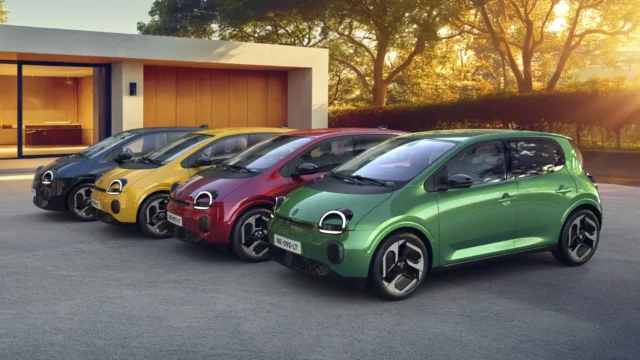
The upcoming electric Twingo could be even more strategically important. Europe badly needs genuinely affordable electric city cars. Many buyers do not need a large SUV, a huge battery or premium performance. They need a compact, efficient car for commuting, local trips, shopping, school runs and short regional journeys. If Renault can deliver the electric Twingo at a sufficiently low price, it could become one of the most important European EVs in the entry-level segment.
The Megane E-Tech Electric and Scenic E-Tech Electric serve a different purpose. These models address buyers who need more range, more space and more family usability. Together, they allow Renault to cover several realistic use cases rather than relying on a single symbolic EV.
This product spread is crucial. A fuel-price shock creates interest. A coherent model range converts that interest into orders.
The order surge is probably a trigger effect, not a sudden conversion
A 50 percent increase in electric-vehicle orders sounds dramatic, but it should not be misunderstood. Most car buyers do not change their entire view of mobility overnight. A war, a fuel-price spike or a few weeks of expensive petrol rarely turns a convinced combustion-car loyalist into an EV buyer by itself.
Car purchases are slower and more layered than that. Buyers compare monthly payments, resale values, insurance, warranty terms, range, charging access, maintenance expectations, brand reputation and household habits. They often spend months researching before signing an order.
This means Renault’s order surge is more likely the result of a trigger effect.
There was already a large group of potential EV buyers who were close to switching. They had read reviews. They had looked at charging maps. They had compared running costs. They may have test-driven an EV. But they were still hesitating.
The reasons for hesitation are familiar: range anxiety, charging anxiety, battery degradation concerns, uncertainty about resale value, high purchase price and fear that a better or cheaper model will arrive soon. These barriers do not always stop the purchase permanently. They simply delay it.
A sudden rise in fuel prices can break that delay.
For these buyers, expensive petrol is not the only reason to buy an EV. It is the final argument that makes waiting feel less rational. The thought process changes from “maybe later” to “why not now?”
This is psychologically important. People often avoid large decisions until an external event gives them permission to act. Fuel-price volatility can become that event. It makes the cost of inaction visible.
France and Germany are not ordinary EV markets
Renault’s strongest reported growth is especially interesting because France and Germany are not neutral test cases. They are heavily policy-shaped automotive markets, and both countries have introduced or revived support mechanisms that affect electric-car demand.
France has become one of Europe’s most important laboratories for socially targeted EV adoption. Its social leasing scheme was designed to make electric cars accessible to lower- and middle-income households, not only to affluent early adopters. Instead of presenting EVs as premium technology, the program frames them as practical, affordable mobility.
This fits Renault unusually well. A French brand with compact electric cars, domestic production and strong national recognition is well positioned to benefit from a policy that tries to democratize electric mobility. The Renault 5 E-Tech Electric and future electric Twingo match the political and consumer logic of this approach: smaller, more affordable, European-made EVs for real-world use.
Germany is equally important, though for different reasons. It is Europe’s largest car market and one of the most influential automotive economies in the world. German EV demand was disrupted when earlier subsidy programs changed, creating uncertainty for buyers and manufacturers. A renewed, more targeted support framework can help restore confidence, especially among private buyers who are sensitive to upfront costs.
This means Renault’s current demand increase cannot be explained by fuel prices alone. Incentives reduce the entry barrier. Fuel prices increase the urgency. Together, they create a much stronger buying signal than either factor would create separately.
A driver may tolerate expensive petrol if an EV still feels too costly. A driver may ignore an EV subsidy if fuel remains cheap. But when fuel gets expensive and the EV becomes financially easier to access, the decision changes quickly.
Expensive fuel changes the total cost calculation
The central economic argument for electric cars is not always the purchase price. It is the total cost of ownership.
A combustion car may still be cheaper to buy in many segments, especially on the used market. But the purchase price is only one part of the financial picture. Fuel, servicing, local taxes, company-car taxation, parking benefits, depreciation and financing all influence the real cost of ownership.
Fuel is the most visible variable. When petrol prices rise, the running-cost advantage of an EV becomes easier to understand. Electricity prices also matter, of course, and public fast charging can be expensive. But for drivers who can charge at home or at work, the per-kilometer cost of electric driving can be significantly lower than driving on petrol or diesel.
This is especially relevant for commuters. The more predictable the daily route, the stronger the EV case becomes. A household that drives mostly short and medium-distance trips can charge overnight and avoid fuel stations almost entirely. Once that routine is established, the emotional relationship with mobility changes.
The driver no longer thinks in terms of filling a tank. The car becomes more like a device that is charged when parked. This is one of the reasons EV ownership can be sticky. After the first transition, many users become reluctant to return to the noise, vibration, servicing and fuel-price exposure of combustion cars.
For Renault, this is strategically valuable. The company does not only need to sell one car. It needs to bring buyers into an ownership experience that makes electric mobility feel normal.
Production capacity is becoming a competitive advantage
Demand is only useful if a manufacturer can supply the cars. That is where Renault’s current situation becomes more industrially significant.
Provost has indicated that Renault is working to keep pace with rising demand and that supplier capacity is under pressure. The company has reportedly created a dedicated task force to manage the situation and is considering extra shifts in the second half of the year at key European facilities, including Douai and Maubeuge in France and Novo Mesto in Slovenia.
These sites are not just factories. They are part of Renault’s attempt to build a European electric-vehicle ecosystem. Douai is particularly important because it sits at the heart of Renault’s ElectriCity industrial project in northern France, which is designed to concentrate EV production, suppliers and expertise in a regional manufacturing cluster.
This matters for several reasons.
First, European production can reduce some political and logistical risks. The EV market has become deeply connected to industrial policy, trade tensions and concerns about dependence on China. A European-built Renault EV can be marketed not only as a car but as part of a European manufacturing strategy.
Second, local production can improve responsiveness. If demand changes quickly, a manufacturer with nearby production and supplier coordination may be better positioned than one relying heavily on long intercontinental supply chains.
Third, capacity itself is now a strategic asset. Some legacy manufacturers are facing underused combustion-car plants or difficult transitions from old platforms to new ones. Renault’s message is different: it is not looking for tenants to fill unused lines. It claims it does not have spare capacity to lease out because its own demand is strong enough.
That is a very important narrative. In an industry where several European manufacturers are struggling with plant utilization, saying “we need more capacity” sounds much stronger than saying “we need to find someone else to use our factories.”
LFP batteries could make Renault’s EVs more affordable
One of the most important parts of Renault’s strategy concerns battery chemistry. Provost has discussed the company’s interest in having Envision, its battery partner, produce LFP cells at the Renault battery site in Douai in the medium term.
LFP stands for lithium iron phosphate. It is not new technology, but it has become increasingly important in the EV industry because it offers several advantages for affordable electric cars. LFP cells usually have lower energy density than nickel-rich chemistries such as NMC, but they can be cheaper, durable, thermally stable and well suited to vehicles where extreme range is not the main requirement.
For compact and urban EVs, that trade-off often makes sense. A small electric car does not always need a very large battery. It needs a battery that is affordable, robust and sufficient for daily use. If the vehicle is designed efficiently, LFP can help reduce cost without making the product feel compromised.
This is one reason Chinese EV makers have become so competitive. Many have used LFP batteries effectively in lower-cost models. European manufacturers must respond if they want to build affordable EVs without relying too heavily on imported cells or expensive chemistries.
For Renault, European LFP production could support several goals at once: lower vehicle costs, more stable supply, reduced dependence on Asian imports and stronger alignment with European industrial policy. It would also make sense for models like the electric Twingo and lower-priced versions of the Renault 5.
Battery cost remains one of the biggest obstacles to affordable EVs. If Renault can push cell costs down while keeping production close to its vehicle plants, it could gain a meaningful advantage in the small and compact EV segments.
Renault’s position differs from Stellantis
The contrast with Stellantis is notable. Stellantis has been dealing with underused capacity in some areas and has explored arrangements involving Chinese manufacturers using European production capacity. Renault, by contrast, says it is rejecting similar approaches because it does not have unused capacity to offer.
This difference should not be exaggerated into a simple winner-and-loser story. Stellantis is a much larger and more complex group, with many brands, platforms and regional exposure. But the comparison does reveal a broader tension in the European car industry.
Traditional manufacturers are trying to transition from combustion to electric powertrains while maintaining factory utilization, protecting jobs, meeting emissions rules and defending market share against Chinese competition. This is extremely difficult. Some plants are optimized for models or powertrains that may decline faster than expected. Others may not yet have enough EV volume to justify full utilization.
Renault’s current EV demand gives it a more favorable short-term story. Instead of explaining how to fill idle factories, it can talk about extra shifts and supplier bottlenecks. That is exactly the kind of industrial narrative European automakers want: domestic EV production, rising demand, battery localization and no spare capacity.
The challenge is that this momentum must be sustained. A short-term order spike is useful, but long-term competitiveness requires stable pricing, efficient production, reliable software, strong dealer execution and continued battery-cost reduction.
Chinese competition is the pressure behind the strategy
Renault’s EV push cannot be separated from Chinese competition. Brands such as BYD, MG, Leapmotor and others have changed European expectations about price, equipment and development speed. Even when consumers do not directly compare every Chinese model with a Renault, the competitive pressure influences the entire market.
Chinese EV makers often move faster, integrate battery supply more tightly and offer strong equipment levels at aggressive prices. European manufacturers cannot rely only on brand history or dealer networks. They need products that feel modern, desirable and financially logical.
Renault’s answer appears to be a combination of European design identity, smaller cars, localized production and lower-cost battery chemistry. This is a more defensible strategy than trying to copy Chinese brands directly. Renault’s advantage is not scale on the level of China’s largest EV groups. Its advantage is European relevance.
A Renault 5 or Twingo does not need to beat every Chinese EV on every specification. It needs to feel right for European streets, European buyers, European regulations and European financing structures. Compact dimensions, recognizable design and practical usability can matter more than headline acceleration or oversized batteries.
But price remains critical. If Renault’s affordable EVs are not affordable enough, Chinese rivals will exploit the gap. This is why LFP batteries, efficient platforms and high factory utilization are not technical side issues. They are central to survival in the next phase of the EV market.
The used EV market is part of the same shift
Fuel-price shocks do not only increase interest in new electric cars. They also push buyers toward used EVs.
This is important because the used market is where mainstream adoption often becomes real. Many households do not buy new cars. They buy three-year-old, five-year-old or older vehicles. If used EVs become more attractive during periods of expensive fuel, the technology spreads beyond early adopters and company-car users.
Renault has a particular history here because of the Zoe. Used Zoe models have already introduced many European drivers to electric mobility at lower prices. As newer Renault EVs enter the market, the used electric ecosystem will expand further.
A stronger used EV market also improves confidence in new EVs. Buyers are more willing to purchase a new electric car if they believe it will retain value and remain desirable after several years. Resale value is one of the hidden psychological barriers in EV adoption. When the second-hand market becomes more liquid, that barrier weakens.
High fuel prices can accelerate this process. A used EV that looked like a niche purchase during cheap petrol periods can suddenly appear practical and financially sensible.
Charging remains the main practical barrier
Even with favorable fuel prices and incentives, charging remains the decisive issue for many buyers.
For households with private parking and home charging, the EV proposition is relatively straightforward. The car can be charged overnight, electricity costs can be planned, and daily driving becomes easy. For apartment dwellers, renters and urban residents without dedicated parking, the decision is more complicated.
Public charging networks have improved across Europe, but the experience is still uneven. Pricing can be confusing. Reliability varies. Some chargers are busy or poorly maintained. Fast charging can be expensive enough to reduce the cost advantage over combustion, especially on long trips.
Renault’s compact EV strategy works best when matched with realistic charging habits. A Renault 5 or Twingo buyer who can charge at home, at work or through reliable local infrastructure will experience the car very differently from someone dependent on occasional public charging.
This means Renault’s EV growth is also tied to infrastructure policy. Affordable cars alone are not enough. Charging access must become normal for people who do not live in detached houses.
That is one reason social leasing and public charging expansion should be viewed together. Subsidizing the car is helpful, but if the target household cannot charge conveniently, adoption will remain limited.
Design is doing more work than many analysts admit
EV adoption is often discussed as though buyers make decisions only through spreadsheets. In reality, design matters enormously.
The Renault 5 E-Tech Electric demonstrates this clearly. Its appeal is not based only on range, charging speed or battery chemistry. It also benefits from emotional recognition. It looks friendly, compact and distinctive. It connects Renault’s past with the electric future without appearing overly retro or artificial.
This is a significant advantage in a market where many EVs look similar. Aerodynamic efficiency and platform constraints have produced a wave of smooth, high-riding, screen-heavy electric crossovers. Some are technically strong, but visually forgettable.
Renault is trying to make small EVs desirable again. That could be more important than it appears. If electric cars are perceived only as expensive compliance products, demand will remain fragile. If they become cars people actually want, incentives and fuel prices become accelerators rather than the only reason to buy.
The electric Twingo may follow the same logic. Its design has already attracted attention because it promises something rare: an inexpensive EV with character. In the entry-level segment, character can help overcome the fear that affordability means dullness.
The psychology of fuel anxiety
Fuel-price shocks have a psychological effect beyond the actual cost increase. They remind drivers that combustion cars are tied to global instability.
Oil prices can be affected by wars, sanctions, shipping disruptions, OPEC decisions, refinery capacity, currency movements and taxation. The average driver cannot control any of these factors. When fuel prices rise suddenly, the combustion car feels less independent than it once did.
Electric cars are not completely immune to energy-price volatility. Electricity prices can also rise, and energy markets are interconnected. But EVs give households more options. Charging can happen at home. Some owners can use solar power. Tariffs can be optimized. Workplace charging may be available. The energy source feels less tied to a single global commodity.
This sense of control matters. Buyers are not only calculating euros per kilometer. They are also reacting to uncertainty. An EV can feel like a way to reduce exposure to the next fuel shock.
Renault’s current order increase may therefore reflect a broader emotional movement: drivers are not merely attracted to cheaper running costs; they are tired of being surprised by fuel prices.
Why affordable EVs are becoming politically important
Europe’s EV transition cannot succeed if electric cars remain premium products. The political legitimacy of the transition depends on affordability.
If only wealthy households can access electric mobility, combustion bans and emissions rules become politically vulnerable. Voters may interpret the transition as a burden imposed on ordinary drivers while richer buyers receive subsidies for expensive cars. This is why smaller, cheaper EVs matter far beyond Renault’s sales numbers.
Renault’s strategy aligns with this political reality. Compact electric cars built in Europe can be presented as industrial policy, climate policy and consumer protection at the same time. They support jobs, reduce oil dependence and offer lower running costs.
This is a much stronger argument than simply telling drivers to buy expensive EVs for environmental reasons.
The Renault 5 and electric Twingo could therefore become politically symbolic products. They represent the idea that the European EV transition does not have to be dominated by large SUVs, luxury models or imported vehicles. It can also include small, practical cars that fit dense cities, narrow streets and normal household budgets.
What could slow Renault down?
Renault’s current momentum is promising, but it is not guaranteed to continue. Several risks remain.
The first is price. If Renault cannot keep transaction prices competitive, demand may soften once fuel prices stabilize. Buyers may be interested in EVs, but affordability still determines the final decision.
The second is supply. A surge in orders can become a problem if delivery times grow too long. Customers who are motivated by fuel-price anxiety may not want to wait many months. If Renault cannot scale production quickly enough, some buyers may choose competitors.
The third is battery cost. LFP localization would help, but medium-term plans do not solve every immediate cost challenge. Battery prices have fallen over time, but volatility in raw materials, trade rules and regional supply chains can still affect margins.
The fourth is charging confidence. Renault can build attractive EVs, but it cannot single-handedly fix every infrastructure gap. If buyers hear too many negative charging stories, hesitation may return.
The fifth is competition. European rivals are not standing still, and Chinese brands are pushing aggressively into affordable EV territory. Renault must keep improving software, efficiency, quality and price discipline.
The sixth is policy uncertainty. EV markets are extremely sensitive to subsidies and tax rules. Sudden changes can distort demand, create purchase delays or damage consumer confidence.
This means Renault’s success depends not only on product appeal, but also on execution across the entire ownership ecosystem.
The petrol shock may have arrived at the perfect time for Renault
The most interesting part of Renault’s current situation is timing.
If the fuel-price shock had arrived when Renault had only an aging EV lineup, the company might not have benefited as much. If it had arrived before the Renault 5, before the electric Twingo strategy and before stronger battery-localization plans, the market reaction might have been weaker.
But the shock has arrived just as Renault is trying to reposition itself around accessible European EVs. That gives the company a rare chance to connect a short-term consumer concern with a long-term industrial strategy.
Expensive petrol creates attention. Renault’s new EVs provide something to look at. Incentives reduce the financial barrier. LFP batteries promise lower future costs. European factories give the story political credibility. Retro-inspired design makes the cars feel desirable rather than merely rational.
This is why the situation is more powerful than a simple fuel-price reaction.
Renault is not just benefiting from expensive gasoline. It is benefiting from the fact that expensive gasoline arrived when the company finally had a stronger electric answer.
Are high fuel prices enough to sell electric cars?
No. High fuel prices alone are not enough.
They can push buyers to investigate EVs, but they cannot compensate for unattractive products, poor pricing, weak charging access or long delivery delays. A fuel-price shock opens the door; the car still has to make sense.
Renault’s current advantage is that its EV strategy is becoming more coherent just as buyers are becoming more sensitive to running costs. That combination can create a much stronger market response than either factor alone.
The real question is whether Renault can turn this moment into lasting loyalty. If new EV buyers find that the cars are reliable, affordable to run, pleasant to drive and easy to charge, the company may gain customers who will remain electric for the next purchase cycle. If the experience is frustrating, the fuel-price effect may fade.
For now, however, Renault appears to be in one of the best positions it has had in years. The company has attractive compact EVs, a credible affordability story, strong French market relevance, renewed interest in Germany and an industrial narrative that contrasts favorably with rivals struggling with unused capacity.
Renault’s electric future depends on more than petrol
The headline story is easy to understand: petrol becomes expensive, Renault sells more electric cars. But the deeper story is more important.
Europe’s car market is entering a phase where electric adoption will no longer be driven mainly by early adopters. It will be driven by normal households, urban commuters, small businesses, public incentives, used-car availability and the practical economics of daily driving.
Renault is trying to position itself exactly there. Not at the luxury end of the EV market. Not in the oversized electric SUV race. Not only in corporate fleet electrification. Its most interesting opportunity is the compact, affordable, emotionally appealing European EV.
Fuel-price shocks can accelerate this transition, but they cannot define it alone. The winners will be the manufacturers that combine low running costs with attractive design, realistic pricing, dependable supply and easy ownership.
Renault may have discovered that expensive gasoline is an excellent salesman. But the cars still have to close the deal.
Image(s) used in this article are either AI-generated or sourced from royalty-free platforms like Pixabay or Pexels.
This article may contain affiliate links. If you purchase through these links, we may earn a commission at no extra cost to you.
Get the weekly RF & IT briefing
Radio guides, RF calculators, AI, Windows, Linux and satellite communication explainers. One useful email per week. No spam.