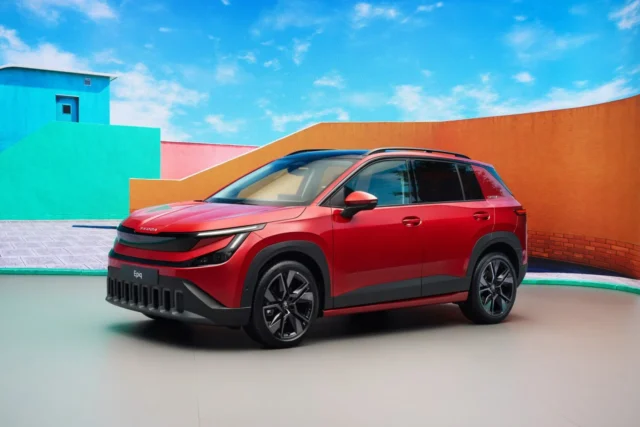
The Škoda Epiq is not the kind of electric car that tries to impress the world with gullwing doors, 1,000 horsepower, a cinema-sized dashboard or a price tag that belongs in the premium segment. Its importance is quieter, but potentially much larger. This is Škoda’s attempt to build an electric SUV for the part of Europe where the EV transition has been slowest: ordinary buyers who want space, range, useful technology and a rational price.
That makes the Epiq more interesting than its compact size suggests. At around 4.1 metres long, it sits in the urban crossover class, but Škoda is positioning it as the most accessible fully electric model in its range and the entry point into the brand’s EV portfolio. The car is expected to use Volkswagen Group’s new-generation MEB+ architecture, front-wheel drive, a practical five-door crossover body and a boot capacity of around 475 litres. Depending on the battery and market version, the projected range reaches up to roughly 440 km.
The headline, however, is not only the battery. The Epiq is also important because it moves Škoda toward a more software-driven, Android-based and connected EV concept. The infotainment system is expected to use a large central display, smartphone-oriented services, remote vehicle control, app-based charging management and a stronger digital ecosystem than older entry-level Škoda models.
In other words, the Škoda Epiq is not just a cheaper electric Kamiq alternative. It is a test of whether Europe’s mainstream EV can become practical, connected, software-driven and still financially realistic.
Why the Škoda Epiq matters
The European EV market is entering a different phase. The first wave of modern electric cars was dominated by expensive models, corporate fleets, premium crossovers and early adopters. That helped prove the technology, but it did not fully solve the mass-market problem. A family that previously bought a Škoda Fabia, Kamiq, Scala or Octavia does not necessarily want a €45,000 electric car, even if the technology is impressive.
The Epiq is designed for that gap.
Škoda wants the Epiq to become the brand’s affordable electric entry model. The strategic point is clear: the company does not only want to compete with other EVs, but also with familiar petrol and hybrid crossovers. If the Epiq can approach the price level of a well-equipped combustion-engine Kamiq in some European markets, the psychological barrier around electric cars becomes much lower.
Until recently, buyers often had to choose between an affordable combustion car and a much more expensive electric alternative. The Epiq is meant to make that decision less dramatic. If the monthly leasing price, insurance cost and charging economics line up correctly, the buyer may no longer need to justify the EV as a luxury decision. It becomes a normal car purchase.
That is why the Epiq may become more significant than some larger, more powerful EVs. It targets volume. It targets first-time EV buyers. It targets city and suburban households. It targets drivers who want the familiar Škoda formula: useful space, sensible ergonomics, predictable running costs and enough technology without premium-brand theatre.
Expected launch and availability
The Škoda Epiq is expected to arrive in Europe as one of the Volkswagen Group’s new compact electric models. Its production and market launch are planned around 2026, with phased availability by country and trim level.
The important detail is that the cheapest version may not necessarily be the first one widely available in every market. This is common in the car industry. Manufacturers often launch better-equipped versions first, then introduce the true entry-level model later. That means the headline price may look very attractive, while early buyers may initially see higher transaction prices.
For Europe, the realistic price picture is likely to be:
The entry-level Škoda Epiq is expected around €25,000–€26,000 in selected European markets. Better-equipped variants with larger batteries, stronger equipment packages or higher trims may realistically sit closer to €30,000–€36,000, depending on country, VAT, incentives, leasing structure and standard equipment.
For the UK market, early figures point to a starting price around the mid-£20,000 range, with higher trims rising above £30,000.
That distinction matters. The Epiq may be marketed as an affordable EV, but affordability will depend heavily on the exact battery, trim level, national incentives and finance offers.
Design: modern solid without the sci-fi costume
The Epiq introduces Škoda’s newer Modern Solid design direction in a compact production-friendly form. This is not a radical wedge-shaped EV concept. It is still recognisably a Škoda SUV, but the details are cleaner, flatter and more digital.
The front end uses the brand’s newer EV face rather than a traditional combustion-engine grille. The lighting signature is sharper, the surfaces are cleaner and the whole car looks more technical without becoming alien. That matters because mainstream EV buyers often do not want their car to look like a rolling experiment. They want something modern, but not strange.
The Epiq’s proportions are also important. It is short enough for European city streets and tight parking spaces, but not shaped like a tiny economy hatchback. The upright SUV-crossover body gives it a more practical image and a higher seating position, while the compact length keeps it usable in urban environments.
Škoda has understood something simple: buyers may accept electric propulsion, but many still want a car that looks normal enough to live with. The Epiq does not try to make EV ownership look like a lifestyle experiment. It tries to make it look like the next logical Škoda.
Interior: less clutter, more software
Inside, the Epiq follows the same practical and simplified design logic. The dashboard is expected to be cleaner than older Škoda interiors, with fewer visual distractions, more open storage, sustainable materials and a stronger focus on the central infotainment system.
The key change is the move toward an Android-based infotainment experience. This is not just a branding detail. It signals that the Epiq is part of the broader industry shift from hardware-defined cars to software-defined cars.
The cabin is expected to use a large central touchscreen, digital driver information, wireless smartphone integration, app-based services and deep MyŠkoda app connectivity. For the user, this means the car is no longer only controlled from inside the cabin. Charging status, pre-conditioning, range planning and remote functions become part of the ownership experience.
In a combustion car, the phone is an accessory. In a modern EV, the phone becomes part of the vehicle’s operating model.
This is where Android-based infotainment becomes strategically important. It can reduce development burden, improve app ecosystem compatibility and make the car feel more familiar to users who already live inside Android Auto, Google services, app stores and smartphone-based navigation. Škoda has not positioned the Epiq as a luxury digital lounge, but as a compact EV where digital control is part of everyday practicality.
Ai in the Škoda Epiq: where the real intelligence is likely to appear
Škoda has not presented the Epiq as an “AI car” in the exaggerated marketing sense. That is good. The more realistic question is not whether the car has a chatbot, but where artificial intelligence and software logic actually improve ownership.
In the Epiq, AI-related value is likely to appear in several practical areas.
The first is route and charging intelligence. EV navigation is more complex than combustion navigation because the car must account for battery state of charge, charger availability, charging speed, weather, traffic, elevation, battery temperature and driver behaviour. In an Android-based connected system, this can become more dynamic over time. The car can learn patterns, suggest charging stops and adapt route planning based on real-world consumption.
The second is energy management. One-pedal driving, switchable regenerative braking and bidirectional charging create a software-controlled energy ecosystem. The car is not only consuming electricity; it can also manage how energy is recovered, stored and potentially used externally.
The third is driver assistance. Systems such as front collision warning, lane assistance, side monitoring, traffic sign recognition and semi-automated travel assistance rely on sensor fusion, object detection, lane interpretation and predictive assistance logic. These are not autonomous driving in the full sense, but they are already software-heavy systems using algorithmic decision-making.
The fourth is personalisation. Android-based infotainment, app store access and connected vehicle profiles can allow the car to adapt to users, remember settings and integrate more deeply with mobile services. This is a less spectacular form of AI, but in a daily car it may matter more than gimmicks.
The Epiq therefore should not be treated as a rolling AI laboratory. It is more accurately a mainstream EV whose intelligence is embedded in navigation, charging, assistance systems, remote control and software-defined user experience.
Android-based infotainment: why it matters
Android-based infotainment is one of the most important technical details in the Epiq because it changes the expectation of what a compact Škoda can be.
Traditionally, affordable cars received simplified infotainment systems. Premium models got the better processors, larger screens, richer connected services and more polished navigation. The Epiq suggests that this hierarchy is changing. Even an entry-level electric Škoda now needs a serious digital platform because EV ownership depends heavily on software.
Charging management is the clearest example. A petrol car does not need to calculate whether a motorway charger will be available, whether the battery should be preconditioned or whether the driver should stop at 15 percent instead of 8 percent. An EV does. Poor software can make an otherwise good electric car feel stressful. Good software can make a modest-range EV feel much easier to live with.
An Android-based system also gives Škoda a path toward app-based features. A dedicated app ecosystem means the infotainment system is not necessarily frozen at delivery. Depending on implementation and market, the car can gain or improve services over time.
This does not automatically mean the system will be perfect. Automotive Android implementations vary widely. Responsiveness, update policy, data privacy, offline behaviour and long-term support will determine whether the system feels modern in five years or obsolete after three. But the direction is clear: the Epiq is built for buyers who expect their car to behave more like a connected device.
Battery, range and charging
The Epiq is expected to be available with different battery versions, all using front-wheel drive. This keeps cost, packaging and efficiency under control. The larger-battery version is expected to offer up to around 440 km of WLTP range, while smaller and cheaper versions will likely deliver less range but a lower entry price.
This battery split is important. A smaller battery keeps the car cheaper, lighter and more efficient for urban use. A larger battery makes it more flexible for motorway trips and family travel. Škoda’s task is to make both versions feel rational.
The Epiq is not trying to win a maximum-range contest. Its real task is to provide enough range for the mainstream buyer without making the car too expensive. Around 400–440 km WLTP is a useful psychological threshold in Europe. It is enough for daily commuting, suburban use, shopping, school runs and many weekend journeys.
On motorways in winter, the real-world range will be lower, as with every EV. This is especially relevant in Central and Northern Europe. A compact EV that offers 440 km WLTP may deliver much less during cold, high-speed motorway driving. That does not make the car bad; it simply means buyers should understand the difference between laboratory range and real-world range.
Fast charging is expected to be competitive for the class, with 10–80 percent charging in roughly 25–30 minutes depending on version, charger and battery temperature. AC charging around 11 kW is also expected, which is important for home wallbox users and public AC chargers across Europe.
Bidirectional charging: the car as an energy device
Bidirectional charging may become one of the Epiq’s most important future-facing features. If available as expected, it could allow the car’s battery to supply energy externally, support devices, or become part of a more advanced home energy setup.
This changes the role of the car. A traditional car is an energy consumer. A bidirectional EV can become part of a home energy system.
In the simplest form, vehicle-to-load can power devices, tools, camping equipment or emergency appliances. In a more advanced form, vehicle-to-home can support domestic energy use during expensive grid periods or outages. Vehicle-to-grid can theoretically return power to the grid, although this depends heavily on local regulation, charger compatibility, tariffs and utility support.
For a compact, relatively affordable EV, this is significant. Bidirectional charging used to be discussed mostly in connection with higher-end electric cars. Bringing it into a mainstream Škoda means the technology is moving toward normalisation.
There is a practical caveat. The presence of bidirectional capability in the car does not mean every buyer can immediately use every bidirectional scenario. Hardware, wallbox support, local standards, energy provider rules and software activation all matter. But as a platform capability, it makes the Epiq more future-proof than a simple budget EV.
One-pedal driving and regeneration
One-pedal driving is expected to be one of the more important everyday features of the Epiq. It allows the driver to accelerate and decelerate mainly with the accelerator pedal. Lift off, and the car slows down more strongly while recovering energy into the battery.
In city traffic, this can make driving smoother and less tiring. It can also improve efficiency when used correctly. For first-time EV drivers, however, the calibration matters. Too aggressive, and the car feels jerky. Too weak, and it feels like a normal automatic with little EV advantage. The ability to switch regeneration intensity is therefore useful because it lets drivers adapt the car to different roads and preferences.
For an urban crossover, this is exactly the kind of feature that matters more than top speed. The Epiq is built for the daily rhythm of traffic lights, roundabouts, school zones, shopping centres and short motorway sections. Regeneration quality will have a direct effect on how polished the car feels.
Practicality: the Škoda argument
Škoda’s strongest brand argument has rarely been glamour. It is usually packaging. The Epiq continues that logic.
Despite its compact exterior, the Epiq is expected to offer a boot of around 475 litres. That is a very strong figure for the segment. With the rear seats folded, luggage capacity should rise substantially, making the car more useful than its exterior length suggests.
That boot figure is one of the Epiq’s strongest selling points. Many compact EVs suffer from packaging compromises because battery placement, rear motor packaging or styling priorities eat into storage. The Epiq’s front-wheel-drive EV layout appears designed to maximise interior and luggage space.
For European buyers, this matters. A car that is short enough for city parking but has family-capable cargo space is more useful than a sleek EV with poor packaging. Pushchairs, shopping bags, sports equipment, luggage and charging cables all need real space. Škoda understands this part of the market better than many brands.
Safety and driver assistance
The Epiq is not being positioned as a stripped-down budget EV. It is expected to include a broad set of safety and assistance systems, including automatic emergency braking, lane assistance, side monitoring, traffic sign recognition and optional more advanced travel assistance.
This is important for two reasons.
First, compact cars are increasingly expected to carry advanced assistance systems, not only for comfort but for safety ratings and fleet appeal. Second, EV buyers often expect more technology than buyers of basic combustion cars, even at similar price points.
Travel assistance will be especially relevant for buyers who do regular motorway or commuting journeys. It should not be confused with autonomous driving, but systems of this type can reduce fatigue by combining adaptive cruise and lane guidance under driver supervision.
The real-world quality will depend on calibration. Poor lane centring or over-sensitive traffic sign recognition can irritate drivers. Good calibration can make the car feel much more expensive than it is.
Price in Europe: affordable, but not uniformly cheap
The Epiq’s price story needs careful handling.
The expected European entry point is around €25,000–€26,000, but that will probably refer to the base version in selected markets. Early higher-equipped variants may cost closer to €30,000–€36,000. The final price will depend on battery size, trim level, country-specific VAT, incentives and whether the car is bought privately, leased or financed through a company scheme.
That means the Epiq is affordable relative to many EVs, but not necessarily cheap in the old small-car sense. Its success will depend heavily on leasing rates, finance offers, national incentives, employer schemes and energy costs.
In markets with strong EV incentives or favourable leasing, the Epiq could become a very compelling private and fleet car. In markets with weak incentives and high electricity prices, the purchase price may still feel high compared with used combustion cars or hybrid alternatives.
The most important price question is not only “What is the list price?” It is “What is the monthly cost compared with a Kamiq, a used Enyaq, a Renault 4 E-Tech, a Citroën ë-C3 Aircross, a Ford Puma Gen-E or a Kia EV3?”
That is where the Epiq’s fate will be decided.
Competition: the new affordable EV battlefield
The Epiq enters one of the most important EV segments in Europe. Its rivals will include compact electric crossovers and hatchbacks from Renault, Citroën, Peugeot, Ford, Kia, Hyundai, Volkswagen and Cupra.
Inside the Volkswagen Group, the Epiq is part of a broader affordable electric model family. Sister or related models are expected from Volkswagen and Cupra, with different design, positioning and brand character.
This internal competition is not a problem; it is the strategy. The Volkswagen Group needs scale. Shared platforms, shared components and regional production help reduce cost. Škoda’s job is to make the package feel practical, spacious and value-focused.
Against Renault, the Epiq will need to compete on charm, efficiency and software quality. Against Citroën, it will need to justify a likely higher price with better range, cabin quality or technology. Against Kia and Hyundai, it will need strong warranty confidence and equipment. Against Ford’s Puma Gen-E, it will need to prove that Škoda practicality still wins.
The Epiq’s best weapon is not one spectacular number. It is the combination: useful range, big boot, compact body, Android-based tech, bidirectional charging and a price that does not look absurd.
Is it really an electric Kamiq?
It is tempting to call the Epiq an electric Kamiq, but technically that is too simple. The Kamiq is a combustion-engine compact SUV based on older small-car architecture. The Epiq is a dedicated EV built on a newer electric platform.
The comparison is still useful from a buyer’s perspective. Both cars target similar urban and suburban customers. Both are compact crossovers. Both are meant to be practical rather than premium. Škoda’s price-positioning also invites the comparison.
But the Epiq changes several fundamentals. It has a flat EV packaging philosophy, software-heavy operation, one-pedal driving, remote charging management and potential bidirectional energy use. It is not merely a Kamiq with a battery. It is Škoda’s attempt to move the Kamiq customer into the EV era without making the transition feel alien.
That is exactly why the model matters. It translates electric mobility into a familiar Škoda format.
The likely buyer
The ideal Epiq buyer is not a technology extremist. It is probably someone who wants an EV but does not want EV ownership to become a hobby.
This buyer wants enough range, not record range.
A usable boot, not a sports-car silhouette.
A clean infotainment system, not a distracting screen overload.
Charging planning that works, not a spreadsheet.
Driver assistance, not self-driving fantasy.
A modern cabin, not a premium price.
The Epiq could also work well as a second household car that gradually becomes the main car because it is cheaper and easier to use day to day. For many families, the first EV is bought cautiously. After a few months, it often becomes the preferred vehicle for most journeys because home charging, instant torque and low running costs are convenient.
If Škoda gets the software and leasing price right, the Epiq could accelerate that pattern.
Weak points and open questions
The Epiq still has unanswered questions.
The first is real-world efficiency. WLTP figures are useful for comparison, but motorway range, winter range and loaded-family range will matter more to buyers. A compact EV with around 440 km WLTP may perform well, but cold weather and high-speed driving can reduce usable range substantially.
The second is software maturity. Android-based infotainment can be excellent, but only if the hardware is fast, updates are reliable and the interface remains stable. Mainstream buyers are less forgiving than enthusiasts when basic functions lag or crash.
The third is charging curve, not just peak power. A 10–80 percent time of around 25–30 minutes sounds strong, but real-world charging depends on how long the car maintains high power, how well it preconditions the battery and how it behaves in winter.
The fourth is trim availability. If the affordable base model arrives later or is sparsely equipped, many buyers may end up looking at versions above €30,000. That does not ruin the car, but it changes the affordability story.
The fifth is competition from used EVs. By 2026, a buyer may compare a new Epiq with a used Enyaq, Tesla Model Y, Kia Niro EV or Hyundai Kona Electric. New-car warranty and modern software help the Epiq, but used larger EVs may look tempting.
Why it could succeed
The Epiq has a realistic formula.
It is not too large. It is not too strange. It is not presented as a premium object. It has a useful boot, credible range, fast enough charging and a digital architecture that fits current expectations. It also arrives under a trusted European mainstream brand at a time when many buyers are waiting for EVs to become normal.
The Android-based infotainment system gives it a modern centre of gravity. The bidirectional charging gives it future energy relevance. The electric platform gives it packaging and efficiency advantages. The Škoda badge gives it practicality credibility.
The key is execution. If the Epiq feels solid, charges reliably, runs efficient software and lands at attractive monthly prices, it could become one of the most important compact EVs in Europe. Not because it is spectacular, but because it is understandable.
That is often how mass adoption works.
The Škoda Epiq is best understood as a normalisation machine for electric mobility. It brings the EV conversation away from luxury performance and back toward the everyday car: school runs, commuting, shopping, weekend trips, app-based preheating, home charging, practical storage and manageable pricing.
Its technical package is stronger than the “affordable EV” label suggests. Around 440 km of range, fast charging in roughly half an hour, 11 kW AC charging, one-pedal driving, expected bidirectional charging, a large boot, Android-based infotainment, a large central display and modern driver assistance systems make it a serious compact electric SUV rather than a compliance car.
The price story is attractive but needs context. The expected European entry point around €25,000–€26,000 is important, but early and better-equipped versions may sit closer to €30,000–€36,000 in some markets.
The Epiq will not be the fastest, flashiest or most luxurious EV in Europe. That is not its job. Its job is to make a connected, Android-based, software-aware electric SUV feel like a rational family purchase. If Škoda delivers that without burying the best features in expensive trims, the Epiq could become one of the defining mainstream EVs of the next few years.
Image(s) used in this article are either AI-generated or sourced from royalty-free platforms like Pixabay or Pexels.
This article may contain affiliate links. If you purchase through these links, we may earn a commission at no extra cost to you.
Get the weekly RF & IT briefing
Radio guides, RF calculators, AI, Windows, Linux and satellite communication explainers. One useful email per week. No spam.