Volvo’s Electric Architecture Enters Full Scale: Platform, Powertrain and Software Now Aligned
The global discussion around electric vehicles has shifted tone over the past few years. Early enthusiasm projected rapid, near-linear replacement of internal combustion engines across all segments. When growth curves normalized—due to infrastructure bottlenecks, macroeconomic pressure, regional policy variation, and consumer hesitancy—many observers interpreted the adjustment as stagnation.
That interpretation misses the structural transformation underway.
Electrification is no longer a speculative experiment or a regulatory compliance exercise. It has become a long-term industrial realignment affecting platform engineering, supply chains, software architecture, manufacturing methods, and user interaction models. The only unresolved variable is timing across different regions—not the direction of travel.
The European Union’s 2035 zero-emission registration target provided a strong regulatory signal. Importantly, the regulation is technologically neutral. It does not mandate battery-electric vehicles specifically; hydrogen fuel cells or alternative zero-emission propulsion systems remain viable if they become commercially and infrastructurally scalable. However, current investment flows, charging network expansion, battery cost trajectories, and platform development strategies clearly indicate that high-voltage battery-electric systems are leading the transition.
Globally, adoption patterns reinforce this structural shift. By 2025, approximately one out of every six newly registered passenger vehicles worldwide was fully electric. China has moved even further, with electric vehicles approaching half of new car sales in several metropolitan regions. Even markets traditionally considered resistant to rapid electrification have seen steady growth, often driven by urban policy incentives, fleet electrification mandates, or import economics.
Electrification is no longer a niche technology for affluent markets. It is becoming baseline architecture.
Against this backdrop, automotive manufacturers face a strategic threshold: partial electrification is no longer sufficient. A credible global player must offer a complete electric portfolio across segments—not symbolic halo models, but volume-capable alternatives in every relevant class.
From transition technology to dedicated platforms
Volvo did not move directly from combustion to pure electric propulsion. For nearly a decade, plug-in hybrid variants acted as transitional architecture. These vehicles familiarized customers with torque-rich electric acceleration, regenerative braking, and charging routines while retaining combustion fallback capability.
That bridging strategy lowered psychological resistance and created behavioral adaptation before full electrification scaled.
The first wave of fully electric models addressed the compact and mid-size segments. The Volvo EX40 and the coupe-inspired Volvo EC40 demonstrated that Volvo’s design identity and safety philosophy could translate cleanly into battery-electric packaging.
The introduction of the Volvo EX30 marked a more decisive architectural shift. Built on a dedicated electric platform rather than adapted combustion underpinnings, the EX30 exploited the packaging freedom enabled by underfloor battery placement and compact electric drive units. Eliminating engine bay constraints allowed improved cabin proportioning, structural rigidity gains, and a lower center of gravity.
The EX30’s competitive entry pricing and performance-oriented upper trims broadened its market reach. Crucially, it was never offered with an internal combustion alternative—signaling that electrification was not an optional derivative but the core identity of the product.
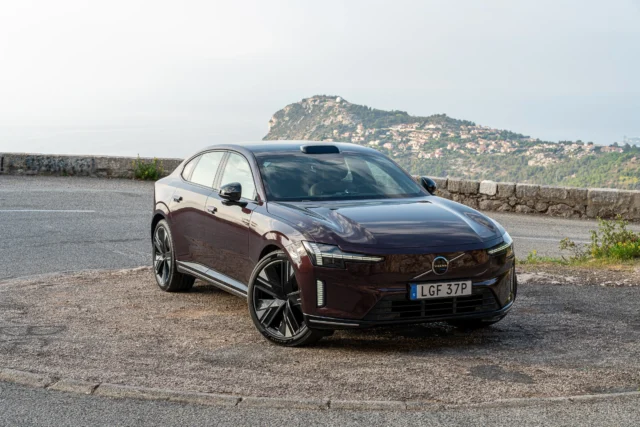
At the upper end of the portfolio, Volvo electrified its flagship class. The Volvo EX90 demonstrated that a full-size, seven-seat SUV—traditionally a combustion stronghold—could deliver family-scale practicality, long-distance usability, and premium comfort without engine-based propulsion. The Volvo ES90 translated similar engineering principles into a streamlined sedan architecture.
These models are not electrified versions of existing combustion platforms. They are clean-sheet electric designs optimized around high-voltage systems, sensor arrays, and software-defined vehicle frameworks.
The strategic importance of the EX60
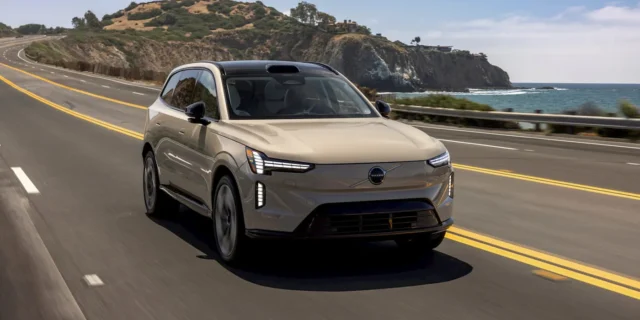
No lineup can be described as complete if the brand’s historical volume leader remains combustion-dependent. For Volvo, the mid-size SUV category has long been central to global sales. The introduction of the Volvo EX60 closes that structural gap.
The EX60 is not simply an electric variant added to an existing nameplate. It integrates the accumulated technical lessons from earlier electric launches while introducing new manufacturing and architectural innovations that reposition the model at the technological forefront of its segment.
With the EX60, electrification moves from portfolio expansion to structural consolidation.
800-volt architecture: speed, efficiency, thermal stability
In early electric vehicle generations, 400-volt systems dominated. They were simpler, less costly, and easier to integrate during transitional platform adaptation. However, as battery capacity increased and consumer expectations shifted toward rapid long-distance usability, system voltage became a critical differentiator.
From the EX60 upward, Volvo deploys an 800-volt electrical architecture. Higher voltage allows the same power transfer at lower current. This reduces resistive losses (I²R), improves thermal management, and enables significantly higher peak charging rates.
Under optimal conditions, charging power can approach 370 kW. More importantly than peak numbers, however, is sustained charging curve stability. High-voltage systems reduce heat generation during fast charging sessions, allowing more consistent power delivery across a wider state-of-charge window.
In real-world terms, this translates into 15–20 minute high-power charging sessions capable of restoring substantial driving range—critical for long-distance travel efficiency. Total journey time depends less on nominal range figures and more on how quickly energy can be replenished mid-route.
Structural battery integration and cell-to-body engineering
Electric vehicle competitiveness is no longer defined solely by battery size. Structural integration has become equally important.
The EX60 adopts a cell-to-body battery configuration. Instead of housing battery modules within a separate pack enclosure bolted to the chassis, the battery assembly contributes directly to structural rigidity. This integration reduces redundant structural elements, lowers total mass, and increases torsional stiffness.
Improved rigidity enhances handling precision, NVH (noise, vibration, harshness) characteristics, and overall safety performance. Reduced mass improves efficiency, braking performance, and tire wear characteristics.
Structural batteries represent a convergence of energy storage and load-bearing architecture—a shift from component-based engineering toward integrated systems design.
Megacasting and manufacturing transformation
Manufacturing evolution is as significant as drivetrain evolution.
The EX60 introduces a rear-structure megacasting solution: a large aluminum structural component produced via high-pressure die casting in approximately 90 milliseconds. This single casting replaces numerous smaller stamped and welded components.
The advantages are multidimensional:
-
Reduced part count
-
Simplified assembly processes
-
Improved dimensional consistency
-
Enhanced structural integrity
-
Lower overall vehicle mass
Megacasting also reduces tolerance stacking errors inherent in multi-part assemblies. Fewer weld points and joints translate into improved long-term structural stability and potentially lower production variability.
This is not cosmetic innovation. It reflects deeper industrial reconfiguration toward simplified, high-precision electric vehicle manufacturing.
Software-defined vehicles and continuous evolution
Electrification is inseparable from digital transformation. Modern electric vehicles function as rolling computational platforms.
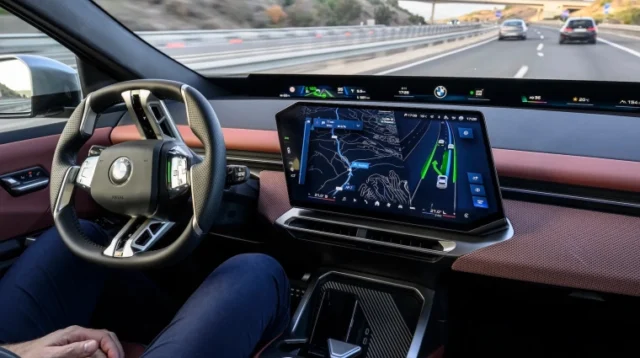
Volvo integrates Android Automotive natively across its lineup. Unlike smartphone projection systems that merely mirror external devices, native integration allows navigation, media, and connected services to run directly on vehicle hardware. This reduces latency, improves reliability, and allows deeper system integration.
Over-the-air (OTA) software updates transform the ownership model. Vehicles can receive performance optimizations, efficiency improvements, feature expansions, and security patches without dealership intervention. The vehicle becomes a continuously evolving product rather than a static mechanical asset.
Future integration of Google Gemini-based AI systems expands the interaction paradigm further. Advanced natural language processing enables conversational control without rigid command syntax. More significantly, access to vehicle camera systems allows contextual interpretation of surroundings.
Potential applications include:
-
Interpreting foreign-language signage
-
Explaining parking restrictions
-
Providing contextual information about visible landmarks
-
Assisting with environmental awareness
This represents a transition from command-based interfaces to adaptive interaction models.
Safety remains central
Electrification does not displace Volvo’s safety identity. Instead, computational capacity and sensor density expand safety system capabilities.
The multi-adaptive seatbelt system, introduced within this new generation, adjusts restraint characteristics based on collision severity and occupant-specific variables—height, body mass, seating position, and additional sensor data. Instead of a fixed load-limiter calibration, the system adapts dynamically to reduce injury risk across a broader demographic range.
Electric platforms also allow optimized crumple zone design due to the absence of large engine blocks. Combined with high structural rigidity from battery integration and megacasting, this enhances energy absorption management during collisions.
Safety engineering remains a defining differentiator rather than a legacy attribute.
Range, charging, and the end of behavioral compromise
Electric vehicle discourse frequently centers on range figures. In practice, charging speed and infrastructure integration have equal or greater influence on usability.
With WLTP ranges spanning roughly 500–800 kilometers depending on configuration, daily driving requirements are easily covered. Long-distance usability depends on route planning efficiency and charging curve performance.
Integrated navigation systems calculate consumption dynamically based on elevation profile, weather conditions, speed, and driving style. Because the system maintains a live database of charging station locations and power capabilities, it can optimize stops for minimal total travel time rather than maximal single-charge range.
For most users, home or workplace AC charging eliminates routine refueling stops entirely. Energy replenishment shifts from a dedicated activity to a background process.
The ownership paradigm changes from reactive refueling to proactive energy management.
Strategic readiness ahead of regulatory deadlines
The 2035 regulatory horizon is often presented as a distant milestone. For manufacturers, however, waiting until the final years to complete portfolio transformation would represent strategic failure.
Volvo’s current lineup indicates that electrification is already structurally embedded across compact, mid-size, and flagship segments. Customers can select electric alternatives without sacrificing segment preference, seating capacity, safety expectations, or brand identity.
Electrification is no longer experimental within the brand—it is operational.
The industrial groundwork is complete. Platform architecture, manufacturing processes, high-voltage systems, software frameworks, and safety integration have converged into a coherent electric ecosystem.
The transition phase is effectively over.
What remains is market alignment.
Image(s) used in this article are either AI-generated or sourced from royalty-free platforms like Pixabay or Pexels.
This article may contain affiliate links. If you purchase through these links, we may earn a commission at no extra cost to you. This helps support our independent testing and content creation.