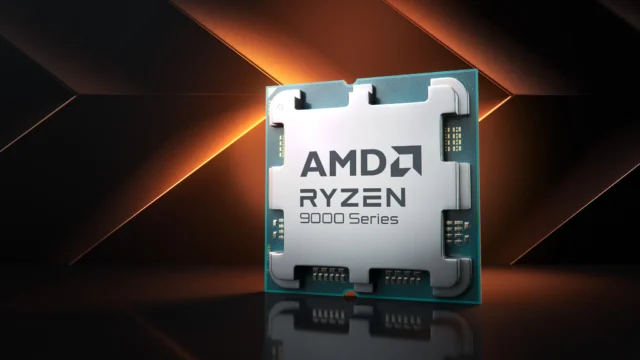
AMD’s 3D V-Cache strategy has taken an unexpectedly interesting turn in 2026. Instead of simply pushing forward with new Zen 5 gaming processors, the company is doing something more unusual: it is filling gaps in the current AM5 lineup, bringing back one of the most loved AM4 gaming CPUs, and openly leaving the door open for a future six-core Ryzen 9000X3D model.
At Computex 2026, AMD introduced the Ryzen 7 7700X3D, confirmed the return of the Ryzen 7 5800X3D as a 10th Anniversary Edition, and indicated that a Ryzen 5 9600X3D could still arrive later this year. The story is not only about new processors. It is also about platform longevity, DDR4 versus DDR5 economics, gaming performance per dollar, and the technical complexity behind AMD’s stacked-cache manufacturing process.
For gamers, PC builders and AM4 owners, this could be one of AMD’s most interesting CPU moves in years.
A surprising new X3D processor for AM5
The first major announcement was the Ryzen 7 7700X3D, a new Zen 4-based processor for the AM5 platform. On paper, it looks like a slightly unusual launch. AMD already has newer Zen 5 Ryzen 9000 processors, and the Ryzen 7 7800X3D has long been one of the most respected gaming CPUs in the desktop market. Yet AMD has decided to introduce another eight-core X3D model, this time positioned as a more affordable entry point into AM5-based 3D V-Cache gaming.
The Ryzen 7 7700X3D features 8 cores, 16 threads, 104 MB of total cache, and a maximum boost clock of up to 4.5 GHz. AMD lists the processor at 329 dollars, with availability beginning on July 16, 2026.
This places it below the original launch price of the Ryzen 7 7800X3D and makes it a potentially attractive option for users who want strong gaming performance without paying for the higher-end X3D parts. However, real-world value will depend heavily on street pricing. If discounted Ryzen 7 7800X3D stock remains close in price, the 7700X3D will need aggressive retail positioning to make sense.
The existence of the Ryzen 7 7700X3D also shows that AMD still sees value in Zen 4. Even though Zen 5 is the newer architecture, Zen 4 with 3D V-Cache remains highly competitive in gaming workloads. Many games benefit more from the large L3 cache than from purely architectural improvements, especially when the GPU is no longer the only limiting factor.
Why 3D V-Cache still matters for gaming
AMD’s X3D processors are not just normal Ryzen chips with a different name. Their main advantage is 3D V-Cache, a technology that stacks additional cache on top of the CPU die. The idea is simple in principle: give the processor much more fast-access memory close to the cores, reducing the need to reach out to slower system memory.
In gaming, this can be extremely useful. Modern game engines constantly stream data: textures, geometry, AI logic, physics calculations, draw calls and world-state information. When more of this data can remain in cache, latency drops and frame pacing can improve. That is why X3D processors often perform exceptionally well in games even when their clock speeds are lower than non-X3D Ryzen models.
This is also why AMD’s X3D lineup has become popular with gamers who do not necessarily need many CPU cores. A game may not use 12 or 16 cores efficiently, but it may benefit significantly from a large L3 cache pool. That makes the X3D models especially interesting for high-refresh-rate gaming, simulation titles, strategy games and CPU-sensitive esports scenarios.
The Ryzen 7 7800X3D became famous for this reason. It was not AMD’s most expensive desktop processor, but in many gaming benchmarks it behaved like a specialist weapon: efficient, relatively cool, and extremely fast where cache mattered.
The Ryzen 7 7700X3D appears to follow that same logic, but at a lower official price.
The missing piece: Ryzen 5 9600X3D
The more intriguing part of AMD’s Computex 2026 discussion was not the Ryzen 7 7700X3D itself, but what did not launch: the Ryzen 5 9600X3D.
A six-core Zen 5 processor with 3D V-Cache would be a logical product for many gamers. It would likely offer excellent gaming performance, lower power consumption than larger chips, and a more accessible price than the eight-core and twelve-core X3D models. It could become the natural choice for budget-conscious AM5 gaming builds.
AMD has not officially announced such a processor yet. However, David McAfee, AMD’s corporate vice president and general manager of Ryzen and Radeon, said at Computex that a six-core Zen 5 X3D processor may be something AMD looks at later this year.
That wording matters. It is not a formal product launch, and it should not be treated as a confirmed release date. But it does mean AMD is aware of the market demand. The Ryzen 5 9600X3D would make sense if AMD wants to offer a lower-cost path into Zen 5 plus 3D V-Cache.
The problem is product segmentation. AMD knows that gamers tend to prefer eight-core CPUs when buying premium gaming processors. A six-core X3D chip can be excellent, but it may sit in an awkward place: too expensive for the cheapest gaming PCs, yet psychologically less attractive than an eight-core model for buyers who want a long-term upgrade.
That is likely why AMD has historically been cautious with six-core X3D processors.
Why six-core X3D chips are rare
The Ryzen 5 7600X3D already showed that six-core X3D processors can be compelling. It delivered strong gaming performance and high efficiency, but it was not a widely available mainstream global product. It was sold in limited channels, making it more of a specialist part than a mass-market CPU.
AMD’s reasoning is understandable. 3D V-Cache packaging adds cost and complexity. If AMD has a limited number of X3D-capable chiplets or packaging capacity, it makes business sense to use them on higher-margin eight-core or Ryzen 9 products rather than cheaper six-core models.
There is also a buyer-perception problem. Many gamers still use six-core CPUs successfully, but when spending extra on a gaming-focused processor, they often prefer eight cores as a safer long-term choice. Even if the real-world gaming gap between six and eight cores is not dramatic in many titles, the market often rewards the more complete-looking specification.
That is why a Ryzen 5 9600X3D would be strategically interesting. It would not only be a CPU for budget gamers. It would also test whether the market is now ready for a more widely available six-core X3D processor.
If priced correctly, it could become one of the most attractive gaming CPUs in AMD’s lineup. If priced too close to eight-core X3D models, it could struggle.
Ryzen 7 7700X3D versus a possible Ryzen 5 9600X3D
The Ryzen 7 7700X3D and a possible Ryzen 5 9600X3D would serve different types of buyers.
The Ryzen 7 7700X3D is a safer all-round gaming option. It has eight cores, a proven Zen 4 foundation, and enough thread capacity for modern games, background tasks, streaming tools and general desktop use. It is not the newest architecture, but it may offer a well-balanced combination of cache, price and platform support.
A Ryzen 5 9600X3D, by contrast, would likely be more focused. With six Zen 5 cores and 3D V-Cache, it could be extremely efficient and very fast in games, especially where cache is the main limiting factor. It would probably appeal to users building a pure gaming PC rather than a workstation or heavy multitasking machine.
The key question would be price. If AMD launched it in a genuinely affordable range, it could become a high-volume gaming chip. If it landed too close to the Ryzen 7 7700X3D or discounted Ryzen 7 7800X3D models, the argument for choosing six cores would weaken.
For now, the Ryzen 5 9600X3D remains a possibility rather than a confirmed product. But the fact that AMD is publicly discussing it suggests the company has not abandoned the idea.
The Ryzen 7 5800X3D returns for AM4
The second major part of AMD’s 2026 X3D story is the return of the Ryzen 7 5800X3D. This processor has almost legendary status among AM4 users. When it originally launched, it gave older AM4 systems a massive gaming upgrade without requiring a new motherboard, new DDR5 memory or a full platform rebuild.
In 2026, AMD is bringing it back as the Ryzen 7 5800X3D 10th Anniversary Edition. The processor keeps the familiar Zen 3 foundation: 8 cores, 16 threads, a 3.4 GHz base clock, up to 4.5 GHz boost, 100 MB of total cache, and a 105 W TDP. AMD says the anniversary edition will be available from June 25, 2026, with a suggested launch price of 349 dollars.
This is not just nostalgia. AM4 remains one of the most successful desktop platforms AMD has ever created. Many users still own capable AM4 motherboards with DDR4 memory, and for them, a CPU upgrade is far cheaper than moving to AM5.
The Ryzen 7 5800X3D remains especially attractive because it can turn an older gaming PC into a much faster system with minimal disruption. For users running Ryzen 5 3600, Ryzen 7 3700X, Ryzen 5 5600X or even some older Ryzen 5000 chips, the 5800X3D can still be a meaningful gaming upgrade.
Why AMD could not simply restart 5800X3D production
At first glance, bringing back the Ryzen 7 5800X3D sounds easy. AMD already designed the chip. The specifications are known. The AM4 platform is mature. The BIOS ecosystem is stable. Why not simply restart production?
The answer is manufacturing technology.
According to AMD’s explanation, the original Ryzen 7 5800X3D used an earlier TSMC stacking and bonding process. That production flow has since changed. The first-generation stacking process used for the original chip was no longer available in the same form, so AMD had to adapt the design to a newer second-generation stacking process.
That required real engineering work. AMD could not just take the old design files, send them back into the factory, and resume shipping processors. The company had to rework the design for the updated process, produce new samples, test them, validate reliability, and certify the manufacturing flow again.
This is an important detail because it changes how we should interpret the re-release. The 10th Anniversary Edition is not merely old stock in new packaging. It exists because AMD invested engineering resources into making an older processor compatible with a newer manufacturing environment.
That is unusual in the CPU market. Most companies prefer to move forward, not spend time adapting older chips for renewed production. AMD’s decision shows how valuable the AM4 install base still is.
Will the new 5800X3D perform differently?
The practical question is whether the re-engineered Ryzen 7 5800X3D 10th Anniversary Edition will perform differently from the original version.
Based on AMD’s positioning, buyers should not expect a major performance change. The core specifications remain the same, and the updated stacking process is not being marketed as a performance upgrade. It is primarily a manufacturing adaptation.
That means gaming performance should be broadly similar to the original Ryzen 7 5800X3D. Thermals and power behavior should also be close, although independent testing will be needed to confirm whether there are small differences in temperature, voltage behavior or boost consistency.
The most important change is availability. Original 5800X3D stock became scarce, and second-hand pricing often rose sharply because demand remained strong among AM4 users. A renewed retail version could reduce pressure on the used market and give buyers a safer, warranty-backed upgrade path.
For many users, that matters more than a few percentage points of performance.
AM4 is still not dead
The Ryzen 7 5800X3D comeback also reinforces a broader point: AM4 is still not dead.
This platform launched in 2016 and has supported multiple CPU generations, from early Ryzen chips to Zen 3 and now a reissued X3D anniversary model. Very few consumer desktop platforms remain relevant for this long. For users who invested in decent AM4 motherboards, this long support cycle has been one of AMD’s strongest advantages.
In 2026, AM4 still makes sense in several cases:
Users who already own an AM4 motherboard and DDR4 memory can upgrade cheaply.
Gamers who do not need PCIe 5.0 or DDR5 can avoid a full platform rebuild.
Budget builders may find used AM4 boards and DDR4 memory more affordable than AM5 parts.
The Ryzen 7 5800X3D still offers strong gaming performance for its age.
However, AM4 is no longer the forward-looking choice for a new high-end build. Anyone starting from scratch should carefully compare AM4 pricing against AM5, especially now that AMD has extended AM5 support.
AM5 support through 2029 changes the upgrade equation
AMD also used Computex 2026 to strengthen confidence in AM5. The company said the AM5 platform will continue to receive new processor support through 2029.
That is a major point for PC builders. One of the reasons AM4 became so popular was its long upgrade path. If AM5 follows a similar pattern, a user buying a motherboard today may have several future CPU upgrade options without replacing the entire platform.
This makes the Ryzen 7 7700X3D more interesting than it might appear from specifications alone. It is not just a CPU purchase. It is also an entry into the AM5 ecosystem, with DDR5 memory, newer chipsets, PCIe 5.0 support on selected boards, and a platform that AMD says will continue for years.
For users building a new PC in 2026, that platform argument may outweigh the raw value of an AM4 upgrade. AM4 is excellent for extending an existing system. AM5 is the better foundation for a new long-term build.
The DDR4 versus DDR5 question
The return of the Ryzen 7 5800X3D and the launch of the Ryzen 7 7700X3D also highlight a familiar dilemma: DDR4 or DDR5?
DDR4 remains cheaper and widely available. Many users already own 32 GB or 64 GB of DDR4 memory, and replacing it adds cost without always producing a dramatic gaming improvement. For those users, AM4 plus a Ryzen 7 5800X3D can be a rational upgrade.
DDR5, however, is the future-facing choice. AM5 requires DDR5, and newer Ryzen processors are designed around it. DDR5 pricing has fluctuated, but for a fresh build, investing in AM5 generally makes more sense unless the budget is extremely tight.
The simplest rule is this:
If you already have a good AM4 motherboard and DDR4 memory, the Ryzen 7 5800X3D 10th Anniversary Edition may be one of the easiest gaming upgrades available.
If you are building a new PC from zero, AM5 is usually the more sensible platform, especially with AMD’s support window now extending through 2029.
What gamers should buy
The best choice depends on the user’s current hardware.
For existing AM4 users, the Ryzen 7 5800X3D remains highly attractive. It avoids the cost of a new motherboard and DDR5 memory, while still delivering strong gaming results. The 10th Anniversary Edition is especially relevant if used-market prices remain inflated.
For AM5 buyers, the Ryzen 7 7700X3D could become a good mid-range gaming option, but only if its real retail price stays comfortably below faster X3D alternatives. If the Ryzen 7 7800X3D or newer Ryzen 9000X3D chips are only slightly more expensive, buyers will need to compare benchmarks and local pricing carefully.
For budget-focused gamers, the possible Ryzen 5 9600X3D is the chip to watch. It could become the most interesting value-oriented X3D processor of 2026, but only if AMD actually launches it and prices it aggressively.
For productivity users, X3D processors are not always the best option. They are gaming specialists. Users who do heavy rendering, compiling, encoding or workstation workloads may be better served by higher-core-count Ryzen 9 processors, even without 3D V-Cache.
Why AMD’s 2026 X3D strategy is unusual
AMD’s current approach is unusual because it does not follow a simple generational pattern.
The company is launching a new Zen 4 X3D chip for AM5.
It is considering a Zen 5 six-core X3D model.
It is bringing back a Zen 3 X3D chip for AM4.
It is extending AM5 support through 2029.
This creates a wide ladder of gaming CPU options rather than a clean replacement cycle. AMD appears to be targeting different groups at once: existing AM4 users, affordable AM5 builders, high-end AM5 gamers, and potential budget X3D buyers.
From a marketing perspective, this is complicated. From a customer perspective, it can be useful. Not every gamer wants to replace an entire PC. Not every buyer wants the newest architecture. Some simply want the best frame rate upgrade for the least money.
AMD seems to understand that the gaming CPU market is now more segmented than before. Platform cost, memory cost, motherboard availability and upgrade path matter almost as much as benchmark charts.
The bigger message: platform longevity sells processors
The deeper story is not only about the Ryzen 5 9600X3D, Ryzen 7 7700X3D or Ryzen 7 5800X3D. It is about AMD’s long-term platform strategy.
AM4 became successful partly because users trusted it. A motherboard bought years earlier could often receive a BIOS update and accept a much newer CPU. That created customer loyalty and gave AMD an advantage over shorter-lived platform cycles.
With AM5 now promised through 2029, AMD is clearly trying to repeat that formula. The Ryzen 7 7700X3D gives AM5 another gaming-focused option. A future Ryzen 5 9600X3D could make Zen 5 X3D more affordable. The revived Ryzen 7 5800X3D rewards users who stayed with AM4.
This is not just a processor roadmap. It is ecosystem management.
For PC gamers, that is good news. More CPU choices usually mean better pricing pressure, more upgrade paths and less need to replace an entire system prematurely.
What to watch next
The next major question is whether AMD will actually launch the Ryzen 5 9600X3D. If it does, the most important details will be price, availability, clock speeds, cache configuration and whether it receives broad global distribution or remains limited like the Ryzen 5 7600X3D.
The second question is how the Ryzen 7 7700X3D performs in independent reviews. Its official specifications are promising, but its value depends on how close it gets to the Ryzen 7 7800X3D and how it compares against Zen 5 X3D alternatives.
The third question is whether the Ryzen 7 5800X3D 10th Anniversary Edition will be available in meaningful quantities. If supply is limited, it may become a collector-style product rather than a practical upgrade for mainstream AM4 users.
For now, AMD’s 2026 X3D lineup looks more interesting than expected. The Ryzen 7 7700X3D gives AM5 another gaming CPU, the Ryzen 7 5800X3D gives AM4 owners one more chance at a legendary upgrade, and the possible Ryzen 5 9600X3D could finally bring a more affordable Zen 5 X3D option to gamers later this year.
The most important takeaway is simple: AMD is not treating 3D V-Cache as a niche experiment anymore. It has become one of the company’s strongest gaming brands, and in 2026 AMD appears willing to use it across old platforms, current platforms and possibly more affordable processor segments.
Image(s) used in this article are either AI-generated or sourced from royalty-free platforms like Pixabay or Pexels.
This article may contain affiliate links. If you purchase through these links, we may earn a commission at no extra cost to you.
Get the weekly RF & IT briefing
Radio guides, RF calculators, AI, Windows, Linux and satellite communication explainers. One useful email per week. No spam.