Extreme overclocking is one of the strangest and most fascinating corners of the PC hardware world. It is not about everyday gaming performance, quiet operation, long-term stability or value for money. It is about pushing silicon, circuit design and electrical engineering to the absolute edge — often for only a few seconds — to prove what modern hardware can do under conditions that no normal desktop PC will ever experience.
At Computex 2026, Gigabyte’s in-house extreme overclocking team, led by the well-known overclocker HiCookie, did exactly that. The company’s overclocking crew achieved a new DDR5 memory frequency world record and also collected several global first-place results during the G.Skill 12th Annual OC World Record Stage.
The headline result was the new memory clock world record: a Corsair Vengeance DDR5 module was pushed to 6778.4 MHz, which corresponds to an effective DDR5 data rate of 13,556.8 MT/s. The result was achieved by Saltycroissant using a Gigabyte AORUS Z890 Tachyon Duo X Ice motherboard and an Intel Core Ultra 7 270K Plus processor.
That number is far beyond anything a normal gaming PC, workstation or enthusiast build would use. But that is precisely the point. Records like this are not meant to show what most users should buy. They show what the best components, the best motherboard layout, the best BIOS tuning and the most experienced overclockers can achieve when every part of the system is optimized for one purpose: maximum frequency.
A new DDR5 memory frequency record
The new record was achieved with a 24 GB Corsair Vengeance LP DDR5 memory module running at 6778.4 MHz. Because DDR memory transfers data on both the rising and falling edge of the clock signal, the effective speed is expressed as 13,556.8 MT/s.
That is an extreme figure even by 2026 standards. High-end consumer DDR5 kits commonly operate in the 6000–8000 MT/s range, with faster enthusiast kits going beyond that under the right conditions. But crossing the 13,500 MT/s barrier belongs to a completely different category. This is not normal XMP or EXPO memory tuning. It is laboratory-style overclocking.
According to the available CPU-Z validation data, the Intel Core Ultra 7 270K Plus processor used in the test was running with a limited active-core configuration: 2 + 2 active cores. The CPU itself was not pushed for maximum processor frequency in this particular run. It operated at 2118.02 MHz with a 105.92 MHz bus speed. This is normal for memory record attempts, because the CPU is not the main target. The goal is to reduce unnecessary load, simplify the platform and give the memory controller the best possible chance of maintaining signal integrity at extreme speeds.
The previous memory clock world record stood at 13,530.4 MT/s, while the third-highest result currently sits at 13,453.6 MT/s. In this context, the new record is not a huge generational leap, but that does not make it less impressive. At this level, even a small improvement is difficult. The higher memory frequencies go, the harder it becomes to keep the signal clean, the system responsive and the module stable enough to complete validation.
Why 13,556.8 MT/s is such a difficult result
Memory frequency records may look simple from the outside: install fast RAM, raise the speed and validate the result. In reality, the process is much more complex.
DDR5 memory is highly sensitive to signal quality. At very high frequencies, even small electrical imperfections can prevent a successful boot or cause immediate instability. Trace length, motherboard layer design, memory slot position, memory controller quality, voltage behavior, BIOS tuning and temperature all matter.
This is why world records are usually achieved with carefully selected hardware. Overclockers do not simply use random retail components and hope for the best. They test multiple CPUs, memory modules and motherboards to find unusually strong samples. In overclocking terminology, this is often called binning. A good memory module may clock very high. A better one may reach record territory. A great one may work only under very specific voltages, temperatures and timing combinations.
At these speeds, the difference between success and failure can be extremely small. A BIOS setting, a voltage offset, a slightly different memory training behavior or a few degrees of temperature change can decide whether the system validates or crashes.
The role of the AORUS Z890 Tachyon Duo X Ice motherboard
One of the most important parts of this record was the Gigabyte AORUS Z890 Tachyon Duo X Ice motherboard. This is not a normal mainstream motherboard designed primarily for full feature density, many expansion slots and maximum compatibility. It is a specialized overclocking board.
The most obvious sign of this is the memory slot layout. Instead of four DDR5 slots, the board uses only two. For normal users, fewer memory slots may look like a limitation. For extreme memory overclocking, it is an advantage.
With only two memory slots, the motherboard can use shorter and cleaner electrical paths between the CPU and the memory modules. Shorter memory traces can improve signal integrity, reduce electrical noise and make very high frequencies easier to achieve. Fewer slots also reduce the complexity placed on the processor’s integrated memory controller.
This is one reason why many high-end overclocking boards use two DIMM slots instead of four. They are not designed for maximum RAM capacity. They are designed for maximum RAM speed.
The PCB layout also matters. Memory overclocking boards typically use optimized trace routing, carefully tuned power delivery and BIOS options aimed at experienced tuners. These details are invisible to most buyers, but they can become decisive when trying to run DDR5 at speeds above 13,000 MT/s.
Liquid nitrogen and the physics of extreme overclocking
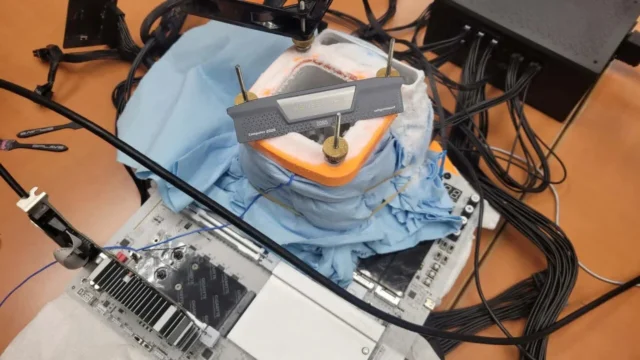
The processor and memory were cooled with liquid nitrogen. That is standard practice in world-record overclocking, but it is worth explaining why.
Liquid nitrogen has a boiling point of around -196 °C. When used with a properly mounted LN2 pot, it can keep a processor or memory module at extremely low temperatures. This helps reduce leakage current and can allow silicon to operate at frequencies or voltages that would be impossible under normal air or water cooling.
However, liquid nitrogen is not a magic solution. It adds its own problems. Components can suffer from cold bugs, where they stop working properly below a certain temperature. Moisture and condensation can damage hardware if the board is not insulated properly. Voltage behavior changes. Memory training can become unpredictable. The overclocker must constantly manage temperature, voltage and stability.
That is why results like this depend heavily on human skill. The hardware is important, but so is the person controlling it. A world-record run is a combination of electrical engineering, patience, experience and timing.
Why memory timing data matters
The available information confirms the frequency result, but does not provide the full memory timing configuration. That is important, because memory performance is not determined by frequency alone.
In everyday systems, timings such as CL, tRCD, tRP and tRAS affect real-world latency and responsiveness. A memory kit running at a very high data rate with loose timings may not always be faster in practical workloads than a slightly slower kit with tighter timings. For normal gaming PCs, the balance between frequency, latency and memory controller stability is more important than a pure headline speed.
In world-record overclocking, however, the goal is different. The point is to reach the highest possible validated frequency. Timings can be relaxed if that helps the module reach a higher clock. This is why a memory frequency record should not be interpreted as a recommendation for daily-use memory settings.
In other words, 13,556.8 MT/s is a technical milestone, not a practical target for most users.
What this means for gamers and PC builders
For most gamers, this record does not mean that they should immediately chase ultra-high-speed DDR5 kits. The sweet spot for gaming performance is usually much lower than world-record territory. Modern platforms often perform best when memory speed, memory controller mode and latency are balanced.
On Intel platforms, very high DDR5 speeds can produce measurable gains in some workloads, especially in memory-sensitive applications. On AMD platforms, the relationship between memory speed, Infinity Fabric behavior and latency is more nuanced. In both cases, there is a point where extra memory frequency becomes expensive, difficult to stabilize and less useful in real games.
Still, records like this matter indirectly. Extreme overclocking helps motherboard vendors improve BIOS behavior, memory training algorithms, PCB design and power delivery. Lessons learned from record attempts can eventually influence more practical products. A feature developed for overclockers today may become part of a more stable enthusiast motherboard tomorrow.
For ordinary users, the takeaway is simple: DDR5 still has significant headroom, and motherboard design remains a major factor in memory performance.
Gigabyte’s wider overclocking success at Computex 2026
The memory world record was not Gigabyte’s only achievement. The company also reported ten global first-place results at the G.Skill 12th Annual OC World Record Stage.
For these additional records, the team moved away from the Intel memory-record platform and used an AMD-based setup instead. The system was built around an X870 AORUS Infinity motherboard, a Ryzen 9 9950X3D2 processor and G.Skill Trident Z5 RGB memory.
The overclocking team included Saltycroissant, Splave, Sofos and HiCookie. These are not casual hobbyists. They are experienced competitive overclockers, and names like HiCookie and Splave are well known in the global OC community.
Gigabyte’s official announcement did not list every benchmark result in detail, but it indicated that the records included CPU frequency achievements and global first-place results in several benchmark applications.
This is important because it shows that the company’s success was not limited to one isolated memory validation. Gigabyte demonstrated strength across multiple platforms and benchmark categories.
Intel for memory frequency, AMD for benchmark domination
One interesting detail is the platform split. The DDR5 memory record was achieved on an Intel Core Ultra 7 270K Plus system with a Z890 motherboard. The additional global first-place results used an AMD Ryzen 9 9950X3D2 processor with an X870 board.
This reflects a broader reality in modern overclocking: different platforms can be better suited to different types of records.
Intel platforms have often been strong in extreme memory frequency attempts, partly because of memory controller behavior and motherboard ecosystem maturity in high-frequency DDR tuning. AMD’s 3D V-Cache processors, on the other hand, are especially interesting for gaming and cache-sensitive workloads, while high-end Ryzen chips can also be extremely competitive in benchmark categories where core count, cache and architecture matter.
The fact that Gigabyte used both platforms suggests a deliberate strategy. Instead of forcing one system to do everything, the team used the best platform for each type of record.
The significance of two-DIMM motherboards
The AORUS Z890 Tachyon Duo X Ice highlights a broader trend in extreme memory tuning: two-DIMM motherboards often dominate high-frequency results.
A four-DIMM motherboard is more flexible for general users. It allows more memory modules and higher total capacity. That is useful for workstations, content creation, virtual machines and long-term upgrade paths.
A two-DIMM board, however, is often better for pushing memory frequency. With fewer slots and cleaner routing, the memory subsystem becomes easier to control. This is especially important with DDR5, where signal integrity becomes increasingly difficult as speeds rise.
This is why some premium overclocking boards look less feature-rich than expensive gaming motherboards. They are not trying to provide everything. They are trying to win in very specific conditions.
For buyers, this distinction matters. A board designed for extreme overclocking may not be the best choice for someone who wants 192 GB of memory, many M.2 drives and maximum expandability. But for someone interested in high-speed RAM tuning, a specialized two-DIMM motherboard can be a better technical choice.
Corsair, G.Skill and the memory arms race
The record system used a Corsair Vengeance DDR5 module, while the additional AMD-based benchmark records used G.Skill Trident Z5 RGB memory. That is also typical of competitive overclocking. Different brands, memory ICs and module designs may perform better in different scenarios.
The DDR5 market has become highly competitive. Memory vendors are constantly refining PCB design, binning higher-quality ICs and releasing faster kits. While most users will never run memory at world-record speeds, the prestige of extreme overclocking still matters for branding.
When a module family appears in a world-record result, it sends a clear message: this memory platform has serious headroom. That does not mean every retail module will behave the same way, but it does strengthen the reputation of the product line among enthusiasts.
For Corsair, the Vengeance DDR5 result is a strong showcase. For G.Skill, the OC World Record Stage remains one of the most visible places to demonstrate high-performance memory in front of the enthusiast community.
Why overclocking records still matter in 2026
It is easy to dismiss extreme overclocking as a niche hobby. After all, almost nobody runs liquid nitrogen cooling at home. Almost nobody disables CPU cores and spends hours tuning memory training just to validate one frequency score.
But overclocking records still matter for several reasons.
First, they test platform limits. Motherboard vendors can learn where their designs succeed and where they fail. BIOS teams can refine memory compatibility and voltage behavior. Engineers can observe failure modes that may never appear in ordinary testing.
Second, they create a public benchmark for engineering quality. A record does not prove that a motherboard is the best choice for every buyer, but it does show that the board can survive and function under extreme electrical conditions.
Third, they keep enthusiast culture alive. PC hardware has become more automated over time. Boost algorithms, AI tuning and preset memory profiles have made manual tweaking less necessary for most users. Extreme overclocking preserves the experimental side of PC building.
Finally, these records influence marketing. Hardware companies want to show leadership. A world record gives them a concrete achievement that is easier to communicate than a long list of technical features.
The difference between validation and real-world performance
A memory frequency validation is not the same as a stable daily overclock. This distinction is important.
A world-record run may only need to remain stable long enough to boot, load the validation software and submit the result. A daily-use system needs to survive hours of gaming, rendering, browsing, updates, sleep cycles and temperature changes. It must also remain stable without liquid nitrogen, without extreme voltage and without constant manual intervention.
That is why users should not compare a 13,556.8 MT/s record directly with their own DDR5 kit. A gaming PC running DDR5-6000, DDR5-6400, DDR5-7200 or DDR5-8000 can be perfectly fast and far more practical. Stability, latency and platform compatibility matter much more than chasing a record number.
For professional workloads, reliability is even more important. A memory error in a benchmark may simply crash the run. A memory error in real work can corrupt data, ruin a render or cause unexplained system instability.
What this says about the future of DDR5
The new record suggests that DDR5 still has room to scale. The technology has matured significantly since its early consumer introduction, and both memory vendors and motherboard manufacturers have learned how to push it further.
Future improvements may come from better memory ICs, improved motherboard routing, stronger CPU memory controllers and more refined BIOS-level memory training. As platforms evolve, some of today’s extreme speeds may eventually become more accessible to high-end enthusiasts, even if they remain far below world-record territory.
That does not mean 13,500 MT/s DDR5 will become normal overnight. Practical memory speeds are limited by cost, stability, voltage, latency and platform support. But the direction is clear: DDR5 is still evolving, and the ceiling has not yet been reached.
For the next generation of desktop platforms, memory performance will remain one of the key battlegrounds. CPU core counts, cache size, AI acceleration and GPU performance get most of the attention, but memory bandwidth and latency still influence the overall system experience.
Gigabyte’s message to the enthusiast market
For Gigabyte, this record is more than a technical trophy. It is a statement to the enthusiast market.
The company wants to show that its AORUS overclocking boards are not just visually distinctive products with aggressive branding. They are capable platforms for serious competitive overclocking. The Z890 Tachyon Duo X Ice and X870 AORUS Infinity results support that message.
In a market where high-end motherboards can be extremely expensive, manufacturers need to justify their engineering decisions. Power delivery, PCB layers, memory trace layout and BIOS tuning are not always easy for buyers to evaluate. World-record results provide a visible proof point.
The achievement also reinforces Gigabyte’s relationship with well-known overclockers. In extreme overclocking, credibility matters. A board that performs well in the hands of HiCookie, Splave, Sofos and Saltycroissant is more likely to gain attention from serious tuners.
A record for the few, but a signal for everyone
The new DDR5 memory clock world record is not something most PC users will attempt to replicate. It required a specialized motherboard, carefully selected memory, an Intel Core Ultra processor, liquid nitrogen cooling and an expert overclocker.
But the result still matters.
It shows how far DDR5 technology can be pushed. It demonstrates the value of motherboard engineering. It highlights the ongoing competition between memory vendors. And it reminds the PC community that hardware still has room for experimentation, even in an era of automatic boost clocks and factory-optimized performance profiles.
Gigabyte’s Computex 2026 overclocking showcase delivered exactly what extreme OC events are supposed to deliver: spectacular numbers, technical curiosity and a glimpse of what modern platforms can do when every normal limit is removed.
For everyday users, the lesson is not to chase 13,556.8 MT/s memory. The lesson is that platform design matters. Memory layout matters. BIOS quality matters. Cooling matters. And even in 2026, the outer edge of PC performance is still being pushed by people willing to pour liquid nitrogen onto expensive hardware in search of one more world record.
Image(s) used in this article are either AI-generated or sourced from royalty-free platforms like Pixabay or Pexels.
This article may contain affiliate links. If you purchase through these links, we may earn a commission at no extra cost to you.
Get the weekly RF & IT briefing
Radio guides, RF calculators, AI, Windows, Linux and satellite communication explainers. One useful email per week. No spam.