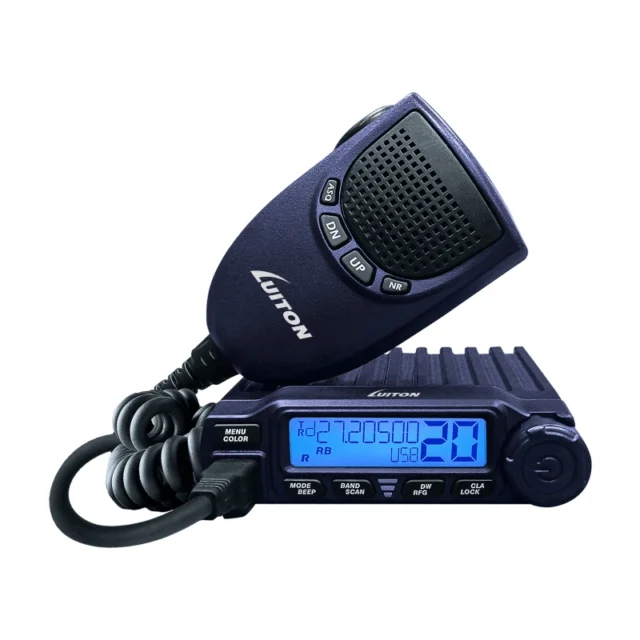
The Luiton LT-310SDR is not the kind of CB radio that quietly fits into the background. At first glance, it looks like a compact mobile transceiver built for modern cars, off-road vehicles, portable radio boxes and space-limited installations. But once the specification sheet is examined more closely, it becomes obvious that this is not just another basic AM/FM CB radio. The LT-310SDR brings together AM, FM, USB and LSB operation, a compact color display, selectable bands, SDR-branded signal processing, AI-style noise reduction and SSB output power quoted at up to 15 watts.
That combination immediately makes it interesting. Traditional CB users know the usual formula very well: 40 channels, 4 watts, AM or FM depending on the country, a simple channel selector, squelch control and maybe a basic signal meter. The Luiton LT-310SDR belongs to a different generation of radios. It is much closer to the compact “export radio” or 10/11-meter enthusiast radio category, where CB-style simplicity meets amateur-radio-style flexibility.
This is exactly why the radio is attractive, but also why it needs to be discussed carefully. In some markets, a device like this may be sold as a CB radio. In others, it may be described as an amateur radio, a 10-meter radio, an export radio or a multi-standard 27 MHz transceiver. The difference is not just marketing language. CB radio rules vary significantly between countries, especially when SSB, output power and frequency coverage are involved.
For hobby users, the LT-310SDR is a tempting little machine. It promises much of what people used to expect from much larger radios: sideband operation, flexible tuning, mobile-friendly installation, digital features and modern receive processing. For a casual buyer who only wants a legal plug-and-play road radio, the picture is more complicated. This is a radio that deserves to be understood before it is installed.
What the Luiton LT-310SDR is
The Luiton LT-310SDR is a compact multi-mode mobile radio designed around the 26–30 MHz region, depending on version, configuration and market. That range includes the classic 27 MHz CB band, the 10-meter amateur band and the surrounding export-radio territory. This is important because the same hardware may be advertised differently depending on where it is sold.
In practical terms, the radio is aimed at users who want a small transceiver with more than just standard AM/FM CB functionality. It supports AM, FM, USB and LSB. That means it can be used for normal short-distance local CB-style communication, but also for longer-distance SSB contacts when propagation conditions are favorable.
The most important difference between a basic CB radio and the LT-310SDR is sideband capability. USB and LSB modes make much better use of transmitter power and receiver bandwidth than AM. When the 11-meter band opens, even modest SSB stations can make long-distance contacts across countries or continents. A compact radio with SSB therefore has a much wider appeal than a simple AM/FM-only unit.
The LT-310SDR also uses a standard SO-239 antenna connector, which is a practical advantage. It can be connected to ordinary PL-259 terminated CB and HF antennas without strange adapters. This matters because many compact radios try to save space with less convenient connectors, while serious 27 MHz users normally already have PL-259 based coax, mobile antennas, base antennas or antenna switches.
Why this radio attracts attention
The LT-310SDR is interesting because it tries to solve a real problem. Many CB and 10-meter radios with SSB are relatively large. Classic SSB CB radios often use traditional front panels with large knobs, wide cases and full-size chassis designs. They are comfortable to operate, but not always easy to install in a modern vehicle.
Modern cars have less spare dashboard space than older vehicles. Consoles are crowded with screens, airbags, climate controls, cup holders and electronics. In off-road vehicles, vans, campers and work vehicles, the radio space is often already occupied by VHF/UHF transceivers, navigation equipment, dashcams or power distribution panels. A tiny SSB-capable 27 MHz radio therefore makes sense.
The LT-310SDR also arrives at a time when radio hobbyists are becoming more comfortable with compact menu-driven equipment. Handheld VHF/UHF radios, small QRP HF rigs, digital-mode transceivers and portable SDR receivers have trained users to accept multifunction buttons and small displays. The LT-310SDR follows that trend. It does not try to imitate a 1980s CB radio. It tries to compress a modern multi-mode feature set into a very small mobile package.
Technical specifications
The Luiton LT-310SDR is specified as a compact mobile radio using a 50-ohm unbalanced antenna system. It operates from a 12–13.8 V DC negative-ground supply, which makes it suitable for normal vehicle electrical systems and standard radio power supplies.
The radio body is approximately 128 × 101 × 25 mm, while the separate PTT/microphone unit is approximately 120 × 60 × 40 mm. The combined radio and PTT weight is about 478 g. These figures place the LT-310SDR firmly in the compact mobile category. It is small enough to mount under a dashboard, inside a center console, on a side panel, in a portable communications case or even in a temporary field setup.
The transmitter output is commonly quoted as approximately 15 W on SSB, 7 W on FM, 7 W average on AM and 16 W PEP on AM. These numbers are above traditional 4-watt CB expectations, especially in AM/FM mode, so the user must understand local regulations before transmitting.
The receiver specification lists SSB sensitivity around 0.25 µV for 10 dB S+N/N, AM sensitivity around 1.0 µV and FM sensitivity around 0.3 µV for 12 dB SINAD. Selectivity is listed as approximately 2.6 / 3.3 kHz for SSB and 6.0 / 9.0 kHz for AM/FM. Audio output is quoted at around 2 W into an 8-ohm speaker.
The radio also includes selectable band options such as CB, 10M, BR, 12H and HF-style configurations, depending on version and startup selection. This flexibility is useful, but it is also one of the reasons the LT-310SDR should not be treated as a simple universal legal CB radio in every country.
Key features
The most important features of the LT-310SDR are its compact size, AM/FM/USB/LSB operation, SSB output capability, color display, selectable band plans, AI-style noise reduction, scan functions, dual watch and standard external antenna compatibility.
The AM and FM modes are useful for local CB-style contacts. AM remains popular in several regions, especially in North America and among traditional CB operators. FM is widely used in Europe and is preferred by many users for its cleaner local audio and better noise rejection in short-range communication.
The USB and LSB modes are the features that lift the LT-310SDR above ordinary compact CB radios. SSB is essential for serious 11-meter DX work and for 10-meter amateur operation where permitted. Even if the operator uses the radio only occasionally on sideband, having USB and LSB available makes the device far more versatile.
The color display is another modern touch. A small radio can become frustrating if the screen is poor, especially when functions are hidden in menus. A readable display helps with channel selection, frequency display, mode indication, signal level, settings and general usability.
Noise reduction is heavily promoted on this radio. The term “AI noise reduction” should be interpreted with caution, but the function itself can still be useful. Vehicle installations often suffer from alternator noise, ignition interference, LED lighting noise, USB charger hash, inverter noise and general urban electrical interference. Any practical receive-side noise reduction can make the radio easier to use.
First impressions
The first impression of the LT-310SDR is that it feels like a modern compact communications device rather than a traditional CB set. The body is small, the display is prominent, and the overall design appears optimized for flexible installation rather than nostalgic operation.
This is good and bad at the same time. For a modern vehicle, the small size is a major advantage. The radio can be mounted where a larger SSB CB rig would be impossible. It can be hidden neatly, used in a camper, placed in a field box or integrated into an off-road communications setup. For users with limited space, this is one of the radio’s strongest selling points.
However, the compact form factor means fewer dedicated controls. Anyone who grew up with large CB radios may miss separate knobs for RF gain, clarifier, mic gain, squelch, volume and channel selection. On a small radio, many settings must be accessed through button combinations or menus. That is not necessarily a flaw, but it changes the operating experience.
The LT-310SDR is therefore better suited to users who accept a modern compact interface. It is less ideal for operators who want every major function on a separate physical control.
SDR name: real SDR or marketing label?
The “SDR” part of the LT-310SDR name is one of the most interesting and potentially confusing details. In strict technical language, SDR means software-defined radio. A true SDR architecture usually moves significant parts of modulation, demodulation, filtering or signal processing into the digital domain.
However, the LT-310SDR is commonly described with a receiver architecture closer to a double-conversion superheterodyne design. That suggests it is not a pure direct-sampling SDR in the same sense as a modern high-end amateur HF transceiver or a computer-connected SDR receiver.
This does not automatically make the name meaningless. Many modern radios use hybrid architectures. They may use conventional RF front ends and mixers while still applying digital processing to audio, filtering, noise reduction, control logic or modulation management. In marketing language, such designs are often called SDR even when they are not pure SDRs in the strictest engineering sense.
For buyers, the practical conclusion is simple: do not buy the LT-310SDR expecting it to behave like a laboratory-grade SDR receiver. Buy it, if appropriate, because it is a compact multi-mode CB/10-meter style radio with modern digital features. The real test is not the label. The real test is receive quality, transmit audio, frequency stability, SSB usability, menu logic and long-term reliability.
AM performance
AM is still a central part of CB radio culture, especially in the United States and among traditional mobile users. The LT-310SDR’s AM output is quoted around 7 W average and 16 W PEP, depending on measurement method and configuration. That is more than the classic 4-watt AM CB reference point.
In practical use, AM performance depends heavily on modulation quality. A high output number does not automatically mean good audio. A radio with too much compression, poor microphone response or badly adjusted modulation can sound harsh, distorted or narrow. A radio with clean modulation and moderate power may sound better and travel farther than a louder but dirtier transmitter.
The LT-310SDR appears to be designed for clean enough AM operation rather than old-school “big swing” CB audio. That may disappoint operators who want extremely loud, heavily processed AM sound, but it is likely better for general communication. Clean AM audio is easier to understand, less fatiguing and less likely to create unnecessary splatter.
For a compact radio, AM should be viewed as a practical local communication mode. It is useful for vehicle-to-vehicle contact, roadside use, local nets, hobby CB activity and casual monitoring. For serious long-distance work, SSB will normally be the more efficient mode.
FM performance
FM is especially important in Europe, where CB FM has long been widely used. FM offers clean local audio, less sensitivity to small amplitude noise and a familiar communication style for users coming from PMR446, VHF/UHF mobile radio or professional land mobile systems.
The LT-310SDR’s FM output is commonly quoted at around 7 W. Again, local regulations matter. In some countries, only certain power levels and type-approved radios are permitted for CB use. From a purely technical perspective, 7 W FM with a good antenna can provide solid local performance on 27 MHz.
The main questions around FM are deviation, audio level and receiver behavior. If deviation is too low, transmitted audio sounds weak. If it is too high, the signal can become distorted or occupy too much bandwidth. Some early user discussions suggest that market-specific tuning may matter. That means European buyers should pay attention to whether the radio is properly configured for local CB FM expectations.
For mobile use, FM can be very pleasant. With a good antenna and clean power wiring, it should work well for short to medium range communication. In urban electrical noise, however, 27 MHz can still be noisy regardless of mode. Noise reduction, squelch behavior and antenna placement will strongly influence the user experience.
SSB performance
SSB is the main reason many people will consider the LT-310SDR. A compact AM/FM CB radio is useful, but not especially rare. A very small radio with USB and LSB is much more interesting.
Sideband operation is more efficient than AM because it concentrates transmitter power into the voice sideband instead of wasting energy on a carrier and duplicate sideband. This is why a 10–15 W SSB radio can be surprisingly effective when connected to a good antenna and used during favorable propagation.
On 27 MHz, SSB opens the door to DX contacts. When the band is active, stations can be heard from hundreds or thousands of kilometers away. A compact radio like the LT-310SDR can therefore serve as a small mobile DX machine, a portable 11-meter station or a lightweight 10-meter experiment radio for licensed amateur use where appropriate.
The important technical points for SSB are frequency stability, clarifier behavior, receive filter quality and transmit audio. If the radio drifts, SSB becomes annoying quickly. If the clarifier is too coarse or awkward, tuning stations is unpleasant. If the receive filter is too wide or too narrow, intelligibility suffers. If transmit audio is thin or unstable, contacts become difficult.
Early impressions suggest that the LT-310SDR is usable on SSB, but it should be treated as a compact budget radio, not a premium HF transceiver. It may perform very well for its size and price, but expectations should remain realistic.
Receiver behavior
Receiver quality is one of the most important aspects of any CB or 10-meter radio. Transmit power is easy to advertise, but receive performance determines whether the operator can actually hear weak stations, separate signals and use the radio comfortably.
The LT-310SDR’s sensitivity figures look respectable on paper. SSB sensitivity around 0.25 µV is adequate for weak-signal use, assuming the front end, noise floor and filtering are well implemented. On 27 MHz, atmospheric noise and local man-made noise often dominate anyway, so extreme sensitivity is not always the limiting factor.
Selectivity matters more in crowded conditions. On SSB, a receive bandwidth around 2.6 kHz is typical for voice communication. It should provide intelligible audio while rejecting some adjacent-channel interference. On AM/FM, wider filtering is normal, but the radio still needs to avoid excessive adjacent-channel bleed-through.
A compact radio may have limitations in strong-signal environments. Large base antennas, nearby transmitters and high local RF levels can overload cheaper receivers. This is not unique to the LT-310SDR. It is a general issue with small multi-mode radios in this price class. Users near strong CB, amateur or commercial transmitters should not expect high-end dynamic range.
Noise reduction and mobile interference
The LT-310SDR’s AI-style noise reduction is one of its most attractive modern features. In real mobile installations, noise can be the difference between a usable and an unusable radio.
Modern vehicles are electrically noisy. Alternators, ignition systems, fuel pumps, LED headlights, engine control units, USB chargers, dashcams, inverters, solar controllers and switching power supplies can all inject noise into the receiver. On HF and 27 MHz, this noise can be very obvious.
A good noise reduction system can reduce steady background noise and make speech easier to copy. The danger is over-processing. If noise reduction is too aggressive, it can make voices sound watery, metallic, clipped or artificial. The best setting is usually not the highest setting. A moderate level often gives the best balance between noise reduction and natural speech.
For the LT-310SDR, this feature should be treated as a tool, not a miracle. It will not fix a terrible antenna installation. It will not eliminate every form of impulse noise. It will not make a noisy vehicle electrically clean. But it may make daily operation much more comfortable.
Display and user interface
The color display gives the LT-310SDR a more modern feel than many classic CB radios. This matters because compact radios depend heavily on screen-based information. The user needs to know the selected mode, channel, frequency, signal level, menu state and active functions.
Screen dimming and selectable colors are useful in vehicles. A display that is too bright at night can be annoying or distracting. A display that is too dim in daylight can be hard to read. Adjustable brightness is therefore more than a cosmetic feature.
The user interface is likely to divide opinions. Operators who enjoy compact modern radios will probably adapt quickly. Operators who prefer large analog-style controls may find it less comfortable. This is especially true while driving. Any menu-driven radio should be configured before driving, not adjusted deeply while on the road.
The best way to use a compact radio like this is to set up the preferred band, mode, power level, screen brightness, noise reduction and microphone settings in advance. Once configured, day-to-day operation becomes much simpler.
Build and installation
The LT-310SDR’s small body gives installers more freedom. It can be mounted under a dashboard, beside a console, in a glovebox area, inside a camper equipment cabinet or on a portable panel.
Because the radio is light, mounting does not require the same heavy bracket arrangement as a full-size mobile HF transceiver. However, it still needs proper ventilation, secure cabling and safe power wiring. Small radios can still generate heat, especially during extended transmission.
Power should be taken from a clean 12 V supply. In a vehicle, direct battery wiring with proper fuse protection is often better than tapping random accessory circuits. Poor power wiring can cause voltage drop, alternator noise, instability and transmitted audio problems.
The antenna connector is a major advantage. The SO-239 socket allows use with standard CB coax systems. But the antenna installation remains the most important part of the station. A poor antenna will make the LT-310SDR seem weak even if the radio itself is working correctly.
Antenna choices
For mobile CB and 10/11-meter use, the antenna is the dominant factor. A tiny radio connected to an excellent antenna will outperform a more expensive radio connected to a poor antenna.
A full-size quarter-wave whip is electrically efficient but physically long. Shorter loaded antennas are more practical for vehicles, but they are always a compromise. The better the loading coil, ground plane and mounting position, the better the result.
A magnetic mount in the center of a metal roof usually works well because the roof provides a useful ground plane. A trunk-lip mount, mirror mount or bumper mount can work, but the RF ground may be weaker. On vans, campers and off-road vehicles, grounding and bonding can become especially important.
For base or portable use, the LT-310SDR should be paired with a proper 27 MHz vertical, dipole, half-wave antenna or other resonant design. A good outdoor antenna will dramatically improve both transmit and receive performance. Indoor compromise antennas may work for local contacts but will limit the radio severely.
SWR should be checked carefully. The radio should not be used into a badly mismatched antenna. Even if the transmitter survives, poor SWR means poor radiated power and unreliable performance.
Legal considerations
The LT-310SDR’s flexibility is both its strength and its risk. A radio capable of multiple bands, higher power and SSB operation may not be legal for ordinary CB use in every country.
In the United States, CB radio has specific rules covering channels, power and certification. In Europe, CB regulations vary by country but are generally harmonized around defined channels, modes and power limits. Some countries permit SSB CB operation under specific conditions. Others have stricter requirements.
The 10-meter amateur band is a different service. It requires an amateur radio license. A radio may be technically capable of 10-meter operation, but that does not make it legal for unlicensed use.
Before transmitting with the LT-310SDR, the user should check local rules regarding CB equipment approval, AM/FM/SSB power limits, allowed frequencies and permitted modifications. Listening is usually less problematic, but transmitting is regulated.
This legal ambiguity does not make the radio useless. It simply means it is an enthusiast radio, not a guaranteed universal legal CB appliance.
Comparison with classic CB radios
Compared with a traditional CB radio, the LT-310SDR is much smaller and more feature-rich. A classic radio may offer easier operation, larger controls and more familiar audio behavior, but it usually cannot match the compact size and multi-mode flexibility of the LT-310SDR.
Older AM/FM CB radios are often better for simple local communication. They are easy to understand, easy to operate and often rugged. For a truck, farm vehicle or workshop, a basic CB may still be the better choice.
However, classic radios without SSB are limited when propagation opens. They can receive AM/FM activity, but they cannot participate in USB/LSB DX operation. For users interested in long-distance 11-meter contacts, sideband is a major advantage.
The LT-310SDR is therefore more exciting than a basic CB, but also more complex. It is not necessarily the best first radio for someone who only wants simple local communication. It is much more interesting for a user who already understands why SSB matters.
Comparison with larger SSB CB and export radios
Larger SSB CB and export radios often provide better ergonomics, stronger audio, more controls and sometimes better receiver performance. Radios in larger cases have more room for cooling, filtering, knobs, speakers and service access.
The LT-310SDR fights back with size and price. It is not trying to be a big base station. It is trying to offer a useful multi-mode feature set in a very small package. That gives it a different role.
A large SSB radio is better for a dedicated shack, long mobile sessions or operators who want maximum control. The LT-310SDR is better for compact installations, portable use, casual DX monitoring and users who want one small box that can do more than ordinary CB.
The best comparison is not “which radio is technically superior?” The better question is “which radio fits the installation and operating style?” For some users, the answer will be a large President, Anytone, CRT, Galaxy or older SSB CB. For others, the LT-310SDR’s size will matter more.
Comparison with amateur HF transceivers
It is important not to compare the LT-310SDR unfairly with full HF amateur transceivers. A Yaesu FT-891, Icom IC-7300, Yaesu FT-710 or similar radio is in a completely different class. Those radios cover more bands, offer better receiver architecture, more filtering, more controls, higher output power and deeper operating features.
The LT-310SDR is a compact 26–30 MHz class radio. It is not a replacement for a full amateur HF station. It does not offer the band coverage, DSP depth, interface quality or system integration expected from a serious HF rig.
But that does not reduce its appeal. Many users do not need a full HF radio in every vehicle or portable kit. They may only want compact 10/11-meter capability with SSB. In that role, the LT-310SDR can make sense.
It is a specialist compact radio, not a universal transceiver.
Prices in the USA and Europe
Pricing is one of the strongest arguments for the LT-310SDR. In the United States, the radio has appeared around the $130 range during promotional offers, although regular listed prices can be higher. At that price, it becomes very attractive for anyone who wants compact SSB capability without buying a much larger and more expensive radio.
In Europe, the price picture is less uniform. Direct import prices may fall around €110–130, depending on the seller, VAT treatment, shipping and promotions. Local reseller pricing can be higher, often around €190–200. That difference is not unusual. European resellers may include VAT, warranty handling, stock availability and customer support, while direct import sellers may be cheaper but riskier.
In Australia, listed prices have been seen around A$259. Again, local availability, import cost and compliance positioning influence the final price.
A realistic street-price summary:
USA: around $130 during discounts
EU direct import: around €110–130
EU local reseller: around €190–200
Australia: around A$259
The buyer should not compare prices only by the headline number. Warranty, return policy, firmware version, band configuration, included accessories and legal suitability may be worth paying extra for.
First impressions from early users
Early impressions around the LT-310SDR are generally curious and cautiously positive. The radio attracts attention because it offers many features in a tiny form. Users are especially interested in SSB operation, receive noise reduction and whether the small radio can deliver usable audio.
Positive comments usually focus on size, value and feature density. The LT-310SDR looks like a lot of radio for the money. It gives experimenters something compact to test on 27 MHz and 10 meters, and it offers a more modern alternative to older large SSB CB radios.
Critical comments tend to focus on uncertainty. Is the FM modulation correctly adjusted? Is the stock microphone good enough? How stable is SSB over time? How legal is it in a specific country? Are the menus convenient? Is “SDR” being used too loosely? These are reasonable questions.
Because the radio is still relatively new, long-term reliability information is limited. That is important. A radio can look excellent in the first week and still reveal weaknesses after months of vehicle vibration, heat, cold, dust and daily use. Buyers should treat early reviews as useful but incomplete.
Strengths
The biggest strength of the LT-310SDR is the combination of size and capability. Very few radios in this physical category offer AM, FM, USB and LSB together with modern noise reduction and a color display.
The second major strength is price. Even at higher European reseller pricing, it remains less expensive than many larger SSB-capable radios. At direct-import or promotional pricing, it becomes especially tempting.
The third strength is installation flexibility. The small chassis makes it suitable for vehicles where a normal SSB radio simply will not fit. This alone may be decisive for many users.
The fourth strength is antenna compatibility. The standard SO-239 connector keeps the radio compatible with normal CB and HF mobile antenna systems.
The fifth strength is experimentation value. For radio hobbyists, the LT-310SDR is an interesting platform for 10/11-meter listening, portable operation, mobile DX and comparison testing.
Weaknesses
The main weakness is legal uncertainty. A radio that can operate outside standard CB limits requires responsible use. Buyers who want a fully compliant plug-and-play CB radio should be cautious.
The second weakness is interface complexity. Compact radios rely on menus. This is acceptable for many users, but not ideal for everyone.
The third weakness is uncertain long-term reliability. The LT-310SDR is still too new to have a deep history of years-long field use.
The fourth weakness is possible variation between units, firmware versions or market configurations. With radios of this type, one buyer’s experience may not perfectly match another’s.
The fifth weakness is the stock microphone and audio chain. Budget compact radios often have acceptable but not exceptional microphone audio. Users expecting rich broadcast-style sound may need to manage expectations.
Who should buy the Luiton LT-310SDR?
The LT-310SDR is best suited to radio hobbyists, CB enthusiasts, 11-meter DX listeners, compact mobile installers, overlanding users, camper owners and licensed amateur operators interested in 10-meter experimentation.
It is also suitable for someone who wants a small radio for a portable communications box. With a decent battery, a tuned antenna and a compact speaker, the LT-310SDR could become a useful field radio for 27 MHz monitoring and SSB activity.
It is less suitable for a completely non-technical user who wants a simple legal CB radio with no setup decisions. It is also less suitable for someone who wants professional land-mobile reliability, commercial certification or full HF amateur-radio capability.
This is not a radio for everyone. It is a radio for users who understand why its feature set is interesting.
Buying advice
Before buying the LT-310SDR, the most important step is to decide how it will be used. If the goal is legal local CB communication, check whether the radio is approved and configurable for the local CB rules. If the goal is 10-meter amateur operation, make sure you have the correct license and understand the band plan. If the goal is receive-only monitoring or experimentation, the legal risk is lower but antenna planning still matters.
The second step is to choose the seller carefully. A cheaper direct import may save money, but local support may be limited. A local reseller may cost more, but warranty handling and configuration advice may be better.
The third step is to budget for a proper antenna. Spending money on the radio while using a poor antenna is false economy. On 27 MHz, antenna quality determines most of the real-world performance.
The fourth step is to plan the installation. Use clean power wiring, proper fusing, good coax and a sensible mounting location. Do not judge the radio after connecting it to a bad power source and a badly tuned antenna.
The Luiton LT-310SDR is one of the more interesting compact CB/10-meter style radios to appear recently. It combines AM, FM, USB and LSB operation with a tiny chassis, color display, selectable bands, AI-style noise reduction and SSB output that makes it far more capable than an ordinary mini CB radio.
It is not perfect. The SDR branding should be interpreted carefully. Legal compliance depends on country and configuration. Long-term reliability is not yet fully proven. The interface may not satisfy operators who prefer large traditional controls. The stock audio and factory settings may not please everyone.
But judged as a compact enthusiast radio, the LT-310SDR is genuinely compelling. It offers a rare combination of portability, price and multi-mode capability. For a casual driver who only wants a basic CB, it may be unnecessarily complex. For a radio hobbyist who wants a small SSB-capable 27 MHz / 10-meter experiment radio, it is much more interesting.
The real value of the LT-310SDR is not that it replaces a full-size HF transceiver or a premium SSB CB radio. It does not. Its value is that it puts serious 10/11-meter capability into a radio small enough to install almost anywhere. That alone makes it one of the most notable compact radios in its category.
Image(s) used in this article are either AI-generated or sourced from royalty-free platforms like Pixabay or Pexels.
This article may contain affiliate links. If you purchase through these links, we may earn a commission at no extra cost to you.
Get the weekly RF & IT briefing
Radio guides, RF calculators, AI, Windows, Linux and satellite communication explainers. One useful email per week. No spam.