For years, the dedicated PC sound card has lived in a strange corner of the desktop hardware market. It never disappeared, but it no longer occupies the same mainstream position it had in the Sound Blaster Live, Audigy or X-Fi era. Modern motherboards usually include acceptable integrated audio, USB DACs have become popular, wireless gaming headsets dominate many desks, and professional users often reach for external audio interfaces. Against that background, a new internal PCIe sound card has to justify its existence very clearly.
That is exactly what the Creative Sound Blaster AE-X tries to do. It is not aimed at the casual user who simply needs sound from a pair of budget speakers. It is positioned for PC users who still care about the audio path inside a desktop system: gamers who want positional cues and headphone power, music listeners who want cleaner output than typical motherboard audio, and creators who need low-latency monitoring without moving into a full studio interface setup.
The headline specification is easy to understand: 32-bit / 384 kHz playback. That number looks impressive on a product page, but the AE-X is more interesting than a single sampling-rate figure. It combines a modern ESS DAC, direct DSD256 decoding, ASIO 2.3 support, optical input and output, analog RCA outputs and a headphone amplifier rated for models up to 600 ohms. Current European listings place it around the €190 mark, which puts it above entry-level cards but below the extreme enthusiast tier.
A sound card in 2026 is no longer a default upgrade
There was a time when buying a sound card was almost automatic for a serious gaming PC. Integrated audio was noisy, feature-limited and often visibly inferior. A dedicated card could improve output quality, add surround processing, reduce CPU load and offer cleaner microphone input. That world has changed. Today, even mid-range motherboards usually provide decent basic audio, and many users are satisfied with USB headsets or HDMI audio through a monitor, AV receiver or graphics card.
That does not make the dedicated sound card irrelevant. It only narrows the audience. A PCIe audio card now makes sense when the user has a specific reason to bypass the motherboard audio stage. That reason may be a high-impedance headphone, a cleaner analog output path, optical connectivity, better software control, lower-latency recording or a preference for an internal solution that does not occupy more desk space.
The Sound Blaster AE-X appears to be built for that narrower, more demanding audience. It is not trying to replace a cheap USB dongle. It is also not trying to be a rack-mounted studio interface with multiple microphone preamps. Instead, it sits in the middle: a desktop PC audio upgrade that mixes hi-fi-style DAC features with gaming-oriented processing and Creative’s long-running Sound Blaster software ecosystem.
Design and installation
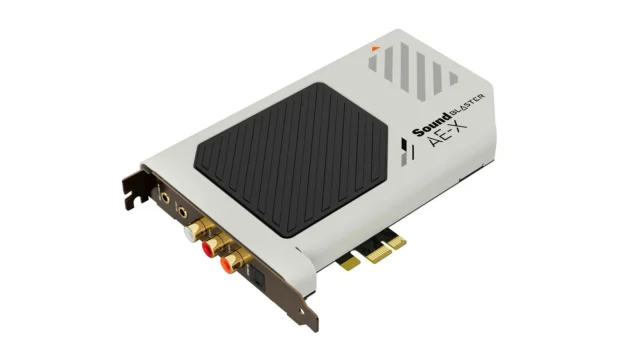
The AE-X is an internal PCI Express sound card. It uses a PCIe x1 interface and is listed as a PCIe 3.0 x1 device, although PCIe compatibility normally allows x1 cards to operate in larger physical slots as well. In practical desktop-building terms, that means the card can usually be installed in a short PCIe slot, or in a longer x4, x8 or x16 slot if the motherboard layout leaves no small slot free.
This matters because modern PC layouts are not always friendly to add-in cards. Large graphics cards can cover adjacent slots, compact micro-ATX boards may offer limited expansion space, and airflow considerations can make slot placement important. The AE-X is therefore most attractive to users with a conventional desktop tower and at least one accessible PCIe slot.
The card’s black-and-white visual design also suggests that Creative expects it to be used in windowed gaming systems. That is not the most important part of an audio product, but it reflects where this device sits in the market. It is not a plain industrial interface hidden behind a workstation. It is a consumer enthusiast component, meant to fit visually into a modern PC build.
The ESS ES9039Q2M DAC is the technical core
At the center of the AE-X is the ESS ES9039Q2M, a two-channel DAC from ESS Technology’s SABRE family. This is one of the key reasons the AE-X is being discussed as more than a simple gaming accessory. ESS DACs are widely used in hi-fi, portable DACs, desktop audio devices and premium PC audio products because they are associated with low noise, high dynamic range and technically clean conversion.
The AE-X is specified for up to 32-bit / 384 kHz playback and a 130 dB signal-to-noise ratio. In real-world listening, those figures should not be interpreted as a guarantee that every user will hear a dramatic transformation. The source material, headphones, speakers, amplifier stage, electrical noise environment and software settings all matter. However, they do indicate that Creative is using a DAC platform well beyond the minimum required for ordinary PC audio.
For high-resolution music playback, the 384 kHz ceiling gives the AE-X compatibility with almost any PCM material a typical consumer is likely to encounter. Most music libraries are still 44.1 kHz or 48 kHz. Many “hi-res” releases are 88.2, 96, 176.4 or 192 kHz. Very few listeners genuinely need 384 kHz playback, but support for it signals that the DAC stage is not the limiting factor.
32-bit / 384 kHz: useful specification or marketing number?
The 32-bit / 384 kHz label deserves a careful explanation. It is a real technical capability, but it should not be misunderstood. A 32-bit playback path does not mean ordinary music suddenly contains 32 bits of meaningful audio information. Most commercial music is distributed in 16-bit or 24-bit form. A 32-bit internal path can still be useful in digital processing, volume control and software mixing because it provides more headroom and reduces rounding errors during calculations, but it does not magically increase the resolution of the original recording.
The same logic applies to 384 kHz sampling. Higher sampling rates can be useful in production workflows, measurement contexts and certain processing chains. For everyday music listening, 44.1 kHz, 48 kHz, 96 kHz and 192 kHz already cover the overwhelming majority of practical needs. The AE-X’s 384 kHz capability is therefore best understood as a compatibility and engineering headroom feature rather than a reason by itself to buy the card.
That said, a high-resolution playback path can still matter to the right user. If someone already owns high-quality headphones, keeps a lossless music library, uses exclusive playback modes, experiments with DSD, or wants to avoid the sometimes mediocre analog output stage of a motherboard, the AE-X becomes much more relevant.
Direct DSD256 decoding for high-resolution audio collectors
The AE-X also supports direct DSD256 decoding. DSD, or Direct Stream Digital, is a different audio encoding approach from PCM. Instead of using the familiar bit-depth and sampling-rate structure of PCM files, DSD uses a high-frequency one-bit stream. DSD256 is a high-rate DSD format commonly associated with specialist hi-res music libraries and audiophile playback systems.
For most gamers, DSD256 will not matter at all. Game audio is not distributed as DSD. Streaming services generally do not rely on it either. But for audiophiles who maintain local high-resolution collections, native or direct DSD handling can be a meaningful feature. It reduces the need to convert everything into PCM before playback, depending on the playback software and driver configuration.
This is one of the areas where the AE-X clearly tries to bridge two worlds. Gaming audio cards typically emphasize surround virtualization, EQ presets and microphone features. Audiophile DACs emphasize conversion quality, bit-perfect playback and format support. The AE-X does not fully become a standalone hi-fi DAC, but it borrows enough from that category to be interesting to headphone-focused desktop users.
ASIO 2.3 support and low-latency work
Another important part of the specification is ASIO 2.3 support. ASIO, short for Audio Stream Input/Output, is a low-latency driver model widely associated with music production and real-time audio work on Windows. Its purpose is to reduce the delay between input, processing and monitoring compared with more generic audio paths.
For a gamer, ASIO may not be a decisive feature. For someone recording guitar, monitoring a microphone, working with virtual instruments or editing audio in a DAW, it can matter a lot. Latency is not only about comfort. If monitoring delay becomes too high, performance and timing suffer. Even a few extra milliseconds can feel unnatural when recording vocals or instruments.
The AE-X is not a substitute for a dedicated multi-input studio interface if the user needs balanced XLR inputs, phantom power, instrument inputs, MIDI, monitor control or multiple outputs. But for a desktop user who occasionally records, edits audio, monitors playback or wants more predictable low-latency behavior than ordinary motherboard audio, ASIO support gives the card a more serious role.
Headphone amplification up to 600 ohms
One of the most practical advantages of the AE-X is its headphone amplifier. Creative lists support for headphones from low impedance models up to 600 ohms. That immediately separates it from many integrated audio solutions, which may sound acceptable with easy-to-drive gaming headsets but struggle with demanding studio or hi-fi headphones.
High impedance alone does not automatically mean high quality, and low impedance does not automatically mean easy drive. Sensitivity also matters. Still, a 250-ohm or 600-ohm headphone typically needs more voltage swing than a standard laptop or motherboard output can comfortably provide. Without enough amplifier power, the result can be low volume, weak dynamics, flattened bass or audible distortion when the user pushes the output hard.
The AE-X’s X-amp headphone amplification is therefore not just a bullet point. It is one of the clearest real-world reasons to consider the card. Users with models from Beyerdynamic, Sennheiser, AKG or other studio-oriented brands may benefit more than users with USB gaming headsets, because USB headsets bypass the sound card entirely.
Gaming audio: positional awareness, EQ and Scout Mode
Creative has always linked the Sound Blaster brand strongly with gaming. The AE-X continues that tradition with software processing, presets and Scout Mode. Scout Mode is designed to make certain in-game sounds easier to identify, especially directional cues such as footsteps, reloads or distant movement. The goal is not neutral audio reproduction. The goal is competitive awareness.
This distinction matters. Audiophile listening and competitive gaming often want different things. For music, a neutral tonal balance, natural dynamics and minimal processing are usually preferred. For competitive shooters, some players intentionally boost upper-mid and treble regions where footstep and movement cues are easier to detect. A sound profile that helps in a tactical FPS may sound thin or artificial with music.
The value of the AE-X is that it can serve both modes if configured properly. A user can keep a cleaner profile for music and a more aggressive profile for gaming. That flexibility is more useful than a single “best” sound setting. In practice, the quality of the software experience will matter almost as much as the hardware.
Creative Nexus and sound customization
The AE-X is also tied to Creative’s modern software environment, including customization options through the Creative Nexus app according to current product coverage. That software layer is where users can adjust output profiles, EQ, headphone processing and other sound enhancements.
This is both an advantage and a possible weakness. Creative’s software ecosystem is powerful, but many experienced PC users have mixed feelings about vendor audio suites. Some want detailed control. Others prefer a clean driver with minimal background services. The AE-X will appeal most to users who actually want to tune their audio rather than install the card and never open the control panel.
AutoEQ support is also notable because it moves the product closer to the modern headphone-correction trend. Headphones vary dramatically in frequency response. A good EQ profile can make a larger audible difference than changing from one competent DAC to another. If Creative’s implementation supports the user’s headphone model well, this could become one of the card’s most useful features.
Connections and desktop flexibility
The AE-X includes a useful mix of analog and digital connectivity. Current specifications list optical digital input, optical digital output, analog RCA outputs and 3.5 mm jack connections. That gives the card more flexibility than a simple headphone-only DAC.
The optical input and output are especially useful for users who still work with S/PDIF devices. Optical connections can help isolate electrical noise because they use light rather than a shared electrical path. That can be useful when connecting to external DACs, AV receivers, recorders or other digital audio equipment.
The RCA outputs make the card suitable for powered speakers, stereo amplifiers or desktop monitor systems with unbalanced analog inputs. RCA is not the same as balanced professional output, so it is not ideal for every studio environment. But for a home desktop, hi-fi amplifier or powered speaker setup, it is practical and familiar.
AE-X versus motherboard audio
The most obvious comparison is not with another sound card. It is with the audio already built into the motherboard. Many users will ask a simple question: is this worth buying if the PC already has sound?
The answer depends on the motherboard and the listening chain. A premium motherboard with a well-isolated audio section, decent op-amps and a good headphone output may already sound good enough for many users. A budget board with a basic codec, weak output stage and audible noise through sensitive headphones may be a very different story.
The AE-X can offer several advantages over integrated audio: a stronger headphone amplifier, better DAC specifications, optical I/O, dedicated software features, ASIO support and a more clearly defined audio path. But it cannot improve everything automatically. If the user listens through a cheap USB headset, Bluetooth headphones or monitor speakers connected over HDMI, the AE-X may do almost nothing for that setup.
The most logical buyer is someone who uses wired analog headphones or speakers and wants the PC itself to provide a better output stage.
AE-X versus USB DACs
The more difficult comparison is with USB DACs and DAC/headphone amplifier combinations. External USB audio devices have become extremely popular because they are easy to install, work with laptops and desktops, stay outside the electrically noisy PC case and often include a physical volume knob.
A good USB DAC/amp can be a very strong alternative to the AE-X. For pure music listening, many users may prefer an external unit from companies such as Topping, FiiO, SMSL, iFi, Schiit or JDS Labs. These products often focus entirely on clean conversion and amplification without gaming software layers.
The AE-X counters with internal installation, Sound Blaster gaming features, PCIe connectivity, optical input and output, and integration into a desktop PC without adding another box to the desk. It also avoids using another USB port and may be more convenient for users who want all audio routing handled inside the PC.
Neither approach is universally better. A USB DAC is often the cleaner choice for minimalism and hi-fi playback. The AE-X is more attractive for users who want one internal device that handles gaming, headphone driving, optical connectivity and PC software enhancement.
AE-X versus external studio interfaces
For creators, the AE-X should also be compared with entry-level studio interfaces. Products such as the Focusrite Scarlett series, Audient iD series, MOTU M-series or Universal Audio Volt line are designed for recording. They usually include microphone preamps, XLR inputs, instrument inputs, direct monitoring and balanced outputs.
The AE-X does not replace that category. If the user records vocals, podcasts, guitars or multiple instruments, a dedicated audio interface remains the better tool. Balanced connections, gain knobs, phantom power and physical monitoring controls are not luxuries in that environment. They are workflow essentials.
However, not every creator needs those features. A video editor, streamer using a USB microphone, music listener, gamer or occasional audio editor may care more about playback quality, headphone power and low-latency software support than about microphone preamps. For that user, the AE-X may be sufficient and more convenient.
Who should consider buying the Creative Sound Blaster AE-X?
The AE-X makes the most sense for a specific type of desktop PC owner. The ideal buyer uses wired headphones or analog speakers, wants better output than integrated audio, values gaming sound features, and may also listen to high-resolution music. This user probably has a full-size desktop PC rather than a laptop, has an available PCIe slot, and does not want another external box on the desk.
It is also a good fit for someone with high-impedance headphones who currently finds motherboard audio weak or unsatisfying. A 250-ohm or 600-ohm headphone connected to a poor onboard output can feel underpowered. A dedicated headphone amplifier stage can be a real improvement.
The AE-X is less convincing for users who already own a high-quality USB DAC/amp, use wireless headphones, rely on HDMI audio, or mainly need professional recording inputs. It is also unnecessary for casual users who only use inexpensive speakers for YouTube, system sounds and occasional gaming.
The price position
At roughly €190 in early European listings, the Sound Blaster AE-X lands in an interesting price bracket. It is not a budget card, but it is also not positioned as an ultra-premium flagship. For comparison, that amount can buy a competent external DAC/amp, an entry-level studio interface, or a better gaming headset. The AE-X therefore has to win on feature combination rather than on one isolated specification.
Its value depends heavily on whether the buyer will use multiple parts of the feature set. If someone only wants a DAC for music, there are many alternatives. If someone only wants gaming surround features, cheaper options may be enough. If someone wants high-resolution playback, optical I/O, headphone power, PCIe installation, Creative software and ASIO support in one package, the AE-X becomes much easier to justify.
Why PCIe audio still has a niche
The launch of a new PCIe sound card is interesting because the market has moved strongly toward external devices. Yet PCIe still has some advantages. It provides a fixed internal installation, avoids desktop clutter and fits neatly into a traditional tower PC. For users who dislike cable mess, external power supplies or USB device conflicts, an internal card is still appealing.
There is also a psychological aspect. Many desktop PC enthusiasts still like the idea of purpose-built internal hardware. They use dedicated graphics cards, capture cards, network cards and sometimes storage controllers. For them, a dedicated sound card feels like a proper component rather than an accessory.
That does not mean PCIe audio will return to mass-market dominance. It probably will not. But niche products can still be good products. The AE-X does not need to sell to every PC user. It only needs to make sense for gamers, headphone users and desktop audio enthusiasts who want something more capable than onboard sound but more integrated than an external DAC stack.
Potential limitations
The AE-X also has limitations that should be considered before purchase. First, it is an internal desktop-only solution. It is not useful for laptops, mini PCs without PCIe expansion or systems where the graphics card blocks every practical slot.
Second, it does not replace a true professional interface for recording. ASIO support is useful, but microphone preamps, balanced outputs and physical gain controls are still important in production workflows.
Third, the quality of the user experience will depend on software. Audio hardware can be excellent, but drivers and control panels determine how easy it is to change sample rates, switch headphones, manage EQ profiles or avoid unwanted processing. Users who prefer driver-only minimalism may not want a feature-rich gaming audio suite.
Fourth, many users will not hear a dramatic benefit unless the rest of the audio chain is good enough. A high-end sound card feeding poor speakers will not create high-end sound. Headphones, speaker placement, room acoustics and source quality remain critical.
Practical setup advice
A buyer who installs the AE-X should take time to configure it properly. The first step is choosing the correct output mode for the actual hardware: headphones, RCA-connected speakers or optical output. The second step is setting an appropriate sample rate. Many users assume they should always select the highest possible value, but that is not necessarily ideal. For general Windows use, 24-bit / 48 kHz or 24-bit / 96 kHz is often more practical than forcing everything to 384 kHz.
For music playback, exclusive mode in a compatible player may help avoid unnecessary Windows resampling. For gaming, the user should test Creative’s processing options carefully rather than enabling every enhancement by default. Some games already have excellent binaural or spatial audio engines, and adding another processing layer can sometimes make positioning worse rather than better.
For high-impedance headphones, gain and volume should be adjusted conservatively. More amplifier capability is useful, but hearing safety still matters. A sound card that can drive 600-ohm headphones can also become dangerously loud with sensitive low-impedance models.
The broader significance of the Sound Blaster AE-X
The Sound Blaster AE-X is not just another PC accessory. It is a sign that Creative still sees life in the internal sound card market. That market is smaller than it once was, but it has not vanished. The PC remains a central entertainment and work platform for millions of users, and audio quality still matters when the listening hardware is good enough.
The AE-X also reflects a broader convergence in desktop audio. The old separation between gaming sound cards and audiophile DACs is less rigid than before. Gamers may own serious headphones. Music listeners may play competitive shooters. Streamers may edit audio. Video editors may also want strong headphone output. A modern PC audio product has to serve several overlapping roles.
That is the real idea behind the AE-X. It is not merely a gaming card with a flashy specification, and it is not a pure hi-fi DAC in PCIe form. It is a hybrid desktop audio component for people who want better conversion, more headphone power, gaming-oriented tuning and flexible PC connectivity in one internal card.
The Creative Sound Blaster AE-X looks like a serious, well-equipped PCIe sound card for a market that has become smaller but more specific. Its strongest technical points are the ESS ES9039Q2M DAC, 32-bit / 384 kHz playback support, 130 dB signal-to-noise ratio, DSD256 decoding, ASIO 2.3 support and headphone amplification for models up to 600 ohms. Its strongest practical argument is not any single number, but the way these features are combined into one desktop-focused product.
It is not the right upgrade for everyone. Users with wireless headsets, HDMI audio, basic speakers or existing external DACs may not need it. Creators who require proper microphone preamps and balanced studio connections should still look at dedicated audio interfaces. But for a desktop PC user with wired headphones, analog speakers, gaming needs and an interest in high-resolution audio, the AE-X is a credible alternative to both onboard sound and external DAC boxes.
The dedicated sound card is no longer a mandatory PC upgrade. The Creative Sound Blaster AE-X does not change that. What it does show is that internal PC audio can still be relevant when the product is aimed at the right audience: not everyone, but the users who know exactly why motherboard audio is no longer enough.
Image(s) used in this article are either AI-generated or sourced from royalty-free platforms like Pixabay or Pexels.
This article may contain affiliate links. If you purchase through these links, we may earn a commission at no extra cost to you.
Get the weekly RF & IT briefing
Radio guides, RF calculators, AI, Windows, Linux and satellite communication explainers. One useful email per week. No spam.