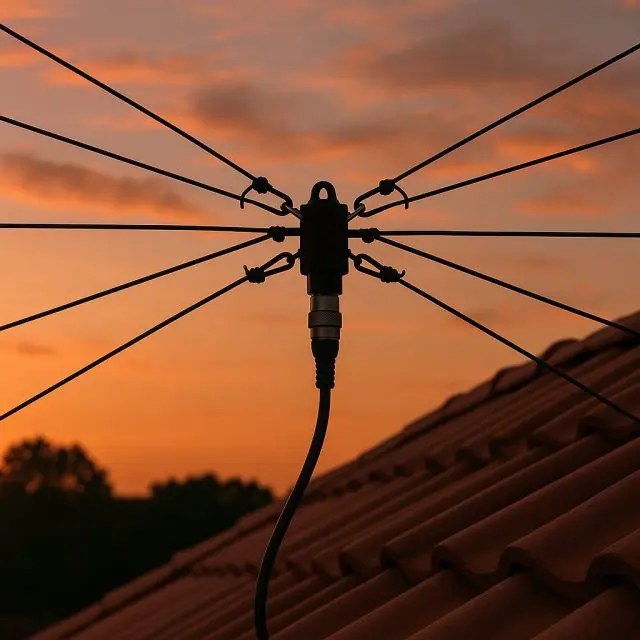
EFHW Antenna Design Calculator
This EFHW antenna calculator helps estimate the starting wire length for an end-fed half-wave antenna. It is designed for amateur radio operators who want a practical starting point before cutting, installing, trimming and tuning an HF wire antenna.
An end-fed half-wave antenna looks simple: one long wire, a matching transformer, coaxial cable and a support point. In real installations, however, small details matter. Wire insulation, height above ground, transformer ratio, feedline routing, counterpoise length, common-mode current and nearby objects can all shift the final resonant frequency.
That is why this calculator should be treated as a design starting point, not as a promise of a perfect final cut length. The correct workflow is:
- calculate the approximate EFHW wire length;
- add a small trim allowance;
- install the antenna in its real operating shape;
- measure the resonant point;
- shorten the wire gradually;
- verify performance on the fundamental and harmonic bands.
Use the calculator to plan EFHW antennas for 40 meters, 20 meters, 80 meters, portable POTA/SOTA operation, backyard HF stations and multiband harmonic use.
Advanced EFHW Antenna Design Calculator
Estimate the starting wire length for an end-fed half-wave antenna, add trimming allowance, review likely harmonic bands, and get practical matching and deployment notes for field tuning.
Design Inputs
Main Results
Likely Harmonic Operation
| Multiple | Approx. Resonant Frequency | Approx. Amateur Band | Comment |
|---|---|---|---|
| No calculation yet. | |||
Design Assumptions
- Waiting for calculation.
Field Tuning Notes
- Waiting for calculation.
What is an EFHW antenna?
An end-fed half-wave antenna, usually shortened to EFHW, is a resonant wire antenna fed at one end of a half-wave radiator. Instead of feeding the antenna in the center like a classic dipole, the feedpoint is placed at the end of the wire.
That simple change makes the EFHW very practical. The feedpoint can be located near the operating position, near a window, at the base of a mast, beside a tree, on a balcony, in a garden corner or close to a portable station setup. This is one reason EFHW antennas are so common among:
- POTA operators;
- SOTA operators;
- QRP field operators;
- emergency communication users;
- small-garden HF operators;
- portable holiday stations;
- experimenters who need a fast multiband wire antenna.
A true EFHW is not just any wire fed at one end. It is intentionally cut to be approximately a half wavelength on its lowest intended operating band. That half-wave condition creates a high impedance at the end of the wire, which is why a matching transformer is normally required.
EFHW vs random wire antenna
The terms “end-fed antenna”, “random wire” and “EFHW” are often used loosely, but they do not mean the same thing.
An EFHW antenna is designed around half-wave resonance. It usually uses a high-ratio transformer, commonly a 49:1 unun, to transform the high end impedance down toward a range that a 50-ohm radio system can use.
A random wire antenna follows a different design logic. It is often cut to avoid problematic resonant lengths and is normally used with a tuner and a different matching arrangement. A random wire also needs a return path, usually through a counterpoise, ground system or feedline arrangement.
So if you are searching for an EFHW antenna length calculator, you are not simply looking for a random end-fed wire formula. You are looking for a length estimate based on half-wave resonance and harmonic operation.
How the EFHW calculator estimates wire length
A common starting formula for a half-wave wire antenna is:
Length in feet = 468 / frequency in MHzFor metric users, the equivalent result can be converted to meters:
Length in meters = feet × 0.3048This formula gives a useful first estimate, but it is not the final answer in every real installation. A good EFHW calculator should also account for:
- target frequency;
- wire correction factor;
- insulated wire behavior;
- trim allowance;
- lowest intended band;
- harmonic band planning;
- counterpoise assumptions;
- real-world installation effects.
The formula gives you a starting point. The antenna analyzer gives you the truth. An antenna resonance simulator can also help visualize how changing wire length shifts the resonant frequency.
Typical EFHW starting lengths by band
The following table gives approximate bare-wire half-wave starting lengths using the classic 468/f formula. Real-world insulated wire may need to be slightly shorter, and every antenna should be trimmed after installation.
| Band | Example design frequency | Approx. starting length | Approx. metric length | Practical note |
|---|---|---|---|---|
| 80 m | 3.65 MHz | 128.2 ft | 39.1 m | Large but useful for lower HF |
| 60 m | 5.35 MHz | 87.5 ft | 26.7 m | Band availability varies by country |
| 40 m | 7.10 MHz | 65.9 ft | 20.1 m | Most popular multiband EFHW base |
| 30 m | 10.12 MHz | 46.2 ft | 14.1 m | Useful for CW/data-focused stations |
| 20 m | 14.20 MHz | 33.0 ft | 10.1 m | Compact and easy to deploy |
| 17 m | 18.10 MHz | 25.9 ft | 7.9 m | Good portable upper-HF option |
| 15 m | 21.20 MHz | 22.1 ft | 6.7 m | Often works as a harmonic band from 40 m designs |
| 12 m | 24.95 MHz | 18.8 ft | 5.7 m | Compact but more installation-sensitive |
| 10 m | 28.40 MHz | 16.5 ft | 5.0 m | Very easy to deploy physically |
These are starting values, not guaranteed final lengths. A 40 meter EFHW, for example, may end up slightly shorter after trimming, especially if insulated wire is used.
Why the lowest band should drive the EFHW design
An EFHW is usually designed from the lowest intended operating band. This matters because the wire length on that band determines the physical size of the antenna and its harmonic behavior on higher bands.
For example, a 40 meter EFHW is approximately half-wave on 40 meters. The same wire may also show usable behavior on harmonic bands such as:
- 20 meters;
- 15 meters;
- 10 meters.
This is one of the major reasons 40 meter EFHW antennas are so popular. A 40 m wire is long enough to provide useful lower-HF operation, but still manageable for portable deployment, garden installations and temporary field setups.
An 80 meter EFHW can also work well, but it is much longer, mechanically more demanding and more sensitive to sag, support height and nearby objects. For many operators, 40 meters is the practical compromise.
Why the 40 meter EFHW is so popular
The 40 meter EFHW antenna has become one of the standard portable and backyard HF designs because it offers a strong balance between size and band coverage.
A typical 40 meter EFHW is around 20 meters long before final trimming. That is still a long wire, but it is manageable with one good tree, a telescopic mast, a fibreglass pole, a sloper layout, an inverted-L layout or a garden-to-house installation.
Its main advantages are:
- practical wire length;
- good portable usability;
- possible harmonic operation on 20, 15 and 10 meters;
- simple deployment with one high support point;
- easy packing for POTA/SOTA;
- lower complexity than many multiband trap antennas.
Its main disadvantages are:
- high feedpoint impedance;
- need for a transformer;
- common-mode current risk;
- possible RF feedback;
- installation-sensitive harmonic behavior;
- high voltage near the wire end and transformer output.
A 40 meter EFHW is not magic, but it is one of the most practical HF antenna compromises available.
Why an EFHW needs a 49:1 or 64:1 unun
The end of a half-wave wire presents a high impedance. It is not a direct 50-ohm feedpoint. If you connect a half-wave wire directly to coax without a suitable matching network, the transceiver will usually see a poor match.
This is why EFHW antennas commonly use a 49:1 unun.
A 49:1 transformer is usually created with a 7:1 turns ratio, because impedance transformation follows the square of the turns ratio:
7 × 7 = 49So a 7:1 turns ratio gives approximately a 49:1 impedance transformation.
A 64:1 unun uses an 8:1 turns ratio:
8 × 8 = 64This can be useful in some installations where the feedpoint impedance is higher, but it is not automatically better.
49:1 vs 64:1 transformer
| Transformer ratio | Typical turns ratio | Common use | Main advantage | Main caution |
|---|---|---|---|---|
| 49:1 | 7:1 | Most common EFHW systems | Good general starting point | Not perfect for every installation |
| 64:1 | 8:1 | Higher impedance cases | May improve match in some systems | Can be worse if impedance is not high enough |
For most practical 40 meter EFHW builds, 49:1 is the usual starting point. If your antenna behaves better with 64:1, that does not necessarily mean 64:1 is universally superior. It means your installation, wire length, height, environment and return path produce a feedpoint impedance that happens to suit that ratio better.
The transformer is only one part of the antenna system.
Why it is usually called an unun, not a balun
Many radio operators casually call every matching device a “balun”, but an EFHW transformer is usually more accurately described as an unun.
A balun connects a balanced system to an unbalanced system. A unun connects an unbalanced system to another unbalanced system.
An EFHW fed with coax is an asymmetrical end-fed antenna connected to an unbalanced feedline. In most practical EFHW designs, the matching device is therefore an unun, not a classic balun.
This distinction is not just terminology. It reminds the builder that the EFHW is an unbalanced antenna system and that feedline current management matters.
Transformer core size, material and power handling
The matching transformer is one of the most critical parts of an EFHW antenna. A small transformer may work well at QRP power but become lossy, hot or unstable at higher power.
Transformer heating can be caused by:
- core material unsuitable for the frequency range;
- core too small for the power level;
- poor winding technique;
- excessive mismatch;
- high duty-cycle modes;
- common-mode current problems;
- poor ventilation;
- long digital transmissions.
Digital modes such as FT8, RTTY and other high-duty-cycle modes can stress an EFHW transformer more than casual SSB operation. A transformer that survives occasional voice peaks may still heat up during long continuous transmissions.
For portable QRP, a small toroid may be acceptable. For 100 W operation, many builders use larger cores such as FT240-size ferrites, depending on design, material and frequency coverage. For higher power, conservative transformer design becomes essential.
Why EFHW antennas need a return path
A common myth says that an EFHW antenna “does not need a counterpoise”. The more accurate statement is this:
An EFHW does not work without a return path. If you do not provide one, the system will usually find one.
That return path may be:
- the coax shield;
- the transceiver chassis;
- station wiring;
- power supply leads;
- USB cables;
- nearby metal objects;
- stray capacitance;
- the operator’s environment.
This is why two EFHW antennas with the same wire length and transformer can behave very differently in different locations. One installation may be quiet and stable. Another may produce RF feedback, unstable SWR and noisy reception.
A short counterpoise wire connected to the ground side of the transformer often makes the system more predictable.
EFHW counterpoise length
There is no single universal counterpoise length for every EFHW installation. A common practical starting point is:
13–20 feet
4–6 meters
This is not a perfect mathematical rule. It is a practical experimental range that often helps reduce uncontrolled feedline current.
The goal of the counterpoise is not to create a perfect ground system. The goal is to provide a more defined return path so the coax shield is less likely to become the main uncontrolled radiator.
A counterpoise can be especially useful when:
- SWR changes when the coax is moved;
- RF appears in the shack;
- the microphone becomes “hot”;
- a laptop disconnects during transmission;
- receive noise is higher than expected;
- the antenna behaves differently at each deployment;
- tuning changes when touching the coax.
Common-mode current in EFHW systems
Because an EFHW is an asymmetrical end-fed antenna, common-mode current is one of the most important practical issues.
Common-mode current means unwanted RF current is flowing on the outside of the coax shield. When this happens, the feedline becomes part of the antenna system.
Common-mode current can cause:
- RF in the shack;
- distorted transmitted audio;
- USB dropouts during FT8;
- unstable SWR;
- changing SWR when the coax is touched;
- high receive noise;
- interference to speakers, keyboards or computers;
- unpredictable radiation pattern;
- inconsistent performance between locations.
If your EFHW changes behavior when you move, shorten, coil or touch the coax, the feedline is probably participating in the antenna system.
In that case, a common-mode choke calculator can help you estimate a practical choke before you keep trimming the antenna wire.
Where to place a common-mode choke on an EFHW
There is no single perfect choke location for every EFHW, but several practical positions are commonly tested.
| Choke position | Why try it | Possible result |
|---|---|---|
| Directly at the transformer | Stops current immediately at feedpoint | May reduce feedline radiation, but can alter system behavior |
| 4–6 m from the transformer | Allows a short defined counterpoise section | Often useful for portable EFHW systems |
| Before the coax enters the shack | Reduces RF entering station equipment | Helpful for RF feedback problems |
| Both near feedpoint and shack | Stronger current control | Useful in difficult fixed installations |
Many EFHW users start with a choke around 15–20 feet from the transformer. This lets part of the coax or a separate counterpoise participate as a defined return path while reducing RF current farther down the feedline.
If you are unsure whether common-mode current is part of the problem, test with a temporary choke.
An ugly balun and coax choke designer can help you compare simple air-core choke dimensions before changing the EFHW wire or transformer.
An air-core “ugly balun” or a ferrite choke can quickly show whether feedline current is affecting the system.
Do not judge an EFHW only by SWR
A low SWR is useful, but it does not prove that the antenna is efficient.
A system can show acceptable SWR while still performing poorly because of:
- transformer loss;
- lossy nearby objects;
- excessive common-mode current;
- poor height;
- high feedline loss;
- bad coax;
- poor connectors;
- weak radiation angle;
- excessive ground or structure coupling.
This is especially important with long coax runs. Feedline loss can make the SWR at the radio look better than the actual situation at the antenna. The transceiver may see a comfortable match while less power is radiated than expected.
Use SWR as one diagnostic tool, not as the only performance measure. For a deeper explanation of reflected power and antenna matching, see this SWR and radio efficiency guide.
Better indicators include:
- repeatable resonance;
- stable tuning;
- transformer temperature;
- received noise level;
- on-air reports;
- comparison against another antenna;
- reverse beacon or PSK Reporter results;
- analyzer readings at the feedpoint;
- reduction of RF feedback.
EFHW installation styles
The same EFHW wire can behave differently depending on how it is installed. Height, angle, nearby objects and support geometry all affect resonance and radiation.
| Installation style | Advantages | Disadvantages | Typical use |
|---|---|---|---|
| Sloper | Simple, one high support point | Asymmetrical pattern, feedpoint environment matters | POTA, SOTA, backyard |
| Inverted-L | Fits smaller spaces, adds vertical component | Stronger coupling to nearby objects | Small gardens, temporary stations |
| Horizontal | More predictable if high enough | Needs two supports | Fixed stations |
| Inverted-V | Space-saving, easy with one mast | Ends may be low, pattern changes | Field operation |
| Low attic wire | Weather-protected, hidden | Lossy environment, building coupling | Compromise home stations |
| Balcony EFHW | Convenient feedpoint | Strong RF feedback risk | Apartments, temporary use |
Sloper EFHW
A sloper is one of the easiest EFHW deployments. One end is raised high with a tree, mast or pole, and the wire slopes down toward the transformer.
This is common for portable operation because it requires only one good high support. The sloper can work well, but its pattern and tuning may be affected by the feedpoint height, counterpoise, coax route and ground slope.
Inverted-L EFHW
An inverted-L EFHW uses a vertical section and a horizontal section. This is useful when there is not enough room for a full straight wire.
The vertical section can help lower-angle radiation, while the horizontal section allows the wire to fit into a limited garden or field area. However, inverted-L installations often interact strongly with nearby buildings, fences, gutters, masts and trees.
Horizontal EFHW
A horizontal EFHW can work well when it is high enough and reasonably clear of nearby conductive objects. It is often more predictable than a very low or sharply bent antenna.
The main limitation is support. A horizontal EFHW usually needs two suitable endpoints, and the wire length can be inconvenient on 40 or 80 meters.
Inverted-V EFHW
An inverted-V EFHW can be convenient in the field. A central high point supports the wire, while the ends slope downward.
The included angle and endpoint height matter. If the ends are very low, losses and detuning may increase. Keep the wire ends away from people, animals and accessible metal structures because high RF voltage may be present.
Portable EFHW antennas for POTA and SOTA
The EFHW is especially popular for POTA and SOTA because it is light, simple and fast to deploy.
A practical portable EFHW kit usually includes:
- pre-cut radiator wire;
- 49:1 unun;
- short counterpoise wire;
- lightweight coax;
- common-mode choke;
- throw line or telescopic mast;
- wire winder;
- small antenna analyzer or SWR meter.
For QRP operation, the EFHW is attractive because the whole antenna system can fit in a small bag.
For operators who prefer a ready-made starting point instead of winding their own transformer, compact EFHW antenna kits and 49:1 unun sets are also widely available. When comparing these kits, check the rated power, supported bands, wire length, connector type and whether a counterpoise is included. See EFHW antenna kit options on AliExpress
For portable station planning, a radio range calculator can help set realistic expectations about antenna height, terrain and practical communication distance. For 100 W field operation, transformer design, wire strength and RF safety need more attention.
A good portable setup should be repeatable. Marking wire lengths, using consistent coax, and carrying a known counterpoise can reduce tuning surprises in the field.
Fixed EFHW antennas for home stations
At home, an EFHW can be installed as a sloper, inverted-L, horizontal wire, attic wire, fence-line wire or garden-to-house wire.
For permanent or semi-permanent use, consider:
- weatherproof transformer housing;
- strain relief;
- UV-resistant wire;
- lightning protection strategy;
- mechanical support;
- drip loops;
- coax routing;
- choke placement;
- RF safety distance;
- transformer heating during long transmissions.
A home EFHW often needs more attention to noise and common-mode current than a portable field EFHW. Buildings, power supplies, solar inverters, Ethernet cables, LED lighting and household wiring can all affect receive noise and RF feedback.
How to cut and tune an EFHW antenna
A disciplined tuning process prevents many common EFHW problems.
1. Choose the lowest intended band
Start with the lowest band you want the antenna to cover. For example, choose 40 meters if you want a 40/20/15/10 m multiband EFHW.
2. Choose a target frequency
Pick a frequency near the part of the band you use most. A CW operator may choose a lower target frequency than an SSB operator.
For example:
| Band | CW/data-focused target | SSB-focused target |
|---|---|---|
| 80 m | 3.55 MHz | 3.75 MHz |
| 40 m | 7.05 MHz | 7.18 MHz |
| 20 m | 14.05 MHz | 14.20 MHz |
| 10 m | 28.10 MHz | 28.40 MHz |
3. Calculate the starting length
Use the calculator to estimate the half-wave wire length. If using insulated wire, apply a realistic correction factor.
Typical insulated wire correction starting points:
| Wire type | Approx. correction factor |
|---|---|
| Bare copper wire | 1.00 |
| Thin insulated hookup wire | 0.96–0.98 |
| PVC-insulated wire | 0.95–0.98 |
| Unknown insulated wire | Start long and measure |
4. Add trim allowance
Add roughly 2–3 percent extra length. It is easier to shorten a wire than to extend it.
5. Install the antenna in its real shape
Do not tune the wire while it is lying on the ground. Raise it into the final or near-final geometry before measuring.
6. Measure the resonant point
Use an antenna analyzer or SWR meter. Find the frequency where SWR is lowest on the fundamental band. When measuring the first resonance, a NanoVNA antenna measurement guide can help you calibrate the instrument correctly before you start trimming the EFHW wire.
7. Interpret the result
| Measurement result | Meaning | Action |
|---|---|---|
| Resonance below target | Wire is too long | Shorten gradually |
| Resonance above target | Wire is too short | Add wire or remake |
| No clear resonance | Transformer/feedline/system issue | Check connections and unun |
| SWR changes when coax moves | Feedline current issue | Add choke/counterpoise |
| Transformer warms quickly | Loss or overload | Reduce power or improve transformer |
8. Use fold-back trimming
Before cutting permanently, fold back the far end of the wire. Folding electrically shortens the antenna without making an irreversible cut.
Once the correct region is found, trim in small steps.
9. Check harmonic bands
After the fundamental band is correct, check higher bands. Do not tune only for 20 meters if the antenna is fundamentally a 40 meter EFHW. Start from the lowest design band.
Troubleshooting EFHW problems
| Problem | Likely cause | Practical solution |
|---|---|---|
| High SWR on all bands | Faulty transformer, poor solder joint, broken wire, bad coax | Check unun continuity, coax and radiator connection |
| Resonance too low | Wire too long | Fold back or trim gradually |
| Resonance too high | Wire too short | Add wire or remake radiator |
| 40 m good, 20 m poor | Harmonic behavior shifted by installation | Check wire length, transformer and feedline routing |
| RF in the shack | Common-mode current on coax | Add counterpoise and choke |
| SWR changes when touching coax | Feedline is part of antenna | Improve choking and define return path |
| Transformer gets hot | Core too small, wrong material, excessive power, high duty cycle | Use larger core or reduce power |
| Noise higher than expected | Coax shield current or poor routing | Add choke, reroute coax, test counterpoise |
| Tuner only works sometimes | System changes with feedline/environment | Stabilize coax route and counterpoise |
| FT8 causes USB dropouts | RF entering computer or audio interface | Add choke near shack and improve station grounding |
| Antenna changes after rain | Wet wire, trees, supports or transformer box | Weatherproof and remeasure |
| Works in one location but not another | Environmental coupling changed | Retune in final installation |
| Good SWR but poor reports | Lossy transformer, low height or feedline radiation | Compare with another antenna and check heating |
EFHW vs dipole
A dipole and an EFHW can both be effective HF wire antennas, but they solve different installation problems.
| Feature | EFHW | Dipole |
|---|---|---|
| Feedpoint | At one end | In the center |
| Matching | Usually needs 49:1 or 64:1 unun | Often close to 50–75 ohms depending on height |
| Feedline behavior | More sensitive to common-mode current | Usually more predictable |
| Installation convenience | Very high | Needs center feed support |
| Portable use | Excellent | Good, but may need more support |
| Multiband harmonic use | Common | Possible with design variations |
| Technical cleanliness | More system-dependent | Usually easier to model |
The EFHW wins when feedpoint convenience matters. The dipole wins when symmetry and predictability matter.
EFHW vs magnetic loop
EFHW antennas and magnetic loops are both popular for limited-space HF operation, but they are very different.
An EFHW uses a relatively long wire. It benefits from available space, height and a clear installation path. It can be efficient and multiband-friendly when installed well.
A magnetic loop is physically compact and narrowband. It can work where a long wire is impossible, but it requires careful tuning and can develop very high voltage across the tuning capacitor.
| Feature | EFHW | Magnetic loop |
|---|---|---|
| Physical size | Long wire | Compact loop |
| Bandwidth | Moderate | Narrow |
| Tuning | Usually less frequent | Often frequent |
| Voltage concern | High at wire end/transformer | Very high at capacitor |
| Best use | Space available for wire | Severe space limits |
| Multiband use | Good with harmonics | Possible but tuning-intensive |
If you have enough space for wire, the EFHW is often simpler. If you do not, a magnetic loop may be worth evaluating.
A magnetic loop antenna calculator can help estimate loop size, tuning capacitance, efficiency and capacitor voltage before you choose a compact loop instead of a wire antenna.
EFHW vs short vertical antenna
A shortened vertical antenna can be convenient where horizontal space is limited. It may be useful for balconies, small gardens, vehicles and temporary setups.
Compared with an EFHW, a short vertical usually needs:
- a loading coil;
- a better radial or counterpoise system;
- more careful grounding;
- higher loss management;
- more tuning attention.
A vertical may give lower-angle radiation when installed well, but a poor radial system can make it inefficient. An EFHW is often easier for casual portable operation, while a vertical can be excellent when the ground/radial system is well designed.
Real radiated power and feedline loss
Transmitter output power is not the same as radiated power.
Loss can occur in:
- coaxial cable;
- connectors;
- matching transformer;
- common-mode current paths;
- nearby lossy objects;
- poor installation height;
- inefficient return paths.
Two stations running 100 W can produce very different real signals if one has a better antenna system.
A coaxial cable loss calculator can help show how much power may be lost before the signal even reaches the antenna system.
For a realistic station view, consider:
Transmitter power
minus coax loss
minus transformer loss
minus mismatch loss
plus or minus antenna gain/loss
equals practical radiated result
This is why RF calculators are useful companion tools for EFHW planning. Coax loss, EIRP/ERP, antenna height and range estimates all help show the difference between transmitter power and useful signal.
An EIRP and ERP calculator can also help estimate how transmitter power, feedline loss and antenna gain combine into effective radiated power.
Safety considerations for EFHW antennas
An EFHW can develop high RF voltage near the end of the wire and at the transformer output. This is especially important at higher power.
Follow these precautions:
- keep wire ends away from people and animals;
- do not route the wire across accessible walkways;
- keep the transformer away from touchable metalwork;
- avoid placing high-voltage points near balconies or gutters;
- use strain relief;
- weatherproof outdoor transformers;
- reduce power during testing;
- check transformer heating;
- avoid transmitting into an unknown mismatch;
- consider lightning protection for permanent outdoor installations.
Do not allow the transformer terminals to carry mechanical tension from the wire. Use a proper strain relief point.
Practical examples
Example 1: 40 meter portable EFHW
Target: 7.10 MHz
Approximate starting length:
468 / 7.10 = 65.9 ft
65.9 ft = 20.1 m
Add 2–3 percent trim allowance:
20.1 m × 1.03 = 20.7 mA practical builder may cut around 20.7 m, deploy the wire as a sloper, measure resonance and trim slowly.
Likely useful bands:
- 40 m;
- 20 m;
- 15 m;
- 10 m.
Example 2: 20 meter compact EFHW
Target: 14.20 MHz
468 / 14.20 = 33.0 ft
33.0 ft = 10.1 m
This is easy to carry and deploy, but it does not provide the same lower-band capability as a 40 m EFHW.
Example 3: 80 meter fixed EFHW
Target: 3.65 MHz
468 / 3.65 = 128.2 ft
128.2 ft = 39.1 m
With trim allowance, the starting wire may be around 40 m. This is a serious physical installation and needs strong supports, careful routing and proper transformer design.
Frequently asked questions
How long is a 40 meter EFHW antenna?
A typical 40 meter EFHW starts around 65–67 feet, or about 20 meters, depending on target frequency and wire type. Insulated wire may require a slightly shorter final length. Always cut a little long and trim after measuring the antenna in its real installation.
Does an EFHW need a counterpoise?
An EFHW needs a return path. If you do not provide a counterpoise, the antenna system may use the coax shield, radio chassis, station wiring or nearby objects. A short counterpoise of around 4–6 meters is often a useful starting point.
Is a 49:1 transformer always required?
A normal EFHW usually needs a high-ratio matching transformer because the end of a half-wave wire has high impedance. A 49:1 unun is the most common starting point. Some systems may work better with 64:1, depending on the installation.
Can I use an EFHW without a tuner?
Sometimes yes, especially if the antenna is well cut and the transformer is suitable. However, harmonic bands may still need a tuner depending on wire length, height, environment and transformer design.
Why is my EFHW noisy?
High noise can come from common-mode current on the coax shield, poor feedline routing, nearby electronics, solar inverters, LED lighting, switching power supplies or building wiring. Adding a choke and improving the return path can help diagnose the problem.
Why does my EFHW have good SWR but poor performance?
Low SWR does not guarantee good radiation. Lossy transformers, poor height, feedline radiation, excessive common-mode current, bad coax or lossy nearby objects can all reduce performance even when SWR looks acceptable.
Is an EFHW better than a dipole?
Not universally. An EFHW is often easier to install because the feedpoint is at the end. A dipole is usually more symmetrical and predictable. The better antenna depends on available supports, space, band goals and installation environment.
Is an EFHW the same as a random wire?
No. An EFHW is intentionally cut as a half-wave radiator on a target band and usually uses a 49:1 or 64:1 unun. A random wire uses a different design approach and usually depends more heavily on a tuner and counterpoise.
Can I use an EFHW indoors or in an attic?
Yes, but performance may be reduced. Buildings contain wiring, metal, insulation foil, gutters, pipes and electronics that can detune the antenna and increase loss or noise. An attic EFHW can work, but it should be treated as a compromise antenna.
Why does my EFHW change SWR when I move the coax?
That is a strong sign that the coax shield is part of the antenna system. Add or adjust a counterpoise, test a common-mode choke and keep the feedline route consistent.
An end-fed half-wave antenna is popular because it is practical. It can be portable, multiband, lightweight and easy to deploy. But it is not just a magic length of wire.
A good EFHW system includes:
- the radiator;
- the 49:1 or 64:1 unun;
- the coax;
- the counterpoise or return path;
- the common-mode choke;
- the installation geometry;
- the height above ground;
- the local RF environment.
The purpose of an EFHW antenna calculator is to give you a strong starting point. The final antenna still has to be installed, measured and trimmed in the real world.
The best results come from a disciplined workflow:
calculate → cut long → install realistically → measure → fold back → trim → choke → test → compareIf you treat the EFHW as a complete RF system rather than just a wire, it becomes one of the most useful and flexible HF antenna designs for amateur radio.
Image(s) used in this article are either AI-generated or sourced from royalty-free platforms like Pixabay or Pexels.
This article may contain affiliate links. If you purchase through these links, we may earn a commission at no extra cost to you.
Get the weekly RF & IT briefing
Radio guides, RF calculators, AI, Windows, Linux and satellite communication explainers. One useful email per week. No spam.