Radio antennas are usually engineered devices: dipoles, verticals, Yagi arrays, log-periodic antennas or large parabolic dishes. These designs are optimized for efficiency, impedance matching and radiation pattern control.
However, the physics behind radio transmission is far more permissive than most people realize. Any conductive object with dimensions comparable to a fraction of a wavelength can interact with electromagnetic fields. Under certain conditions it can even radiate or receive radio signals.
Because of this, radio amateurs, researchers and engineers have experimented with a wide variety of unconventional antennas. Some were serious experiments, others were demonstrations of electromagnetic theory, and a few were simply curiosity-driven tests.
The following examples illustrate some of the strangest antennas ever attempted.
Sausage antenna
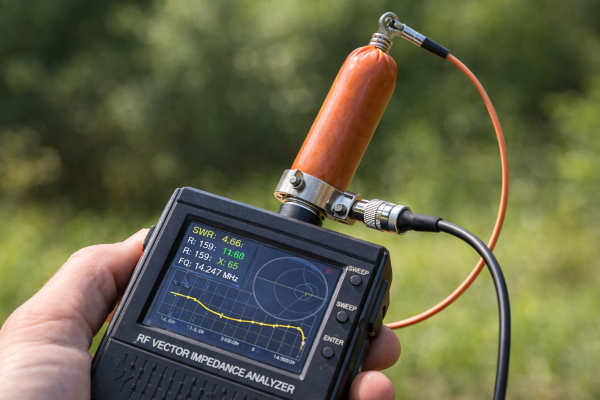
One of the most famous novelty experiments involved a simple sausage used as an antenna.
Sausages contain salt and moisture, which gives them weak electrolytic conductivity. While this conductivity is extremely poor compared to metal, it is not zero. When connected to a low-power transmitter, the sausage can act as a very inefficient radiator.
In demonstrations, radio signals were successfully transmitted over short distances using such an antenna. The radiation resistance was extremely low while the loss resistance was high, which resulted in terrible efficiency. Nevertheless, the experiment proved that almost any conductive medium can radiate RF energy.
Umbrella antenna
The umbrella antenna is one of the more practical unconventional designs.
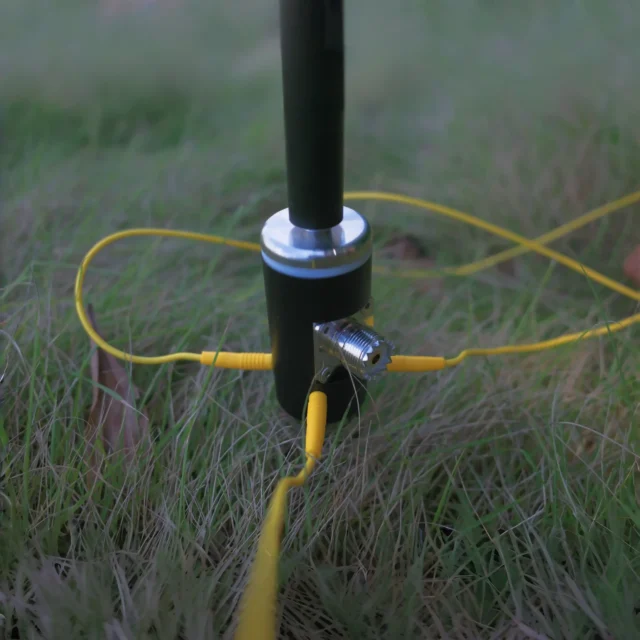
When opened, an umbrella creates a radial structure consisting of multiple metallic ribs extending from a central hub. This geometry resembles the ground radial system used in vertical antennas.
Some portable antenna experiments use the umbrella frame as a radial system with a short vertical radiator attached to the top. The result is a rapidly deployable field antenna that can be assembled within seconds.
Shopping cart antenna
A metal shopping cart forms a complex conductive grid structure.
In one amateur radio experiment, a shopping cart was connected directly to a transmitter and used as a radiating element. The cart’s metal mesh created multiple resonances at various frequencies.
While the impedance was unpredictable and the radiation pattern highly irregular, the system was still capable of transmitting detectable RF signals.
Bed frame antenna
Metal bed frames consist of several long steel tubes connected together.
Some radio amateurs have experimented with bed frames as indoor random-wire antennas. Because the structure contains multiple conductive segments, it can exhibit several resonance points across the HF bands.
Although inefficient compared to purpose-built antennas, a bed frame can still function as a receiving antenna.
Fence antenna
Metal fences are actually one of the most common improvised antennas.
A long fence can easily reach tens or even hundreds of meters in length. When connected at one end through a proper matching network, it can behave as a long-wire antenna.
In rural environments this method has occasionally been used by amateurs who cannot install visible antennas.
Gutter antenna
House gutters often form long continuous metal conductors running along the roofline.
If properly connected and matched, a gutter system can function as an inverted-L antenna. The horizontal section runs along the roof while the downspout acts as the vertical section.
This hidden antenna technique has been used by many operators living in antenna-restricted areas.
Kite antenna
The kite antenna dates back to the early days of wireless communication.
A long wire attached to a kite can lift an antenna hundreds of meters into the air. This significantly improves signal propagation, especially on low-frequency bands.
Early naval radio stations sometimes used kite-supported antennas before tall towers became common.
Balloon antenna
Balloon-supported antennas operate on the same principle as kite antennas.
A wire attached to a balloon can be raised to considerable height, forming a very efficient vertical radiator. Research groups and military communication systems have occasionally used this technique for temporary deployments.
Parachute antenna
Some military emergency communication systems deploy antennas using parachutes.
In these systems a wire antenna is released along with a parachute, allowing it to descend slowly while remaining suspended in the air. During the descent the wire forms a temporary vertical antenna.
This method can establish communication quickly without requiring ground structures.
Power line antenna
High-voltage power lines extend for hundreds of kilometers and can unintentionally behave as large antennas.
These lines can radiate or receive electromagnetic energy, which is why they often generate radio noise known as power-line interference.
Engineers working on electromagnetic compatibility frequently study this phenomenon.
Railroad track antenna
Railroad tracks are long steel conductors that run continuously across large distances.
Although not designed as antennas, they can conduct and radiate RF energy under certain conditions. In some experiments the rails behaved as extremely long wire antennas.
This effect is also relevant for electromagnetic interference studies.
Helicopter rotor antenna
Helicopter rotor blades can sometimes interact with radio signals.
If the blades contain conductive materials, they can behave as rotating antenna elements. The rotation introduces dynamic polarization effects and can produce unusual electromagnetic scattering patterns.
This phenomenon is usually undesirable and must be considered during avionics design.
Human body antenna
The human body can also interact with radio frequency energy.
Because the body contains electrolytes and conductive tissues, it can act as a weak antenna. This is why handheld radios and mobile phones often change impedance characteristics when held in the hand.
Antenna engineers frequently model this interaction during device design.
Towed submarine antenna
Submarines operating underwater often rely on towed wire antennas.
A very long wire is deployed behind the submarine while it moves slowly through the water. These antennas operate at extremely low frequencies where radio waves can partially penetrate seawater.
Such systems allow submarines to receive communication signals while submerged.
Atmospheric plasma antenna
One of the most unusual antenna concepts is the plasma antenna.
Instead of metal conductors, ionized gas is used as the radiating element. When energized, the plasma column behaves as a conductive path capable of radiating electromagnetic energy.
Plasma antennas have been studied for military and research applications because they can potentially be switched on and off electronically and may produce lower radar signatures.
Why these antennas work
All of these strange antennas rely on the same fundamental principle: electromagnetic resonance.
An antenna interacts efficiently with radio waves when its physical dimensions correspond to a significant fraction of the wavelength. The most common resonant lengths are:
quarter wavelength
half wavelength
long-wire multiples
Even when a structure is not perfectly resonant, it can still radiate energy if RF current flows through it.
Efficiency depends on several factors:
electrical conductivity
radiation resistance
loss resistance
impedance matching
surrounding environment
Improvised antennas often suffer from high losses and unpredictable radiation patterns, but they still demonstrate the underlying physics of radio transmission.
Why engineers and amateurs experiment with unusual antennas
Unconventional antenna experiments are more than just curiosities. They help illustrate key concepts of antenna theory and electromagnetic propagation.
They also demonstrate that radio communication can sometimes be established with extremely limited resources.
For radio amateurs, experimentation has always been a core part of the hobby. Testing unusual antennas provides insight into how electromagnetic energy interacts with the real world.
In some cases, these strange experiments even lead to practical ideas for portable or hidden antenna systems.
Image(s) used in this article are either AI-generated or sourced from royalty-free platforms like Pixabay or Pexels.
This article may contain affiliate links. If you purchase through these links, we may earn a commission at no extra cost to you.
Get the weekly RF & IT briefing
Radio guides, RF calculators, AI, Windows, Linux and satellite communication explainers. One useful email per week. No spam.