
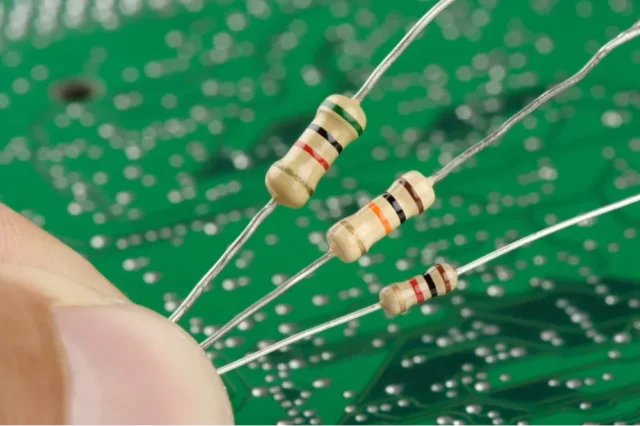
Identifying resistor values quickly and accurately is essential in electronics design, repair, prototyping, and education. This Resistor Color Code Converter allows you to instantly decode color bands into precise resistance values (Ω, kΩ, MΩ, GΩ) and convert numeric resistance values back into standard 4-band or 5-band color codes. Unlike static lookup charts, this bidirectional converter supports SI unit formatting, tolerance interpretation, and optional E12 / E24 preferred value validation. It is suitable for electronics students, hobbyists, technicians, and engineers who need fast, standards-aware resistor identification. Use it to decode unknown axial resistors, verify component selections during circuit design, or generate correct color band sequences for documentation and PCB assembly.
Advanced Resistor Color Code Calculator
Color → Value
Value:
Value → Color
Resistor color codes: the small painted bands that still matter in modern electronics
Resistor color codes look like one of the oldest rituals in electronics. A tiny cylindrical component, usually beige, blue, green, brown, or grey, carries a few painted rings around its body. To a beginner, those rings can look like decoration. To an experienced technician, they are a compact technical label: resistance value, multiplier, tolerance, and sometimes temperature coefficient, all compressed into a few millimeters of paint.
Even in an age of digital multimeters, online calculators, surface-mount components, and automated PCB assembly, the resistor color code is still worth understanding. It appears in repair work, hobby electronics, vintage radios, audio equipment, laboratory prototypes, educational kits, and through-hole components used in power circuits. When a resistor has no printed number, the color bands are often the only immediate clue to its value.
This article gives a complete, practical, magazine-style explanation of resistor color codes: how they work, how to read 4-band, 5-band and 6-band resistors, what tolerance means, why multipliers matter, how to avoid common reading mistakes, and how this old system still fits into modern electronics.
What resistor color codes actually do
A resistor is a passive electronic component that limits current, divides voltage, sets bias points, loads circuits, shapes filters, protects inputs, and stabilizes countless electronic designs. Its most important value is resistance, measured in ohms. Small values may be measured in fractions of an ohm, while high values may reach kilohms, megohms, or even gigohms.
The problem is simple: many resistors are too small to print clear text on them, especially older carbon film and metal film through-hole types. Instead of writing “4.7 kΩ ±5%” on the component body, manufacturers use colored bands.
The color code is not random. Each color represents a number. The first bands give the significant digits, another band gives the multiplier, and another band gives the tolerance. On some precision resistors, a sixth band indicates the temperature coefficient, usually expressed in parts per million per degree Celsius.
This means that the colors are not just a label. They are a compact numeric system.
A resistor marked yellow, violet, red, gold is not simply “a resistor with colored rings.” It is a 4.7 kΩ resistor with ±5% tolerance. A resistor marked brown, black, black, red, brown is a 10 kΩ precision resistor with ±1% tolerance. Once the code becomes familiar, these values can be read almost instantly.
Why the color code still matters today
At first glance, resistor color codes may seem outdated. Many modern components are surface-mount devices with printed numeric markings such as 103, 472, or 1001. Many repair technicians simply measure components with a multimeter. Many design tools generate bills of materials automatically. So why learn the color code at all?
Because real electronics work is not always clean, documented, or ideal.
In repair work, a burnt resistor may still have one or two readable bands. In vintage audio equipment, radios, test instruments, and power supplies, through-hole resistors are everywhere. In amateur radio projects, educational kits, amplifier circuits, Arduino modules, sensor boards, and experimental breadboards, color-banded resistors remain common. In old schematics, parts lists often assume that the builder understands resistor values and tolerances.
Knowing the color code also makes circuit work faster. When building a prototype, it is much easier to grab a 10 kΩ or 220 Ω resistor from a parts bin if you can recognize brown-black-orange or red-red-brown by sight. It reduces mistakes, speeds up troubleshooting, and gives you a better intuitive feel for circuit values.
A digital meter is useful, but it is not a substitute for understanding. A resistor color code is part of electronic literacy.
The basic resistor color table
The standard resistor color code assigns digits to colors from black to white. The same colors are used for significant digits and multipliers, although their meaning changes slightly depending on the band position.
| Color | Digit | Multiplier |
|---|---|---|
| Black | 0 | ×1 |
| Brown | 1 | ×10 |
| Red | 2 | ×100 |
| Orange | 3 | ×1,000 |
| Yellow | 4 | ×10,000 |
| Green | 5 | ×100,000 |
| Blue | 6 | ×1,000,000 |
| Violet | 7 | ×10,000,000 |
| Grey | 8 | ×100,000,000 |
| White | 9 | ×1,000,000,000 |
| Gold | — | ×0.1 |
| Silver | — | ×0.01 |
For tolerance bands, the most common values are different:
| Color | Tolerance |
|---|---|
| Brown | ±1% |
| Red | ±2% |
| Green | ±0.5% |
| Blue | ±0.25% |
| Violet | ±0.1% |
| Grey | ±0.05% |
| Gold | ±5% |
| Silver | ±10% |
| No band | ±20% |
In everyday hobby electronics, the most common tolerance bands are gold, brown, and sometimes red. Gold usually means a general-purpose ±5% resistor. Brown usually indicates a ±1% precision resistor. Red indicates ±2%.
How to read a 4-band resistor
The 4-band resistor is the classic format and probably the one most people imagine when they think of resistor color codes.
A 4-band resistor is read like this:
First band: first digit
Second band: second digit
Third band: multiplier
Fourth band: tolerance
For example:
Yellow – violet – red – gold
Yellow = 4
Violet = 7
Red multiplier = ×100
Gold tolerance = ±5%
So the value is:
47 × 100 = 4,700 Ω
That is 4.7 kΩ ±5%.
Another example:
Red – red – brown – gold
Red = 2
Red = 2
Brown multiplier = ×10
Gold tolerance = ±5%
22 × 10 = 220 Ω
So this is a 220 Ω ±5% resistor.
A third example:
Brown – black – orange – gold
Brown = 1
Black = 0
Orange multiplier = ×1,000
Gold tolerance = ±5%
10 × 1,000 = 10,000 Ω
That is 10 kΩ ±5%.
This structure is very efficient. Two significant digits are enough for most standard resistor series, especially older carbon film and general-purpose resistors.
How to read a 5-band resistor
A 5-band resistor gives more precision. It is common on 1% metal film resistors and other precision parts.
A 5-band resistor is read like this:
First band: first digit
Second band: second digit
Third band: third digit
Fourth band: multiplier
Fifth band: tolerance
For example:
Brown – black – black – red – brown
Brown = 1
Black = 0
Black = 0
Red multiplier = ×100
Brown tolerance = ±1%
100 × 100 = 10,000 Ω
So this is a 10 kΩ ±1% resistor.
Another example:
Red – violet – black – brown – brown
Red = 2
Violet = 7
Black = 0
Brown multiplier = ×10
Brown tolerance = ±1%
270 × 10 = 2,700 Ω
That is 2.7 kΩ ±1%.
A 5-band code can be confusing at first because a familiar value may look different from its 4-band version. For example, 4.7 kΩ in 4-band form may be yellow-violet-red-gold. But a 1% 4.7 kΩ resistor in 5-band form may be yellow-violet-black-brown-brown:
470 × 10 = 4,700 Ω
The extra digit does not necessarily mean the resistor has a strange value. It often just means the resistor is from a tighter tolerance series.
How to read a 6-band resistor
A 6-band resistor is similar to a 5-band resistor, but it adds one more band for temperature coefficient.
The structure is:
First band: first digit
Second band: second digit
Third band: third digit
Fourth band: multiplier
Fifth band: tolerance
Sixth band: temperature coefficient
The temperature coefficient tells you how much the resistance changes with temperature. It is usually expressed in ppm/°C, meaning parts per million per degree Celsius.
For example, a 100 ppm/°C resistor changes by 100 parts per million for every 1 °C change in temperature. That sounds tiny, and in many ordinary circuits it is tiny. But in precision measurement, voltage references, sensor conditioning, oscillators, analog filters, and laboratory equipment, temperature drift can matter.
Common temperature coefficient colors include:
| Color | Temperature coefficient |
|---|---|
| Brown | 100 ppm/°C |
| Red | 50 ppm/°C |
| Orange | 15 ppm/°C |
| Yellow | 25 ppm/°C |
| Blue | 10 ppm/°C |
| Violet | 5 ppm/°C |
Not every resistor uses every possible code, and manufacturers may vary in availability. In ordinary hobby work, the sixth band is less common. In precision electronics, it becomes more relevant.
Which side should you start reading from?
This is one of the most common beginner problems. A resistor can often be physically rotated, and the bands may appear symmetrical. Reading it from the wrong end gives the wrong value.
In most cases, there are several clues.
The tolerance band is often gold, silver, brown, red, green, blue, violet, or grey, and it is usually separated slightly from the other bands. On a 4-band resistor, the tolerance band is often spaced farther away from the first three bands. Gold and silver are especially useful because they are almost never used as significant digit colors. If one end has a gold or silver band, that is usually the tolerance end, so you read from the other side.
For example:
Gold – red – violet – yellow
If read from left to right, this makes no sense because gold is not a valid first digit. Turn it around:
Yellow – violet – red – gold
Now it reads correctly as 4.7 kΩ ±5%.
With 5-band and 6-band resistors, the problem can be more subtle because brown or red tolerance bands can also appear as digit colors. In that case, look for spacing. The tolerance and temperature coefficient bands are often slightly separated from the significant digit group. Also consider common resistor values. A reading that gives a standard value such as 10 kΩ, 4.7 kΩ, 1 kΩ, 220 Ω, or 100 Ω is more likely than a strange value outside the E-series.
However, this is not foolproof. Some small resistors have tight spacing. Some colors fade. Some manufacturers print bands close together. When in doubt, measure the resistor with a multimeter, ideally after lifting one leg from the circuit if other components may affect the reading.
Understanding the multiplier band
The multiplier band is where many reading mistakes happen. The digit bands create a base number, but the multiplier determines the scale.
Take these three examples:
Brown – black – red – gold = 10 × 100 = 1,000 Ω = 1 kΩ
Brown – black – orange – gold = 10 × 1,000 = 10,000 Ω = 10 kΩ
Brown – black – yellow – gold = 10 × 10,000 = 100,000 Ω = 100 kΩ
The first two bands are the same in all three examples: brown and black, which means 10. Only the multiplier changes. But that one band shifts the value by factors of ten.
This is why orange, yellow, green, and blue multipliers are so important in practical electronics. A brown-black-orange resistor is 10 kΩ, a very common pull-up or bias resistor. A brown-black-yellow resistor is 100 kΩ, often used in high-impedance dividers or signal circuits. A brown-black-red resistor is 1 kΩ, commonly used for LEDs, transistor bases, and general current limiting.
Gold and silver multipliers are used for values below 10 Ω. For example:
Red – red – gold – gold
Red = 2
Red = 2
Gold multiplier = ×0.1
Gold tolerance = ±5%
22 × 0.1 = 2.2 Ω
Another example:
Green – blue – silver – gold
Green = 5
Blue = 6
Silver multiplier = ×0.01
Gold tolerance = ±5%
56 × 0.01 = 0.56 Ω
Low-value resistors like these are used in current sensing, emitter resistors, power circuits, audio amplifiers, and protection circuits.
What tolerance really means
Tolerance tells you how close the actual resistance should be to the marked value. A resistor marked 1 kΩ ±5% does not have to measure exactly 1,000 Ω. It can be anywhere from 950 Ω to 1,050 Ω and still be within specification.
A 1 kΩ ±1% resistor should be between 990 Ω and 1,010 Ω.
This may seem like a minor detail, but tolerance has real consequences.
In an LED current-limiting resistor, ±5% is usually fine. In a simple pull-up resistor on a digital input, ±5% or even ±10% is often acceptable. In an audio tone control, a few percent may not matter much. But in a precision voltage divider, instrumentation amplifier, oscillator timing network, measurement circuit, RF attenuator, filter, or ADC front-end, resistor tolerance can strongly affect performance.
Tolerance is not the same as stability. A resistor may start within ±1%, but its value can drift with temperature, age, humidity, power dissipation, and stress. For precision work, you may need to consider tolerance, temperature coefficient, long-term stability, voltage coefficient, noise, and power rating.
Still, tolerance is the first practical indicator of accuracy. Gold means ordinary general-purpose precision. Brown means much better. Violet or grey tolerance bands indicate components intended for more demanding applications.
Common resistor values and the E-series
Resistor values are not arbitrary. Manufacturers typically follow standardized preferred number series such as E6, E12, E24, E48, E96, and E192. These series divide each decade into a set number of logarithmically spaced values.
For example, common E12 values include:
10, 12, 15, 18, 22, 27, 33, 39, 47, 56, 68, 82
These repeat by decade:
10 Ω, 100 Ω, 1 kΩ, 10 kΩ
22 Ω, 220 Ω, 2.2 kΩ, 22 kΩ
47 Ω, 470 Ω, 4.7 kΩ, 47 kΩ
68 Ω, 680 Ω, 6.8 kΩ, 68 kΩ
That is why values like 220 Ω, 4.7 kΩ, 10 kΩ, 47 kΩ, and 100 kΩ appear constantly in real circuits.
Precision resistors use denser series such as E96, which includes more values per decade. This is one reason 1% resistors often use 5 bands. Three significant digits are needed to represent values like 10.2 kΩ, 12.1 kΩ, 49.9 kΩ, or 100 kΩ accurately.
Understanding preferred values helps when reading ambiguous resistors. If a color looks like orange or red under poor light, the expected circuit function and the standard value series may help you decide which reading is more plausible.
Practical examples of 4-band resistor codes
A few common 4-band examples are worth memorizing because they appear everywhere.
Brown – black – brown – gold
10 × 10 = 100 Ω ±5%
Red – red – brown – gold
22 × 10 = 220 Ω ±5%
Orange – orange – brown – gold
33 × 10 = 330 Ω ±5%
Yellow – violet – brown – gold
47 × 10 = 470 Ω ±5%
Brown – black – red – gold
10 × 100 = 1 kΩ ±5%
Red – red – red – gold
22 × 100 = 2.2 kΩ ±5%
Yellow – violet – red – gold
47 × 100 = 4.7 kΩ ±5%
Brown – black – orange – gold
10 × 1,000 = 10 kΩ ±5%
Yellow – violet – orange – gold
47 × 1,000 = 47 kΩ ±5%
Brown – black – yellow – gold
10 × 10,000 = 100 kΩ ±5%
Orange – orange – yellow – gold
33 × 10,000 = 330 kΩ ±5%
Brown – black – green – gold
10 × 100,000 = 1 MΩ ±5%
These values are so common that recognizing them by sight becomes almost automatic after some practice.
Practical examples of 5-band resistor codes
With 5-band resistors, the pattern changes because three bands are used for significant digits.
Brown – black – black – brown – brown
100 × 10 = 1 kΩ ±1%
Brown – black – black – red – brown
100 × 100 = 10 kΩ ±1%
Brown – black – black – orange – brown
100 × 1,000 = 100 kΩ ±1%
Red – red – zero? Actually black as third digit – brown – brown
Red – red – black – brown – brown = 220 × 10 = 2.2 kΩ ±1%
Yellow – violet – black – brown – brown
470 × 10 = 4.7 kΩ ±1%
Yellow – violet – black – red – brown
470 × 100 = 47 kΩ ±1%
Orange – orange – black – brown – brown
330 × 10 = 3.3 kΩ ±1%
Blue – grey – black – brown – brown
680 × 10 = 6.8 kΩ ±1%
The key is to resist the habit of interpreting the third band as a multiplier. On a 5-band resistor, the third band is still a digit. The fourth band is the multiplier.
Why 10 kΩ can look different on different resistors
A 10 kΩ resistor may appear in several forms depending on tolerance and coding style.
As a 4-band ±5% resistor:
Brown – black – orange – gold
10 × 1,000 = 10,000 Ω
As a 5-band ±1% resistor:
Brown – black – black – red – brown
100 × 100 = 10,000 Ω
As a 6-band precision resistor:
Brown – black – black – red – brown – brown
100 × 100 = 10,000 Ω, ±1%, 100 ppm/°C
The value is the same, but the code layout is not. This is one of the reasons beginners sometimes misread precision resistors. They see brown-black-black-red-brown and try to interpret it as a 4-band code plus an extra band, which leads to confusion. The correct approach is to count the bands first, then apply the proper format.
Carbon composition, carbon film and metal film resistors
The color code appears on many resistor technologies, but the body color and band style may vary.
Carbon composition resistors are older components often found in vintage radios, amplifiers, and test gear. They can drift significantly over time, especially after exposure to heat and humidity. Their color bands may be faded, darkened, or discolored. In restoration work, measuring them is often necessary, because the color code may no longer reflect the actual resistance.
Carbon film resistors are common general-purpose parts. They usually have decent stability and are inexpensive. Many older kits and consumer devices use them.
Metal film resistors are common in modern through-hole circuits, especially where lower noise and better tolerance are desired. Many blue-bodied resistors are metal film types, often with 1% tolerance and 5-band color codes.
Wirewound resistors may use color bands, printed markings, or body labels depending on size and power rating. They are often used for low resistance, high power, and current-limiting applications.
The color code tells you the resistance value and related specifications, but not necessarily the entire resistor technology. For power rating, voltage rating, pulse capability, noise, inductance, and temperature behavior, you may need the datasheet or component type.
Power rating is not shown by the color code
A very important limitation: the standard color bands usually do not tell you the resistor’s power rating.
A 220 Ω resistor can be 0.125 W, 0.25 W, 0.5 W, 1 W, 2 W, or much larger. The color code may look similar, but the physical size is different. Larger resistors generally dissipate more power, but exact ratings depend on construction, material, ambient temperature, ventilation, and mounting.
Power rating matters because a resistor converts electrical energy into heat. The dissipated power is:
P = I²R
or
P = V² / R
If too much power is dissipated, the resistor overheats. It may drift, discolor, crack, smoke, go open-circuit, or damage nearby components. In power supplies, audio amplifiers, RF circuits, LED drivers, and motor controls, power rating is not optional.
For example, a 100 Ω resistor carrying 100 mA dissipates:
P = I²R = 0.1² × 100 = 1 W
A tiny 0.25 W resistor would be overloaded. A 2 W resistor might be more appropriate, depending on thermal conditions.
The color code gives the value. It does not guarantee the resistor is physically suitable for the job.
Resistor color codes in real troubleshooting
In practical troubleshooting, the color code is often used together with circuit context and measurement.
Suppose you open an old power supply and find a resistor connected in series with an LED indicator. The bands are red-red-brown-gold. That reads as 220 Ω ±5%. In a low-voltage LED circuit, that makes sense.
Now suppose you find brown-black-orange-gold connected from a microcontroller input to the positive supply. That reads as 10 kΩ ±5%. It is probably a pull-up resistor.
A yellow-violet-orange-gold resistor in an audio preamp may be 47 kΩ ±5%, possibly part of a bias network or input impedance path.
A low-value resistor such as brown-black-gold-gold, which reads as 1 Ω ±5%, may be a current sense resistor, emitter resistor, source resistor, or protection component.
Context matters. A value that seems odd in one part of a circuit may be perfectly normal somewhere else. A 1 MΩ resistor in a high-impedance input is common. A 1 MΩ resistor in series with a power LED would probably not make sense. A 0.22 Ω resistor in a power amplifier output stage may be normal. A 0.22 Ω resistor as a microcontroller pull-up would not be normal.
The color code gives the starting point. Circuit knowledge tells you whether the reading is plausible.
Reading damaged or burnt resistors
A burnt resistor is one of the harder cases. Heat can darken the body, destroy one or more bands, or change colors enough that red looks brown, orange looks brown, or yellow becomes almost invisible.
When a resistor is badly burnt, do not trust the color code blindly. The resistor may have failed because another component shorted downstream. Replacing it with the same value without finding the cause can lead to another burnt resistor.
A sensible repair process looks like this:
Identify as many bands as possible.
Compare with the schematic if available.
Look for identical channels or repeated circuit sections.
Measure surrounding components.
Check semiconductor junctions, capacitors, and loads.
Estimate whether the resistor is a current limiter, divider element, bleeder, snubber, or fuse resistor.
Use a suitable power rating and safety type when replacing it.
In stereo amplifiers, one channel can often be used as a reference for the other. In multi-output power supplies, similar resistor networks may repeat. In vintage equipment, service manuals may list component values even when the physical bands are unreadable.
Some resistors are designed to act as fusible resistors. Replacing a fusible resistor with an ordinary resistor may create a safety hazard. In mains-connected circuits, always consider flameproof rating, voltage rating, and safety classification.
Color perception and lighting problems
Reading resistor color bands is not always as simple as looking at a clean chart.
Brown, red, and orange can look similar under warm light. Blue and violet can be hard to distinguish on small components. Grey may look like faded blue or dirty white. Gold can look brown under poor lighting, especially on older parts. Silver can oxidize or appear grey.
The resistor body color also affects perception. A beige carbon film resistor and a blue metal film resistor make the same band color look slightly different. Dust, flux residue, heat discoloration, and age make the problem worse.
Good lighting helps. A white LED bench lamp or daylight-balanced light source makes color identification more reliable. Magnification helps as well. Many technicians keep a loupe, magnifying lamp, or phone camera nearby for small parts.
When a color is uncertain, use the expected value series and circuit context. If a resistor appears to be yellow-violet-orange but the orange could be red, the difference is large: 47 kΩ versus 4.7 kΩ. In that case, a multimeter measurement is the safer answer.
Measuring resistors in circuit
A multimeter can confirm a resistor value, but in-circuit measurement can be misleading. Other components connected in parallel can lower the measured resistance. Capacitors may charge during measurement. Semiconductor junctions may affect readings. Transformers, coils, and other paths may create unexpected results.
If the measured value is higher than the marked value, something is suspicious, because parallel paths normally reduce resistance, not increase it. The resistor may have drifted high or gone faulty. If the measured value is lower than the marked value, it may simply be because another path exists in the circuit.
For accurate measurement, lift one leg of the resistor from the circuit and measure it isolated. This is especially important in precision circuits, old equipment, and fault diagnosis.
However, for quick checks, in-circuit measurement is still useful. If a 10 kΩ resistor reads 10 kΩ in circuit, it is probably fine. If it reads open circuit, it is very likely faulty. If it reads 2 kΩ, the resistor may be in parallel with something else, or it may be the wrong part. More investigation is needed.
Color code versus SMD resistor markings
Through-hole resistors usually use color bands. Surface-mount resistors usually use printed codes, although very small SMD resistors may have no marking at all.
A common 3-digit SMD code works like this:
103 = 10 × 10³ = 10 kΩ
472 = 47 × 10² = 4.7 kΩ
221 = 22 × 10¹ = 220 Ω
100 = 10 × 10⁰ = 10 Ω
A 4-digit precision SMD code works similarly:
1001 = 100 × 10¹ = 1 kΩ
1002 = 100 × 10² = 10 kΩ
4701 = 470 × 10¹ = 4.7 kΩ
4992 = 499 × 10² = 49.9 kΩ
There is also an EIA-96 code for 1% SMD resistors, using a combination of two digits and a letter. That system is different from the color code and requires a lookup table.
The principle, however, is similar: significant figures plus multiplier. Learning resistor color codes helps you understand the logic behind other resistor marking systems too.
The role of resistor values in everyday circuits
Color codes become more meaningful when connected to real circuit functions.
A 220 Ω or 330 Ω resistor is often used for LED current limiting in 5 V circuits. A 1 kΩ resistor is common in signal lines, transistor base circuits, and general current limiting. A 4.7 kΩ or 10 kΩ resistor is widely used as a pull-up or pull-down resistor for digital inputs. A 47 kΩ or 100 kΩ resistor may appear in audio circuits, biasing networks, feedback paths, and voltage dividers. A 1 MΩ resistor is common in high-impedance inputs, discharge paths, and measurement circuits.
Once you know these patterns, the color bands start to become part of the circuit’s language. Brown-black-orange no longer feels like a code to decode slowly. It simply looks like “10 kΩ.” Red-red-brown becomes “220 Ω.” Yellow-violet-red becomes “4.7 kΩ.”
This recognition is useful when building breadboard circuits. It is also useful when checking whether a kit was assembled correctly. A misplaced 10 kΩ and 100 kΩ resistor may make a circuit fail while still looking visually similar to an inexperienced builder.
Resistor color codes and voltage dividers
One of the most common resistor applications is the voltage divider. Two resistors connected in series can produce a lower voltage at their junction. The output voltage is determined by the ratio of the two resistors.
For example, if R1 is 10 kΩ and R2 is 10 kΩ, the output is half the input voltage. If the input is 5 V, the output is 2.5 V.
If R1 is 10 kΩ and R2 is 20 kΩ, the output is two-thirds of the input voltage. If the input is 5 V, the output is about 3.33 V.
In voltage dividers, tolerance matters. If both resistors are ±5%, the output voltage can shift noticeably. In ADC measurement circuits, sensor interfaces, and reference dividers, precision resistors may be needed.
Color codes help identify whether a divider uses ordinary ±5% resistors or tighter ±1% parts. Gold tolerance bands suggest general use. Brown tolerance bands suggest more precision.
Resistor color codes in audio circuits
Audio equipment contains many resistors, and their values influence gain, impedance, filtering, mixing, and tone control behavior.
In a guitar pedal, a 1 MΩ input resistor may define the input impedance so passive pickups are not loaded too heavily. In an amplifier feedback network, resistor ratios set voltage gain. In tone stacks and filters, resistor values interact with capacitors to shape frequency response. In mixing circuits, resistors isolate signals and define summing behavior.
A color code error in an audio circuit can change the sound dramatically. Replacing a 47 kΩ resistor with 4.7 kΩ may reduce input impedance or alter gain. Replacing 100 kΩ with 10 kΩ may overload a previous stage. In vintage repairs, knowing color codes helps avoid mistakes when replacing drifted carbon composition resistors.
Noise can also matter in audio. Metal film resistors are often preferred over old carbon composition resistors in low-noise signal paths. The color code gives value and tolerance, but the resistor type and placement also influence performance.
Resistor color codes in radio and RF circuits
In radio-frequency circuits, resistor values can affect impedance matching, biasing, attenuation, stability, and termination. A 50 Ω dummy load, for example, must dissipate RF power and maintain a suitable impedance over frequency. Small carbon or metal film resistors may not be appropriate at high power or high frequency.
RF attenuators use precise resistor networks. The values are chosen carefully to maintain impedance while reducing signal level by a known number of decibels. In such circuits, tolerance and parasitic behavior matter. Lead length, resistor construction, and layout can become important.
In receiver front ends, mixers, oscillators, and IF stages, resistors set bias points and load impedances. A wrong resistor value can reduce gain, increase distortion, shift operating point, or cause instability.
For amateur radio builders, color code recognition remains useful. Many kits still include through-hole resistors, and assembly instructions often list values. Being able to quickly identify 100 Ω, 1 kΩ, 4.7 kΩ, 10 kΩ, and 100 kΩ parts reduces assembly errors.
Resistor color codes in power supplies
Power supplies often contain resistors used for bleeders, startup circuits, feedback dividers, current sensing, snubbers, and load balancing.
A bleeder resistor discharges capacitors after power is removed. These resistors can be high value, such as 100 kΩ or 470 kΩ, but they may need adequate voltage and power ratings.
Feedback divider resistors determine output voltage in regulated supplies. A small error in value can shift the output voltage. Precision resistors may be used where accuracy matters.
Current-sense resistors are often low-value components, such as 0.1 Ω, 0.22 Ω, 0.47 Ω, or 1 Ω. These may use gold or silver multiplier bands if they are color-coded, but many power sense resistors are marked with printed values instead.
Startup resistors in offline power supplies operate under high voltage and may fail open. They are not always ordinary resistors. Voltage rating and flameproof construction may matter. Reading the color code is only the first step; selecting a safe replacement requires more information.
Resistor values, prefixes and notation
Resistor values are often written using metric prefixes:
Ω = ohm
kΩ = kilo-ohm = 1,000 Ω
MΩ = mega-ohm = 1,000,000 Ω
So:
470 Ω = 470 ohms
4.7 kΩ = 4,700 ohms
47 kΩ = 47,000 ohms
470 kΩ = 470,000 ohms
4.7 MΩ = 4,700,000 ohms
In schematics, values may be written in several styles:
4.7 kΩ
4k7
4K7
470R
1M
0R22
The letter sometimes replaces the decimal point to avoid ambiguity. For example, 4k7 means 4.7 kΩ. 2R2 means 2.2 Ω. 0R47 means 0.47 Ω.
This notation connects naturally to color codes. Yellow-violet-red means 4.7 kΩ, which may appear on a schematic as 4k7. Red-red-gold means 2.2 Ω, which may appear as 2R2.
Mnemonics for resistor color codes
Many people memorize the digit order with a mnemonic. The sequence is:
Black, brown, red, orange, yellow, green, blue, violet, grey, white
Or numerically:
0 black
1 brown
2 red
3 orange
4 yellow
5 green
6 blue
7 violet
8 grey
9 white
Rather than relying on outdated or awkward phrases, it may be better to memorize the visual progression directly. Black is zero. Brown is one. Red, orange, and yellow rise through the warm colors. Green, blue, and violet continue upward. Grey and white finish the scale.
For many learners, repeated exposure works better than a sentence. Read ten or twenty real resistors, check them with a meter, and the code starts to become familiar. Common values become visual patterns rather than abstract data.
Common beginner mistakes
The first common mistake is reading from the wrong end. This is especially common when the tolerance band is brown instead of gold or silver.
The second mistake is using the 4-band method on a 5-band resistor. A 5-band resistor has three significant digits, not two.
The third mistake is confusing the multiplier with another digit. In a 4-band resistor, the third band is the multiplier. In a 5-band resistor, the fourth band is the multiplier.
The fourth mistake is misreading similar colors. Brown, red, and orange are frequent sources of error. Blue and violet can also be confusing.
The fifth mistake is ignoring tolerance. A 10 kΩ ±5% resistor and a 10 kΩ ±1% resistor may both work in many circuits, but not all. In precision networks, tolerance may be critical.
The sixth mistake is assuming the color code gives power rating. It does not. Physical size and datasheet information matter.
The seventh mistake is measuring a resistor in circuit and assuming the reading is the resistor alone. Parallel circuit paths can produce misleading measurements.
The eighth mistake is replacing a burnt resistor without finding the cause. Resistors often burn because something else failed.
Why some resistors have no tolerance band
Older resistors may sometimes appear to have only three bands. In the classic system, no tolerance band means ±20%. This was acceptable in many older consumer circuits where exact values were not critical.
A three-band resistor works like the first three bands of a 4-band resistor:
First digit
Second digit
Multiplier
No band = ±20%
For example:
Brown – black – orange
10 × 1,000 = 10 kΩ ±20%
Today, ±20% resistors are less common in new electronics because ±5% and ±1% resistors are inexpensive. But in vintage equipment, old stock, and certain non-critical circuits, you may still encounter them.
Why precision resistors often use blue bodies
Many hobbyists associate blue-bodied resistors with metal film precision resistors. This is often true, but body color is not a universal standard. A blue resistor is commonly metal film and often ±1%, but you should still read the bands or consult the component information.
Beige or tan resistors are often carbon film. Green, brown, grey, or blue bodies may indicate different manufacturers, series, coatings, or flameproof types. Body color can suggest something, but it should not replace proper identification.
The band code remains the primary marking for value and tolerance on through-hole parts.
Resistor color codes and component sorting
Anyone who has built kits or maintained a parts drawer knows that resistor sorting matters. A pile of loose resistors can quickly become chaotic. Color code knowledge makes sorting faster, but labeling storage compartments is still wise.
A practical storage system might separate common decades:
Below 10 Ω
10 Ω to 99 Ω
100 Ω to 999 Ω
1 kΩ to 9.9 kΩ
10 kΩ to 99 kΩ
100 kΩ to 999 kΩ
1 MΩ and above
For larger collections, sorting by E-series values makes sense. For example, all 10 kΩ resistors in one bin, all 4.7 kΩ resistors in another, all 220 Ω resistors in another.
Precision resistors should ideally be kept separate from general ±5% resistors. Power resistors should also be separated by wattage. Low-value current-sense resistors deserve special attention because they are easy to confuse with ordinary low-ohm resistors but may have different power and tolerance specifications.
How resistor color codes help in education
The resistor color code is a useful teaching tool because it connects numbers, physical components, and real circuit behavior. Students learn that components are not abstract symbols. A schematic value must correspond to an actual part, and that part must be identified correctly.
Reading color bands also reinforces place value and scientific notation. A multiplier is just a power of ten. A 47 with a red multiplier becomes 4,700. A 47 with an orange multiplier becomes 47,000. A 47 with a yellow multiplier becomes 470,000.
This helps beginners develop number sense in electronics. They begin to see that 470 Ω, 4.7 kΩ, 47 kΩ, and 470 kΩ are related by decades, but they behave very differently in a circuit.
Resistor color codes in kits and breadboard projects
Electronic kits often include resistors taped in strips with labels. But labels get lost, parts are removed from tape, and instructions sometimes assume the builder can identify values. Breadboard projects are even more prone to resistor mix-ups because parts are reused repeatedly.
A typical beginner kit may include:
220 Ω resistors for LEDs
330 Ω resistors for LEDs
1 kΩ resistors for general current limiting
4.7 kΩ resistors for pull-ups
10 kΩ resistors for pull-ups and dividers
100 kΩ resistors for biasing or timing circuits
1 MΩ resistors for high-impedance inputs
These values appear so frequently that learning their color codes pays off quickly. It reduces dependence on trial-and-error measurement and makes building circuits more fluent.
The relationship between resistance and current
The reason resistor values matter comes from Ohm’s law:
V = I × R
Voltage, current, and resistance are directly related. If the voltage is fixed and resistance increases, current decreases. If resistance decreases, current increases.
For example, with 5 V across a 1 kΩ resistor:
I = V / R = 5 / 1,000 = 0.005 A = 5 mA
With 5 V across a 220 Ω resistor:
I = 5 / 220 ≈ 22.7 mA
That difference can be the difference between a dim LED and an overloaded LED, or between a safe transistor base current and excessive drive. Reading the resistor correctly is not just a bookkeeping detail; it affects the electrical behavior of the circuit.
The relationship between resistance and heat
Every resistor dissipates power when current flows through it. The more current and resistance involved, the more heat may be produced. The formula P = I²R is especially useful because it shows how strongly current affects power. Double the current, and the power increases by four times.
This is why a resistor can have the correct color code but still be the wrong part. A 100 Ω resistor marked brown-black-brown may be electrically correct in resistance, but if the circuit dissipates 1 W and the resistor is rated only 0.25 W, it will overheat.
In visual inspection, overheated resistors may show darkened bodies, cracked coating, lifted PCB traces, browned circuit boards, or damaged nearby capacitors and wiring. If the color bands are still readable, they provide a value. But the repair must also address wattage and failure cause.
Resistor tolerance in digital circuits
Digital electronics often tolerate wide resistor variation. A pull-up resistor on a microcontroller input may work well whether it is 4.7 kΩ, 10 kΩ, or even 47 kΩ, depending on speed, leakage, noise, and power requirements. That is why general-purpose resistors are common in digital projects.
However, tolerance is not irrelevant. In high-speed digital buses, resistor values can affect rise time, impedance, termination, and signal integrity. In USB, Ethernet, RF digital interfaces, and fast logic lines, resistors may need specific values and tolerances. In analog-to-digital converter inputs, resistor dividers can directly affect measurement accuracy.
So the rule is not “digital circuits do not care.” The rule is that simple digital circuits often tolerate ordinary resistor values, while precision, high-speed, low-power, or mixed-signal circuits may not.
Resistor tolerance in analog circuits
Analog circuits are often more sensitive to resistor values. Gain stages, filters, oscillators, references, and measurement circuits may rely on resistor ratios.
For an op-amp non-inverting amplifier, gain is set by two resistors. If their values shift, the gain shifts. For an RC filter, resistance and capacitance determine cutoff frequency. If the resistor tolerance is wide, the filter frequency may vary. In sensor circuits, resistor accuracy can affect calibration.
This is where ±1%, ±0.5%, or better resistors become useful. In some cases, matched resistor networks are better than individual precision resistors because ratio tracking over temperature matters more than absolute value.
The color code gives the tolerance class, but high-end analog design may require deeper specifications.
Temperature coefficient in practice
Temperature coefficient is easy to ignore until it causes a problem. Suppose a resistor has a temperature coefficient of 100 ppm/°C. A 50 °C temperature change would produce:
100 ppm/°C × 50 °C = 5,000 ppm
That is 0.5%.
For a general LED resistor, that is irrelevant. For a precision measurement circuit, it may be significant. A 10 ppm/°C resistor over the same temperature range would shift by only 0.05%.
In outdoor equipment, automotive electronics, RF power devices, battery systems, and industrial sensors, temperature variation can be large. A circuit calibrated on the bench may behave differently in a hot enclosure or cold field environment.
A 6-band resistor gives a quick indication of temperature coefficient, but datasheets provide the full picture.
The difference between accuracy, precision and resolution
In casual electronics language, people often use accuracy and precision interchangeably. Resistors help explain the difference.
Tolerance is about how close the actual value is to the nominal value when manufactured. A 10 kΩ ±1% resistor should be close to 10 kΩ. A 10 kΩ ±5% resistor may be farther away.
Precision can also refer to repeatability, stability, and narrow variation. A resistor network with matched values may be very precise in ratio even if absolute values are not perfect.
Resolution is more relevant to measurement systems. If an ADC or meter cannot resolve small changes, using ultra-precision resistors may not improve the final result.
In practical design, the resistor color code tells you only part of the accuracy story. The circuit’s total error budget includes many components.
Vintage electronics and old resistor codes
Most modern resistors use the familiar color band system, but old equipment may include parts with unusual markings, body-end-dot codes, printed values, or manufacturer-specific styles. Very old carbon composition resistors sometimes used body color, end color, and dot color to indicate value.
In vintage restoration, do not assume every old resistor follows modern band placement. Service manuals, component layout diagrams, and historical references may be needed.
Old resistors also drift. Carbon composition resistors often drift upward in resistance with age. A resistor marked 100 kΩ may measure 130 kΩ or more decades later. Whether this matters depends on the circuit. In some vintage radios, drifted resistors can reduce gain, shift bias, increase distortion, or make alignment difficult.
Replacing old resistors with modern metal film parts can improve stability and noise, but in some restoration contexts, preserving appearance or original technology may matter.
Safety considerations when replacing resistors
Replacing a resistor is not always as simple as matching the color code.
In low-voltage hobby circuits, a resistor of the same value and equal or higher power rating is usually acceptable. In mains-connected equipment, high-voltage circuits, power supplies, amplifiers, and safety-critical devices, more care is needed.
Consider:
Resistance value
Tolerance
Power rating
Voltage rating
Flameproof or fusible type
Temperature coefficient
Physical size and mounting
Pulse or surge rating
Inductance
Circuit function
Safety approvals
A fusible resistor should be replaced with a fusible resistor. A flameproof resistor should be replaced with a flameproof type. A current-sense resistor should match value, tolerance, and power characteristics. A high-voltage divider resistor may require suitable voltage rating, not just wattage.
The color code tells you the nominal value. It does not tell you every safety-relevant parameter.
How to choose resistor tolerance for new projects
For basic Arduino, LED, relay, transistor, and breadboard projects, ±5% resistors are usually fine. For most modern hobby use, however, ±1% metal film resistors are cheap enough that many builders use them as standard.
For audio, sensor, op-amp, and measurement circuits, ±1% is often a sensible default. For precision dividers, references, calibration networks, and instrumentation, ±0.1% or matched resistor networks may be needed.
For RF attenuators, impedance networks, and filters, both tolerance and construction matter. Leaded resistors may have parasitic inductance and capacitance, especially at higher frequencies. SMD resistors can perform better in RF layouts, but power and voltage ratings must still be considered.
In short: choose tolerance based on the circuit’s sensitivity, not just habit.
Why the color code is efficient
The resistor color code survives because it is compact, durable, and readable without power. It does not require a barcode scanner, software, or database. It works on tiny cylindrical components and remains visible after years in equipment, at least when heat and dirt have not destroyed it.
It also has a useful human factor: repeated values become recognizable patterns. An experienced technician does not mentally calculate every resistor from scratch. Many values are recognized visually, just as words are recognized without spelling each letter.
That visual speed is valuable on a workbench. It helps when sorting parts, checking assemblies, repairing boards, and teaching electronics.
Quick reference for common values
Here are common 4-band resistor values used in many circuits:
100 Ω: brown – black – brown – gold
220 Ω: red – red – brown – gold
330 Ω: orange – orange – brown – gold
470 Ω: yellow – violet – brown – gold
1 kΩ: brown – black – red – gold
2.2 kΩ: red – red – red – gold
3.3 kΩ: orange – orange – red – gold
4.7 kΩ: yellow – violet – red – gold
10 kΩ: brown – black – orange – gold
22 kΩ: red – red – orange – gold
47 kΩ: yellow – violet – orange – gold
100 kΩ: brown – black – yellow – gold
220 kΩ: red – red – yellow – gold
470 kΩ: yellow – violet – yellow – gold
1 MΩ: brown – black – green – gold
For 5-band ±1% resistors:
100 Ω: brown – black – black – black – brown
1 kΩ: brown – black – black – brown – brown
10 kΩ: brown – black – black – red – brown
100 kΩ: brown – black – black – orange – brown
4.7 kΩ: yellow – violet – black – brown – brown
47 kΩ: yellow – violet – black – red – brown
2.2 kΩ: red – red – black – brown – brown
22 kΩ: red – red – black – red – brown
How to use a resistor color code converter intelligently
An online resistor color code converter is convenient, especially when working with unfamiliar 5-band or 6-band resistors. It reduces mental arithmetic and helps avoid mistakes. But the best use of a converter is not blind dependence.
A good workflow is:
Read the bands visually.
Enter the colors into the converter.
Check whether the value makes sense in the circuit.
Confirm with a multimeter if the part is old, damaged, or mission-critical.
Check power rating and resistor type before replacement.
The converter gives the electrical value. Your judgment determines whether that value is plausible and whether the physical component is suitable.
Why resistor color code knowledge improves circuit intuition
Learning the color code is not only about identifying components. It builds intuition for values and circuit behavior.
When you see red-red-brown, you think of LED current limiting and low-value series resistors. When you see brown-black-orange, you think of digital pull-ups, bias networks, and general-purpose 10 kΩ use. When you see brown-black-green, you think of high impedance and low current. When you see gold or silver multipliers, you think of low-ohm current sensing or power applications.
This value intuition is one of the differences between merely assembling circuits and understanding them. A wrong resistor is not just a wrong part. It changes current, voltage, timing, gain, impedance, heat, and sometimes safety.
The future of resistor color codes
Surface-mount technology dominates mass-produced electronics, and many tiny resistors no longer use color bands. Yet through-hole resistors are not disappearing from education, repair, prototyping, power electronics, kits, test fixtures, and specialist applications.
Color-banded resistors are easy to handle, easy to solder, and easy to inspect. They are still ideal for teaching and practical experimentation. In repair work, they remain common in older equipment and in modern devices where larger resistors are needed for power or voltage reasons.
So the resistor color code is not just an old standard preserved by nostalgia. It remains a practical skill. Like reading schematic symbols or using Ohm’s law, it is part of the basic language of electronics.
Image(s) used in this article are either AI-generated or sourced from royalty-free platforms like Pixabay or Pexels.
This article may contain affiliate links. If you purchase through these links, we may earn a commission at no extra cost to you.
Get the weekly RF & IT briefing
Radio guides, RF calculators, AI, Windows, Linux and satellite communication explainers. One useful email per week. No spam.

