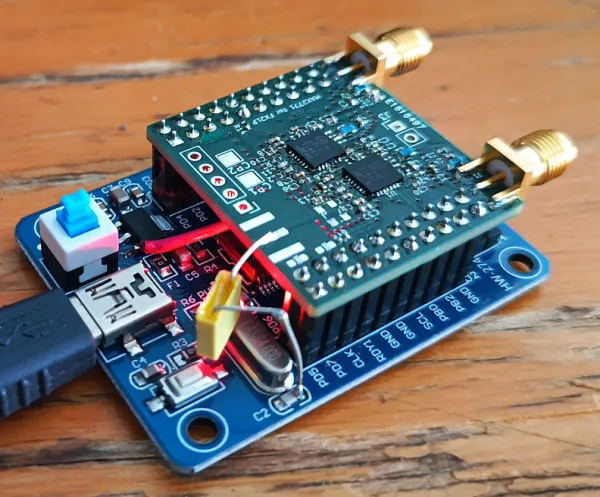
The small circuit that changed homebrew radio
Some radio circuits develop an almost mythical reputation. The Tayloe detector is one of them. Many newcomers see the name in SDR receiver designs, SoftRock articles, QRP transceiver schematics or I/Q mixer discussions and assume it must be something mathematically intimidating. In reality, the basic idea is surprisingly elegant.
The Tayloe detector is a clever way of converting a radio-frequency signal into two low-frequency signals that a computer, microcontroller, DSP chip or audio interface can process. It does this not by using a traditional diode detector or a classic analog mixer in the usual way, but by rapidly sampling the incoming RF signal in four phase positions.
That sounds abstract, but the practical result is simple: with a cheap high-speed switching IC, a local oscillator and a few carefully chosen passive components, it becomes possible to build a highly capable software-defined radio front end.
This is one of the reasons modern amateur radio receivers, QRP transceivers and experimental SDR projects became so accessible. The Tayloe detector helped move complexity away from coils, filters, mechanical alignment and multi-stage analog circuits, and toward digital signal processing.
That shift changed homebrew radio.
From analog complexity to software-defined radio
Older receivers often depended on many tuned circuits, mixers, IF stages, filters and alignment points. A good superheterodyne receiver is a beautiful piece of engineering, but it is not always beginner-friendly. It needs stable oscillators, careful filtering, gain distribution, shielding and alignment. A small mistake in one stage can affect everything that follows.
The rise of software-defined radio changed the design philosophy. Instead of building an entire receiver chain in analog hardware, the front end only needs to bring the signal down to a form that software can understand. Once the signal exists as an I/Q baseband stream, demodulation, filtering, bandwidth selection, notch filtering, AGC, phase correction and mode switching can happen digitally.
The Tayloe detector fits perfectly into this idea. It is not a complete radio by itself, but it is an excellent bridge between the RF world and the digital world.
For radio amateurs, the turning point came when simple SDR kits started to appear in the early 2000s. One of the most influential was the SoftRock family of kits by Tony Parks, KB9YIG. These small receivers and transceivers showed that an extremely modest RF front end could produce impressive results when combined with a PC sound card and suitable SDR software.
Instead of a traditional forest of inductors, ceramic filters and IF transformers, the SoftRock-style architecture used a quadrature sampling detector built around fast analog switches such as the FST3253. To many builders, it looked almost too simple to be true. Yet it worked.
The key was the Tayloe detector.
Who was Tayloe?
The circuit is often incorrectly called a “Taylor detector,” but the correct name is Tayloe detector. It is named after Daniel Richard Tayloe, N7VE, who filed a patent application for what became known as the Tayloe Product Detector in the late 1990s.
The basic concept belongs to the family of product detectors and quadrature sampling detectors. Its role is to multiply, sample or switch the incoming RF signal in relation to a local oscillator so that the wanted signal is translated down to baseband.
In practical amateur radio language, it is a very efficient RF-to-I/Q converter.
That phrase may sound dry, but it is the heart of the story. Once a receiver has clean I and Q signals, software can do the rest.
The simplest mental model: a very fast rotary switch
The easiest way to understand a Tayloe detector is to forget the intimidating terminology for a moment.
Imagine a very fast rotary switch. The antenna signal arrives at the input of this switch. The switch does not send the signal continuously to one output. Instead, it connects the incoming RF signal to four outputs one after another, in a repeating cycle.
Those four outputs represent four phase positions:
0 degrees
90 degrees
180 degrees
270 degrees
The switch is controlled by a local oscillator-derived clock. Each output receives a small time slice of the incoming RF waveform. Because the switching happens in a synchronized way, the circuit captures information about the signal’s phase and amplitude.
This is not random sampling. It is ordered, phase-aware sampling.
From these four sampling points, the circuit creates two final signals:
I, meaning in-phase
Q, meaning quadrature, shifted by 90 degrees
The receiver does not merely learn how strong the signal is. It also learns how the signal is moving in phase. That second part is what makes I/Q reception so powerful.

How four phases become two signals
At first, the four-output idea seems confusing. If the detector samples the RF signal at four phases, why does the receiver end up with only two outputs?
The reason is that the four samples form two opposite pairs.
The 0-degree and 180-degree samples belong to the same axis. They are opposite sides of the in-phase component. This becomes the I signal.
The 90-degree and 270-degree samples belong to the second axis. They are opposite sides of the quadrature component. This becomes the Q signal.
A useful analogy is a coordinate system. The I signal is like the horizontal axis. The Q signal is like the vertical axis. To define each axis properly, you need both a positive and a negative direction. That is why the four switching phases are useful: they create two complete axes rather than two vague sample points.
In a practical circuit, the opposite phase pairs are usually processed differentially. The circuit subtracts one side from the other, which gives a clearer and more useful baseband signal.
This is where the operational amplifiers and RC networks often seen around Tayloe detector schematics come in.
The role of capacitors and op-amps
A Tayloe detector is sometimes described as a “sampling mixer,” but it is not only the switch that matters. The capacitors connected to the switch outputs are essential. They store the sampled charge and act as part of a low-pass filtering system.
During each switching interval, the incoming RF signal charges one of the sampling capacitors. Over many cycles, these capacitors build up a low-frequency representation of the signal difference between the RF input and the local oscillator.
If the incoming signal is exactly at the local oscillator frequency, it appears near DC at the output. If it is slightly above or below, it appears as a low-frequency audio or baseband signal. This is the same basic frequency translation idea used in mixers, but implemented through high-speed switching and charge sampling.
The op-amps then process the paired outputs. In many designs, they operate as differential amplifiers. They look at the difference between opposite phase samples rather than simply measuring each sample against ground.
That differential approach has an important advantage. Common disturbances, offsets and unwanted movement that affect both sides similarly tend to cancel out. The useful signal remains, while shared noise and drift are reduced.
In simple terms, the circuit asks:
How different is this phase sample from its opposite partner?
That difference becomes meaningful signal.
Why this is not really digital, but feels close
It is tempting to say that a Tayloe detector “digitizes” the signal, because it samples the RF waveform in timed slices. Strictly speaking, that is not correct. The detector does not convert the signal into numbers. It does not perform analog-to-digital conversion by itself.
The output is still analog.
However, the sampling behavior does make it feel conceptually close to the digital world. The detector breaks the RF signal into controlled phase-related pieces, stores them briefly as charge on capacitors, and produces low-frequency analog I/Q signals that are much easier to digitize later.
In many simple SDR receivers, those I/Q signals are fed into a stereo sound card. The left channel carries I, the right channel carries Q. The computer then samples those two analog channels and performs the actual digital signal processing.
This is why early low-cost SDR kits were so effective. They used the PC sound card as the analog-to-digital converter and the computer CPU as the demodulator, filter bank and spectrum analyzer.
The RF front end could remain very simple.
Why I/Q signals are so powerful
A single audio signal can tell you that something is getting stronger or weaker. That is useful, but incomplete.
An I/Q signal pair gives a much richer description of the original radio signal. It contains both amplitude and phase information. With those two pieces, software can reconstruct what is happening around the tuned frequency.
The I/Q pair can be imagined as two shadows of the same moving object, viewed from two directions at right angles. One shadow alone can be ambiguous. Two perpendicular shadows reveal far more about the object’s motion.
In radio terms, the I and Q channels allow the software to determine not only how large the signal is, but also how its phase changes over time. That is crucial for modern demodulation.
AM detection can be done by observing amplitude changes.
FM detection can be done by observing phase or frequency changes.
SSB demodulation can separate upper and lower sidebands.
CW can be filtered and shifted cleanly.
Digital modes can be decoded because the phase and amplitude behavior of the signal is preserved.
Without I/Q information, a receiver loses part of the signal’s geometry. It may still work for some modes, but it becomes harder to distinguish whether a signal component is above or below the local oscillator. That distinction is essential for image rejection and sideband selection.
Upper sideband, lower sideband and image rejection
One of the most important practical benefits of I/Q reception is the ability to separate positive and negative frequency components around the tuned frequency.
In a traditional direct-conversion receiver with only one baseband output, signals above and below the local oscillator can fold into the same audio range. This creates an image problem. A signal 1 kHz above the local oscillator and a signal 1 kHz below it can both appear as a 1 kHz tone.
The receiver may hear them, but it cannot inherently know which side they came from.
With I and Q, the situation changes. Because phase direction is preserved, software can tell whether the signal is rotating one way or the other in the complex plane. That rotation direction corresponds to whether the signal is above or below the local oscillator.
This is the mathematical basis for sideband separation.
For SSB reception, that is extremely useful. The software can select USB or LSB by using the relationship between I and Q. In an analog receiver, this would require carefully designed filters and oscillator placement. In an SDR, it becomes a signal-processing operation.
This is one of the reasons I/Q receivers feel almost magical when first encountered. A small circuit produces two audio-like signals, and suddenly software can choose bandwidth, sideband, filtering and demodulation mode.
The magic is really mathematics combined with a clever front end.
The local oscillator and the 90-degree problem
A Tayloe detector needs correctly phased switching signals. The four sampling phases must be timed accurately. In most practical designs, this means the local oscillator system must provide quadrature drive: signals separated by 90 degrees.
Older homebrew SDR circuits often generated this using logic dividers. For example, an oscillator might run at four times the desired receive frequency, and flip-flop logic would divide it down into four switching phases. This method could produce accurate quadrature timing, but it required the oscillator to run at a higher frequency.
Modern designs often use programmable frequency generators, DDS chips or clock synthesizers. Devices such as Si5351-based modules, DDS oscillators and microcontroller-controlled synthesizers made it much easier to generate stable, flexible local oscillator signals across a wide tuning range.
This development was important. The Tayloe detector simplified the RF side of the receiver, but early implementations still needed a clean and accurate oscillator system. As oscillator modules became cheaper and easier to program, the whole SDR architecture became more accessible.
The combination of a quadrature sampling detector and a programmable local oscillator is what made many small modern radios practical.
Why phase and amplitude balance matter
I/Q systems are powerful, but they are not automatically perfect. The I and Q channels should ideally have equal amplitude and exactly 90 degrees of phase separation. In the real world, small errors appear.
The switch may not be perfectly symmetrical. Capacitors have tolerances. Op-amps are not identical. PCB layout can introduce differences. The local oscillator phases may not be exactly spaced. The audio interface may have slightly different gain in the left and right channels.
These imperfections create I/Q imbalance.
The most visible result is reduced image rejection. If I and Q are not balanced, unwanted mirror signals may leak through. In an SDR display, this can show up as images appearing on the opposite side of the tuned frequency.
Fortunately, software can compensate for many of these errors. SDR applications often include I/Q phase and gain correction settings. By adjusting these parameters, the user can significantly improve image rejection.
This is another example of the SDR philosophy: hardware does enough to capture the essential information, and software corrects the remaining imperfections.
Why cheap switching ICs work so well
One of the surprising things about Tayloe detector circuits is that they can be built with inexpensive high-speed analog switch ICs. Parts such as the FST3253 became popular because they could switch fast enough, had low resistance and were widely available.
This does not mean any switch will do. The detector’s performance depends on switch resistance, capacitance, speed, charge injection, isolation and layout. At HF frequencies, however, suitable bus-switch or analog-switch parts can perform remarkably well.
The circuit’s efficiency comes from the fact that it is not trying to burn signal energy in the same way as some traditional passive mixers. The sampling capacitors capture charge at the right moments, and the low-pass behavior helps translate the wanted signal to baseband.
In practical amateur radio receivers, the result can be very sensitive and clean for very little hardware cost.
That is why the Tayloe detector became so attractive to experimenters. It offered a direct path from antenna to sound card with fewer tuned stages than traditional designs.
Is the Tayloe detector a mixer?
Yes, but it is a special kind of mixer.
A conventional mixer multiplies an RF signal by a local oscillator signal and produces sum and difference frequencies. The difference frequency is usually the wanted output. In a superheterodyne receiver, that output may be an intermediate frequency. In a direct-conversion receiver, it may be audio or baseband.
The Tayloe detector also performs frequency translation, but it does so through commutating sampling. The RF signal is successively switched into phase-related storage capacitors. This switching action is equivalent to mixing with square-wave local oscillator components.
So it is correct to call it a product detector, sampling mixer or quadrature sampling detector, depending on context.
The important practical point is that it converts RF into baseband I/Q.
Why it became popular in amateur radio
The Tayloe detector arrived at the right time. Several technology trends came together.
Personal computers became fast enough for real-time DSP.
Sound cards became good enough to sample audio-frequency I/Q signals.
Microcontrollers became easier to program.
DDS and clock-generator modules became affordable.
High-speed switching ICs became cheap and widely available.
SDR software became available to ordinary users.
Homebrew radio culture was ready for a new architecture.
The result was a wave of simple SDR receiver and transceiver kits. Builders could assemble a small board, connect it to a PC, and see a live waterfall display of the HF spectrum. For many operators, that was a completely new experience.
The radio was no longer just a box with a tuning knob. It became a visual, flexible, software-defined instrument.
The Tayloe detector was not the only reason this happened, but it was one of the enabling circuits.
Where the Tayloe detector fits in a receiver
A simplified receiver chain using a Tayloe detector looks like this:
Antenna
Band-pass filtering
RF input conditioning
Quadrature local oscillator
Tayloe detector / quadrature sampling detector
I and Q low-pass filtering
Audio or baseband amplification
ADC or sound card input
DSP software
Demodulated audio
The band-pass filter in front of the detector is still important. The Tayloe detector is not a magic replacement for all RF filtering. Strong out-of-band signals can still cause problems. A good receiver still needs sensible front-end filtering, gain control and shielding.
However, compared with many older analog receiver architectures, the number of tuned RF and IF stages can be greatly reduced.
This is where the simplicity appears. Not because radio suddenly became easy, but because the hard parts moved.
Instead of aligning multiple analog stages, the designer can focus on oscillator quality, layout, filtering and software processing.
The transmitter side
The same I/Q concept can also be used in transmitters. If a receiver can use I and Q to describe a signal, a transmitter can generate I and Q signals to create a desired RF waveform.
In a simple SDR transmitter, software generates baseband I/Q signals. These are converted to analog signals, filtered and fed into a quadrature modulator or switching mixer arrangement. With proper phasing, the transmitter can generate SSB, AM-like signals, digital modes or other modulation types.
This is why many SDR transceivers feel symmetrical. The same mathematical representation works in both directions.
Receive: RF becomes I/Q.
Transmit: I/Q becomes RF.
The Tayloe detector itself is mainly associated with receive-side sampling detection, but the broader quadrature architecture supports both RX and TX design.
What beginners should not misunderstand
The Tayloe detector is simple, but not primitive.
It is easy to draw a basic schematic and easy to explain the rotary-switch analogy, but a good implementation still requires care. PCB layout matters. Clock quality matters. Grounding matters. Switch selection matters. Op-amp choice matters. Input filtering matters. Audio interface quality matters.
A poor Tayloe-detector receiver can suffer from hum, images, overload, poor balance, oscillator leakage or noise. A good one can perform far above what its part count suggests.
Another common misunderstanding is that the detector alone defines the receiver. It does not. The Tayloe detector is the front-end conversion mechanism. The overall radio depends on everything around it: filters, oscillator, gain structure, ADC, DSP software and user interface.
It is a brilliant building block, not a complete miracle.
Why it feels modern even decades later
The Tayloe detector remains interesting because it reflects the direction of modern radio engineering. It turns an RF problem into a signal-processing problem. It reduces analog complexity while preserving the information software needs.
That philosophy appears everywhere now.
Modern SDR dongles, direct-sampling receivers, digital transceivers, panadapters, spectrum scopes and even many professional communication systems rely on the same basic idea: capture enough information about the signal, then process it flexibly in software.
The specific hardware may differ. Some radios use direct ADC sampling at RF. Others use quadrature mixers, zero-IF architectures or low-IF architectures. But the conceptual goal is similar: preserve amplitude and phase information so the digital side can make intelligent decisions.
The Tayloe detector is one of the most approachable ways to see that idea in action.
A practical analogy for the whole system
Think of a traditional receiver as a mechanical workshop. Every task has its own tool: one filter for this job, another tuned stage for that job, a separate detector for another mode, and careful alignment everywhere.
A Tayloe-based SDR receiver is more like a digital camera sensor. The front end captures the scene in a structured way. After that, software decides how to display, filter, crop, enhance or interpret it.
The detector does not “know” whether you want AM, SSB, CW or digital modes. It simply delivers the raw coordinate information. The software performs the interpretation.
That is why the same simple hardware can become many different receivers depending on the software.
Why the Tayloe detector is still worth learning
For anyone interested in amateur radio, SDR or RF electronics, the Tayloe detector is worth understanding because it connects several important concepts:
mixing
sampling
quadrature signals
baseband conversion
software-defined radio
image rejection
SSB demodulation
phase and amplitude balance
DSP-based receiver design
It also teaches an important engineering lesson. A circuit does not have to look complicated to be powerful. Sometimes the most elegant designs are those that move complexity into the place where it can be handled most efficiently.
In this case, the analog RF circuit collects the right information. The software does the heavy lifting.
That is the essence of modern SDR.
The Tayloe detector is not mysterious once its purpose is understood. It is a fast, phase-controlled sampling system that converts an RF signal into I and Q baseband components. Those two components give software enough information to demodulate AM, FM, CW, SSB and many digital modes, while also allowing sideband selection and image rejection.
Its popularity in amateur radio came from perfect timing. Cheap switching ICs, better sound cards, accessible SDR software, programmable oscillators and more capable microcontrollers all arrived at a moment when radio builders were ready for simpler hardware and more flexible processing.
The result was a major change in homebrew receiver design. A small IC, a quadrature clock and a few surrounding components could replace much of the intimidating analog complexity that once kept many experimenters away from serious receiver construction.
That is why the Tayloe detector still matters. It is one of the circuits that made modern radio feel understandable, buildable and programmable.
Image(s) used in this article are either AI-generated or sourced from royalty-free platforms like Pixabay or Pexels.
This article may contain affiliate links. If you purchase through these links, we may earn a commission at no extra cost to you.
Get the weekly RF & IT briefing
Radio guides, RF calculators, AI, Windows, Linux and satellite communication explainers. One useful email per week. No spam.