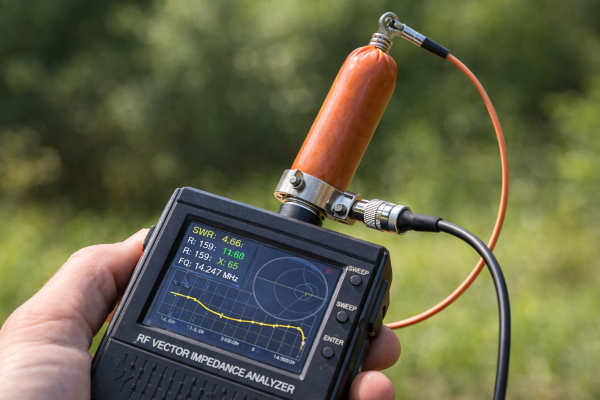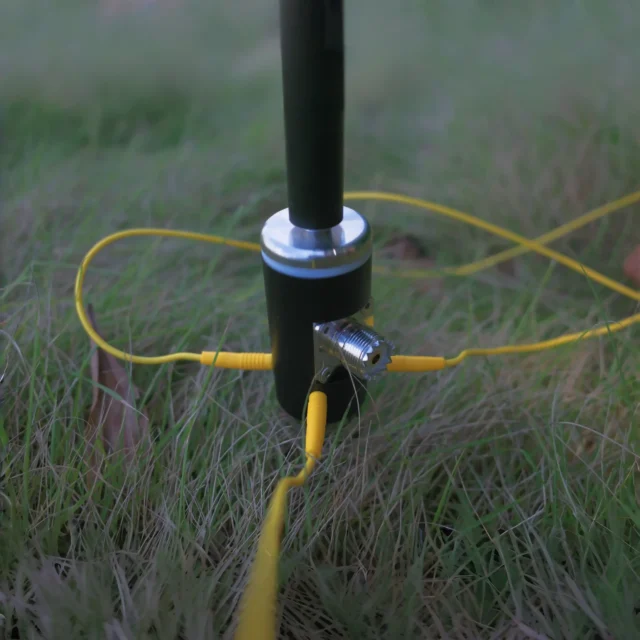
A vertical antenna always looks deceptively simple. One conductor rises into the air, the coaxial cable connects at the base, the SWR meter shows something that may or may not be acceptable, and the station is on the air. From a distance, it seems like the most compact and practical form of HF antenna: no long dipole stretched between trees, no full-size horizontal wire across the garden, no tower carrying a large beam. Just a vertical radiator, a feedpoint, and the promise of low-angle radiation.
The reality is more interesting. A vertical antenna is not only the visible metal, fiberglass-supported wire, telescopic whip or loaded element above the feedpoint. Electrically, it is a system. The upper half is obvious because it stands in the air. The lower half is less visible, but it is just as important. That lower half is the counterpoise, ground plane or radial system. Without it, the antenna does not stop being an antenna, but it becomes a much less predictable one. The coax shield may become part of the radiating structure, RF currents may flow through lossy soil, the radiation pattern may be distorted, local noise may increase, and a deceptively good SWR may hide poor real-world efficiency.
This is why radial systems matter. They are not decorative wires. They are not optional accessories in the strict electrical sense. They are the return-current structure of a vertical monopole. In HF operation, especially on the lower bands, a good radial system can be the difference between a vertical antenna that merely tunes and a vertical antenna that actually radiates well.
What a radial system really does
A vertical monopole can be imagined as one half of a dipole turned upright. In a textbook model, the missing half is replaced by an image antenna in a perfectly conducting ground plane. In the real world, the earth is not a perfect conductor. Even soil that seems physically moist and electrically promising is still lossy at radio frequencies. RF currents returning through real ground lose energy as heat. That lost energy does not become useful radiation.
The radial system gives those return currents a better path. It reduces the amount of RF current that must travel through lossy soil, spreads current over a larger conductive area, and stabilizes the feedpoint environment. In a ground-mounted installation, the radials work less like sharply tuned antenna elements and more like a conductive screen or capacitive shield near the earth. In an elevated installation, the radials behave much more like resonant conductors and must be treated as part of the antenna.
This distinction is fundamental. Many beginners try to apply the same rule to every radial system: “cut the radials to a quarter wavelength.” Sometimes that is correct. Sometimes it is not. For elevated radials, quarter-wave resonance is usually central to the design. For radials lying on or just under the ground, exact resonance is usually not the main objective, because the lossy, dielectric environment of the soil detunes them. Their practical purpose is to improve the RF conductivity of the area immediately around the antenna base and reduce ground loss.
A ground rod alone does not solve this problem. It can be valuable for lightning protection, static drainage, safety bonding or as a mechanical tie point, but a single rod driven into the earth is not an efficient RF ground plane for HF vertical operation. RF ground loss is mostly a surface and near-field problem around the antenna base, not something that can be solved simply by going deeper into the ground. A deep rod may look electrically serious, but at RF it does not replace a field of radials.
The hidden cost of a “good” SWR
One of the common traps with vertical antennas is confusing impedance match with radiation efficiency. A vertical can show an attractive SWR while wasting a large part of the transmitter power in ground loss, loading coil loss or unwanted current paths. The SWR bridge does not know whether power is being radiated into the ionosphere or dissipated in the earth. It only reports how well the transmitter sees the load at the end of the feedline.
At resonance, the feedpoint resistance of a vertical antenna is made up of several components. The desirable component is radiation resistance: the part associated with power converted into electromagnetic radiation. The undesirable components include conductor loss, loading coil loss, trap loss and earth loss. If a quarter-wave vertical has a radiation resistance around the mid-30-ohm region, adding ground loss can bring the feedpoint impedance closer to 50 ohms. The match may look better, but the signal may be worse.
This is why a poor radial system can sometimes produce a more convenient SWR than a better one. As the radial system improves, loss resistance drops, and the feedpoint impedance may move away from 50 ohms. That is not a failure. It can be evidence that less power is being wasted. The correct response is not to remove radials until the SWR becomes prettier, but to match the antenna properly with a suitable network, transformer, radial slope, element length adjustment or other impedance-matching method.
The shorter the vertical, the more severe this issue becomes. A physically short, inductively loaded vertical has lower radiation resistance and higher loss sensitivity than a full-size quarter-wave radiator. If the antenna is only a small fraction of a wavelength long, every ohm of ground loss matters more. The radial system becomes more critical because the useful radiation resistance is already low. In practical terms, a short loaded vertical with a poor radial field can tune, but most of the RF energy may never become useful radiation.
Ground-mounted radials
A ground-mounted vertical is the most common practical arrangement for many amateur radio stations. It is mechanically simple, visually modest and easy to access. The antenna base is near the soil, the radials spread outward, and the feedline enters at or near ground level. This can work very well, but the radial system must be understood correctly.
For ground-mounted verticals, radials do not need to be individually resonant. In fact, exact quarter-wave cutting is usually unnecessary because proximity to the earth changes the electrical behavior of the wires. The practical goal is coverage: create a reasonably conductive area around the base of the antenna so that the return currents do not have to flow through bare soil.
More radials usually help more than obsessing over a perfect individual radial length. A few very long wires are not the same as a dense radial field. The highest current density and the most important loss region are near the base of the antenna. That means short-to-moderate radials distributed around the feedpoint can often provide more practical benefit than two or three long wires disappearing in convenient directions.
This is also why symmetry is desirable but not always mandatory. In an ideal open field, radials would spread evenly in all directions like spokes from a wheel. In a real garden, there may be fences, walls, paths, buildings, trees, driveways or buried services. When perfect geometry is impossible, the best usable radial field is still better than no radial field. Radials can bend around obstacles, follow property lines, run under grass, curve along flower beds or take imperfect paths. The radiation pattern may become slightly asymmetrical, but efficiency often remains acceptable if enough conductive area is created around the antenna.
A useful practical approach is to start with a modest radial field and expand it. The first few radials produce the most obvious improvement. After that, additional radials still help, but with diminishing returns. A small system may make the antenna usable. A medium system may make it efficient enough for serious operation. A very large system approaches broadcast-station practice, but that is rarely necessary for amateur use unless the goal is maximum low-band performance.
For many amateur installations, a practical ground radial field may begin with 8 to 16 radials and improve noticeably as it grows toward 24, 32 or more. Where space and wire are available, more can be added over time. On the lower HF bands, where wavelengths are long and vertical antennas are often shortened, the radial system is especially important.
Radial length on the ground
For ground-mounted radials, length should be considered together with number. A sparse system of only a few radials does not automatically become excellent by making those few radials very long. If the field has very few wires, a large amount of soil remains exposed to the antenna’s near field, and the return current distribution is still poor. In that situation, adding more radials may produce more benefit than making the existing ones dramatically longer.
Once the radial count increases, longer radials become more valuable. A dense system of very short radials can reach a point where extra wires add less improvement unless the radial field also extends farther outward. In other words, the best design is not simply “as many as possible” or “as long as possible” in isolation. The useful question is: how much conductive coverage can be created around the base of the antenna, given the available land, wire, labor and visual restrictions?
A common rule of thumb is that ground radials should not be shorter than the height of the vertical radiator when possible. This is not a rigid law, but it reflects the importance of covering the near-field region around the base. If a vertical is physically short, the situation becomes more complex because radiation resistance is also lower, and losses become proportionally more damaging.
For multiband operation, ground-mounted radials have a practical advantage: a single radial field can support multiple bands. Since the radials are not being used primarily as sharply resonant elevated elements, the same buried or surface wires contribute across a wide frequency range. The lowest intended band usually drives the physical scale. A radial field that is useful on 40 meters will also contribute on 20, 15 and 10 meters, although the current distribution and relative effectiveness change with frequency.
Surface radials or buried radials
Radials may lie directly on the ground or be buried shallowly. From an RF standpoint, very shallow placement is usually adequate. Deep burial is not necessary and may even be counterproductive if it increases loss or makes installation harder. The usual practical reason for burying radials is not RF performance but safety and durability. Surface wires are tripping hazards, lawnmower hazards and animal hazards. Once grass grows over thin wires, they often disappear naturally, but until then they require care.
Insulated wire is commonly suitable. Bare wire can work, but insulation helps reduce corrosion and makes the installation more durable. Wire gauge is usually not critical because current is distributed among many conductors. Very thin wire may break mechanically; very thick wire is expensive and harder to handle. The best radial wire is often the wire that can actually be installed in sufficient quantity and left in place for years.
The connection point at the feedpoint matters. All radials should return to the ground side of the antenna feedpoint with the shortest practical connection. A long vertical lead from the antenna base down to a remote radial plate can become part of the radiating system and change the electrical length of the antenna. This is especially problematic at higher frequencies, where even a short physical lead becomes a significant fraction of a wavelength.
Elevated radials
Elevated radial systems are electrically different from ground radial systems. Once the radial wires are raised above the earth, they increasingly behave as tuned counterpoise elements rather than merely as a lossy-ground shield. This allows far fewer radials to be used, but those radials must be designed more carefully.
A pair of elevated quarter-wave radials can provide very good efficiency for a vertical on a single band. Four elevated radials, evenly spaced, usually improve pattern symmetry and make the system less sensitive to nearby objects. With elevated radials, the usual starting point is a quarter wavelength per radial for each operating band. The approximate free-space formula often used for a quarter-wave radial in feet is:
Length in feet = 234 to 240 / frequency in MHz
The exact number depends on conductor insulation, wire diameter, end effects, nearby structures and installation geometry. In practice, elevated radials are cut slightly long and then trimmed or adjusted while measuring resonance and feedpoint behavior.
Because elevated radials are resonant, multiband operation requires more planning. A single set of radials may not serve every band equally. Separate pairs or sets may be needed for different bands, and interaction between adjacent radial wires can shift the required lengths. If several bands are used, the radials should be separated as much as practical. Bundling many tuned radials tightly together near each other for long distances can cause detuning and unpredictable matching.
A key advantage of elevated radials is efficiency. The earth is still present, but the strongest return currents are no longer forced to flow through the soil in the same way. Even modest elevation can reduce near-field loss substantially. This is why an elevated vertical with a few tuned radials can outperform a ground-mounted vertical with a modest radial field, especially when the elevated antenna is also more in the clear and farther from absorbing objects.
The importance of radial slope
Elevated radials do not have to be perfectly horizontal. In fact, sloping them downward is often useful. A vertical over a very good ground plane may show a feedpoint impedance lower than 50 ohms. Drooping the radials downward raises the feedpoint impedance and can bring the system closer to a direct coaxial match. This is the principle behind the classic ground-plane antenna with downward-sloping radials.
Moderate downward slope usually has little negative effect on radiation performance and can make mechanical installation easier. The radial ends can be tied to fences, posts, trees or nonconductive supports, provided the ends remain insulated and inaccessible. Excessively steep angles can change the system behavior and provide diminishing returns, but a controlled downward slope is a legitimate matching tool.
The radial slope also influences safety. Elevated radials can carry significant RF voltage, especially near their ends. They must be high enough or placed carefully enough that people and animals cannot touch them during transmission. This is not only a technical matter but a practical installation requirement. A low elevated radial stretched across a garden path is a poor design even if the analyzer likes it.
One radial, two radials or four?
A vertical can be made to operate with one elevated radial, but it should not be expected to behave like a symmetrical omnidirectional antenna. A single radial creates an unbalanced counterpoise. The radiation pattern can become directional, the polarization mix can change, and deep nulls may appear. This may still be useful in a constrained portable or temporary installation, but it is not the same as a proper ground plane.
Two elevated radials arranged 180 degrees apart are a much better starting point. They create a more balanced structure and can work efficiently on a given band. For many practical installations, two resonant elevated radials per band are a workable compromise between performance, visual impact and mechanical complexity.
Three or four equally spaced radials improve the system further. They produce a more symmetrical ground plane and a more predictable pattern. Four radials per band are often considered a strong practical standard for elevated installations, especially where the antenna is intended to behave as a conventional vertical with predominantly vertical polarization and relatively uniform azimuth coverage.
Beyond four, additional elevated radials can still help, particularly by reducing sensitivity to nearby objects and stabilizing impedance, but the installation becomes more complex. The decision depends on the operating goal. A casual multiband station may accept two per band. A more serious low-angle DX installation may justify four or more, especially on the most important band.
Ground-mounted versus elevated: the real trade-off
The choice between ground-mounted and elevated radials is not simply about performance. It is a trade-off between RF efficiency, mechanical complexity, available space, safety, visual impact and tuning difficulty.
A ground-mounted radial system is forgiving. The radial lengths are not critical. The wires can be hidden in grass. A single radial field can serve many bands. It is mechanically stable and visually modest. The disadvantage is that it usually requires more wire to reach high efficiency, and performance is more dependent on soil conditions and nearby objects.
An elevated radial system can achieve high efficiency with far fewer wires. It can be excellent where the antenna can be mounted on a roof, mast, deck, shed, tower or other elevated support. It also places the antenna more in the clear, which often reduces absorption by buildings, fences and vegetation. The disadvantages are resonance sensitivity, safety concerns, visual exposure and the need for separate or carefully planned radials for multiple bands.
For a permanent home station, ground radials are often easier to expand gradually. For a roof, balcony or mast-mounted installation, elevated tuned radials may be the only realistic choice. For portable work, two elevated wires cut for the operating band can be remarkably effective. For stealth operation, hidden wires along gutters, fences, roof edges or landscaping may be better than textbook geometry that cannot actually be installed.
Metal roofs, vehicles and large conductive structures
A radial system does not always have to be a set of individual wires. Large conductive surfaces can act as a counterpoise or ground plane if they are sufficiently large, well bonded and appropriately located. Metal roofs, vehicle bodies, trailers, metal terraces, structural steel and other large conductive masses can provide useful capacitive coupling to the earth and a low-loss return-current surface.
This is why mobile antennas work at all on vehicles that are physically much smaller than a quarter wavelength on HF. The vehicle body is not a perfect infinite ground plane, but it provides a conductive surface that is far better than a single ground rod. The best mobile antenna position is usually near the center of the available conductive surface because this gives the most symmetrical current distribution and reduces shadowing by the vehicle body.
A metal roof can be especially valuable for a fixed vertical installation. If the roof panels are electrically continuous or well bonded, the roof may act as a broad counterpoise across multiple bands. In practice, seams, paint, oxide layers, fasteners and bonding quality matter. A roof that appears metallic may not be an RF-continuous sheet unless the sections are bonded. When it works, however, it can replace a large amount of radial wire.
Metal gutters, flashing and sheet-metal edges may also contribute, but they should be treated with caution. They can act as part of the counterpoise, but they can also produce unpredictable current paths, noise pickup, common-mode currents or pattern distortion. If used deliberately, they should be bonded carefully at the feedpoint and evaluated by on-air performance, common-mode behavior and received noise, not only by SWR.
The role of common-mode current
A poor or incomplete radial system often encourages the coaxial feedline to become part of the antenna. RF current flows on the outside of the coax shield, returning through the station, mast, equipment, building wiring or operator environment. This is called common-mode current, and it can create several symptoms: RF in the shack, unstable SWR when the coax is moved, distorted radiation pattern, increased received noise, microphone bite, computer interference or unexpected interaction with nearby equipment.
A good radial system reduces the incentive for current to use the coax shield as a return path. A common-mode choke or 1:1 current balun at or near the feedpoint can also help, especially with elevated installations, sparse radial systems, short coax runs or difficult ground conditions. The choke should not be seen as a substitute for the radial system. It is a current-control device. The radial system still provides the intended return path.
In many vertical installations, the most stable arrangement combines both: an adequate radial or counterpoise system and a feedline choke. This keeps the antenna currents where they belong and prevents the coax from silently becoming an extra radial, unwanted radiator or noise pickup conductor.
Why soil quality changes everything
Soil conductivity and dielectric properties strongly affect vertical antennas. Wet, mineral-rich ground generally performs better than dry sandy or rocky soil. Saltwater is in a different class entirely. Near seawater, a vertical can become a remarkably strong low-angle radiator because far-field ground losses are reduced and very low-angle radiation is better supported.
This is one reason coastal verticals are famous for DX performance. The antenna itself may not be exotic. The environment is. A simple vertical near saltwater can outperform a more elaborate inland installation because the far-field reflection and loss conditions are dramatically better. Radials still matter at the feedpoint, but the surrounding environment helps the launched wave.
Inland operators cannot fully reproduce saltwater performance by adding a few ground rods or watering the lawn. A radial system mainly addresses near-field loss around the antenna. It cannot completely remove far-field loss caused by the larger ground environment. This does not make radials less important; it clarifies their job. They make the antenna system more efficient at the feedpoint, while the broader terrain still influences the final low-angle radiation result.
Radials for shortened verticals
Short verticals are common because full-size quarter-wave radiators become physically large on 80 and 40 meters. A quarter wavelength on 80 meters is around 20 meters tall. Many home stations cannot install that. The practical solution is loading: coils, traps, capacitive hats or adjustable elements. These methods allow resonance with a shorter radiator, but they do not remove the physics.
As the radiator becomes shorter, radiation resistance falls. If radiation resistance is low, the same amount of loss resistance consumes a larger fraction of the transmitter power. A few ohms of ground loss may be a minor issue for a full-size radiator but a major issue for a heavily loaded short vertical. This is why compact verticals are so dependent on counterpoise quality.
A short vertical over a minimal ground system may still make contacts, especially with digital modes and favorable propagation, but its efficiency may be poor. Improving the radial system often brings a larger benefit than changing the whip, replacing coax or chasing a perfect SWR curve. The lower the band and the shorter the radiator, the more important this becomes.
Multiband radial systems
Multiband verticals create a practical challenge. The radiator may use traps, loading coils, adjustable elements or broadband matching to cover several bands, but the counterpoise must still support RF currents. The best radial strategy depends on whether the system is ground-mounted or elevated.
For ground-mounted multiband verticals, a broad radial field is usually the simplest solution. The radials do not have to be cut separately for each band. A large number of wires of practical length, spread around the base, will provide a useful RF ground across multiple bands. The lowest band generally determines how ambitious the system should be.
For elevated multiband verticals, the situation is less forgiving. Since the radials are resonant, each band may need its own tuned pair or set. Radials for different bands can interact. Their spacing, routing and height affect the final length required. Theoretical quarter-wave calculations are only a starting point. Measurement and trimming are part of the process.
There are creative alternatives. Fan-style radial systems, folded paths, multiconductor arrangements and shared supports can reduce the number of tie-off points. But the principle remains: elevated radials are antenna elements. Treat them with the same respect as the vertical radiator itself.
Pattern distortion and real-world geometry
A perfectly symmetrical vertical over a perfect radial system produces a reasonably omnidirectional pattern in azimuth. Real installations rarely achieve this. Buildings, metal fences, gutters, roof structures, trees, masts, utility wiring and uneven radial layouts all affect the pattern.
This does not mean the antenna is unusable. Pattern distortion is often acceptable, and sometimes even helpful if it favors a desired direction. But it should be understood. If radials are concentrated on one side of the antenna, if a metal roof lies in one direction, or if the vertical is mounted close to a house wall, the pattern may not be circular. Nulls and lobes can appear. Received noise may also differ by direction because the antenna system is coupling to nearby structures.
For general amateur use, perfect omnidirectionality is often less important than low loss, mechanical safety and a clear location. A vertical in the open with an imperfect radial layout may outperform a textbook radial layout installed too close to a building, inverter, metal balcony or noisy wiring. Antenna systems are always compromises between theory and site reality.
Practical installation strategy
The best radial system is the one that fits the site and can be maintained. A theoretical 120-radial field is irrelevant if the operator can only install six wires. A beautiful elevated radial system is a hazard if people can touch the ends. A metal roof counterpoise is useful only if it is electrically continuous enough. A hidden gutter counterpoise is convenient only if it does not bring noise and common-mode current into the station.
For a ground-mounted vertical, the practical strategy is usually progressive improvement. Install the antenna where it has the clearest view and the least interaction with buildings. Begin with a reasonable number of radials. Keep the feedpoint connection short and solid. Add radials over time. Watch for changes in feedpoint impedance, received noise, on-air reports and reverse beacon results. Do not judge only by SWR.
For an elevated vertical, begin with the operating bands. Cut radials long. Keep pairs opposite each other where possible. Use at least two per band, preferably more where practical. Slope them downward if impedance matching requires it. Keep the radial ends insulated and out of reach. Add a good common-mode choke at the feedpoint. Expect to tune the system in place because nearby objects and radial interaction will alter the final lengths.
For a stealth installation, think in terms of RF current paths rather than visual textbook diagrams. A wire hidden along a roof edge, fence line or gutter may be useful if it is connected correctly and kept short at the feedpoint. Several imperfect radials are usually better than one clever but lonely conductor. When metal structures are used, bonding quality and noise pickup become central issues.
Safety, voltage and durability
Radials are easy to underestimate because they often lie on the ground or look like passive wires. In transmitting systems, they can carry RF current and develop high voltage, especially near the ends of elevated resonant radials. Ends should be insulated. Elevated radials should not cross walkways at human height. Installations must avoid power lines, service drops, metal ladders, accessible railings and other hazardous structures.
Buried radials should be shallow enough to install and repair but protected from garden tools and lawn equipment. Weatherproof the feedpoint. Use corrosion-resistant hardware where possible. If dissimilar metals meet, expect oxidation over time. A radial system that performs well on day one may degrade if connections corrode, lugs loosen or buried joints absorb moisture.
Mechanical strain relief is also important. Thin radial wire can break where it leaves a terminal plate if it moves in wind or is pulled by soil movement, animals or maintenance work. A simple radial plate, stainless hardware, ring terminals and a protected feedpoint box can make the difference between a temporary experiment and a durable station antenna.
Testing a radial system
The most misleading test is SWR alone. A low SWR can indicate a good match, but it can also indicate loss. Better tests include field strength comparison, reverse beacon reports, WSPR or FT8 spot analysis, received signal comparisons against known antennas, common-mode current measurement, and stability checks while moving the feedline.
If adding radials changes the SWR, that is expected. If adding radials lowers noise, improves reports or changes the feedpoint impedance, that is useful information. If the antenna becomes harder to match but stronger on the air, the radial system is probably doing its job. The matching network can be adjusted; lost RF power cannot be recovered after it has heated the soil.
A simple current meter or clamp-on RF ammeter can be very revealing. Measuring current on individual radials, the coax shield and nearby conductors helps show where the antenna current is actually flowing. If significant current appears on the outside of the coax shield, the radial system and choking arrangement need attention.
Common mistakes
The first mistake is assuming that a vertical antenna with “no radials required” has escaped the need for a counterpoise. It has not. It is using some form of internal, shortened, hidden, tuned or lossy counterpoise. That may be convenient, but convenience is not the same as efficiency.
The second mistake is using a ground rod as the only RF ground. A rod may be good for safety bonding, but it is not a substitute for a radial field at HF.
The third mistake is cutting ground-mounted radials with unnecessary precision. Exact resonance matters far more for elevated radials than for wires lying on or under the ground.
The fourth mistake is installing a long vertical wire between the antenna feedpoint and the radial field. That wire becomes part of the antenna and can detune the system.
The fifth mistake is removing radials because the SWR became less convenient after improvement. Lower loss can expose the real feedpoint impedance. That calls for matching, not deliberate inefficiency.
The sixth mistake is letting the coax shield become the missing radial. This often creates RF in the shack and unpredictable noise pickup.
What “enough radials” means
There is no universal number. Enough radials means the antenna performs efficiently enough for the purpose, remains stable, does not put unwanted RF on the feedline, and fits the physical site. A casual 20-meter vertical in a small garden may be satisfactory with a modest radial field. A serious 80-meter DX vertical needs much more attention. A portable elevated vertical may work well with two tuned wires. A permanent ground-mounted low-band antenna benefits from as much radial coverage as the site allows.
The useful mindset is not perfection but loss control. Every radial is an attempt to move current out of lossy soil and into copper, aluminum or another conductor. Every improvement in the return path increases the chance that transmitter power becomes radiated signal rather than heat. At some point, the returns diminish. Before that point, radial work is often among the most effective upgrades available.
The final picture
A vertical antenna is not a single pole. It is a radiator plus a return-current system. The radial field is not an accessory but the lower half of the antenna. Ground-mounted radials create a conductive screen that reduces near-field soil loss. Elevated radials act as tuned counterpoise elements and can provide high efficiency with fewer wires. Large metal surfaces can substitute for wire radials in some installations, but only when they provide a sufficiently large and well-bonded conductive structure. Soil quality, antenna height, loading, radial geometry and common-mode control all interact.
The most important lesson is that SWR is not performance. A lossy vertical can match beautifully. A better radial system may make the match less convenient while making the signal stronger. The antenna analyzer is useful, but the ionosphere, field strength and current distribution tell the deeper story.
For most amateur radio installations, the best radial system is not the biggest theoretical one. It is the best practical one: enough wire, enough symmetry, short feedpoint connections, controlled common-mode current, safe routing, durable materials and a clear understanding of whether the radials are ground-mounted non-resonant conductors or elevated resonant elements. Build that correctly, and the vertical antenna becomes what it was meant to be: compact, low-angle, efficient and far more capable than its simple appearance suggests.
Image(s) used in this article are either AI-generated or sourced from royalty-free platforms like Pixabay or Pexels.
This article may contain affiliate links. If you purchase through these links, we may earn a commission at no extra cost to you.
Get the weekly RF & IT briefing
Radio guides, RF calculators, AI, Windows, Linux and satellite communication explainers. One useful email per week. No spam.