Artificial intelligence is rapidly becoming one of the most power-hungry sectors of the global technology industry. Modern AI infrastructure needs huge amounts of electricity, advanced cooling, high-bandwidth networking, specialized chips, and enormous physical data center campuses. As demand grows, the question is no longer only how fast AI models can improve, but where the infrastructure behind them can realistically be built.
SpaceX appears to have one of the most radical answers: move part of the AI computing stack into orbit.
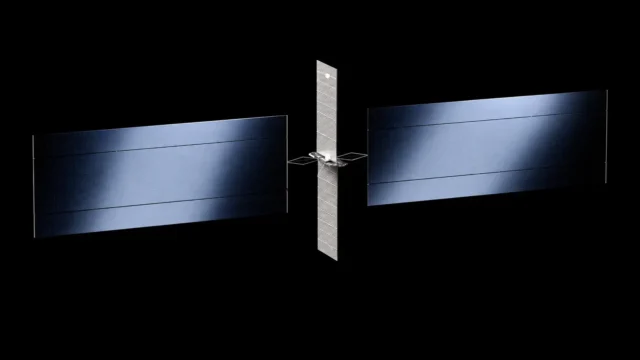
The concept is bold even by Elon Musk’s standards. Instead of relying only on terrestrial data centers, SpaceX has proposed a future network of orbital computing satellites that could use solar power in space and process AI workloads far above Earth. The company has already taken a formal regulatory step in this direction. In January 2026, SpaceX filed an application with the U.S. Federal Communications Commission seeking authority for a new non-geostationary satellite system of up to one million satellites, described in FCC documentation as the “SpaceX Orbital Data Center” system.
At the same time, SpaceX’s own pre-IPO risk disclosures appear to be far more cautious than the public rhetoric surrounding the idea. According to Reuters, SpaceX’s confidential S-1 filing warns investors that space-based AI data centers rely on unproven technologies, involve significant technical complexity, and may never become commercially viable.
That contrast is the real story. Space data centers are not pure science fiction, but they are also not a simple solution to Earth’s AI infrastructure problem.
Why put data centers in space?
The basic argument for orbital data centers sounds attractive. Space has abundant sunlight, no weather, no clouds, no land-use disputes, and no local opposition to industrial infrastructure. In theory, large solar arrays in orbit could provide continuous or near-continuous energy for computing systems, especially if satellites are placed in carefully chosen orbits.
For AI infrastructure, this matters. Training and running advanced models requires huge amounts of electrical power. Terrestrial data centers are already facing bottlenecks related to grid capacity, cooling, water consumption, permitting delays, and competition for suitable land. In some regions, power availability has become as important as fiber connectivity.
SpaceX’s orbital data center idea attempts to sidestep some of those limits. Instead of bringing more power to the data center, the data center would be moved closer to a massive natural power source: the Sun.
There is also a strategic reason. SpaceX already operates the Starlink satellite network, builds satellites at scale, launches payloads with reusable rockets, and is increasingly tied to AI through Musk’s wider business ecosystem. The company’s ongoing work on next-generation Starlink architecture, including Starlink Gen2 satellites, also shows how SpaceX is gradually moving from basic satellite connectivity toward larger and more capable orbital infrastructure. If any private company can attempt a vertically integrated space-computing platform, SpaceX is the obvious candidate.
Reuters has reported that SpaceX is positioning AI as a major future opportunity in its IPO narrative, with the company presenting enterprise AI as a far larger addressable market than its current space and connectivity businesses.
The cooling problem is often misunderstood
One of the most common claims about orbital data centers is that space is cold, so cooling should be easy. This is only partly true.
Space is not cold in the same practical sense as a cold room or an air-conditioned data center. In vacuum, there is no air to carry heat away through convection. A server rack on Earth can use fans, chilled water, liquid cooling loops, heat exchangers, and ambient air movement. In orbit, heat must mainly be removed through radiation.
That means an orbital data center needs large radiators, careful thermal design, and extremely reliable heat-transfer systems. High-performance AI chips generate enormous heat density. Moving that heat from the processors to external radiating surfaces is not trivial, especially when weight, launch volume, orientation, sunlight exposure, and long-term material degradation all matter.
The problem is solvable in principle. Spacecraft already use thermal control systems. But scaling that up from satellite electronics to AI-class compute infrastructure is a different engineering category.
In a terrestrial hyperscale facility, cooling equipment can be repaired, upgraded, expanded, or replaced. In orbit, hardware failure is much harder to manage. A failed pump, cracked thermal interface, damaged radiator, or degraded power system could turn an expensive computing satellite into orbital junk.
The maintenance issue may be the biggest barrier
Modern data centers are not static machines. They are maintained constantly. Drives fail, power supplies fail, networking equipment is upgraded, servers are replaced, and GPU clusters are refreshed as newer hardware becomes available.
This is especially important for AI. The lifecycle of AI accelerators is short. A cluster built with state-of-the-art chips can become less competitive within only a few years. The economics of AI infrastructure depend heavily on performance per watt, chip availability, interconnect speed, and utilization rate.
An orbital data center would not have the same maintenance model. Unless robotic servicing becomes routine and economical, the most likely approach is replacement rather than repair. That might work for some satellite constellations, but it becomes more questionable when the payload is expensive compute hardware rather than communications equipment.
This is where the commercial risk becomes obvious. A terrestrial data center can be upgraded in phases. An orbital system may require launching new hardware generations repeatedly while safely deorbiting obsolete units. That adds cost, operational complexity, and environmental concerns.
Data movement is another major limitation
A data center is useful only if data can move in and out efficiently. This is where orbital computing faces a fundamental challenge.
For some workloads, space-based processing could make sense. Earth observation satellites, defense platforms, climate monitoring systems, and scientific instruments already generate data in orbit. Processing that data locally before sending only the most valuable results back to Earth could reduce bandwidth requirements and latency.
This is the strongest near-term use case for orbital computing: edge processing in space.
General-purpose AI cloud computing is harder. If users on Earth need to upload massive datasets to orbit, run training or inference, and then download results, the communications layer becomes a serious bottleneck. Optical inter-satellite links, ground stations, beam steering, spectrum coordination, weather effects on optical downlinks, and latency all become part of the data center architecture.
Terrestrial data centers are plugged directly into dense fiber networks. Orbital data centers need a far more complicated relay system. That does not make them impossible, but it weakens the argument that space automatically offers cheaper AI infrastructure.
One million satellites would change the orbital environment
The scale of SpaceX’s FCC application is extraordinary. A system of up to one million satellites would be far larger than today’s operational satellite population. Even if such a number represents a long-term regulatory ceiling rather than an immediate deployment plan, it raises major questions about orbital traffic management, debris risk, spectrum use, and astronomical interference.
The FCC filing itself describes a new NGSO system of up to one million satellites, which would represent the first step toward a far more ambitious space-energy and space-computing architecture.
At that scale, even very low individual failure rates can become significant. Collision avoidance, controlled deorbiting, tracking, software reliability, and international coordination would all need to operate at an unprecedented level.
SpaceX has already faced criticism over the brightness of Starlink satellites and the impact of large constellations on astronomy. A computing constellation several orders of magnitude larger would intensify those debates.
SpaceX is selling ambition, but warning about risk
The tension between ambition and caution is not unusual in an IPO process. Public companies must disclose risks clearly to investors, especially when future growth depends on unproven technologies.
That is why the SpaceX S-1 language matters. Public presentations can emphasize vision. Regulatory filings must discuss failure scenarios, technical uncertainty, cost exposure, and commercial viability.
According to Reuters, SpaceX’s filing describes its AI and space data center ambitions as technically complex and commercially uncertain, even while the company continues to present AI as a major long-term growth opportunity.
This does not mean SpaceX is abandoning the idea. It means the company is formally acknowledging that the path from orbital concept to profitable infrastructure is not guaranteed.
Where orbital data centers could make sense first
The most realistic first step is not a full replacement for Earth-based hyperscale data centers. It is specialized orbital edge computing.
In that model, satellites process data where it is created. A remote sensing satellite could analyze imagery before downlinking it. A defense constellation could identify relevant signals locally. A scientific platform could filter raw instrument data in orbit. A communications network could use onboard AI for routing, anomaly detection, or spectrum management.
These applications do not require space to beat terrestrial data centers on every metric. They only require local processing to reduce latency, bandwidth use, or operational dependency on ground infrastructure.
A second possible use case is AI inference for workloads where the model is already stored in orbit and the input/output data is relatively small. That could be useful for some autonomous space systems or specialized government applications.
Large-scale AI training in orbit is a much more difficult proposition. Training frontier models requires enormous chip density, rapid networking between accelerators, massive datasets, stable power, hardware refresh cycles, and high utilization. Today, Earth still offers a much more practical environment for that.
Why Earth-based data centers still have the advantage
Terrestrial data centers are not perfect, but they have major advantages that space cannot currently match.
They can be built near power plants, fiber routes, cities, industrial zones, or cold climates. They can use liquid cooling, direct-to-chip systems, immersion cooling, waste heat recovery, and grid-scale energy storage. Engineers can physically access the hardware. Failed components can be replaced. Security can be audited. Data residency laws can be followed. Hardware can be upgraded without launching rockets.
The cost curve also matters. SpaceX has reduced launch costs dramatically, but launching, powering, cooling, networking, managing, and eventually deorbiting computing satellites is still far more complex than building another terrestrial facility in a well-connected region.
For most cloud workloads, the simple answer remains: build on Earth.
The long-term vision is still important
Even if orbital AI data centers are not commercially practical today, the idea should not be dismissed entirely. Many technologies begin as impractical infrastructure visions before finding narrower early use cases.
Reusable rockets were once considered unrealistic by much of the aerospace industry. Satellite broadband was long viewed as inferior to terrestrial networks for most users. SpaceX has already shown that aggressive scaling can change cost assumptions.
The question is whether the same logic applies to AI compute in orbit.
For that to happen, several breakthroughs would be needed: cheaper launch capacity, more efficient AI accelerators, better radiation-hardened compute hardware, autonomous servicing, high-capacity optical links, reliable thermal systems, and a regulatory framework for extremely large constellations.
Without those pieces, orbital data centers remain an ambitious experiment rather than a near-term replacement for terrestrial AI infrastructure.
The realistic verdict
Space-based data centers are not a bad idea in every context. They are a bad idea if they are presented as an easy or obvious substitute for Earth-based data centers.
The strongest near-term case is space-native computing: processing orbital data in orbit, reducing downlink requirements, supporting autonomous spacecraft, and serving specialized defense, scientific, or communications workloads.
The weakest case is general-purpose AI cloud infrastructure for everyday terrestrial users. For that market, the economics, maintenance model, latency, bandwidth, thermal engineering, and hardware refresh cycle still favor Earth.
SpaceX’s proposal is therefore best understood as a high-risk infrastructure bet. It fits the company’s long-term strategy, it may produce useful technologies, and it could open a new category of space-based computing. But it is not yet a proven business.
The idea is technically fascinating. Commercially, it remains unproven. Environmentally and operationally, it raises serious questions. And for now, even SpaceX’s own IPO risk language appears to admit that orbital AI data centers may be far harder to monetize than they are to imagine.
Faq
Are space data centers technically possible?
Yes, at least in limited form. Satellites already contain onboard computing systems, and more advanced orbital processing is realistic. The difficult part is scaling this into AI-class data center infrastructure with high power density, reliable cooling, fast networking, and long-term maintainability.
Would solar power make orbital data centers cheaper?
Solar power is one of the strongest arguments for the concept, but it does not automatically make the whole system cheaper. Launch costs, satellite manufacturing, thermal control, networking, maintenance, replacement cycles, and deorbiting costs all have to be included.
Is space really easier for cooling?
No. Space has no air, so heat cannot be removed by convection. Orbital systems must radiate heat away, which requires large radiators and careful thermal engineering. This is possible, but not simple for high-density AI hardware.
Could SpaceX replace Earth-based AI data centers?
Not in the near term. Earth-based facilities remain easier to build, repair, upgrade, connect, regulate, and scale. Orbital data centers are more plausible first as specialized space-based edge computing systems.
Why is SpaceX interested in this?
SpaceX has rockets, satellite manufacturing, Starlink infrastructure, and a strategic connection to AI through Elon Musk’s wider technology ecosystem. Orbital computing could combine these assets into a new long-term business line, but the commercial model remains uncertain.
Image(s) used in this article are either AI-generated or sourced from royalty-free platforms like Pixabay or Pexels.
This article may contain affiliate links. If you purchase through these links, we may earn a commission at no extra cost to you.
Get the weekly RF & IT briefing
Radio guides, RF calculators, AI, Windows, Linux and satellite communication explainers. One useful email per week. No spam.