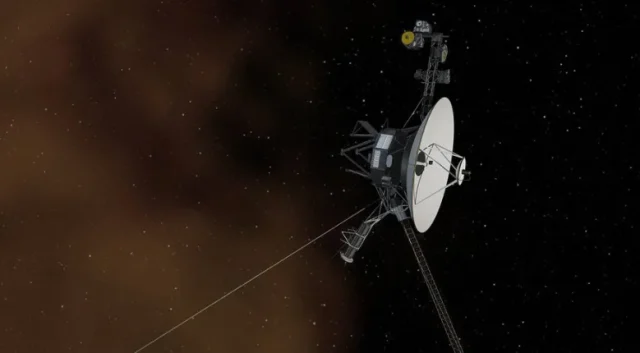
For nearly half a century, Voyager 1 has been the quiet machine at the edge of human reach, continuing to send scientific data back to Earth long after its original mission had already become history. Launched in 1977, the spacecraft has traveled so far that even light now needs almost a full day to cross the distance between Earth and the probe. And yet the greatest threat to Voyager 1 today is not some sudden mechanical disaster. It is a much simpler and far more unforgiving problem: the spacecraft is slowly running out of usable electrical power.
That reality came into focus again in April 2026, when mission engineers shut down another scientific instrument in order to preserve energy for the spacecraft’s most essential systems. It was not an isolated event or a sign of unexpected collapse. It was the latest step in a long, carefully planned effort to keep one of NASA’s most legendary missions alive for as long as physics will allow.
The modern story of Voyager 1 is no longer mainly about planetary exploration. It is about endurance, deep-space communications, aging electronics, and the extraordinary challenge of operating a spacecraft built with 1970s technology while it continues its journey through interstellar space.
Power is now the defining limit
Voyager 1 still carries the same fundamental power source it launched with: a radioisotope thermoelectric generator, or RTG. This system converts heat from the decay of radioactive material into electricity, providing long-term power without the need for solar panels. That design made perfect sense for a mission headed toward the outer Solar System, where sunlight becomes far too weak to support conventional solar generation.
The problem is that RTGs do not produce the same level of power forever. Their electrical output declines over time, and after decades in space the margin has become extremely thin. What was once enough to support a full scientific payload and all the spacecraft’s major subsystems has become a steadily shrinking reserve that must be managed with extreme care.
Because of that decline, engineers have been forced to make increasingly difficult choices about what remains active. Scientific instruments that once contributed valuable data must now be evaluated not only for their research importance, but also for how much energy they consume compared with the benefit they still provide. The result is a gradual narrowing of the spacecraft’s capabilities in exchange for more operating time.
This is the phase Voyager 1 has now entered. It is no longer a mission of abundance. It is a mission of controlled reduction.
Another instrument goes quiet
The latest casualty of that power strategy was the Low-Energy Charged Particles instrument, known as LECP. This instrument had worked for decades, measuring low-energy ions, electrons, and other charged particles in space. It was one of the most durable elements of the mission, a scientific tool that had remained active since the spacecraft’s early years and continued contributing to the study of the outer heliosphere and interstellar environment.
Its shutdown was not simply symbolic. It marked another step in the transformation of Voyager 1 from a broad scientific platform into a minimally sustained interstellar probe. As each instrument goes offline, the spacecraft loses another way of sensing the environment around it. But without those sacrifices, the mission itself would end sooner.
That is the central tension of the Voyager program in 2026. To preserve the spacecraft, parts of the science must be surrendered. Each decision buys time, but each decision also narrows the window through which humanity can still observe the region beyond the Sun’s protective bubble.
A spacecraft built around specialized computers
Part of what makes Voyager 1 so extraordinary is that it continues to function at all, given the era in which it was designed. This is not a spacecraft powered by anything resembling a modern processor. It was built around a set of dedicated, highly specialized computer systems, each responsible for a narrow category of tasks rather than acting as a single all-purpose onboard computer.
Voyager 1 relies on three major computing subsystems, and each has a redundant counterpart. One system is responsible for command processing and high-level control. Another handles the collection, packaging, and formatting of telemetry and scientific data. A third governs attitude control and the physical orientation of the spacecraft, ensuring that the antenna stays pointed toward Earth and that the vehicle maintains the correct posture in space.
By modern standards, the computing capability involved is astonishingly small. The total memory available across these systems is tiny compared with even the simplest modern consumer electronics. There is no excess performance, no high-level operating system in the modern sense, and no room for the sort of software complexity now taken for granted. Everything aboard Voyager was designed around strict purpose, limited resources, and reliability.
That design philosophy has proven far more durable than many would have expected. The spacecraft’s computers may look primitive on paper, but they were built for one thing above all else: survival in deep space.
Software from another era
The software side of Voyager 1 is just as unusual as the hardware. Its onboard code belongs to a computing world that predates modern software engineering culture. Much of the spacecraft software was written in low-level assembly language, directly tied to the onboard hardware architecture. In parts of the command system, engineers also relied on spacecraft-specific pseudocode structures and highly customized logic tailored to the mission.
This is one of the reasons Voyager operations are so difficult today. The challenge is not merely that the software is old. It is that the software was created for an environment, architecture, and engineering culture that almost no longer exists in practical form. The tools, assumptions, and documentation styles are all products of a very different technological era.
That does not mean the code is incomprehensible. Clearly it is still understood well enough to maintain the mission. But the number of people capable of working with it confidently is limited, and the knowledge required is highly specialized. Supporting Voyager today is less like maintaining a legacy business application and more like preserving a functioning technical artifact from a lost branch of computing history.
This rare expertise has become one of the mission’s hidden dependencies. Keeping Voyager alive is not only about preserving hardware and power. It is also about preserving enough human understanding to continue operating a machine whose logic was designed nearly fifty years ago.
Why even small software changes are hard
Modern engineers are used to immediate feedback. On Earth, a software bug can be examined through logs, debug tools, test benches, simulations, virtual machines, and repeated trial-and-error. Voyager 1 offers none of those luxuries in the familiar sense. It is too far away, too old, too slow to communicate with, and too precious to treat casually.
That makes every software or command-level intervention a highly constrained operation. Engineers cannot simply experiment in real time. A change must be planned carefully, checked repeatedly, and executed with the knowledge that any mistake could jeopardize the operation of a spacecraft that cannot be physically reached or repaired.
This difficulty has become especially visible whenever Voyager has experienced anomalous data behavior. Diagnosing faults on a machine this far away is an exercise in disciplined inference. The team must interpret incomplete telemetry, understand the interaction between aging hardware and old software, and devise solutions that fit within the spacecraft’s shrinking operational envelope.
In that sense, Voyager maintenance is not ordinary troubleshooting. It is remote systems archaeology under mission-critical conditions.
Distance changes everything
Voyager 1 is now so far from Earth that communication is defined by delay. A command transmitted from Earth takes roughly a day to reach the spacecraft. The return signal takes about the same time to come back. That means any full interaction cycle can stretch to nearly two days.
This single fact shapes the entire mission.
There is no real-time control. There is no rapid back-and-forth testing. There is no immediate confirmation that a command was received and executed correctly. Engineers send instructions, wait many hours, receive telemetry, analyze the result, and only then determine the next step. Every adjustment unfolds at the pace of interstellar distances.
This delay is not just an inconvenience. It changes the entire philosophy of spacecraft operations. Commands must be conservative. Sequences must be robust. Autonomous protection routines onboard the spacecraft become essential, because if something unexpected happens, Earth cannot intervene quickly enough to solve the problem directly.
Voyager 1 therefore operates with a strange mixture of human control and operational isolation. It is still guided from Earth, but on timescales so slow that the spacecraft must often depend on its own built-in logic to survive between contacts.
The radio link is a triumph of engineering
The continued communication with Voyager 1 is one of the most impressive radio achievements in the history of spaceflight. The spacecraft transmits using deep-space radio frequencies in the S-band and X-band ranges. Commands sent to the probe use one part of that system, while telemetry and science data returned to Earth primarily rely on another. In practical terms, this means the mission depends on microwave radio links in frequency ranges around a few gigahertz, with the downlink centered in the X-band near 8.4 GHz and command communication associated with the lower S-band region.
Those numbers sound ordinary until the scale is considered. Voyager 1 is not communicating across a continent or even across Earth orbit. It is sending an extremely faint signal across a vast fraction of a light-day. By the time that signal reaches Earth, it is unimaginably weak. Recovering usable information from it requires giant antennas, extremely sensitive receiving systems, advanced signal processing, and the disciplined support of the Deep Space Network.
This is also why the data rates involved are so low by modern standards. Voyager is not streaming high-bandwidth information. It is returning carefully structured telemetry and scientific measurements at modest bit rates, because reliability matters far more than speed at these distances. Every bit that makes it home represents a victory over path loss, noise, and the sheer scale of interstellar separation.
Voyager is no longer the spacecraft most people remember
Public memory often freezes Voyager 1 in the era of Jupiter, Saturn, and the famous Golden Record. That version of the mission remains historically important, but it no longer reflects the spacecraft’s operational reality. Today Voyager 1 is not a planetary camera platform racing past giant worlds. It is an aging scientific outpost drifting through interstellar space, keeping a small number of instruments alive while mission control carefully protects the systems that still matter most.
Its cameras have long been silent. Many instruments that defined the early mission are gone. The spacecraft today is leaner, more fragile, and more dependent on operational discipline than at any earlier point in its lifetime. Yet in another sense it is more remarkable than ever, because it continues to do useful work in a region where direct measurement is extraordinarily rare.
That is what gives the mission its unique place in modern space science. Voyager 1 has become less visually dramatic and more scientifically subtle. It is now a probe of boundaries, fields, plasma, particles, and the fading edge of solar influence.
The mission has entered an era of survival engineering
In earlier decades, the central question surrounding Voyager was how much new science it could produce. Now the more urgent question is how much longer the spacecraft itself can remain viable.
This is where survival engineering takes over from classic exploratory science. Every decision involves trade-offs between power, temperature, communication stability, fault tolerance, and scientific return. Mission managers are not just preserving a spacecraft. They are managing a shrinking system in which each active component consumes some of the remaining future.
That requires an unusually disciplined mindset. Instead of asking what would be ideal, engineers must ask what is still sustainable. Instead of maximizing performance, they are extending viability. Instead of running a mission at full capability, they are carefully managing decline.
And yet there is nothing defeatist about that process. On the contrary, it is one of the purest examples of aerospace engineering maturity. A spacecraft that long ago exceeded its intended lifespan is still functioning because each generation of operators has found ways to adapt it to new constraints without losing sight of what makes it valuable.
Why Voyager 1 still matters
There is a temptation to think of Voyager 1 today mainly as a historic relic, still interesting for nostalgic reasons but scientifically marginal. That would be a mistake.
The spacecraft remains important because it continues to observe a region of space that humanity has barely explored directly. Its measurements contribute to the understanding of the heliosphere, the interaction between the solar wind and the interstellar medium, cosmic particles, magnetic structures, and plasma behavior far beyond the orbit of the planets. Few missions can claim to operate in such an environment, and fewer still have done so for this long.
Beyond the science, Voyager 1 also remains one of the strongest demonstrations of long-term engineering ever achieved. It proves that carefully designed systems, even with minimal computing resources by modern standards, can survive for generations when purpose-built architecture, redundancy, conservative design, and operational rigor are allowed to work together.
That lesson extends far beyond spaceflight. In an era of disposable electronics and rapidly obsolete platforms, Voyager stands as a reminder that durability is not accidental. It is designed.
The silence will come, but not yet
At some point Voyager 1 will fall silent. Its power source will continue to weaken, more systems will be shut down, and eventually the spacecraft will no longer have enough energy to support meaningful communication or science operations. That outcome is unavoidable.
But the important part of the story is not that the end is approaching. It is that the mission has lasted this long at all.
Voyager 1 is still operating with ancient onboard computers, rare low-level software, tiny memory resources, and a communications link so delayed that every exchange unfolds over days. It is still navigating the immense dark using radio engineering, careful command strategy, and a power budget measured in ever more precious watts. It is still sending back evidence that a machine built in the 1970s can outlast entire eras of technology.
That is why each new power-saving decision matters. It is not just another technical update. It is another chapter in one of the most resilient engineering stories ever written.
Voyager 1 may be entering its quietest years, but it remains one of the clearest signals humanity has ever sent into the universe — and one of the most astonishing signals still coming back.
Image(s) used in this article are either AI-generated or sourced from royalty-free platforms like Pixabay or Pexels.
This article may contain affiliate links. If you purchase through these links, we may earn a commission at no extra cost to you.
Get the weekly RF & IT briefing
Radio guides, RF calculators, AI, Windows, Linux and satellite communication explainers. One useful email per week. No spam.