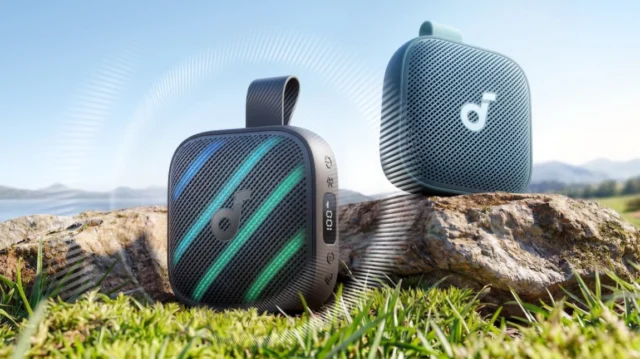
A small speaker trying to behave like a bigger one
Portable Bluetooth speakers are easy to underestimate. On paper, the recipe looks almost trivial: put a driver, a small amplifier, a battery and a Bluetooth module into a compact enclosure, add a few buttons, and the product is ready. In practice, this category is full of compromises. Some tiny speakers are loud but harsh. Others have decent mids but no bass. Many look rugged but sound thin, while others sound acceptable only until the volume is pushed above living-room level.
The Soundcore Boom Go 3i enters this crowded field with a more ambitious idea. It is not trying to be a cheap pocket speaker for occasional background music. It wants to be a small, weatherproof, outdoor-ready Bluetooth speaker that can survive real use, deliver more punch than its size suggests, and add a few extras that are genuinely useful rather than purely decorative.
That is a difficult balance to strike. A speaker this small cannot defeat physics, but clever engineering can stretch the limits surprisingly far. The Boom Go 3i does exactly that: it packages a 15 W mono audio system, BassUp 2.0 bass enhancement, IP68 protection, RGB lighting, a flexible strap, a battery display, app-based EQ control, multipoint Bluetooth, TWS pairing, Auracast support and even an emergency alarm into a body that is still small enough to throw into a backpack without thinking about it.
It is not the cheapest mini Bluetooth speaker around, but after using it, it becomes clear that Soundcore is not selling only volume or only design. The Boom Go 3i is built around a complete outdoor-use concept.
Design and build quality
The Boom Go 3i is compact, dense and deliberately rugged. Its body measures roughly 102 × 106 × 46 mm and weighs about 370 grams, which puts it into the “small but not toy-like” category. It feels substantial in the hand without becoming annoying to carry.
The design is modern but not overdone. Depending on market availability, the speaker is offered in multiple colors, with black and blue among the most typical versions. The front grille hides both the driver area and the LED lighting strips, while the sides carry the physical controls and the small display. The shape is rounded and friendly, but that also means one small practical limitation: it does not stand especially confidently on every side. A flatter side panel would have made positioning easier on a desk, shelf or stone wall.
The speaker’s outdoor personality is more important than its decorative side. The Boom Go 3i has an IP68 rating, meaning it is designed to resist dust ingress and withstand immersion in water under defined test conditions. It is also built to tolerate accidental drops from around one meter, which matters more in real life than most people admit. Small speakers are often clipped to bags, placed near pools, carried to beaches, used on bicycles or thrown into picnic gear. They fall. They get wet. They collect dust. A speaker that cannot handle that lifestyle has limited value as a truly portable device.
The Type-C port is water-resistant even without a traditional rubber flap. This is convenient, because flap-covered ports often become the weakest point on rugged gadgets after a year or two of use. The side buttons are rubberized and easy enough to find by touch, although the compact body means they are naturally close together.
The box contents are simple: the speaker, a USB-C to USB-C cable of about 0.6 m, and basic documentation. There is no carry case and no included carabiner. That sounds like a missing accessory at first, but Soundcore has chosen a better integrated solution.
The strap is more important than it looks
Many compact outdoor speakers rely on a small loop and a carabiner. That works, but it is not very flexible. You can hang the speaker from something, but you cannot always fasten it tightly to a specific object.
The Boom Go 3i uses an integrated silicone strap on the back. It can be locked into pre-formed slots in more than one configuration, which makes it far more useful than a basic hanging loop. You can create a simple carrying loop, attach it to a backpack, hang it from a hook, or secure it more firmly around a pole, railing, bicycle frame, fence, tent structure or similar object.
This is one of the speaker’s best practical features. It does not look dramatic in product photos, but in use it makes the speaker easier to place, harder to lose and more adaptable outdoors. A rugged speaker is only useful if you can put it where the sound actually works, and the Boom Go 3i gives you more options than most pocket-size competitors.
Audio hardware and sound character
The Boom Go 3i uses a mono speaker arrangement built around a 2-inch driver supported by a passive radiator-style bass chamber. Soundcore rates the output at 15 W, with peak loudness up to 92 dB. For a speaker of this size, those numbers are notable. Many compact Bluetooth speakers in this physical category sit closer to the 7–10 W range, so Soundcore is clearly pushing the enclosure harder than average.
The first thing to understand is that this is still a small mono speaker. It will not create the scale, stereo width or effortless low-frequency authority of a larger portable speaker. It is not a replacement for a party speaker, a bookshelf system or a proper stereo setup.
But within its size class, the Boom Go 3i performs very well. The sound is warm, energetic and fuller than expected. BassUp 2.0 plays a major role here. With BassUp enabled, the low end gains real body, especially with pop, electronic music, hip-hop, dance tracks and modern compressed streaming mixes. The bass does not become subwoofer-deep, because that would be physically unrealistic, but it gives the sound enough weight to avoid the thin, plastic character that many pocket speakers suffer from.
The midrange is more important than the bass in everyday listening, and this is where the Boom Go 3i avoids a common mistake. Some small speakers exaggerate the low end so aggressively that vocals become muddy. Here, voices remain understandable even when BassUp is active. Podcasts, YouTube videos, acoustic music and vocal-heavy tracks are still pleasant to listen to.
The treble is slightly more restrained. Out of the box, the speaker leans toward warmth rather than sparkle. This is not necessarily a problem outdoors, where overly sharp highs can become tiring, but listeners who prefer a brighter sound will probably want to adjust the EQ in the Soundcore app.
BassUp 2.0 and equalizer control
BassUp 2.0 is not just a marketing label on this speaker. It changes the perceived size of the Boom Go 3i quite dramatically. With BassUp disabled, the speaker becomes cleaner but noticeably lighter. With BassUp enabled, it sounds more confident, more fun and more appropriate for outdoor background music.
The good part is that Soundcore does not force one sound profile on everyone. The speaker has a physical control for switching bass enhancement, and the app gives deeper control through presets and custom equalizer settings.
This matters because small speakers are highly sensitive to placement and music style. A speaker hanging from a bicycle frame outdoors may need a different EQ than the same speaker placed on a kitchen counter. Bass-heavy dance music may benefit from BassUp, while spoken-word content may sound clearer with a flatter profile. The app makes those adjustments simple enough to be worth using.
In this category, app support can feel like an unnecessary extra. With the Boom Go 3i, it is actually part of the product’s value. The difference between presets is large enough that users should not judge the speaker only by its default sound.
Bluetooth, codecs and connectivity
The Boom Go 3i supports Bluetooth 6.0, which gives it a modern wireless foundation. In practical use, connection stability is strong, pairing is straightforward, and latency is acceptable for casual video watching. The speaker also supports AAC, which is useful for Apple devices and many modern smartphones.
There is no 3.5 mm analog input. That may disappoint users who still like wired sources, older MP3 players, shortwave receivers or small radios with headphone outputs. For mainstream use, however, this is becoming normal. The Boom Go 3i is clearly designed as a wireless-first product.
Multipoint support is a useful addition. It allows more than one source device to be paired and managed, which is convenient if the speaker is shared between a phone and a tablet, or between two people during travel.
The more advanced wireless feature is multi-speaker support. Two Boom Go 3i units can be paired in TWS mode for a wider stereo effect, while Auracast support opens the door to larger synchronized speaker setups with compatible devices. On a single unit, the sound is mono and compact. With two units, the product becomes much more interesting for users who want a small but flexible stereo system for a room, terrace or campsite.
Controls and display
The side controls cover the basics: volume, playback and mode-related functions. The play/pause button behaves in a familiar headphone-style way, with double and triple presses used for track skipping. This makes the speaker easy to control without reaching for the phone.
The second side panel is more distinctive because it includes a small display. Its most useful role is showing battery status. Many Bluetooth speakers still rely on vague LED dots or app-only battery information, so a real display is welcome. It makes the Boom Go 3i feel more complete and more practical.
The display also shows operating modes, including BassUp, normal and Eco modes. Eco mode disables BassUp and lighting to preserve battery life. That is useful because the RGB lighting is fun, but not always necessary. During long outdoor use, battery life is often more valuable than visual effects.
The only missed opportunity is that the display could have shown more information. A volume level indicator, Bluetooth source status or EQ mode label would have made it even more useful.
RGB lighting without becoming ridiculous
RGB lighting on small speakers can easily feel childish or unnecessary. On the Boom Go 3i, the implementation is better than expected. The lighting is integrated behind the front grille in four lines, so it does not dominate the design when turned off.
The speaker offers multiple music-reactive lighting modes and several ambient lighting styles. Colors can also be customized in the app. For evening use, camping, balcony listening or small gatherings, the LEDs add atmosphere without turning the speaker into a cheap disco toy.
Still, lighting has a cost. It reduces battery life. Soundcore wisely allows users to switch it off, and many people will do exactly that during long trips or daytime outdoor use.
Battery life and powerbank function
The Boom Go 3i has a 4800 mAh internal battery. Soundcore claims up to 24 hours of playback under favorable conditions, although real-world runtime depends heavily on volume, BassUp, lighting and temperature. At moderate volume with lighting disabled, the speaker can last a full day of casual use. At higher volume with BassUp and RGB effects active, battery life will naturally drop.
The built-in battery can also be used as an emergency power source through the USB-C port. This is not a replacement for a dedicated powerbank, and it should not be treated as one. The capacity is modest compared with proper travel powerbanks, and charging speed is not the main purpose of the device.
But as an emergency feature, it makes sense. If a phone is nearly dead during a trip, walk, beach day or outdoor event, the Boom Go 3i can provide enough charge to keep it alive. In practical terms, it can bring a modern smartphone from empty to a partially usable level rather than fully recharge it quickly. That is still valuable when navigation, messaging or emergency calls matter.
Outdoor safety features
One unusual feature is the emergency alarm mode. By pressing the power button five times, the speaker can emit a loud alarm rated up to 92 dB. This is not something most users will need every day, but it fits the product’s outdoor identity.
For hiking, camping, cycling, boating, beach use or crowded public spaces, an attention-grabbing alarm can be useful. It is not a substitute for dedicated safety gear, but it is a sensible extra for a rugged portable speaker.
The rugged housing, strap, IP68 rating, strong output and alarm mode all point in the same direction: Soundcore has designed this as a speaker for movement, not just for a desk.
Real-world listening impressions
The Boom Go 3i sounds larger than it looks. That is the simplest way to describe it.
At low and medium volume, it has an inviting, warm character. It is enjoyable for casual listening, background music, YouTube, podcasts and travel use. The bass is present enough to make popular music feel alive, and the mids remain clear enough for vocals.
At higher volume, the speaker still holds together better than many compact rivals. It does not immediately collapse into harsh distortion, although the physical limits become more obvious. Very bass-heavy tracks at high volume will naturally expose the limits of the small enclosure. This is not a miracle device; it is a carefully tuned compact speaker.
The soundstage is limited because the speaker is mono. There is no real stereo separation from a single unit. That matters less outdoors, where reflections and listening position are less controlled, but it is noticeable indoors. Users who care about stereo imaging should consider buying two units and using TWS pairing.
For its size, the Boom Go 3i belongs near the top of the compact rugged speaker category. It is not the absolute loudest small speaker, and it is not the most neutral. Its strength is the combination of volume, bass weight, portability, ruggedness and feature depth.
Price and value
In Western Europe and the United States, the Soundcore Boom Go 3i sits in the upper part of the compact Bluetooth speaker category rather than in the budget segment. Depending on launch offers, retailer pricing and local taxes, buyers should expect it to compete roughly in the €70–90 / $80–100 range.
That price positioning is important. The Boom Go 3i is not aimed at users who simply want the cheapest possible small Bluetooth speaker. There are plenty of lower-cost models for casual indoor listening or occasional background music. Soundcore is instead targeting buyers who want a compact speaker that feels more complete: rugged construction, IP68 protection, a useful integrated strap, strong battery life, app-based sound tuning, RGB lighting, Bluetooth 6.0, multipoint pairing, TWS/Auracast support and emergency powerbank functionality.
In that context, the price becomes easier to justify. The Boom Go 3i is still small enough to carry anywhere, but it does not feel like a disposable travel gadget. It is closer to a premium mini outdoor speaker: not large, not cheap, but clearly designed for people who expect their speaker to survive beaches, backpacks, terraces, bikes, poolsides and weekend trips.
For buyers in the EU and US, the most important question is not whether this is the cheapest speaker in its size class. It is whether the extra features are worth paying for. If ruggedness, portability, bass response, long battery life and app control matter, the Boom Go 3i offers a stronger overall package than many generic compact Bluetooth speakers.
What could be better
The Boom Go 3i is strong, but not perfect.
The mono sound limits spatial presentation. A second unit solves that, but also doubles the cost. The treble could be more open by default, although EQ adjustment helps. The display is useful but could show more information. The rounded side panels make some placement positions less stable than they could be. There is no analog input, which will bother a small but technically minded group of users.
The powerbank feature is useful, but buyers should treat it as a backup function rather than a serious charging solution. The RGB lighting is pleasant, but not essential, and many users will disable it to extend runtime.
None of these issues ruin the product, but they are worth knowing before buying.
Who should buy the Soundcore Boom Go 3i?
The Boom Go 3i makes the most sense for people who want a rugged everyday speaker rather than a fragile desk gadget. It is well suited for travel, garden use, beach days, cycling breaks, camping, workshops, hotel rooms, balconies, poolside listening and casual outdoor gatherings.
It is also a good choice for users who value practical design details. The silicone strap, IP68 protection, battery display and app-based EQ are not decorative features. They make the speaker easier to use in real situations.
It is less ideal for audiophiles looking for neutral stereo sound, users who need a wired input, or buyers who simply want the loudest speaker for the lowest price. Physics still applies, and a pocket-size mono speaker cannot replace a larger system.
The Soundcore Boom Go 3i is not impressive because it is tiny. It is impressive because it behaves like a mature outdoor speaker despite being tiny.
Its strongest qualities are not isolated specifications, but the way those specifications work together. The 15 W output gives it real presence. BassUp 2.0 helps it avoid thinness. The app lets users reshape the sound. IP68 protection makes it suitable for rougher environments. The silicone strap is genuinely practical. The display is useful. The battery is strong enough for long listening sessions. The emergency alarm and powerbank mode add extra security for outdoor use.
It is not cheap in the way generic Bluetooth speakers are cheap. It is also not trying to be. The Boom Go 3i is a compact, rugged, feature-rich Bluetooth speaker that feels designed by people who understand how portable speakers are actually used.
For summer travel, outdoor listening and everyday carry, it is one of the more complete small Bluetooth speakers in its class.
Image(s) used in this article are either AI-generated or sourced from royalty-free platforms like Pixabay or Pexels.
This article may contain affiliate links. If you purchase through these links, we may earn a commission at no extra cost to you.
Get the weekly RF & IT briefing
Radio guides, RF calculators, AI, Windows, Linux and satellite communication explainers. One useful email per week. No spam.