Ferrari has always been associated with mechanical passion.
For decades, the company built its identity around roaring combustion engines, dramatic exhaust notes, razor-sharp throttle response, and interiors focused almost entirely on driving. Traditional Ferraris did not need giant displays or futuristic user interfaces to feel special. The emotional experience came from mechanical interaction itself — the sound behind the driver’s head, the vibration through the chassis, the aggressive movement of the tachometer needle climbing toward redline.
But the automotive world is changing rapidly.
Electrification is rewriting the rulebook for high-performance cars, and manufacturers are now facing a difficult challenge: how do you preserve emotion in a vehicle that no longer produces the same mechanical theater as a naturally aspirated V12?
The Ferrari Luce represents one of the company’s boldest answers yet.
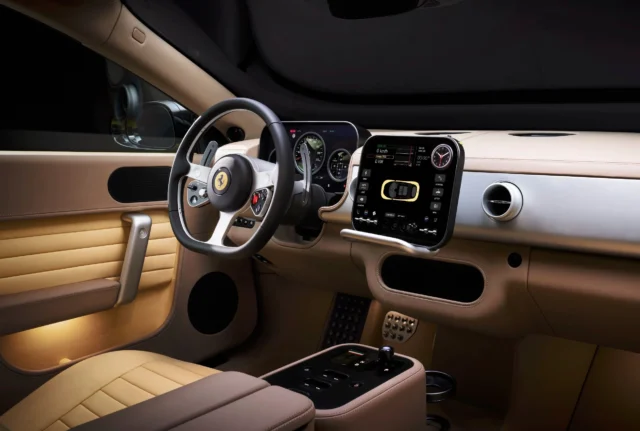
Instead of trying to imitate the past, Ferrari embraced a radically futuristic direction. The Luce is not simply Ferrari’s first fully electric grand touring machine. It is also a rolling technology statement that completely rethinks what a luxury performance car interior can look and feel like in the age of advanced digital interfaces.
At the center of that transformation stands an unexpectedly important player: Samsung Display.
The South Korean technology giant became the exclusive supplier of every major display inside the Ferrari Luce, engineering some of the most unusual automotive OLED panels ever installed in a production vehicle. What Ferrari and Samsung created together goes far beyond oversized infotainment screens or conventional digital instrument clusters.
The Luce introduces layered OLED structures, mechanical components floating between display layers, giant precision-cut openings inside AMOLED panels, rotating infotainment systems, and one of the most experimental cockpit architectures the automotive industry has seen in years.
This is not just another luxury EV dashboard.
It is closer to industrial art fused with advanced display engineering.
Why Ferrari Needed To Reinvent The Interior Experience
The arrival of Ferrari’s first fully electric flagship presented a serious identity problem for the company.
Traditional Ferrari models naturally generated emotional engagement through mechanical behavior:
- Engine acoustics
- Gear shifts
- Vibration
- Analog gauges
- Physical driver feedback
- Combustion drama
Electric drivetrains fundamentally alter that sensory experience.
Even the fastest electric vehicles often feel eerily silent compared to traditional supercars. Instant torque delivers brutal acceleration, but the emotional rhythm of an internal combustion engine disappears.
That forced luxury manufacturers into a new kind of competition.
Instead of relying only on mechanical engineering, brands increasingly differentiate themselves through:
- Interior design
- Software experience
- Ambient lighting
- Interface design
- Display technology
- Cabin atmosphere
Ferrari understood that the Luce could not simply receive a generic oversized touchscreen like countless other modern EVs.
The interior itself needed to become emotionally engaging.
This is where the collaboration with Samsung Display and the LoveFrom design studio — founded by legendary former Apple designer Jony Ive — became critically important.
Their mission was ambitious:
Create a cockpit that feels futuristic without becoming cold or sterile.
The Death Of The “Tablet On Dashboard” Era
Modern automotive interiors increasingly suffer from the same design problem.
Manufacturers simply place larger and larger flat screens across the dashboard and call the result futuristic.
In many vehicles, infotainment systems now resemble oversized tablets awkwardly glued onto otherwise conventional interiors.
Ferrari clearly wanted to avoid this trend.
The Luce dashboard does not revolve around a single giant rectangular display. Instead, the entire cabin functions as a layered visual ecosystem where displays, lighting, physical materials, and mechanical elements blend together into a unified experience.
The dashboard architecture immediately looks different from anything currently dominating the EV market.
Rather than focusing on pure screen size, Ferrari focused on:
- Visual depth
- Physical layering
- Dynamic motion
- Material contrast
- Mechanical integration
- Spatial illusion
This makes the cockpit feel less like consumer electronics and more like a futuristic luxury instrument panel from a science-fiction film.
Samsung’s Multi-Layer OLED System Is Unlike Anything In Production Cars
The technical centerpiece of the Ferrari Luce is its astonishing dual-layer AMOLED instrument cluster.
Samsung engineers developed a completely new automotive display architecture specifically for the vehicle.
Most modern digital instrument clusters use a single flat display behind protective glass. Even expensive luxury EVs generally follow this basic concept.
The Luce abandons that approach entirely.
Instead, Ferrari and Samsung created a multi-layer OLED structure where several visual systems coexist physically within the same dashboard space.
The setup combines:
- A 12-inch lower OLED display
- A 12.9-inch upper OLED display
- Mechanical analog needles positioned between the display layers
- Dynamic real-time overlays
- Floating visual elements
- Physically separated information zones
The lower OLED layer handles foundational visual elements such as:
- Instrument graphics
- Background environments
- Interface structure
- Speed and vehicle indexes
The upper 12.9-inch OLED layer contains three large circular openings, allowing sections of the lower display to remain visible underneath.
This immediately creates an unusually strong sense of depth.
Instead of looking like flat software graphics, information appears physically separated in space.
The upper display layer handles dynamic content including:
- Warning alerts
- Navigation information
- Weather data
- Clock functions
- Travel notifications
- Driving mode indicators
Positioned between the OLED layers are actual mechanical needles that move differently depending on active drive modes and interface configurations.
This hybrid analog-digital approach creates a visual experience unlike conventional fully digital dashboards.
Ferrari Quietly Solved One Of The Biggest Problems With Modern EV Interiors
Many modern electric vehicle cabins look technologically impressive at first glance, but over time they can feel emotionally empty.
Completely flat digital interfaces often lack physical character.
Ferrari appears to understand something many automakers forgot:
Luxury is not just about technology.
It is about emotional interaction.
The Luce dashboard restores some of that emotional depth through physical movement.
Mechanical needles still matter psychologically because human eyes naturally respond to:
- Real motion
- Mechanical inertia
- Physical depth
- Reflections
- Material texture
This is one reason luxury mechanical watches remain desirable despite smartphones displaying time more accurately.
Ferrari applied the same principle to the Luce cockpit.
The dashboard does not merely display information.
It performs visually.
Samsung Had To Push OLED Manufacturing Far Beyond Smartphone Technology
One of the most fascinating technical details behind the Luce project involves the extreme manufacturing complexity of the OLED panels themselves.
According to Samsung Display engineers, the company relied heavily on advanced HIAA technology — short for Hole In Active Area.
This manufacturing process allows engineers to create openings directly inside active OLED display regions.
Most consumers already encountered smaller versions of this technology in smartphones, where tiny OLED cutouts are used for front-facing cameras.
But Ferrari demanded something dramatically more ambitious.
Samsung reportedly had to engineer openings approaching 100 millimeters in diameter inside automotive-grade OLED panels.
That is an enormous challenge.
Creating giant holes inside active OLED layers introduces serious engineering problems involving:
- Structural stability
- Electrical continuity
- Thermal behavior
- Brightness consistency
- Mechanical durability
- Pixel reliability
And unlike smartphones, automotive displays must survive extremely harsh operating environments.
The Ferrari Luce displays need to tolerate:
- Summer heat inside parked vehicles
- Long-term UV exposure
- Continuous vibration
- Temperature cycling
- Humidity fluctuations
- Multi-year durability requirements
This forced Samsung Display to develop manufacturing approaches far beyond conventional consumer electronics production.
The Luce effectively became a technology showcase demonstrating how flexible OLED engineering can become when cost limitations are removed.
The Rotating Center Screen Feels Almost Cinematic
The Ferrari Luce also abandons traditional infotainment layout conventions.
The center OLED display measures 10.1 inches, but even this screen received unusual treatment.
Ferrari designers requested a physically perforated OLED structure to integrate a traditional three-hand analog clock directly into the display area.
Once again, the company intentionally merged classic luxury aesthetics with futuristic display engineering.
But perhaps the most visually dramatic feature is the screen’s ability to rotate left or right depending on whether the driver or passenger wants primary control access.
This creates a surprisingly theatrical interaction.
Most vehicles treat displays as static components.
The Luce turns them into moving architectural elements within the cabin itself.
While rotating automotive displays have appeared before in experimental luxury vehicles, Ferrari’s implementation feels unusually integrated into the overall cockpit philosophy rather than functioning as an isolated gimmick.
The movement itself becomes part of the experience.
Even Rear Passengers Receive A Futuristic Interface
Rear-seat passengers were not ignored either.
A fourth OLED display is integrated into the rear central tunnel section between the seats.
At 6.3 inches, the panel is physically smaller than many modern smartphones, yet it still controls important comfort functions including:
- Multi-zone climate control
- Cabin settings
- Passenger information
- Time display
- Secondary comfort adjustments
This reflects how luxury electric vehicles are evolving.
High-end EVs increasingly function less like traditional automobiles and more like mobile digital living spaces.
Every passenger now expects interaction, customization, and personalized interface access.
OLED Technology Is Becoming The New Luxury Standard
The Ferrari Luce also highlights a much broader industry transition.
OLED displays are rapidly becoming the premium standard for luxury automotive interiors.
Compared to traditional LCD technology, OLED offers several major advantages:
- Perfect black levels
- Higher contrast ratios
- Faster response times
- Better viewing angles
- Flexible shapes
- Extremely thin construction
- Improved visual depth
For automotive designers, the most important advantage may actually be physical flexibility.
OLED panels can be:
- Curved
- Layered
- Transparent
- Perforated
- Ultra-thin
- Custom-shaped
This gives designers dramatically more creative freedom compared to rigid LCD panels.
The Luce demonstrates just how extreme that flexibility can become.
Ferrari’s Dashboard Looks More Like Luxury Architecture Than Consumer Electronics
One of the most striking aspects of the Luce interior is how carefully Ferrari avoided making the cabin feel like a giant smartphone.
Many modern EV interiors unintentionally resemble oversized consumer electronics products.
Ferrari instead approached the cockpit more like architectural design.
The layered OLED structures, floating mechanical components, and deep visual separation create a space that feels sculptural rather than purely digital.
The dashboard changes depending on:
- Lighting conditions
- Drive modes
- Vehicle state
- User interaction
- Interface animations
This dynamic personality helps the cabin feel alive rather than static.
The Luce May Influence The Entire Automotive Industry
Ultra-expensive halo vehicles often preview technologies that later appear across the wider industry.
Ferrari likely understands that relatively few people will ever purchase a Luce.
But the vehicle serves another purpose:
It demonstrates what future automotive interiors could become.
The project may influence future developments involving:
- Layered dashboards
- Dynamic physical interfaces
- Hybrid analog-digital instrumentation
- Advanced OLED shaping
- Interactive cockpit architecture
- Emotion-focused EV interior design
In many ways, the Luce feels less like a traditional Ferrari product and more like a concept car accidentally allowed into production.
Why Luxury Car Design Is Becoming Increasingly Software-Driven
For decades, performance car development focused primarily on mechanical engineering.
Now software and interface design increasingly shape the ownership experience.
Modern luxury vehicles compete not only through horsepower but also through:
- UI responsiveness
- Display quality
- Visual design
- Cabin interaction
- Personalization
- Digital ecosystems
Samsung’s involvement in the Luce reflects this industry shift perfectly.
Display manufacturers are becoming just as important to luxury vehicle development as engine suppliers once were.
In the EV era, the cockpit experience itself becomes a defining part of the brand.
Ferrari Still Understands Emotion Better Than Most EV Manufacturers
Many electric vehicles emphasize efficiency, autonomy, and technology, but often struggle to create emotional attachment.
The Ferrari Luce appears to approach electrification differently.
Rather than minimizing drama, Ferrari amplified it through visual and interactive design.
The OLED architecture creates movement.
The layered displays create depth.
The rotating screen creates theater.
The mechanical needles preserve physical emotion.
Everything inside the cabin seems engineered to make the driver feel something.
That may ultimately become Ferrari’s greatest advantage in the electric era.
Samsung Quietly Turned The Luce Into A Showcase Of OLED Engineering
For Samsung Display, the Ferrari Luce represents much more than another supplier partnership.
It functions as a global demonstration of what advanced OLED technology can achieve inside future vehicles.
Automotive displays are becoming one of the fastest-growing premium technology sectors because modern vehicles increasingly contain:
- Multiple dashboard displays
- Passenger entertainment panels
- Interactive surfaces
- HUD systems
- Smart control interfaces
Winning a project as visually radical as the Luce immediately positions Samsung as a leader in high-end automotive display innovation.
And given the technical complexity involved, competitors will likely need years to match some of these manufacturing capabilities.
The Ferrari Luce Feels Like A Glimpse Into The Next Decade
The most fascinating aspect of the Ferrari Luce may be how dramatically different it feels from today’s mainstream EV design language.
Many current electric cars focus heavily on minimalist interiors dominated by giant flat screens.
Ferrari instead chose complexity, layering, motion, and visual richness.
The result feels closer to cinematic science fiction than conventional automotive design.
Whether this exact design philosophy becomes mainstream remains uncertain.
But the Luce clearly demonstrates one thing:
The future of luxury performance cars may depend just as much on display engineering and interface design as on motors, batteries, or acceleration figures.
And in the Ferrari Luce, Samsung’s OLED technology became every bit as important to the vehicle’s identity as the electric drivetrain hidden underneath the bodywork.
Image(s) used in this article are either AI-generated or sourced from royalty-free platforms like Pixabay or Pexels.
This article may contain affiliate links. If you purchase through these links, we may earn a commission at no extra cost to you.
Get the weekly RF & IT briefing
Radio guides, RF calculators, AI, Windows, Linux and satellite communication explainers. One useful email per week. No spam.