Tesla’s european FSD rollout reaches a new stage
Tesla’s Full Self-Driving story in Europe has entered a new and more serious phase. After years of delays, regulatory caution and repeated uncertainty, the company’s supervised driving system is no longer only a North American product waiting on the sidelines of the European market. The Netherlands opened the door first, and Lithuania has now become another important step in the system’s country-by-country expansion.
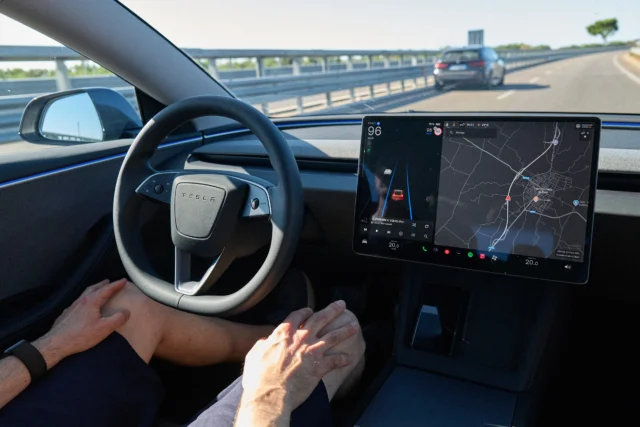
This does not mean that Tesla cars in Europe are suddenly autonomous vehicles. It does not mean that drivers can stop watching the road, take their hands and attention away, or treat the vehicle as a robotaxi. The system remains FSD Supervised, which means the car can perform advanced driving tasks under human oversight, while the human driver remains responsible at all times.
That distinction is central to the entire debate. Tesla uses the term Full Self-Driving, but European regulators have been careful to frame the approved system as a driver assistance system rather than true self-driving. Even with that limitation, the latest development is significant. Lithuania’s move shows that the Dutch approval may not remain an isolated national case. It may become a template other European countries can follow while the broader EU process continues.
Why Lithuania matters more than its market size
Lithuania is not one of Europe’s largest car markets. With a population of roughly three million people, it cannot match Germany, France, Italy, Spain or the Netherlands in terms of vehicle volume. On paper, it is a small market.
But in regulatory terms, small countries can matter.
The importance of Lithuania’s move is not mainly about how many Tesla owners can activate FSD Supervised there. The importance is symbolic and procedural. If another EU member state accepts the regulatory path opened by the Netherlands, it supports the idea that Tesla’s system can spread through national recognition before a full EU-wide decision is completed.
That creates momentum.
For Tesla, every additional European country helps demonstrate that FSD Supervised is not only a Dutch exception. For regulators, it adds pressure to clarify how advanced driver assistance systems should be treated under European law. For drivers, it suggests that the long-delayed arrival of Tesla’s most controversial software package in Europe may finally be moving from promise to deployment.
The Netherlands opened the door first
The current European phase began with the Netherlands. On April 10, 2026, the Dutch vehicle authority issued a type approval with provisional validity for Tesla’s FSD Supervised system. The approval followed a long evaluation process, including testing and regulatory review.
That approval was important because the Netherlands has long played a central role in Tesla’s European regulatory strategy. It is also where Tesla’s European headquarters are located, and Dutch authorities have been involved in earlier Tesla-related approval processes.
The Dutch decision did not create instant EU-wide availability. Instead, it established a national approval and opened a path for potential wider recognition. The issue was then moved into the EU-level process, where broader approval may still require a formal decision by the relevant European bodies.
This is why the Lithuanian development matters. If EU-wide approval is still pending, individual national decisions can shape the political and regulatory climate before Brussels reaches a final position.
What FSD supervised actually does
Tesla’s FSD Supervised is an advanced driver assistance system designed to handle a wide range of driving tasks. Depending on software version, market and regulatory limitations, it can steer, accelerate, brake, follow navigation routes, change lanes, respond to traffic signals and manage many everyday road situations.
However, the supervised label is not decorative. It defines the legal and operational nature of the system.
The driver must monitor the road. The driver must be ready to intervene. The driver remains responsible for the vehicle. The car is not legally a fully autonomous vehicle. It is not a Level 4 system in the legal sense, even if some of its behavior may appear more capable than traditional lane keeping or adaptive cruise control.
This is one of the most important misunderstandings around Tesla’s software. Many observers compare FSD Supervised with full autonomy because the vehicle can appear to perform complex driving tasks on its own. But under European approval logic, the presence of human supervision changes the classification entirely.
The system may be technically impressive. It may reduce workload in certain situations. It may eventually become the foundation for higher levels of autonomy. But the current approved European version is still a supervised driver assistance system.
Why the name remains controversial
The phrase “Full Self-Driving” has always been controversial. Critics argue that it suggests more autonomy than the system legally provides. Tesla and its supporters counter that the product name is paired with “Supervised” and that the driver is repeatedly told to remain attentive.
European regulators have been particularly cautious about this issue because driver misunderstanding can become a safety risk. If drivers believe the car is more autonomous than it really is, they may supervise less effectively. That problem is not unique to Tesla, but Tesla’s naming makes the debate sharper.
This is why European authorities often avoid describing the system as real self-driving. They prefer language such as driver assistance, supervised driving or driver-controlled assistance. The difference may sound semantic, but in traffic safety and liability law it is critical.
A system that assists the driver and a system that replaces the driver are not the same thing. FSD Supervised belongs to the first category.
Belgium was expected to move quickly
Before Lithuania became the next visible step, Belgium appeared to be a strong candidate for early progress. Belgian officials had publicly indicated that they wanted to move quickly with the technology, and testing activity had already drawn attention.
Belgium therefore seemed positioned to become one of the next important markets in Tesla’s European FSD expansion. However, testing approval is not the same as consumer rollout. A limited public-road test is a regulatory step, not a market launch.
Lithuania’s importance is that it appears to have moved directly into recognition and rollout territory, rather than only supervised testing.
That makes the European map more complicated. The rollout may not follow market size, political visibility or public expectation. Smaller countries may move faster if their authorities are willing to recognize the Dutch approval path.
Country-by-country expansion could happen before EU-wide approval
The European Union is designed to reduce regulatory fragmentation, especially in areas such as vehicle type approval. In an ideal single-market process, a system approved under the right EU framework can be recognized across member states.
In practice, emerging technologies often move through a more complicated path. Tesla’s FSD Supervised is not a conventional feature covered neatly by older regulations. It sits between traditional driver assistance and higher automation. This makes national regulators cautious and creates space for provisional or country-specific decisions.
This is the real regulatory story. Lithuania is not just another country on a list. It is evidence that the national-recognition route may be viable, at least in the short term.
If more member states accept the same logic, Tesla may not need to wait passively for a single continent-wide approval before expanding availability. At the same time, a fragmented rollout could create legal and practical complications for drivers who cross borders.
What this means for Tesla owners in Europe
For Tesla owners in Europe, the development is important but uneven. It does not mean that every Tesla owner in every EU country can immediately activate FSD Supervised. Availability depends on country approval, software version, vehicle hardware, Tesla’s rollout schedule and any required user training or activation process.
In the Netherlands, the launch was expected to proceed carefully rather than as an unrestricted switch-on for all users. Similar controls would be expected in other markets because regulators are unlikely to accept a completely unrestricted release of such a system.
Hardware compatibility may also matter. Tesla has several hardware generations on European roads, including older cars with previous Autopilot hardware and newer cars equipped with more capable computer and camera configurations. The exact rollout may not be identical across all vehicles.
For owners, the practical message is simple: FSD Supervised in Europe is no longer theoretical, but availability remains country-specific and vehicle-specific.
Why this could help Tesla in Europe
Tesla has faced a much more difficult European market in recent years. Competition from Chinese and European EV makers has increased sharply. Price pressure has intensified. Model Y and Model 3 remain important products, but Tesla no longer has the same uncontested technological halo it enjoyed earlier in the EV transition.
FSD Supervised could help restore some of that differentiation.
Many electric cars now offer strong acceleration, long range, fast charging and modern infotainment. Tesla’s advantage increasingly depends on software, efficiency, charging infrastructure and autonomous-driving credibility. If FSD Supervised becomes available in more European countries, Tesla can again market a feature that many competitors cannot match at the same level of public visibility.
This does not automatically translate into higher sales. Some buyers distrust Tesla’s autonomy claims. Some European drivers may not want to pay for FSD. Some regulators may restrict the system heavily. But from a brand perspective, European FSD availability gives Tesla a stronger technology narrative at a time when the company needs one.
Why regulators remain cautious
European regulators have good reasons to move carefully. Advanced driver assistance systems can create new safety risks if drivers overtrust them. A system that performs well most of the time may still fail in rare, complex or ambiguous situations. Those edge cases are exactly where human supervision becomes essential.
There are also broader legal questions. If a supervised system makes a mistake and the driver fails to intervene, responsibility remains with the driver. But if the system’s interface, marketing or behavior encouraged overtrust, regulators may still ask whether the manufacturer contributed to the risk.
This is why approval processes involve more than technical capability. Regulators examine driver monitoring, warnings, operational limits, human-machine interface design, training requirements, safety claims and real-world evidence.
The difference between technical capability and legal autonomy
One of the biggest challenges in covering Tesla FSD is separating what the car can do from what the law allows it to be.
A vehicle may be technically capable of navigating many urban and highway scenarios without driver input for extended periods. That does not automatically make it legally autonomous. Legal autonomy depends on system certification, operational design domain, responsibility transfer, fallback behavior and regulatory classification.
In a Level 4 autonomous system, the vehicle can perform the driving task within a defined area or condition without expecting the human to supervise every moment. In FSD Supervised, the driver remains the fallback. That places it in a different category.
This is why calling the system “self-driving” without context can be misleading. It may describe the visual impression of the car’s behavior, but it does not describe the legal framework. The approved European version is best understood as a highly capable supervised driving assistance system.
Why Lithuania may accelerate the domino effect
The phrase “domino effect” is often overused in technology news, but in this case it may be appropriate. Once one EU country approves or recognizes a system, others can examine that decision rather than starting from zero. If a second country follows, the political cost of being third becomes lower.
Lithuania’s decision may therefore matter because it reduces the sense that the Netherlands is alone. Other smaller or innovation-friendly countries may now have a clearer path. They can look at the Dutch assessment, the Lithuanian recognition and Tesla’s operational controls, then decide whether their own national framework allows similar treatment.
This does not guarantee rapid Europe-wide adoption. Larger countries may still demand more evidence. Some regulators may remain skeptical. But the regulatory conversation changes once more than one member state is involved.
For Tesla, that momentum is valuable.
What could happen next
The next stage is likely to involve three parallel tracks.
The first track is national recognition. More EU countries may decide to follow the Dutch approval route and allow FSD Supervised under local conditions. These countries may not wait for a full EU-wide decision.
The second track is formal EU review. European institutions and technical committees may continue examining whether the system can be accepted more broadly. That process may involve additional questions, data requests and political negotiation between member states.
The third track is real-world monitoring. Once the system is used by actual customers on European roads, regulators will watch safety data, user behavior, incident reports and compliance with supervision rules. A smooth rollout could strengthen Tesla’s case. Problems could slow or reverse momentum.
This means the Lithuanian launch is not the end of the approval story. It is part of the early operational phase.
The safety debate will not disappear
Tesla supporters often argue that FSD Supervised can reduce crashes by improving lane discipline, reaction time, object detection and consistency. Critics argue that the system still makes unpredictable mistakes and that human supervisors may become complacent.
Both sides focus on safety, but they define the problem differently.
Supporters compare the system with ordinary human driving and ask whether it reduces risk overall. Critics focus on automation-specific failure modes and ask whether drivers can reliably supervise a system that works well most of the time but may fail suddenly.
That second question is especially important. Human attention is not perfect. If a system handles 99 routine situations correctly, the driver may be less prepared for the one situation where intervention is needed. This is a known challenge in partially automated driving.
European regulators therefore need more than impressive demonstration videos. They need evidence that the system, the driver monitoring process and the user instructions together produce safer real-world behavior.
Why FSD supervised is important for the future of autonomy
Even though FSD Supervised is not full autonomy, it may be a necessary bridge toward more advanced systems. Tesla’s strategy relies heavily on collecting real-world driving data, improving neural-network-based behavior and expanding software capability through fleet learning.
A supervised rollout in Europe gives Tesla access to more diverse road environments, including different lane markings, signs, traffic cultures, roundabouts, urban layouts and weather conditions. Europe is not a single driving environment. A system that works in the Netherlands may need to handle different road behavior in Lithuania, Belgium, Germany, Italy or Spain.
That diversity is valuable, but it also increases complexity. European roads include dense historical city centers, narrow rural lanes, tram systems, cyclists, pedestrians, complex priority rules and country-specific signage. A robust system must handle this variety safely.
For Tesla, each additional country is both a market opportunity and a technical test.
What competitors will watch
Other automakers will follow Tesla’s European FSD progress closely. Mercedes-Benz, BMW, Volkswagen Group, Stellantis, Volvo, Polestar, Hyundai, Kia and Chinese brands all have advanced driver assistance strategies. Some focus on Level 2 highway assistance. Others are pursuing Level 3 systems under narrower conditions. Some Chinese automakers are moving quickly toward urban assisted-driving systems in their home market.
Tesla’s approach is different because it attempts to offer a broad supervised driving system through software across a large consumer fleet. If regulators accept that model in Europe, competitors may face pressure to accelerate similar systems.
However, competitors may also choose a different legal strategy. Some may prefer narrower but more formally automated Level 3 functions, where the vehicle can take responsibility under specific conditions. Tesla’s FSD Supervised remains broader in scope but still requires driver responsibility.
That contrast will shape the European autonomous-driving market over the next few years.
What this means for the term “self-driving”
The Lithuanian rollout also renews the debate over language. The public often uses “self-driving” as a broad phrase for any car that appears to steer itself. Regulators use more precise categories. Tesla uses the product name Full Self-Driving but adds Supervised. Media coverage often compresses the nuance, creating confusion.
For clarity, the best wording is probably this: Tesla FSD Supervised is an advanced driver assistance system that can perform many driving tasks but does not remove the driver’s responsibility.
That sentence is less exciting than “self-driving cars arrive in Europe,” but it is more accurate.
Accuracy matters because public understanding affects behavior. If drivers treat FSD Supervised like autonomy, the risk increases. If they treat it like a powerful assistant that still needs supervision, the system can be used closer to its intended design.
Could this lead to robotaxis in Europe?
Not immediately.
Tesla’s broader autonomous-driving vision includes robotaxis and unsupervised driving, but the current European approval path is not the same thing. FSD Supervised does not create a legal basis for driverless commercial operation. It does not allow the car to operate without a responsible human driver. It does not turn private Teslas into autonomous taxis.
However, it may be a stepping stone. If Tesla can demonstrate that supervised FSD works safely in European traffic, the company may later use that evidence to support more advanced approvals. But Level 4 or driverless operation would require a different regulatory framework, different safety evidence and likely much more restrictive operational conditions at first.
For now, FSD Supervised should be viewed as consumer driver assistance, not a robotaxi launch.
Why the EU-wide decision still matters
Even if more countries follow Lithuania, EU-wide approval remains important. A fragmented rollout is inefficient. Tesla would prefer a consistent European market, not a patchwork where one country allows the system and another does not.
EU-wide recognition would simplify communication, software deployment, subscription sales, support and compliance. It would also give Tesla a stronger legal foundation.
For drivers, EU-wide approval would reduce confusion. A Tesla owner crossing borders should not have to wonder whether a major driving-assistance feature changes legal status at each national boundary. In a continent where cross-border driving is common, inconsistent approval creates practical problems.
That is why the Brussels process remains central, even if national decisions continue in parallel.
Why this story is bigger than Tesla
The Tesla FSD rollout is not only a Tesla story. It is a preview of how Europe will handle AI-driven mobility.
Cars are becoming software-defined machines. Driving assistance is moving from rule-based systems to neural-network-heavy behavior prediction and control. Regulatory systems built around mechanical safety, emissions, crash tests and conventional driver assistance now have to evaluate continuously updated AI behavior.
That is difficult.
A traditional car component can be tested, certified and left mostly unchanged. An AI driving system evolves through software updates. Its performance depends on data, model behavior, edge-case handling, driver monitoring and user interaction. Regulators must decide how to approve not just a static product, but a changing system.
Tesla is the most visible test case because it pushes aggressively and markets autonomy heavily. But the same regulatory challenge will apply to many automakers.
The central question: safety or speed?
Europe has often been slower than the United States in allowing broad deployment of experimental driving technology. Tesla supporters see this as excessive caution. Critics see it as necessary safety discipline.
The Lithuanian move suggests that Europe may now be willing to move faster, but not without conditions. The approval remains supervised. The driver remains responsible. The system is being introduced through national and EU regulatory structures rather than a completely open beta model.
This may become the European compromise: allow advanced systems, but define them carefully, require driver control, impose training or activation requirements and monitor the rollout closely.
That approach will frustrate those who want rapid autonomy, but it may be the only politically realistic way to bring these systems to European roads.
What to watch next
The most important signals over the coming months will be the number of additional countries recognizing the Dutch approval, the response of larger EU member states, the timing of any technical committee decision, and Tesla’s actual customer rollout pace.
It will also be important to watch whether regulators impose country-specific restrictions. Some countries may allow the system but limit certain behaviors. Others may require additional documentation, local testing or driver education. If the rollout becomes too fragmented, Tesla’s European FSD strategy could become difficult to manage.
The other key issue is incident reporting. If FSD Supervised operates without major controversy in early European markets, Tesla will gain a stronger argument for expansion. If high-profile incidents occur, opponents of wider approval will have more leverage.
Lithuania’s move is a small-market development with large strategic meaning. It suggests that Tesla’s FSD Supervised rollout in Europe may not depend entirely on waiting for one EU-wide decision. The Netherlands created the first opening, and Lithuania appears to show that other member states can follow.
Still, the system should not be described as full autonomy. It remains supervised. The driver remains responsible. European regulators are allowing a powerful driver assistance system, not a driverless car.
For Tesla, this is a meaningful victory. For European drivers, it is the beginning of a more advanced but still supervised driving experience. For regulators, it is a live test of how AI-based vehicle software should be approved, monitored and controlled.
The wider impact may only become clear later. If more countries follow quickly, Lithuania could be remembered as the second step in a broader European FSD rollout. If larger markets hesitate, it may remain an early but limited sign of progress.
Either way, the old question has changed. The issue is no longer whether Tesla FSD can enter Europe at all. It already has. The real question is how quickly Europe is willing to let supervised AI driving move from isolated national approvals to a continent-wide automotive feature.
Image(s) used in this article are either AI-generated or sourced from royalty-free platforms like Pixabay or Pexels.
This article may contain affiliate links. If you purchase through these links, we may earn a commission at no extra cost to you.
Get the weekly RF & IT briefing
Radio guides, RF calculators, AI, Windows, Linux and satellite communication explainers. One useful email per week. No spam.