Amd may be preparing another zen 4 x3d processor
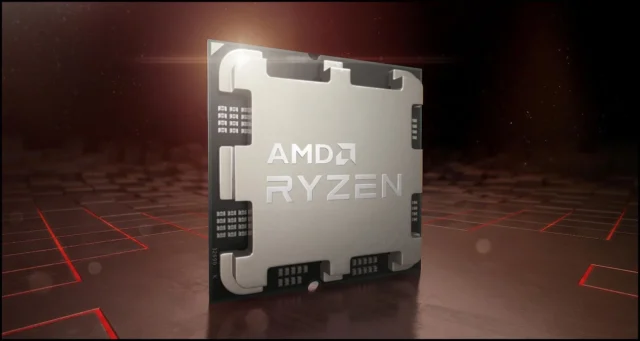
AMD may not be finished with its Zen 4 desktop processor family yet. According to recent leaks, the company could be preparing a new Ryzen 7 7700X3D, a gaming-focused AM5 processor positioned below the well-known Ryzen 7 7800X3D. The rumored chip is expected to use AMD’s 3D V-Cache technology, offer 8 cores and 16 threads, and carry a large 96 MB L3 cache configuration similar to the 7800X3D. Current reports describe it as a lower-clocked, more affordable alternative rather than a completely new architecture.
The idea is not difficult to understand. The Ryzen 7 7800X3D became one of the most important gaming processors of the AM5 generation because it combined a simple single-CCD design with a large amount of stacked cache. It did not need the highest clock speeds or the highest power budget to perform extremely well in games. Its strength came from reducing memory dependency in cache-sensitive workloads, especially modern games that benefit from having more data close to the CPU cores.
A Ryzen 7 7700X3D would follow the same logic, but with a more aggressive price-performance target. If AMD launches it near the 300-dollar mark, or slightly below it, the chip could become one of the most interesting late-generation AM5 processors for gamers who want strong frame rates without paying for a flagship Ryzen 9000 X3D model.
At this stage, however, the processor remains unannounced. AMD has not officially confirmed the Ryzen 7 7700X3D, so every specification should be treated as leak-based information rather than final product data.
Why a ryzen 7 7700x3d would make sense
At first glance, launching another Zen 4 chip in 2026 may seem unusual. AMD already has newer Zen 5 processors on the market, and the Ryzen 9000 X3D family is the more modern performance platform. Yet the possible arrival of a Ryzen 7 7700X3D would make strategic sense for several reasons.
The AM5 platform is still active, DDR5 pricing has improved, motherboard availability is broad, and many users are looking for a gaming CPU that does not force them into the highest price bracket. Not every gamer needs a top-tier Ryzen 9 or the fastest possible Zen 5 X3D chip. Many simply want a processor that can drive a powerful graphics card at 1080p, 1440p or ultrawide resolution without becoming an obvious bottleneck.
This is where AMD’s X3D strategy has historically been very effective. The company can take an existing architecture, add a large vertically stacked cache, reduce clock speeds slightly to stay within safe voltage and thermal limits, and produce a CPU that performs especially well in games. The result often looks modest on a traditional specification sheet but performs far better than expected in real-world gaming benchmarks.
A Ryzen 7 7700X3D would also help AMD defend the lower end of the enthusiast gaming market. If the 7800X3D remains expensive or becomes harder to find, a cheaper 8-core X3D part could fill the gap. It would give AM5 buyers a more accessible route into 3D V-Cache without stepping down to a six-core model or stretching their budget toward newer premium chips.
Expected specifications
The leaked Ryzen 7 7700X3D specifications point to a processor that is very close to the Ryzen 7 7800X3D in structure but deliberately limited in frequency. The reported configuration includes 8 Zen 4 cores, 16 threads, 8 MB of L2 cache and 96 MB of L3 cache. The 96 MB L3 figure would likely come from the usual 32 MB of standard L3 cache plus an additional 64 MB stacked through AMD’s 3D V-Cache design. Reports also mention a 120 W TDP, matching the official TDP class of the Ryzen 7 7800X3D.
The main difference would be clock speed. The Ryzen 7 7800X3D is rated with a 4.2 GHz base clock and up to 5.0 GHz boost clock. The rumored Ryzen 7 7700X3D is said to reduce that to around 4.0 GHz base and 4.5 GHz boost.
That lower boost clock is important. AMD cannot simply sell a 7800X3D under another name at a lower price without damaging its own product stack. A 500 MHz reduction in maximum boost would create enough separation between the two models, especially in lightly threaded tasks and some games that respond to frequency more strongly than cache.
The rumored specification would place the Ryzen 7 7700X3D in a familiar role: a slightly slower but potentially much better-value version of a proven gaming CPU.
Ryzen 7 7700x3d vs ryzen 7 7800x3d
The most obvious comparison is with the Ryzen 7 7800X3D. Both chips are expected to share the same basic formula: one CCD, 8 cores, 16 threads, Zen 4 architecture and 96 MB of L3 cache. That means the gaming behavior of the two processors could be broadly similar in titles where cache capacity matters more than peak frequency.
The difference would come from clocks and binning. A lower-clocked 7700X3D would likely trail the 7800X3D in CPU-limited gaming scenarios, especially at lower resolutions or with very high-end graphics cards. It would also be slower in lightly threaded productivity workloads, where boost frequency matters. Applications such as code compilation, photo editing, compression, decompression and general desktop workloads may show a clearer gap than many games.
In real gaming conditions, however, the difference may be smaller than the clock table suggests. Many modern games are limited by the GPU at 1440p and 4K, and even at 1080p the extra cache can reduce frame-time spikes and help maintain smoothness. If the Ryzen 7 7700X3D keeps the same 96 MB L3 cache, it could retain much of the character that made the 7800X3D popular.
The key question is price. If the 7700X3D costs too close to the 7800X3D, it will be difficult to justify. If it arrives noticeably cheaper, it could become the more rational choice for many AM5 gaming builds.
Why 3d v-cache matters for gaming
AMD’s 3D V-Cache technology is not just a marketing label. It changes how the processor behaves in workloads that repeatedly access large amounts of data. Instead of depending as heavily on slower system memory, the CPU can keep more data in its large L3 cache. This can reduce latency, improve frame rates and, in some cases, improve 1% lows and frame-time consistency.
Games are often well suited to this kind of improvement. Modern game engines constantly move data related to world geometry, physics, artificial intelligence, object states, draw calls and scene management. When more of that data can remain close to the CPU cores, the processor spends less time waiting for memory.
This does not mean every game scales dramatically with X3D processors. Some titles are GPU-limited. Some are more sensitive to clock speed. Some depend more on engine design than cache capacity. But across many gaming benchmarks over the last few years, AMD’s X3D processors have repeatedly shown that a large L3 cache can be more valuable than raw frequency.
That is why a lower-clocked Ryzen 7 7700X3D could still be attractive. Even if it loses some performance to the 7800X3D, the shared cache structure could allow it to remain very competitive against ordinary non-X3D Ryzen processors and many competing CPUs in its expected price range.
The importance of a single-ccd design
One reason the Ryzen 7 7800X3D became so highly regarded is its simple single-CCD layout. Unlike some Ryzen 9 X3D models, which combine multiple chiplets and require more careful scheduling between cache-rich and non-cache chiplets, the 7800X3D gives the operating system a more straightforward target. All cores sit behind the same cache arrangement.
If the Ryzen 7 7700X3D follows the same approach, it may inherit this advantage. A single 8-core CCD with 3D V-Cache is easy to understand and easy to use. There is no need for the user to think about which tasks should run on which chiplet. There is less dependence on driver-level scheduling behavior. For a gaming PC, that simplicity matters.
This could make the Ryzen 7 7700X3D more attractive than a more complex high-end CPU for users who primarily care about games. More cores are useful for heavy productivity, rendering, virtual machines or workstation tasks, but many games still respond better to fast cores, low latency and large cache than to very high core counts.
An 8-core, 16-thread X3D chip remains a very sensible gaming configuration.
Possible price positioning
Reports suggest that AMD may target a price around 300 dollars, possibly slightly below that level. Other reports put the expected range closer to 299 to 349 dollars, which means the final value depends heavily on launch pricing and real retail availability.
If AMD manages to position the Ryzen 7 7700X3D below 300 dollars, the chip could become highly competitive. At that level, it would appeal to users building a new AM5 gaming system with a mid-range or upper-mid-range GPU. It would also attract buyers who want the X3D gaming advantage but do not want to pay for the newest Zen 5 X3D processors.
At 329 or 349 dollars, the situation becomes more complicated. The chip would still be interesting, but it would need to be clearly cheaper than the 7800X3D and not too close to faster newer-generation alternatives. CPU pricing changes quickly, and a small difference on paper can disappear once retailer discounts, bundles and regional taxes are added.
AMD’s best move would be to create a clean gap: the 7700X3D as the affordable 8-core X3D option, the 7800X3D as the stronger Zen 4 gaming part where still available, and the Ryzen 9000 X3D series as the premium current-generation choice.
Who would buy the ryzen 7 7700x3d?
The ideal buyer for the Ryzen 7 7700X3D would be a gamer building or upgrading an AM5 system with a clear focus on frame rates, efficiency and long platform life. This is not the processor for someone who needs maximum multi-threaded productivity performance. It is also not necessarily the right choice for users who already own a Ryzen 7 7800X3D.
Instead, it would target several practical groups.
The first group is new AM5 builders who want a gaming-first CPU at a sensible price. These users may be pairing the processor with GPUs such as the Radeon RX 7800 XT, RX 7900 GRE, RX 9070-class cards, GeForce RTX 4070-class cards, RTX 5070-class cards or similar mid-to-high-tier hardware. For them, the CPU needs to be strong enough to avoid obvious bottlenecks but not so expensive that it steals budget from the graphics card.
The second group is users moving from older AM4 systems. Someone with a Ryzen 5 3600, Ryzen 5 5600X or Ryzen 7 3700X may be considering a full platform upgrade. A reasonably priced AM5 X3D CPU could make that transition more attractive.
The third group is competitive gamers who play CPU-sensitive titles at high refresh rates. Games such as large multiplayer shooters, simulation titles, strategy games and certain esports titles can benefit from strong CPU performance and good frame-time behavior.
The fourth group is buyers who missed the best pricing window for the Ryzen 7 7800X3D. If that chip becomes expensive, scarce or regionally inconsistent, a 7700X3D could serve as the more available replacement.
Who should avoid it?
Not everyone should wait for or buy a Ryzen 7 7700X3D.
Users who already own a Ryzen 7 7800X3D would have no reason to downgrade. The rumored chip appears to be slower, not faster. Users who need high multi-core throughput for rendering, heavy content creation, software development or workstation applications may be better served by Ryzen 9 models with more cores.
Budget buyers may also find better value in non-X3D Ryzen 5 or Ryzen 7 processors, especially if they play mostly GPU-limited games at 1440p or 4K. In those scenarios, spending more on the graphics card often matters more than choosing an X3D CPU.
Finally, anyone building a system around the newest possible technology may prefer Zen 5 or later. A Zen 4 X3D processor can still be excellent, but it is not the newest architecture. Its appeal depends on price, not novelty.
Gaming performance expectations
Because the Ryzen 7 7700X3D has not been officially reviewed, exact performance claims would be premature. Still, the rumored specifications allow a reasonable expectation.
In cache-sensitive games, the chip could perform close to the Ryzen 7 7800X3D, especially when the GPU becomes the limiting factor. The shared 96 MB L3 cache configuration is the most important part of the design, and that feature appears to remain intact.
In games that respond strongly to clock speed, the 7700X3D would likely fall behind more clearly. A 4.5 GHz maximum boost clock is not weak, but it is a meaningful reduction from the 7800X3D’s 5.0 GHz peak. That could show up in older game engines, esports titles at extremely high frame rates or CPU-limited benchmark scenarios.
The most interesting metric may not be the average frame rate. It may be 1% lows and frame-time consistency. X3D processors are often valued not only because they can increase peak FPS, but because they can reduce stutter in certain games. If the Ryzen 7 7700X3D preserves that behavior, it could feel faster and smoother than many non-X3D alternatives even when average FPS numbers are close.
Productivity performance expectations
The Ryzen 7 7700X3D would probably be less impressive outside gaming. That does not mean it would be slow. An 8-core, 16-thread Zen 4 processor is still capable for everyday computing, streaming, office work, software development, light editing and general creator tasks.
However, 3D V-Cache does not transform every workload. Many productivity applications prefer higher clock speeds, more cores, wider memory bandwidth or newer instruction-level improvements. A lower-clocked Zen 4 X3D chip may therefore trail non-X3D Ryzen 7 processors in certain applications, especially when those applications do not benefit from the extra cache.
This has always been part of the X3D trade-off. AMD’s stacked cache chips are often optimized around gaming efficiency rather than maximum all-round frequency. For users who split their time evenly between gaming and heavy workstation workloads, the best choice may not be the cheapest X3D CPU.
For a gaming-first PC, however, that compromise can be acceptable.
Power, heat and cooling
The leaked 120 W TDP figure may look high, especially because some lower-end X3D parts are rated at 65 W. But TDP alone does not tell the full story. X3D processors often operate within conservative voltage limits, and real gaming power consumption can be much lower than worst-case synthetic load behavior.
A Ryzen 7 7700X3D with lower boost clocks could be easier to cool than the 7800X3D in some scenarios, although that depends on AMD’s final voltage and power behavior. If the chip is tuned conservatively, it could become a very efficient gaming processor.
Most users would not need extreme cooling. A good dual-tower air cooler or quality 240 mm liquid cooler should be more than enough for typical gaming systems, assuming the final specifications resemble the current leaks. Even a solid mid-range air cooler may be sufficient if the CPU behaves like other X3D models.
The more important requirement is motherboard BIOS support. Any new AM5 processor will need appropriate firmware recognition, so users should be ready to update their BIOS before installation, especially on older AM5 boards.
Platform compatibility
The rumored Ryzen 7 7700X3D is expected to use Socket AM5, which means it should work with AMD 600-series and 800-series motherboards after BIOS support is added. That includes chipsets such as A620, B650, B650E, X670, X670E, B850, B850E and X870-class boards, depending on vendor support.
This broad compatibility could be one of the strongest arguments for the chip. AM5 gives users DDR5 memory, PCIe 5.0 support on many boards, modern connectivity and a platform that AMD has kept active across multiple CPU generations.
For users building a new system, the 7700X3D could pair well with a B650 or B850 motherboard rather than requiring an expensive flagship board. Since X3D processors are not typically bought for manual overclocking, spending too much on extreme VRM features may not be necessary. A stable board with good memory compatibility, enough M.2 slots and proper BIOS support would be the more sensible choice.
Memory choice also matters. DDR5-6000 with good timings has often been treated as a practical sweet spot for Zen 4 AM5 builds. The large L3 cache can reduce memory sensitivity in some games, but a balanced DDR5 kit is still recommended.
Why amd might reuse zen 4
Some buyers may wonder why AMD would release another Zen 4 X3D processor instead of focusing entirely on Zen 5. The answer is probably segmentation.
Zen 4 silicon is mature. Manufacturing behavior is well understood. Motherboard support is established. DDR5 compatibility has improved since the early AM5 launch period. AMD can use a Zen 4-based X3D model to address a lower price tier without weakening the premium position of newer Ryzen 9000 X3D processors.
This is a common strategy in the CPU market. Older architectures do not immediately lose value when a new generation arrives. If the older chip still performs well in the right workload and can be priced attractively, it can remain commercially useful.
The Ryzen 7 5700X3D showed how effective this approach can be on AM4. It gave many users a cheaper way to access X3D gaming performance without buying the highest-end model. That chip eventually reached end-of-life, leaving room for AM5-based affordable X3D options to carry the same idea forward.
A Ryzen 7 7700X3D could become the AM5 version of that value strategy.
How it could affect the cpu market
If AMD releases the Ryzen 7 7700X3D at the right price, it could put pressure on several processor categories at once.
It could make ordinary 8-core non-X3D Ryzen chips less attractive for gaming builds unless they are heavily discounted. It could also pressure Intel’s mid-range gaming CPUs, especially in systems where gaming performance per watt and upgrade path matter. At the same time, it could create internal competition with AMD’s own 7800X3D and lower-end Ryzen 9000 processors.
That internal competition may be intentional. AMD may prefer to capture the sale with a cheaper X3D processor rather than leave budget-conscious gamers to choose an Intel alternative or stay on older platforms.
The most sensitive issue is product overlap. If the 7700X3D performs too close to the 7800X3D, it could reduce demand for the older flagship gaming chip. If it is too slow or too expensive, buyers may ignore it. The balance between clock speed, price and availability will determine whether it becomes a niche product or a mainstream gaming recommendation.
The 300-dollar question
The rumored price is the central story. A Ryzen 7 7700X3D at around 300 dollars is not just another SKU. It would be a statement that AMD wants to make 3D V-Cache more accessible on AM5.
At 299 dollars, the processor could be extremely attractive. It would sit in the zone where many gamers are willing to spend more than entry-level money but still want clear value. At that price, it could free more of the total build budget for the GPU, which remains the most important gaming component in most systems.
At 349 dollars, the story becomes weaker. It would still be a good CPU if performance is strong, but the buyer would start comparing it more carefully with discounted 7800X3D models, Ryzen 9000 alternatives and Intel competitors.
At more than 349 dollars, it would risk becoming difficult to recommend unless supply conditions make the 7800X3D unavailable or much more expensive.
This is why AMD’s final pricing decision matters more than the name. The Ryzen 7 7700X3D only makes sense if it is clearly positioned as a value-oriented X3D option.
Could it be region-limited?
One unresolved question is availability. AMD has previously released certain processors in limited channels or specific regions. Some X3D and non-X3D models have appeared only through selected retailers, OEMs or regional markets. That makes it possible that the Ryzen 7 7700X3D may not receive a clean global retail launch.
If the processor is limited to certain regions, its impact will be smaller. It may become a strong recommendation in one market and irrelevant in another. Regional pricing could also vary significantly. A CPU that looks excellent at 299 dollars in the United States may be less compelling after European VAT, weaker availability or retailer markup.
For international buyers, official confirmation will be important. Until AMD announces the chip, there is no certainty about launch regions, boxed retail availability or whether the product will appear primarily through system integrators.
Possible naming confusion
The Ryzen 7 7700X3D name is logical, but it may still create confusion. AMD already has a Ryzen 7 7700, Ryzen 7 7700X and Ryzen 7 7800X3D. Adding a 7700X3D would create a product that sounds like a direct cache-enhanced version of the 7700X, but its expected clock behavior would be closer to a deliberately restrained gaming chip.
The name also raises expectations. Many users may assume that a “7700X3D” should be only slightly below a “7800X3D.” That may be true in some games, but not necessarily in every workload. AMD would need to communicate the product clearly to avoid disappointment.
The most important distinction is that X3D does not mean universally faster. It means optimized for cache-sensitive performance, especially gaming. A non-X3D chip with higher clocks may still win in certain productivity tasks.
Should gamers wait?
Gamers planning an AM5 build have a practical decision to make. If they need a PC immediately and find a Ryzen 7 7800X3D, Ryzen 7 9800X3D or another strong gaming CPU at a good price, waiting for an unconfirmed processor may not be necessary. Hardware rumors can change, and launch timing is unknown.
However, users who are not in a hurry may want to watch the Ryzen 7 7700X3D story closely. If it appears at the expected price and with the expected cache configuration, it could become one of the best value gaming processors on the AM5 platform.
The best strategy is to wait for independent benchmarks. The specification sheet can suggest likely behavior, but final performance depends on clocks under load, power limits, BIOS behavior, memory compatibility and game-by-game cache scaling.
No one should buy or plan a system entirely around a leaked CPU until AMD confirms the product.
What benchmarks will matter most?
If the Ryzen 7 7700X3D launches, reviewers should test it against the Ryzen 7 7800X3D, Ryzen 7 7700X, Ryzen 7 9700X, Ryzen 7 9800X3D and relevant Intel alternatives. Average FPS alone will not be enough.
The most useful benchmarks will include 1% lows, frame-time consistency, 1080p CPU-limited tests, 1440p realistic GPU-paired tests and power consumption during gaming. Productivity benchmarks should also be included, but the chip’s main purpose is clearly gaming.
It will also be important to test different game engines. Some games respond dramatically to 3D V-Cache, while others show smaller gains. Strategy games, simulation titles, large open-world games, competitive shooters and CPU-heavy multiplayer titles are especially relevant.
A good review should answer one simple question: how much gaming performance does the buyer lose compared with the 7800X3D, and how much money do they save?
The broader meaning of a cheaper x3d cpu
The rumored Ryzen 7 7700X3D also says something about the direction of the desktop CPU market. Gaming performance is no longer only about higher clock speeds and more cores. Cache design, latency, scheduling behavior and platform cost have become just as important.
AMD’s X3D processors have changed buyer expectations. Many gamers now understand that the best gaming CPU is not always the one with the highest frequency or the largest core count. Sometimes a carefully tuned 8-core processor with a large L3 cache is the more effective choice.
If AMD extends that logic to a lower price point, it could make X3D technology feel less like a premium feature and more like a normal part of serious gaming builds. That would be good for AM5 adoption and good for users who want strong performance without buying the most expensive processor in the lineup.
The Ryzen 7 7700X3D is not official yet, but the rumor is believable because the product would fit AMD’s current desktop strategy. A lower-cost 8-core Zen 4 processor with 3D V-Cache would fill a clear gap below the Ryzen 7 7800X3D and offer gamers a more affordable way into AM5 cache-optimized performance.
The expected specifications are straightforward: 8 cores, 16 threads, 96 MB of L3 cache, Socket AM5 compatibility and lower clocks than the 7800X3D. That combination would not make it the fastest gaming CPU on the market, but it could make it one of the most sensible gaming CPUs if AMD prices it correctly.
The final verdict depends on three things: official confirmation, real retail price and independent benchmarks. If AMD launches the Ryzen 7 7700X3D near 300 dollars and it keeps most of the 7800X3D’s gaming performance, it could become a very strong recommendation for AM5 gaming PCs.
Until then, it remains a promising leak rather than a confirmed product. But if the information proves accurate, AMD may be preparing exactly the kind of processor many gamers still want: not the newest architecture, not the highest clock speed, not the most expensive flagship, but a practical 3D V-Cache gaming CPU with enough performance and the right price.
Image(s) used in this article are either AI-generated or sourced from royalty-free platforms like Pixabay or Pexels.
This article may contain affiliate links. If you purchase through these links, we may earn a commission at no extra cost to you.
Get the weekly RF & IT briefing
Radio guides, RF calculators, AI, Windows, Linux and satellite communication explainers. One useful email per week. No spam.